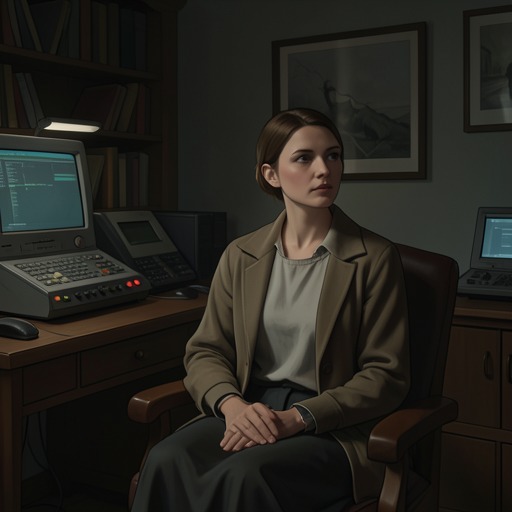
A returned to France in January 1991 and reunited with the narrator
Simple PassionA’s return to France in January 1991 brings the narrator face to face with the man whose absence has organized her memories and writing. Their reunion is brief and intimate, but it does not resume their former relationship: after he leaves again, she understands the visit as almost unreal, a date rather than a continuation of their story. Its decisive effect is paradoxical. The encounter offers no renewed future, yet clarifies the meaning of a passion whose intensity cannot be explained by what it ultimately provides.
Background: Memory, Waiting, and Public Time
Before the reunion, the narrator has repeatedly tried to make the present yield to the past. Since A left, she has measured the time apart in weeks and aligned ordinary public events with the period when he was still with her. A shopping-mall opening, Mikhail Gorbachev’s visit to Paris, or Michael Chang’s victory at Roland-Garros becomes a cue for recalling a specific moment with A. Even incidental scenes—a visit to an archive room at La Sorbonne, a walk along Boulevard Voltaire, trying on a skirt—return with such precision that she wonders why memory cannot carry her back into the day itself.
Writing begins about two months after A’s departure, with the sentence, “From September last year, I did nothing else but wait for a man . . .” The narrator can attach the relationship to the Algerian October Riots, the weather on 14 July 1989, and even the purchase of a blender before a planned meeting. By contrast, she cannot tie the writing of a particular page to the fall of the Berlin Wall or the execution of Nicolae and Elena Ceaușescu. Passion and writing, she concludes, produce fundamentally different experiences of time. Her use of the past tense makes the earlier period feel endlessly repeatable, but writing also creates a new pain, replacing the old distress of waiting for A’s calls and visits.
In February 1991, the expected conflict between Iraq and the Western coalition breaks out while the pages remain unfinished. Reports of bombing in Baghdad and forecasts of further disasters leave the narrator waiting anxiously for news, in a condition she compares with the frustrated desire to know what would happen during the affair. The resemblance has a limit: this public crisis leaves no room for fantasy or imagination. The episode places the return within a world whose political events proceed independently of the narrator’s private chronology.
The Call and the Reunion
On the first Sunday of the war, in the evening, the telephone rings and the narrator recognizes A’s voice. For an instant, panic overtakes her; she repeats his name and cries. He says, “It’s me, it’s me,” and wants to see her at once, saying he will take a taxi. With only half an hour before his arrival, she dresses and puts on makeup in a frenzy, then waits in the hallway wearing a shawl he has never seen. He enters without knocking, as he used to. He appears to have been drinking: he sways when he embraces her and stumbles on the way upstairs.
Afterward, A wants only coffee. The narrator learns that his life in the East resembles the one he had in France: he has the same job, and still has no child, although his wife would like one. At thirty-eight he retains a youthful appearance but looks wearier; his nails are less tidy and his hands less smooth, changes she associates with the cold climate where he lives. When she reproaches him for not keeping in touch, he jokes about the point of a casual call asking how she is. He never received the postcard she sent from Denmark to his former workplace in Paris.
They dress again, gathering their clothes from the tiled floor, and the narrator drives him to his hotel near the Etoile. At traffic lights between Nanterre and Pont-de-Neuilly, they kiss and touch. The drive carries the reunion back into ordinary geography, but it cannot settle what the encounter means. In the tunnel at La Défense on her return journey, she asks herself where her story has gone, then recognizes that she can hope for nothing more.
The Visit’s Ending and Meaning
A leaves three days later without another meeting. On the phone before he goes, he says, “I’ll call you.” The narrator does not ask whether he means a call from his country or from Paris on a future visit. The promise therefore remains open but indefinite; it supplies no dependable plan and does not undo the separation.
She has the impression that the visit never happened. In her account it belongs not to the story she had carried through the year, but merely to a date: 20 January. The man who returned is not the man she had held within herself while he was in France and while she wrote about him. She believes she will never see that remembered man again. Yet the visit’s near-unreality gives the passion its true meaning: it does not need to culminate in an intelligible outcome, and for two years it has been the most violent and unaccountable reality of her life.
Writing, Objects, and What Remains
The reunion takes place after the narrator has begun to see signs that A’s world is separating from hers. On the Metro, two girls mention a house in Barbizon; the name brings back A’s account of spending a Sunday there with his wife. The memory now sits beside other associations, including the name Brunoy, once linked to an old friend. She wonders whether the world is beginning to mean something outside A. The cat trainer at the Moscow Circus, the toweling bathrobe, Barbizon, and the accumulated words, images, and gestures of the affair are starting to come apart. The written book, she says, is only a minor trace of the living text of passion.
That trace is difficult to relinquish. Rereading the opening pages recalls the bathrobe A wore at her home, but the narrator distinguishes the durable meaning writing may have for her and for others from the private object, which may eventually become a bundle of rags. Writing has not relieved her grief: when she puts down her pen, she still longs for A’s voice, foreign accent, and touch, and imagines him living an unknown life in a cold city. She continues small acts that preserve hope, including playing patience, giving a ten-franc coin to a beggar at Auber Metro station, and wishing that A will call or come back. The fact that he does return once does not make that hope a future she can rely on.
The episode thus interrupts, rather than resolves, the narrator’s cycle of waiting and recollection. In the immediate aftermath, she asks where her story has gone; in retrospect, she makes the answer sharper: the visit cannot restore the remembered man or give the passion a conventional resolution. Its significance lies in the distance between the real encounter and the figure preserved in memory, and in the way writing keeps a remainder of an experience whose living signs are already beginning to fall apart.