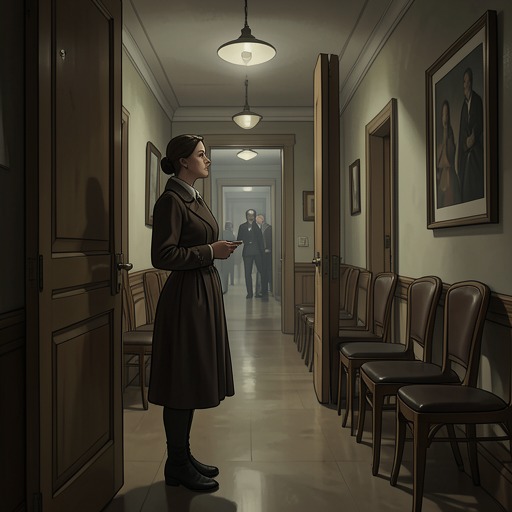
Absence and presence
Simple PassionAbsence and presence name the emotional and narrative structure of the narrator’s passion for A. His presence makes a few hours together seem more consequential than other achievements and experiences; his absence turns calls, dates, memories, and imagined scenes into measures of uncertainty. The distinction is not a stable opposition between happiness and sorrow: even intimacy is shadowed by its ending, while jealousy can seem preferable to the emptiness of having nothing left to await. In the account’s final turn, the last visit appears almost not to have happened, yet its estrangement gives the passion its meaning as an intense reality that cannot be explained or made to last.
Presence as a Measure of Value
The narrator describes an afternoon with A as an interval between the sounds of his Renault 25 arriving and driving away. Within that interval, lying together mattered more to her than having children, passing exams, or traveling to distant countries. The comparison makes presence not merely a source of pleasure but the measure by which other parts of life temporarily lose importance. The encounter is brief, but its force reorganizes the value of the time around it.
The hours together are already divided by their ending. The narrator removes her watch before A arrives, while he keeps his on; when she goes to the kitchen for ice, the clock above the door counts down the remaining time. His unhurried departure, marked by dressing and fastening his tie, turns his ordinary preparations into the closing of their shared interval. Her sense of herself as time flowing makes the contrast bodily and temporal: presence does not suspend time but intensifies awareness of its passage.
This experience resists a clean division in which presence means happiness and absence means pain. Even while they are together, the narrator anticipates his departure and experiences pleasure as future pain. Later, when A’s long-awaited call comes to arrange a meeting, it does not relieve her anxiety; she remains in the same state of distress, and even the sound of his voice cannot make her happy. The call confirms the possibility of another meeting without ending the condition of waiting that has gathered around it.
Absence, Waiting, and Jealousy
In A’s absence, the narrator is troubled by imagined interruptions and rivals. She becomes convinced, after reading about a Cuban dancer touring Paris, that A must have met the woman pictured in the article and imagines them together. The scene is not evidence about what A has done; it shows how absence gives an imagined possibility the force of certainty. His inaccessibility leaves room for a jealousy that cannot be settled by what the narrator knows.
The narrator considers ending the affair to escape dependence on A’s calls and the suffering they produce. But she immediately sees the consequence she fears more: days with nothing to wait for. She would rather continue even if A had another woman, or several, because the present torment still contains the prospect of his return. Jealousy thus becomes a frail privilege, not because it is painless, but because it belongs to an attachment that remains active. Its eventual end, whether through A’s departure from the country or his decision to stop seeing her, is anticipated as something outside her control.
Absence also governs how the narrator acts in public. She avoids an event where A will be present because she cannot bear to see him merely among other people. While she stays away, she imagines him smiling and attentive to a woman as he had once been with her. Learning afterward that only a handful of people attended brings relief, and she repeats the phrase as though the size and atmosphere of the gathering could be linked to the chance of A flirting. The reasoning cannot establish what he did; its importance lies in the way waiting makes incidental details seem capable of offering reassurance.
Repetition as an Attempt to Restore Presence
After A has left, the narrator tries to make the present repeat an earlier time when he was there. She returns mentally to Venice, recalling the route along the Zattere and the alleys of Giudecca Island, and reconstructs her room at the La Calcina Hotel through its narrow bed, blocked window, table, and books. She sometimes feels the urge to return to the same hotel and room. The inventory concerns a holiday from before she met A, but she treats exhaustive recollection as a possible route back into a past that had once opened onto happiness.
This desire to reverse time spreads from places to dates and ordinary events. The narrator calculates how many weeks have passed since A left, and attaches the opening of a shopping mall, Gorbachev’s visit to Paris, or Chang’s victory at Roland-Garros to the time when he was with her. She recalls small scenes—a room at La Sorbonne, a walk along Boulevard Voltaire, trying on a skirt in a Benetton shop—with such vividness that she wonders why she cannot enter the remembered moment as easily as another room. The contrast is between the precision of recall and its failure to restore presence: the scene can be recovered in detail, but its time cannot be re-entered.
The narrator identifies repetition as the organizing impulse of this period: she wants to turn the present back into the past, reopening it to happiness. The same desire appears in dreams, where the dead return, a missing child is revived to retrace the events leading to her death, and scenes involving A shift between distance and renewed desire. These are not resolutions of her loss. They render the wish to reverse time in a form that repeatedly offers a return and makes its impossibility visible.
Description Instead of Explanation
The account refuses to treat the affair as a conventional story governed by a complete chronology. The narrator says that she is not recounting a liaison or arranging events around exact dates, such as A’s coming on 11 November, or approximate periods, such as weeks passing. For her, the relationship was experienced as absence or presence, not as a measured sequence. She therefore presents signs of passion, wavering between one day and every day, rather than a continuous plot that would imply events can be mastered by placing them in order.
This method preserves the uncertainty and immediacy of the experience instead of correcting them retrospectively with irony. The narrator distinguishes the listing and description of facts from the derision available after an event, insisting that such retrospective distance was not part of living through the passion. She also declines to search for its origins in childhood, recent history, psychoanalysis, or inherited cultural models of emotion. She does not want to explain the passion in a way that might frame it as a mistake or disorder requiring justification; she wants to describe it. Absence and presence consequently shape both what the narrator experienced and how she chooses to tell it.
The Last Visit and the End of Presence
By April, the passion has changed: the narrator sometimes wakes without immediately thinking of A, and the prospect of seeing friends, going to the cinema, or enjoying a meal has become less dreadful. She remains within the age of passion, but it is no longer continuous. This gradual change does not erase the past. A remembered remark about a cat trainer at the Moscow Circus briefly brings a feeling that everything is all right, before the narrator recognizes that the words belong to a remote reality and that another winter has passed.
The ending concentrates the conflict between presence and absence in A’s last return. After an encounter that makes her wonder where her story is and conclude that she can hope for nothing more, A leaves three days later without their meeting again. He says by phone that he will call, but the narrator does not ask whether he means from his country or from Paris on a future visit. The promise leaves open the possibility of contact without supplying the certainty that would make waiting end.
The narrator ultimately has the impression that the visit on 20 January never took place: it belongs to the calendar as a date, but not to the story she had been carrying through the year of his absence. The man who returned is not the man she had held within herself while he was away and while she wrote about him, and she says she will never see that man again. Paradoxically, this almost unreal visit gives the passion its meaning—not as a coherent or lasting relationship, but as a violent, unaccountable reality that was most powerful where it could not be explained. The final distinction is therefore not simply between a real presence and a remembered absence: the visit occurred, yet the person who had lived in memory was irretrievable.