The narrator’s grief after A’s departure
Simple PassionThe narrator’s grief after A’s departure begins with the expectation that she may never see him again and unsettles nearly every measure of ordinary life. She wakes in the night, struggles to fill the day, and repeatedly tries to restore the past in which A was present. Writing records this persistence but does not cure it: only over time does the grief cease to be continuous, while its bodily memory and its transformation into literature remain.
The Body and the Shape of Absence
A has been back in his own country for six months when the narrator describes the aftermath. At first, waking at two in the morning brings such pain that she says she does not care whether she lives or dies. During the day she tries to keep occupied because idleness feels dangerous, and makes herself dress and apply makeup, even putting in contact lenses when doing so takes considerable effort. She cannot watch television or browse magazines: advertisements for perfume and microwaves seem to present the same image of a woman waiting for a man. She turns her gaze away from lingerie shops, whose displays recall a life organized around A.
Night does not offer a clean break from the day. For many weeks she wakes in the middle of the night and remains confused and unable to think until morning; she longs for deep sleep, but A continues to hover in her mind. The days ahead seem to have no plans and no destination. Time no longer appears to carry her somewhere; instead, it seems only to make her grow older. The grief is thus not merely a feeling attached to remembered events: it alters her sense of what the present and future can do.
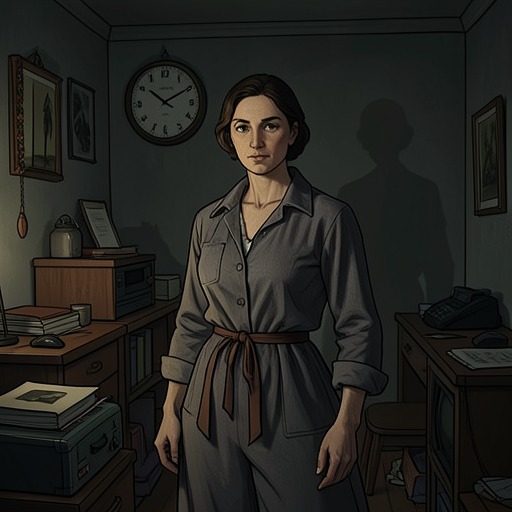
Her bodily sense of time had already formed during their meetings. She removed her watch before A arrived, while he kept his on, and watched the kitchen clock count down the hours remaining. After he left, she sat among the glasses, plates, overflowing ashtray, clothes, and unmade sheets rather than tidying at once. The objects held the traces of their time together, so clearing them away would mean confronting its end. In retrospect, the contrast is stark: during the affair, the hours were measured through anticipation and the body; after his departure, time seems emptied of movement and purpose.
Repetition, Memory, and the Absent Man
The narrator describes the period as one in which all her thoughts and actions involve repeating history. She wants to turn the present back into the past, as though repetition might reopen the happiness that has ended. She counts the weeks since A left and links public occasions to the time when he was with her. A shopping mall opening, Gorbachev’s visit to Paris, or Chang’s victory at Roland-Garros can each become a marker for remembering where she was and what she was doing with A.
This effort to recover the past reaches into small, ordinary scenes as well as major events. She vividly relives standing in an archive room at La Sorbonne, walking along Boulevard Voltaire, or trying on a skirt in a Benetton shop. The details are not important in themselves; their force comes from their place in the vanished period of the relationship. She wonders why she cannot step back into one of those moments as easily as she can enter another room. The comparison makes memory’s limit concrete: recollection can restore detail, but not the time or presence that gave it meaning.
She also tries to reconstruct A himself. His green eyes, the lock of hair over his forehead, the curve of his shoulders, and other remembered features return with such vividness that she questions the distance between bodily memory and hallucination, between remembering and madness. The intensity of this reconstruction does not restore contact. It sharpens the difference between the remembered figure and the real man, whose voice and foreign accent she can no longer hear, whose skin she can no longer touch, and whose life in an unknown cold city is inaccessible to her.
The attempt at repetition also takes practical forms. When she returns to a place where she had been the previous year, she wears the same suit and tries to believe that identical circumstances will produce identical effects, including a call from A. At bedtime, demoralized, she recognizes that she has spent the day believing in that call. The ritual does not alter the outcome; it demonstrates how hope persists after its grounds have disappeared. She also agrees to attend a seminar in Copenhagen partly because the trip offers a way to send A a postcard she expects he will answer. On the return flight, she sees the journey for what it was: travel undertaken simply to reach him through a message.
Writing and the Limits of Consolation
About two months after A’s departure, the narrator begins writing with the sentence, “From September last year, I did nothing else but wait for a man . . .” She can attach memories of the relationship to particular circumstances, including the October riots in Algeria, the weather on 14 July 1989, and buying a blender in June on the day before a meeting. But she cannot connect a particular page of the manuscript to a rainstorm or to world events such as the fall of the Berlin Wall and the execution of the Ceausescus. In her account, living through passion and writing about it entail fundamentally different perceptions of time.
At first, writing seems to offer a way to remain within the age of passion. The past tense gives the earlier pages the quality of endless repetition and expresses the belief that life had been better then. Yet composing those pages also produces pain, replacing the former distress of waiting for A’s calls and visits with a new distress: rereading. The pages recall his toweling bathrobe, which he wore at her home before dressing to leave. Unlike the robe, which may one day become an insignificant bundle of rags, the written pages may continue to mean something to the narrator and perhaps to other readers. She recognizes that writing may be an attempt to rescue even the robe from oblivion.
Nevertheless, setting down the pen does not lessen her grief. The written A is more accessible than the man himself, whom the narrator imagines living an unknown life far away. To ease sorrow she plays patience, gives a ten-franc coin to a beggar at Auber Metro station, and makes the wish that A will call or return. Writing may belong to these practices of hope, but it does not resolve the loss. Its significance lies instead in preserving the experience in words that A may never read and that are not intended for him.
Returning to an Earlier Trauma
In the midst of this grief, the narrator feels compelled to revisit the place where she had a clandestine abortion twenty years earlier. She hopes, though vaguely, that the earlier trauma may cancel her present sorrow. The journey takes her to Passage Cardinet: she gets off at Malesherbes Metro station, asks a grocer for directions, and finds the partly erased street plaque. The façades have been restored and are white; she pushes open one of the few doors that does not require a digital code and looks at the tenants’ list.
The place has changed. The elderly auxiliary nurse who had accompanied her to the nearest station has died or moved to a suburban old people’s home, and the street’s current residents are affluent. As the narrator heads toward Pont-Cardinet, she imagines walking beside the woman, who had insisted on accompanying her, apparently to make sure she did not collapse outside the building. The remembered episode comes back as a past reality whose very occurrence feels difficult to believe, a feeling the narrator distinguishes from the way she would experience a fictional character.
The visit does not cancel the present grief; she says plainly that the episode altered nothing. Yet she is glad to have taken the initiative and revived the memory of an act of despoilment that, like her present suffering, was also caused by a man. She wonders whether other women return to the site of an abortion, and whether writing can help readers recognize such feelings as normal, or discover that others have experienced them. The episode therefore connects private memory to the possibility of shared recognition without claiming that revisiting the past heals it.
A Changed, Intermittent Grief
By April, the narrator sometimes wakes without immediately thinking of A. The prospect of meeting friends, going to the cinema, or enjoying a good meal has become less frightening. She remains within what she calls the age of passion, but it has changed: it is no longer continuous. The change is modest and initially almost imperceptible; she anticipates a future in which she will not even notice that A was absent from her thoughts on waking.
Memory still returns, but now it can bring a brief calm as well as pain. She recalls A saying that a cat trainer at the Moscow Circus was incredible. For an instant she feels as if everything is normal again, like emerging from a dream before realizing it was a dream. Then she recognizes that the words belong to a remote past: another winter has passed, and the circus performer may have left. The moment displays both the consolation and the limit of recollection. A remembered phrase briefly restores the feeling of shared time, but its outdatedness immediately marks the distance from it.
The narrator finally understands the experience as a change in her relation to time and to other people. She measured time differently with her whole body, and through A discovered that people could be capable of desires, beliefs, and attitudes she had once considered absurd in others. He brought her closer to the world without making the relationship permanent. Her account does not present grief as a neat recovery: it becomes less constant, while memory continues to revise the meaning of the relationship. The writing converts that particular history into an offering to readers, not a book about A or a straightforward account of the narrator herself, but words describing how his existence affected her life.