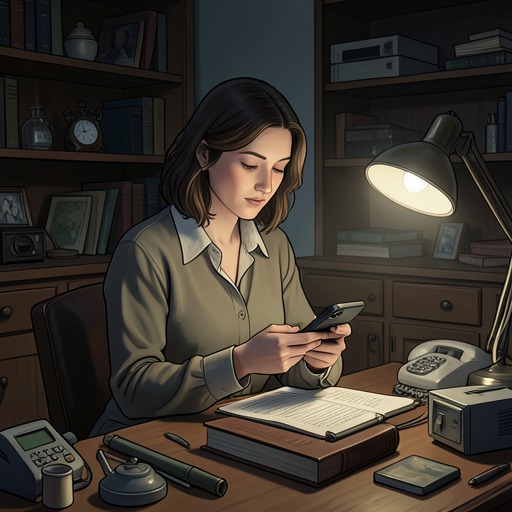
The narrator’s state of waiting for A to call and meet
Simple PassionThe narrator’s state of waiting for A to call and meet turns an affair into a governing condition of everyday life. From September onward, the narrator continues familiar tasks but experiences them as nearly automatic; purposeful thought and effort are concentrated on A, on preparing to see him, and on interpreting the intervals between meetings. Waiting does not merely precede the relationship’s encounters: it determines what the narrator notices, how time passes, and what ordinary life is worth.
Ordinary Life Reorganized
The narrator still goes to the supermarket and cinema, takes clothes to the dry cleaner’s, reads, and marks essays. Yet the routine persists largely through habit. The narrator has only vague memories of films, people, and activities, and describes speaking and laughing without deliberate thought. By contrast, reading newspaper articles about A’s country and choosing clothes and makeup require active attention because they are connected to him. Daily life is outwardly continuous but inwardly narrowed: its actions continue while their independent significance recedes.
Conversation and reading are drawn into the same narrowing focus. The narrator listens closely when a subject might connect to A’s work, home country, or travels, even when the speaker does not know that this private association is driving the attention. A description of a Havana nightclub becomes compelling because A may have visited it years before. In a book, a sentence about lovers kissing with their eyes closed seems to confirm the narrator’s belief that A loves her, since he kisses her that way. The rest of the book then returns to its practical role as something to fill the time between meetings. Other people’s accounts and literary passages are not encountered on their own terms; they become evidence through which the narrator tries to read A.
The Telephone and the Appointment
The narrator has no future beyond the telephone call that will set the next meeting. She tries to stay home whenever work does not require her to leave, because A knows her working hours and might call during her absence. Even household noise becomes a threat: the vacuum cleaner and hairdryer might prevent her from hearing the telephone. Each ring briefly raises hope, which collapses during the slow reach for the receiver if the caller is someone else; disappointment can turn into resentment toward the person on the line. A’s voice, by contrast, instantly dissolves the painful wait, leaving the narrator astonished at how much importance that voice has acquired.
The expectation of a visit creates a more acute interval. When A says he will arrive in an hour, the narrator understands that the proposed timing gives him an excuse to be late without arousing his wife’s suspicions. The narrator becomes intensely energetic but cannot organize even simple preparations, such as showering, setting out glasses, doing her nails, or mopping the floor. The expected arrival is anticipated through particular sounds—the car braking, a door slamming, footsteps on the concrete porch—and with a terror that overwhelms any settled sense of who is being awaited.
A longer gap between call and visit does not make the narrator more independent. Three or four days of notice mean having to endure work and social commitments before the next meeting, while the narrator wishes to do nothing but wait and fears that something will prevent the appointment. Driving home half an hour before A is expected, the narrator fleetingly imagines having an accident and thinks, “I’m not sure that I would stop.” The thought registers the extremity of the waiting: even ordinary self-preservation appears momentarily subordinate to reaching the meeting.
Preparing, Recording, and Measuring Time
Once dressed, made up, and ready, the narrator cannot return to reading or marking essays. Concentration itself seems liable to spoil the wait. On a sheet of paper, the narrator writes the date and time, records the expectation that A will come, and sets down fears that he might not arrive or might no longer desire her. Afterward, the same sheet receives the brief record that he came and scattered details of the meeting. Read one after the other, the two entries enclose an interval in which words and gestures make everything else seem trivial, even the writing intended to preserve them. The page gives the wait a form, but it also displays how little the written account can contain of the encounter between its entries.
The few hours of a visit are measured through the body and through objects that mark what remains. The narrator removes her watch before A arrives; he keeps his on. While getting ice in the kitchen, she checks the clock and registers the shrinking time, asking where the present has gone. His unhurried dressing—shirt, socks, underpants, trousers, tie, jacket—makes departure unfold in visible stages. As the meeting ends, the narrator describes becoming only time flowing through herself. The contrast between his watch and her watchlessness gives concrete shape to two different relations to the limited hours.
After the Visit and the Return of Waiting
After A leaves, fatigue arrives as a wave, and the narrator sits without immediately restoring the room. The glasses, plates and leftovers, overflowing ashtray, discarded clothes and lingerie, and sheets spilling onto the carpet remain in place. The narrator wants to preserve this disorder because each object recalls a touch or moment, making the room a still life whose intensity cannot be conveyed by a museum painting. Washing is postponed until the next day so that A’s presence remains with her. The room’s residue makes absence tangible even as it holds the encounter in memory.
The narrator counts how many times they have made love and feels that each adds something to the relationship, while also fearing that the accumulation of physical intensity will eventually draw them apart. In this account, desire is a finite capital: gain in intensity means loss in time. A semi-sleep follows, accompanied by a sensation of sleeping in A’s body; the next day brings apathy, the replay of a caress or a word, and involuntary recollection in places such as the underground and supermarket. Once, absorbed in a daydream on the platform at the Opéra station, the narrator lets a train pass. When the lethargy gradually lifts, expectation begins again, and each day without a call renews the fear that A has left.
Embodied Memory and the Meaning of Waiting
Waiting also persists when A is not present as an immediate appointment. In places where doing nothing is permitted—railway platforms, the Metro, and waiting rooms—the narrator begins to daydream about him as soon as she sits down. Repeated images and memories produce a bodily pleasure that the narrator compares to orgasm, as if the brain itself could become a sexual organ. The state is therefore not only anxious suspension: reverie can briefly make absence pleasurable, even as the recurring return to A keeps the narrator’s attention bound to him.
The narrator attempts to retain A through a detailed reconstruction of his appearance, recalling his green eyes, the lock of hair on his forehead, and the shape of his shoulders, as well as other physical features. She recognizes how little separates this reconstruction from hallucination, or memory from madness. In another moment, while lying on her stomach, she gives herself an orgasm that she experiences as somehow his. These episodes show memory becoming a substitute presence, but they do not end the cycle of waiting or establish that A will return.
The retrospective account gives the state its widest significance in the claim that time was measured differently, with the whole body. The narrator also says that the experience brought her nearer to the world by exposing what people can be capable of, including desires and beliefs she had once considered absurd in others. Writing translates the effect of A’s existence on her life rather than presenting itself as a book about him or about herself. The repeated waits, preparations, brief meetings, and returns to absence thus become more than a record of an affair: they are the form through which the narrator describes how passion reorganized perception and made time itself felt.