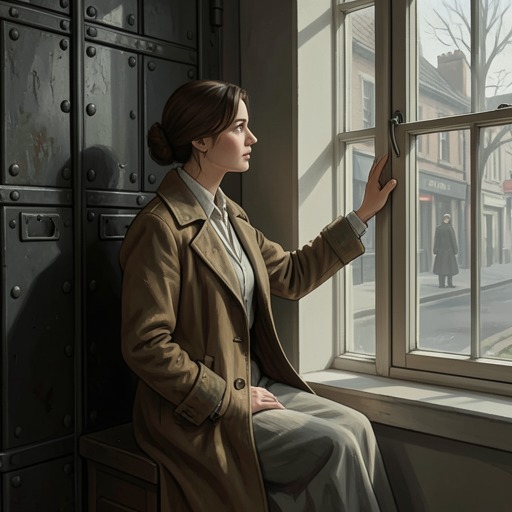
Writing as description rather than explanation
Simple PassionWriting as description rather than explanation is the narrator’s deliberate method for writing about her passion for A: rather than reconstructing why it began or turning the affair into a fully ordered story, she records the signs through which it was lived. The method keeps the experience open to readers without pretending that narrative can restore the absent man or make the passion’s causes definitive.
A Form Between Testimony and Inventory
The narrator cannot settle on a single genre for her account. She has lived her passion as though in a novel, yet is unsure whether she is writing testimony, a confidence of the kind found in women’s magazines, a manifesto, a statement, or critical commentary. That uncertainty is not a failure to choose a form; it registers the difficulty of giving private experience a public shape without forcing it into a familiar explanation.
She distinguishes her practice from telling the story of a liaison. Much of that story escapes her, and the chronological markers that might ordinarily organize an affair—A’s arrival on a particular day or the passage of several weeks—do not define its lived reality. For her, the relationship is experienced as absence or presence. The writing therefore gathers signs of passion, moving between “one day” and “every day,” rather than supplying a continuous plot.
The list is meant to approach the reality of the passion through its particulars, not to claim that a sequence of incidents can contain it completely. Repetition matters because the experience itself returns and persists; the movement between an isolated day and the condition of every day gives the account a rhythm closer to obsession than to conventional chronology. Description becomes a way of registering what the narrator could experience even when a complete story, and its exact order, remain beyond her reach.
Refusing Causal Explanation
The narrator explicitly declines to search for the passion’s origins in childhood, in recent history, or in the cultural models of emotion that have shaped her. She names different possible sources—from Gone with the Wind and Phèdre to Edith Piaf’s songs and the Oedipus complex—without allowing any one of them to become the key that supposedly unlocks the affair. Cultural inheritance and personal history may both matter, but neither is made into a conclusive explanation.
That refusal also rejects the implication that passion must be justified as a mistake or treated as a disorder. To explain it in those terms, the narrator suggests, would already place the experience on trial. Her stated aim is instead to describe what the passion was and how it affected her. The distinction does not claim that the affair has no history or causes; it limits what the writing asserts it can know, and refuses to substitute a diagnosis for the experience itself.
The account is consequently resistant to hindsight’s easy irony. The narrator says there is no irony or derision in the listing and description, because those are ways of telling things to oneself or others after an event, not of experiencing them at the time. The form tries to preserve the seriousness with which each sign was then felt, rather than allowing later judgment to recast that seriousness as foolishness.
Time, Repetition, and the Written Record
The difference between living in passion and writing about it appears in the narrator’s sense of time. She can recall the relationship through sharply fixed details: the October Riots in Algeria, the heat and hazy sky on 14 July 1989, and buying a blender in June on the day before a meeting with A. But she cannot connect a particular page of the later writing to a rainstorm or to events in the wider world during the months after his departure, including the Fall of the Berlin Wall and the Execution of Nicolae and Elena Ceaușescu. The affair’s details retain their own internal calendar; the act of writing does not line up so neatly with public events or particular weather.
When she begins to write, she wants to remain in the age of passion, when even the choice of a film or lipstick was directed toward one person. The past tense of the book’s first part conveys endless repetition and the sense that life was better then. Writing gives that repeated past a form, but it also produces pain: rereading those pages is distressing in a way comparable to seeing and touching the toweling bathrobe A used at her home before dressing to leave. The robe carries the intimate force of a shared presence, while the pages preserve the experience in words that may mean something to others as well as to her.
Yet the writing does not lessen grief. When the pen is put down, the narrator still longs for the man whose voice, foreign accent, and skin she can no longer encounter. The real A, living an unknown life in an unknown cold city, is more inaccessible than the written figure designated by the letter A. The book can describe the consequences of his absence; it cannot make him present again. Even so, the written record remains one of the actions through which she lives with sorrow, alongside playing patience, giving a ten-franc coin to a beggar at Auber Metro station, and wishing that A will call or return.
Publication, Privacy, and What the Book Offers
The narrator’s ability to write without shame depends partly on the distance between writing and reading. At the moment of writing, she imagines, only she can see the pages; the moment when other people read them feels so remote that she can imagine being dead, or a war or revolution having intervened. That delay lets her write without dwelling on consequences, much as she recalls lying in the scorching sun at sixteen or making love without contraceptives at twenty. The privacy is provisional, but while it holds, writing can proceed without the social judgment that publication may bring.
Once the need to write has been satisfied, however, the prospect of showing the text to others changes its emotional conditions. The narrator stares at pages covered in handwriting only she can interpret and feels astonishment and something like shame. She had not felt this while living the passion or writing it; the thought of publication brings her closer to other people’s judgments and to society’s “normal” values. The private manuscript can still seem almost childish and inconsequential, like declarations of love or obscene expressions written on exercise-book covers when there is no risk of anyone reading them. Typing the text into public characters marks the end of that innocence.
Her reluctance to finish is also a way of delaying the trauma of letting others read the book. She knows writing cannot offer the unexpected in the way real life can, and she has not treated publication as an eventual consequence while the need to write was active. Now that the pages exist, she cannot readily part with them, just as she could not leave A while waiting and desire were continual. Description thus records not only the passion but the writer’s changing relation to its record: private necessity becomes a public object, and the prospect of judgment makes the act of completing it another threshold.
The book’s claim is finally neither that it is a complete account of A nor that it is simply an autobiography. The narrator recalls A telling her that she would not write a book about him, then insists that she has written neither a book about him nor a book about herself. She has translated into words the effect his existence had on her life; the words are probably ones he will never read and are not intended for him. She imagines that translation as an offering to others. Description, in this sense, does not explain the beloved or settle the meaning of the affair: it gives readers a form of access to what the experience did to the person who lived it, while leaving the living man beyond the text’s possession.