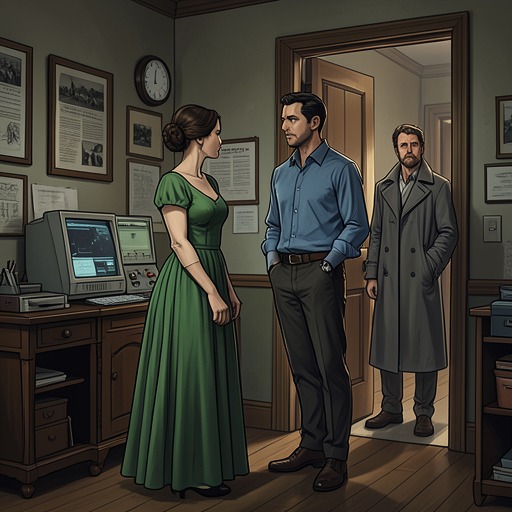
Duan Agrees to Pretend to Be Kim’s Fiancé
SpontaneousDuan Agrees to Pretend to Be Kim’s Fiancé marks the point when Kimani Cannon’s invented engagement acquires a willing partner, a family visit, and a ring. Duan Jeffries’s offer answers a practical problem—Kim must take a supposed fiancé to Shreveport before her mother’s wedding—but it also turns their recent intimacy into a new kind of closeness. The arrangement is explicitly pretend, yet its public gestures begin to resemble the commitment it imitates.
Background and the Lie
The plan grows out of pressure Kim had tried to deflect rather than a wish to marry. Her mother, Wynona Cannon-Longleaf-Higgins-Gunter, and her aunt Gertrude believe that Kim’s exposure to her parents’ relationship helps explain why she has not found what they consider a healthy relationship with a man. Kim understands that her mother wants to see her only child married, and she does not want Wynona to blame herself or worry unnecessarily. Kim is content with her marital status; the family’s concern, in her view, has been intensified by Gertrude’s romantic outlook and her enthusiasm for reality television.
Without Kim’s knowledge, Gertrude had submitted her name and biography to How to Find a Good Man. Kim was selected for a televised scavenger hunt intended to help her find a man, and the film crew arrived at the hospital to surprise her. To get out of participating, Kim said that she had become engaged after Gertrude sent in her information. The story initially worked: her family was satisfied, she was left alone, and nobody asked for the supposed fiancé’s name. But the cover story did not dissolve. Wynona now wants to meet him, and the proposed wedding to Edward Villarosas is only three weeks away.
Kim explains that she must go home the following week, meet the man who may become her fourth stepfather, and bring a man she can present as her fiancé. Duan suggests that she tell her family the truth. Kim rejects that as an easy solution because she knows her family, especially Gertrude, and does not want to dismiss her aunt’s well-meant involvement. The fake fiancé is therefore not simply a joke between friends: it is the solution Kim believes will let her face both the family visit and the imminent marriage plans without reopening the explanation behind her original lie.
Duan’s Offer and Kim’s Test
Duan’s offer comes as they are parting in a taxi. He is about to go his way while Kim returns to Key West, and he feels the separation acutely. He asks whether she has any prospects and, when she does not supply an answer that resolves the problem, offers to be added to her list. The offer follows the sexual encounter they shared in her hotel room; Kim later remembers that timing and wonders whether he meant it seriously or spoke in the heat of what they had just shared. Duan’s private reluctance at the prospect of her taking another man also gives the offer a personal edge, even though he knows the decision is hers.
The question returns when Kim raises the possibility of taking a fake fiancé with her. She is due to leave on Friday and plans to spend a week with her mother, including a few days getting to know the man Wynona wants to marry. Kim has been tempted to ask Duan about his earlier offer, but she has not been sure how to interpret it. Rather than continue guessing, she makes the proposal’s practical meaning plain: her mother and aunt will question him and press for details such as a wedding date, and the performance will not be effortless.
Duan sets aside his fishing pole and confirms that he meant what he said: he has become her pretend fiancé. He accepts that Kim will have to guide him on what to say. His agreement changes the arrangement from Kim’s solo fabrication into a story they must maintain together. The role is defined by its audience and limits: he is to help her face her mother and aunt, not to announce a real engagement to everyone they encounter.
The Ring and the Public Performance
Duan takes responsibility for supplying the visible sign of engagement. At the airport, before the trip, he checks that a ring is still in his shirt pocket. It is the ring his grandmother left him to give to the woman he would one day marry, and Kim has agreed that using it is a good idea. For Duan, the choice has two purposes: it is a personal gesture toward a woman he has come to regard as a friend, and it is part of his business in accompanying her while investigating whether Edward Villarosas is guilty of murder.
At breakfast, Duan asks for Kim’s left hand, takes a small jewelry box from his pocket, and slides the ring onto her ring finger. It fits perfectly. He explains that his grandmother left it to him as her oldest grandson. Since he had no plans to marry, he had considered giving it to Terrence Jeffries, but his father advised him to keep it because it had been left to him. The heirloom thus serves a role Duan once did not expect to occupy: for now, it makes the invented engagement visible and lends the performance an inherited object with a real history.
A waitress sees the ring and assumes the two have just become engaged. Duan answers, “Yes, we did.” Kim catches on and confirms it when the waitress congratulates them. The exchange briefly carries their private arrangement into public life, beyond the mother and aunt it was designed to persuade. When Kim asks why he let the waitress believe the engagement was real, Duan says, “For all intents and purposes, we have.” Kim draws the boundary back, reminding him that they are role-playing for her family, not necessarily for strangers. The small disagreement exposes the fiction’s central tension: the words, ring, and shared performance can make the engagement look real even while Kim insists on its limited purpose.
Consequences and Significance
The agreement gives Kim a companion for the visit and a way to meet Wynona’s demand without confessing how the original lie began. It also gives Duan a place in the situation surrounding Edward, whose planned marriage to Wynona is the reason Kim must make the trip at all. The reopened investigation into the disappearances of Edward’s former wives is not separate from Duan’s decision: he has volunteered to travel in the role Kim needs while pursuing his own inquiry into the man she is expected to meet.
The sequence advances through increasingly concrete acts of consent. Duan first offers himself as a prospect; Kim later tests whether he meant it; he confirms the arrangement; he brings a family ring; and, when a stranger reads the gesture as an actual engagement, both of them sustain that reading. Yet their agreement remains a performance negotiated between them, not a wedding promise. Kim specifies the difficult audience and the limits of the act, while Duan agrees to follow her lead. The resulting pretend engagement is at once cover story, investigative access, and a new shared undertaking whose symbols are more genuine than its stated terms.