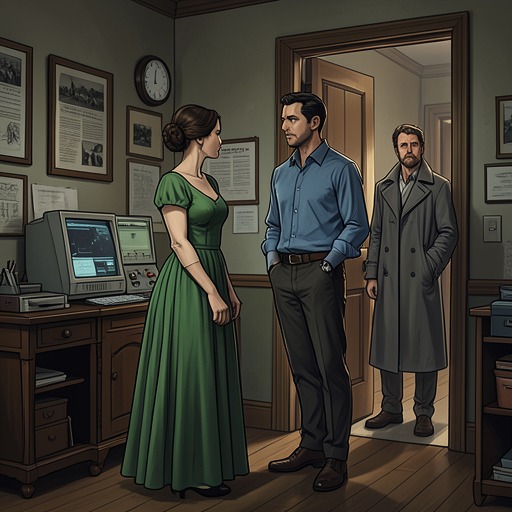
Kimani Cannon and Duan Jeffries’s Fake Engagement Arrangement
SpontaneousKimani Cannon and Duan Jeffries’s Fake Engagement Arrangement is a deception devised to shield Kimani Cannon from family matchmaking and later used to accompany her to Shreveport. It also gives Duan Jeffries a reason to spend time near Edward Villarosas, a man he suspects in the disappearance of two former wives. What starts as a convenient public fiction therefore carries two private purposes—and becomes increasingly difficult to keep emotionally separate from the relationship it is supposed to imitate.
Origins and Family Pressure
Kimani Cannon’s claim of being engaged is a lie prompted by her aunt Gertrude’s intervention. Kimani Cannon explains that her mother and Gertrude believe witnessing her parents’ troubled relationship shaped her difficulty forming what they consider a healthy relationship with a man. Duan Jeffries recognizes the force of that history: what his mother did to his father has also made him wary of trusting women, though he understands that neither of them believes every person is the same.
Gertrude, whom Kimani Cannon describes as a committed romantic and reality-television enthusiast, secretly submitted her niece’s name and biography to How to Find a Good Man. Kimani Cannon was selected for a televised scavenger hunt and learned of it when a film crew arrived at the hospital. To escape the show, she said that she had become engaged after Gertrude submitted her information. The lie worked at first: her family was satisfied, and nobody asked who the supposed fiancé was. That reprieve ended when Kimani Cannon’s mother wanted to meet him.
The pressure bears on Kimani Cannon’s own stated resistance to marriage. A previous partner wanted a more serious relationship than she did, despite having initially claimed to share her preference for something noncommittal. She also connects her distrust of men to her father’s conduct and to an episode in which a stepfather made an unwanted advance; knowing something about self-defense helped her protect herself. Watching her mother live as though she could not manage without a man strengthened Kimani Cannon’s resolve not to make marriage her future, although she says she would like a child someday. Taking a pretend fiancé home thus answers her family’s expectations without representing a change in those convictions.
The Proposal and Its Double Purpose
The family request intersects with an investigation Duan Jeffries wants to revive. Five years earlier, he had investigated the disappearances of Edward Villarosas’s wives, but Edward Villarosas had ironclad alibis, and the available evidence did not justify changing the cases from missing persons to homicide. He had claimed that the women left him for other men. Duan Jeffries still felt that something about Edward Villarosas did not add up and wanted another opportunity to look for information he had missed.
A wedding planned for three weeks later offered a possible opening. Kimani Cannon needed a date and expected to meet Edward Villarosas for the first time; going to Shreveport early could give Duan Jeffries time around him. Landon Chestnut observed that Edward Villarosas might reveal something during a longer stay and that he would not recognize Duan Jeffries, who had already left the police force. Duan Jeffries understood the investigative advantage, but he was not sure Kimani Cannon would ask him to go.
When Kimani Cannon finally tested whether his earlier offer to accompany her had been serious, Duan Jeffries agreed. He told her he was dead serious and accepted the role of pretend fiancé. Kimani Cannon warned that her mother and Gertrude would ask questions and try to pin them down to a wedding date. Duan Jeffries left the answers to her, promising to follow her lead. The arrangement was therefore not a claim that they had privately decided to marry; it was an agreed performance, with Kimani Cannon directing what they would tell her family.
The Ring and the Public Performance
The fiction acquired a tangible prop when Duan Jeffries chose an engagement ring. Before leaving for the trip, he checked that it was still in his shirt pocket. The ring had been left to him by his grandmother to give to the woman he would one day marry. Kimani Cannon had agreed that it was a good choice, but its meaning remained divided: Duan Jeffries considered the gesture personal because he had come to regard her as a friend, and practical because he hoped the visit would help him assess Edward Villarosas. The family-facing symbol thus carried a history and an investigative purpose beyond the supposed engagement.
At the meeting with her mother, Kimani Cannon introduced Duan Jeffries as her fiancé. Wynona Cannon-Longleaf-Higgins-Gunter responded warmly and asked him to call her Wynona, rather than use the string of surnames Kimani Cannon had recited. In that first encounter, the performance achieved its immediate social aim: Kimani Cannon appeared to have the man her family had been waiting to meet. The ring and introduction made the invented status legible to others, even though its original terms remained pretend.
Intimacy Beyond the Arrangement
The arrangement develops against a relationship already shaped by attraction, but Kimani Cannon and Duan Jeffries do not initially describe that attraction in the same way. Kimani Cannon had said that short-term relationships suited her and that marriage was not in her plans. When Duan Jeffries explained his willingness to accompany her partly in terms of kissing and sex, she noticed that he called their encounters sex rather than making love. She nevertheless accepted that they were officially pretend engaged. Her attention to his wording signals a difference between the practical agreement they have made and the emotional meaning she is beginning to attach to their intimacy.
Their recurring Sunday breakfasts in bed sharpen that difference. Duan Jeffries points out that they have shared breakfast that way for three weekends in a row, and Kimani Cannon jokes that the practice could become a hard habit to break. When he describes their recent frequency of sex, she again focuses on the word itself, wondering whether sex is all they have been sharing and when he might stop treating it as merely sex. The fake engagement does not itself settle that question; it gives their growing closeness a public label while leaving their private expectations uncertain.
That uncertainty changes most clearly for Kimani Cannon during an intimate encounter. She tries to concentrate on the physical experience rather than on what she feels in her heart, then recognizes that it is not just sex for her: she understands it as love, in a way she had not thought possible. The arrangement’s decisive consequence is therefore not a confirmed marriage or a stated mutual commitment. It is the widening gap between the convenient fiction they agreed to perform and the real emotional stakes Kimani Cannon has begun to feel, while Duan Jeffries’s investigative purpose remains part of the reason he went with her.