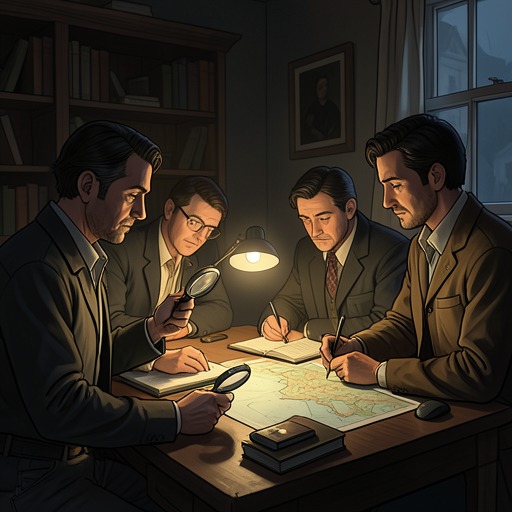
Villarosas Missing-Persons Investigation Report
SpontaneousThe Villarosas Missing-Persons Investigation Report is the extensive case file on the separate disappearances of Edward Villarosas’s former wives, Mandy and Sandra. It records how each woman vanished amid circumstances that left investigators with unanswered questions rather than proof of a crime. When Duan Jeffries gives the three-hundred-page document to Kimani Cannon, it becomes both a record of the original investigative dead ends and a working map for reassessing them as Edward prepares to marry Kim’s mother, Wynona Cannon-Longleaf-Higgins-Gunter.
Nature and Scope
The report gathers information from multiple sources, including witness interviews and investigative records, but does not deliver a definitive finding. The cases had been examined by Atlanta detectives, yet investigators could not connect Edward to either disappearance or move the cases from missing persons to homicide. His alibis were verified by family and friends, and he and the women were not even in the same cities when they disappeared. The file therefore preserves an unresolved evidentiary problem: suspicion persisted, but the available material did not establish what had happened to either woman.
The two cases were separated by five years. Their chronology mattered to Duan and his friend Landon Chestnut, who had investigated the later case while serving as a detective. Landon had repeatedly reached dead ends, and his frustration with the investigation was among the reasons he later left the police force to join Duan’s private-investigation firm. When the case returned to their attention, the report offered a concrete basis for reopening questions that had once gone unanswered, without converting old suspicion into a conclusion.
Mandy Villarosas’s Disappearance
According to the file, Mandy failed to return from what should have been a weekend trip to Orlando with two girlfriends. She left their hotel room shortly after breakfast, saying she was going to meet someone. When she had not come back by lunchtime, her companions became worried and contacted Edward; he encouraged them to notify the police. The women said they did not know whom Mandy intended to meet, but reported that she had flirted with a man at a club the night before and believed he could be the person she planned to see.
The file also records an alternative explanation that complicated the inquiry. Mandy’s friends described her as having flirted with the man, a detail that could suggest she had chosen to leave or had arranged a meeting unrelated to Edward. Two years after her disappearance, Edward divorced her on the grounds of desertion; a year later, he remarried. These facts could not resolve whether Mandy had left voluntarily, met another person, or suffered harm. They instead preserve the competing possibilities that Kim and Duan would have to test rather than assume away.
Sandra Villarosas’s Disappearance
The second case begins with Sandra’s failure to appear for work. A concerned coworker reported her missing after she did not show up. Edward was away on a fishing trip in Florida with friends, having left two days earlier; Sandra herself had driven him to the airport. Witnesses verified the trip and confirmed that Sandra had been seen around town after his departure. The account thus provided Edward with an alibi supported by other people and placed the two spouses apart when Sandra disappeared.
The report establishes a striking parallel and an important difference: both women were never heard from again, but the circumstances recorded around their last known movements were not identical. In neither case did the original investigation produce a body or a confirmed explanation. Edward said his wives had left him for other men, while the case material left the women’s actual fates unknown. The file’s value lies partly in keeping those claims and uncertainties visible together, rather than treating suspicion as proof.
Kim and Duan’s Review of the File
Kim reads the report after Duan gives it to her, working through a document considerably larger than the medical reports she is accustomed to reviewing as a nurse. She notes the difference between a medical file that reaches a diagnosis and an investigative file that accumulates information without a definite conclusion. The report’s size does not make its uncertainties disappear: after reading roughly the first hundred pages on Mandy’s disappearance, Kim still finds unanswered questions and has the second case to examine.
Duan’s annotations make the file usable as a shared investigative tool. He has highlighted passages and added questions on sticky notes, many of which match the issues Kim herself would have raised. She studies whether the two women might have shared physical or emotional characteristics and, more urgently, whether either woman’s circumstances resemble those of her mother. Because Wynona is considering marriage to Edward, the comparison gives Kim a personal stake in scrutinizing the case, but she agrees that if Edward is innocent she will apologize to him and her mother. She wants the evidence, not the mere existence of suspicion, to determine what she believes.
One unresolved lead concerns the man Mandy reportedly flirted with. Duan and the investigators consider contacting people who attended a reunion in hopes of finding a photograph of him. Mandy’s companions believed the man from the club might be the person she intended to meet the next day. If that identification held, a third party could have been responsible for her disappearance. The report therefore supports several competing explanations; it does not establish that Edward was guilty, and the possibility of another man prevents the investigators from treating the husband as the only suspect.
From Unresolved File to Renewed Investigation
The report’s limitations become the starting point for further inquiry. Duan stresses that two investigations had not produced evidence sufficient to charge Edward, and that even strong suspicions and an investigator’s intuition could not substitute for proof. Kim, whose professional outlook favors decisions based on evidence, challenges the reliance on instinct and asks to examine the reports herself. Their disagreement sharpens the distinction between a reason to investigate and a basis for declaring someone guilty.
Later work adds information that was not a finding of the original report. Landon speaks with an old girlfriend of Edward’s, who describes his jealous accusations and threats; Chevis Fleming visits Stein Green in a Florida prison, where Green admits that Edward hired him to get rid of both wives because he believed they had been unfaithful. That later statement dramatically changes the significance of the old case files, but it should not be confused with what the original investigations established. The report remains the record of a pair of disappearances that initially resisted proof, and the foundation against which the new testimony and leads can be assessed.