“Thou art God”
Stranger in a Strange Land“Thou art God” is Mike’s imperfect English rendering of a central Martian certainty: divinity is not outside the world, but belongs to each self and to all that groks. The phrase begins as a difficult translation, becomes the foundation of a public religion, and finally names Mike’s insistence that understanding carries responsibility. Its comfort is inseparable from its burden: each person must choose and answer for the world that choice helps make.
Meaning and translation
Mike first tries to explain that grokking is not merely a way of knowing a thing. The grass beneath his feet groks, he says, and the word he needs is God; he then points to Jubal and declares, “Thou art God!” The explanation extends to Anne, Jill, himself, and the grass, joining perception, existence, and creation rather than setting a divine observer apart from them. When Mike says, “That which groks,” he is offering a compact gloss, not a complete equivalent for the Martian concept.
The limits of that gloss remain important. Mike recognizes that the idea seems simple in Martian but slippery in English, and waits for a time when he and Jill can understand it together. Later, he holds the English sentence and its Martian counterpart in mind simultaneously, feeling nearer to grokking while knowing that the English can never carry the original concept’s crystal inevitability. Translation makes the doctrine communicable, but also exposes what it cannot preserve.
From Martian certainty to human religion
Mike describes the Martians as having one religion, but not a faith: it is a certainty one groks. He repeats the teaching to Jubal, and explains it to Dr. Mahmoud as a shared recognition: “Thou art God.” Mahmoud’s response shows that the formula can be held alongside an existing faith. He remains a servant of God, yet also accepts that each person participates in the shaping of the universe and bears responsibility for what it becomes.
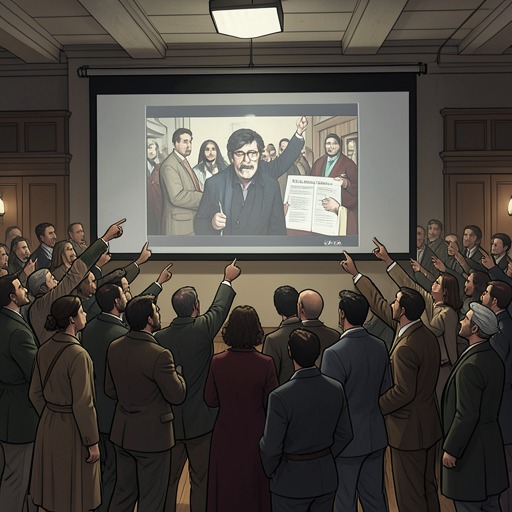
The phrase travels beyond private conversation into worship. At one service Mike sings in Martian and the congregation answers in Martian, with the English refrain “Thou art God!” echoed by a Martian word. Patty later repeats the English formula simply. The same language can sound like a familiar religious affirmation to one hearer and, to another, like an unsettling challenge. A churchgoer explains that Mahmoud considers it no true translation: the Martian expression might suggest the universe proclaiming its own self-awareness, among other meanings that English cannot contain. A Fosterite calls it heresy and reads defiance into it. The disagreement reveals that the phrase’s public reach does not guarantee shared understanding.
Choice and responsibility
The doctrine’s sharpest implication appears at the cusp, where Mike must choose for himself. His growth out of the nestling stage brings a solitude that no water brother can remove: Jill may teach or guide, but the decision cannot be shared. Mike’s choice becomes a kind of ownership that cannot be sold or given away; he is inseparable from the action he takes and its consequences. In this context, “Thou art God” is not permission to escape judgment. It names the responsibility that comes with being the one who chooses.
That burden governs Mike’s explanation of his work to Jubal. He says he had seen the condition of the planet and believed it could be changed; the discipline and knowledge he had learned in a Martian nest could be made available to others. Because schools and colleges could not teach what he needed to teach, he presented it in the form of religion, appealing to curiosity and entertainment. He judges the result as partial: some accepted the teaching as an easy prize or conversion, while others ignored it, still imagining God as external and responsible for comforting them. For Mike, the missing lesson is that effort must be their own, and that people are responsible for the trouble they help create.
His formulation also refuses to separate the holy from the ordinary. Mike says that even the sparrow and the cat stalking it are God, each carrying out God’s thoughts. This does not remove conflict from existence; it places both participants within the same encompassing reality. The claim is therefore not only that people possess sacred value, but that responsibility cannot be handed off to a power wholly outside them.
Public reception and final use
Jubal’s response remains skeptical without dismissing Mike as a fraud. He believes Mike sincerely teaches what he sees as truth, though he questions the reality of the Old Ones and considers Mike’s creed no more or less credible than other religions. His uncertainty underscores the gap between sincere teaching and successful transmission: Mike can offer the words, but cannot make others accept their full meaning.
That gap becomes explicit near the end. Mike tells Jubal that the doctrine is “not a message of cheer and hope”; it is defiance and an unafraid assumption of personal responsibility. Only a few of those around him, he says, have accepted its bitter as well as its sweet aspect. The many who treat it as a reward without a contest, or who ignore it, have missed the demand for effort and accountability. The language of universal divinity therefore does not promise effortless happiness; it makes self-deception harder to maintain.
In the final confrontation, Mike tells the people opposing him that by fighting him they fight themselves, because there is no other outside the shared reality he describes. Addressing his brothers, he expresses love, urges them to drink deep and grow closer, and repeats “Thou art God.” Moments later, after turning his attention to a grasshopper near him, he says the phrase once more and discorporates. Jill rejects the idea that he is simply gone: those who have grokked him cannot be separated from him. The doctrine thus closes where its translation began, in the relation between a perceiving self and the life around it, while leaving Mike’s death understood through Martian teaching rather than ordinary disappearance alone.