Ben Caxton
Stranger in a Strange LandBen Caxton is a newspaperman whose effort to expose the government’s concealment of Valentine Michael Smith turns professional curiosity into personal risk. His investigation leads to his disappearance and return, while his later place among Smith’s water brothers and the community around the Church of All Worlds gives him a lasting role beyond journalism: Smith eventually names him as a successor in managing the estate.
Identity and Investigative Method
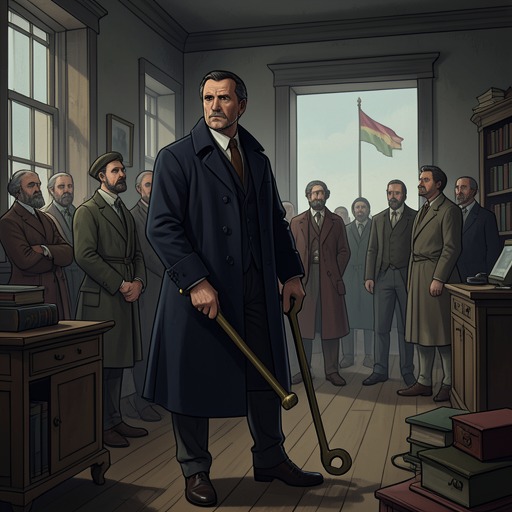
Caxton identifies himself to Jill Boardman as a newspaperman, and the occupation shapes his response to Smith’s case. He recognizes that the authorities control both access and the rules of engagement, yet decides to challenge them rather than accept the official account. His plan is to enter Bethesda Medical Center with a Fair Witness on one side and a lawyer on the other, then demand to see Smith in the hope of forcing the matter into public view.
For that attempt, Caxton secures James Oliver Cavendish, a highly regarded Fair Witness whose experience before the Federation’s High Court and reputation for total recall lend weight to the challenge. Cavendish’s fee exceeds Caxton’s weekly earnings, but Caxton expects to charge it to the Post syndicate and considers the expense justified. The choice shows him combining investigative nerve with an understanding that a confrontation with government power requires credible witnesses and institutional leverage.
The Smith Investigation and Disappearance
Caxton’s inquiry places him in opposition to the government. Jubal Harshaw recognizes that Caxton’s accusation—that Smith is being held as a political prisoner—has provoked the government’s instinct to defend itself, and regrets involving Jill in the danger. Caxton, for his part, knows that the authorities have the advantage, but still intends to press the hospital confrontation into public view.
The evidence later establishes that Caxton went to Bethesda Medical Center on a Thursday morning with his lawyer and Cavendish. Afterward, a message apparently from him told his assistant, Kilgallen, that he would be away for a few days. Harshaw initially considers the possibility that Caxton has simply gone pursuing a story, as he sometimes does, but the message does not resolve the concern. His investigators find that the record of the cab Caxton used has also been tampered with. Since there was no apparent reason for Caxton to alter the record himself, Harshaw concludes that someone with access to a public carrier’s records concealed where Caxton went and used the message to disguise his disappearance. He fears Caxton may be dead, while Jill and Harshaw continue to assume he is alive until they have proof otherwise.
Caxton’s absence makes the risks of the investigation concrete for the people around him. Harshaw asks Jill how she can search for Caxton without increasing the danger that his unknown captors will harm him. The question turns the investigation from a press effort into an urgent effort to locate a missing friend, with uncertainty—not confirmed knowledge of his fate—driving the search.
Return and Place in Smith’s Community
Caxton eventually returns to the circle around Smith. When he comes to the Temple, Jill has sent him a radiogram directing him to its living-quarters entrance, located on the street behind the building. He describes the Temple as a large, labyrinthine complex with a public auditorium, smaller spaces for invited meetings, and extensive living quarters above the main hall. His arrival there places his own return within the growing institutional life of Smith’s movement.
His responses to that community are characteristically practical and wry. After seeing Smith’s new public presence, Caxton remarks that Smith could sell shoes to snakes. The comment registers his recognition of Smith’s persuasive ability without suggesting that Caxton has surrendered his own judgment. In another exchange, Caxton calls out an opponent’s racket, explaining that he has refrained from exposing it in his column because the syndicate is afraid to publish the story. His profession remains a way of assessing power and the limits imposed on public speech, even after his life has become closely tied to Smith’s followers.
Caxton also accepts the community’s language and relationships. At a meal where water is passed around the table, Harshaw offers water to the girl beside him; the quiet ritual shows the practice extending into ordinary shared life. Caxton’s later place among Smith’s water brothers is also evident when Smith tells him that he would rather not see a particular matter in Caxton’s column, explaining that he hopes to command a spaceship again. Their relationship therefore includes both intimacy and a continuing negotiation over what a newspaperman should publish.
Relationships and Independence
Caxton and Harshaw combine friendship with disagreement. Caxton criticizes Harshaw’s decision to accept sovereign honors for Smith, arguing that Smith should instead have signed away any rights claimed under the Larkin theory. His objection is not abstract: he believes Harshaw knew that Douglas wanted that result. The disagreement highlights Caxton’s preference for a direct settlement over symbolic recognition, even while he remains close enough to Harshaw to challenge him openly.
That independence extends to money. When Smith’s financial affairs and the possible management of his estate are discussed, Caxton admits that he has none of Harshaw’s objections to being rich. Yet he also observes that Mars is already inhabited, keeping the financial question connected to the political and ethical dispute over claims to the planet. Caxton’s position is neither detached idealism nor simple acquisitiveness: he can acknowledge the attraction of wealth while insisting on a fact that complicates Earth’s claims.
Estate and Continuing Role
Smith’s will gives Caxton a formal responsibility within the group. Harshaw explains that the people present are each at least millionaires, with the exact amounts still to be calculated, and that there are no conditions on their inheritances. Joseph Douglas is to remain manager for anyone who wants the capital left invested; if Douglas does not remain, management will pass to Caxton. Caxton accepts that possibility and says the business can be placed in his name, while proposing to hire a professional businessman named Saul.
That decision offers a pointed resolution to the contrast between Caxton’s work as a newspaperman and his new financial position. He does not present himself as a trained administrator; instead, he plans to bring in someone with business expertise. His appointment is conditional on Douglas’s departure, but it establishes Smith’s trust in him and places Caxton in the practical chain of responsibility for the estate. The character who began by trying to force a hidden detention into public view ends with a role in safeguarding the resources of the community formed around Smith.