Champion
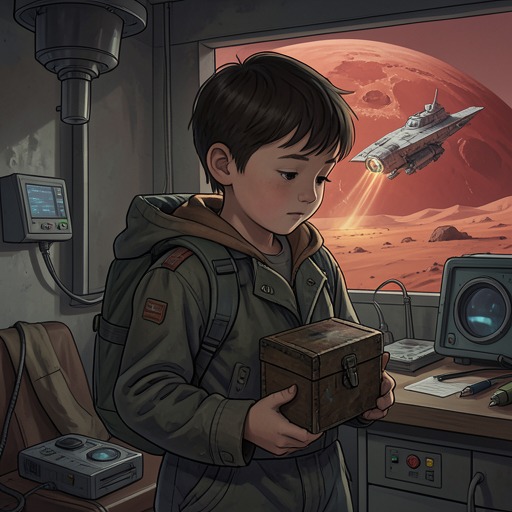
Stranger in a Strange LandChampion is the Federation ship whose successful voyage to Mars transforms the mystery of the lost Envoy into the first human encounter with a living Martian civilization. By finding both the expedition’s wreck and its sole survivor, Valentine Michael Smith, the ship carries back not merely a rescue but a new political reality: Mars is inhabited, and Smith’s arrival on Earth will make his person, origins, and rights matters of public consequence.
Voyage and Discovery
Champion followed an earlier, thwarted reconnaissance. Six years after Envoy fell silent, the drone probe Zombie had orbited Mars and returned with photographs of a landscape inhospitable to humans, an atmosphere too thin for human life, engineered canals, and what appeared to be ruined cities. A large crewed expedition was considered urgent, but World War III intervened. The delay ultimately produced a stronger and safer undertaking than the first expedition, rather than an immediate attempt to repeat its fate.
The Federation ship crossed under the Lyle Drive in nineteen days. Its company consisted of eighteen experienced spacemen and more than eighteen male pioneers, all male. Captain van Tromp directed the landing just south of Lacus Soli, intending to search for Envoy. Unlike the silence that had prompted the search, Champion reported to Earth by radio every day, making its progress a continuing public account rather than a single discovery announced on its return.
Three dispatches successively altered what Earth understood. First came the blunt report that Envoy had been located and had no survivors. The next declared that Mars was inhabited. A third corrected the apparent finality of the first: one Envoy survivor had been found. The order matters. The search begins as an investigation of a lost ship, becomes evidence of another civilization, and then turns into the recovery of a person who connects that civilization to the human expedition.
The Survivor and His Arrival
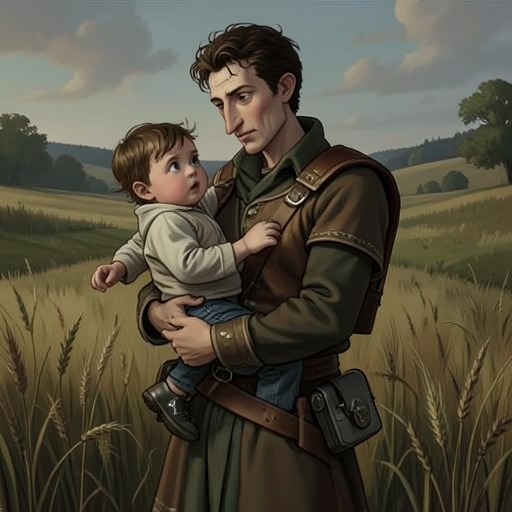
Van Tromp treated the survivor not as a scientific specimen or a public spectacle but as a passenger whose condition required protection. Before Champion reached Earth, he radioed instructions that Valentine Michael Smith must not undergo the strain of a public reception, and requested a low-gravity shuttle, a stretcher, ambulance service, and an armed guard. Those precautions set a controlled, private arrival against the extraordinary public significance of the discovery.
The captain sent the ship’s surgeon, Dr. Nelson, with Smith to Bethesda Medical Center. There, the surgeon was to see that Smith was installed in a suite, transferred gently into a hydraulic bed, and shielded from outside contact by marine guards. Van Tromp did not accompany the survivor into the medical suite: he went instead to an extraordinary session of the Federation High Council. The ship’s voyage thus ends in two linked destinations, a protected hospital room for Smith and an urgent political proceeding for the captain.
At the Council, the High Minister for Science acknowledged that Van Tromp had authority to order unusual medical care for someone temporarily in his charge, but challenged his continued interference with the department’s work. The minister described Smith as a source of immense scientific information. Van Tromp’s brief agreement did not withdraw the protections he had arranged; the contrast makes clear that the survivor’s scientific value and immediate vulnerability were already competing claims.
The Lost Expedition and Smith’s Parentage
The discovery of Smith also reopened the story of Envoy’s crew. The original expedition had included eight people in four married couples, among them Captain and Mrs. Brant and Doctor and Mrs. Smith. Later discussion of the crew’s recorded biological data established that Valentine Michael Smith was the son of Mary Jane Lyle Smith and Captain Michael Brant, rather than Doctor Smith. His parentage therefore crossed the expedition’s formal marital pairings and became an intimate revelation embedded in a matter of scientific record.
The identification rested on blood typing, Rh factor, hair and eye color, and other genetic information gathered for the crew. The evidence was unusually extensive because all eight members had been measured and typed. The same records used to identify the only survivor’s parents also supported an assessment of his biological inheritance: Brant’s recorded IQ was 163 and Mary Jane Lyle Smith’s was 170, and both were described as leaders in their fields. Champion’s recovery consequently brings to Earth not only a surviving crew member, but a person whose identity can be reconstructed from the expedition’s own meticulous documentation.
From Rescue to Interplanetary Politics
Champion’s find had consequences well beyond the rescue. The announcement that Mars was inhabited undermined the assumptions behind human claims to the planet, while Smith’s survival gave Earth a living individual through whom the encounter could be addressed. His status could not be reduced to the familiar categories of scientific subject or ordinary citizen; the later dispute over his rights drew directly on the legal precedent established by the Larkin Decision.
That precedent emerged from competing claims to the Moon. After earlier national expeditions and a joint United States and Canadian effort, General Atomics sent its own settlers from an island leased from Ecuador. When later Federation and Russian vessels arrived, the corporation claimed the Moon. The Federation High Court ruled that a corporation, as a legal fiction, could not own a planet; the actual occupiers, Larkin and his associates, were recognized as a sovereign nation and admitted to the Federation through a political compromise involving concessions to the corporation and its subsidiary, Lunar Enterprises. The resulting rules for planetary colonization were intended to prevent bloodshed, and the Larkin Decision became established planetary law.
The connection to Champion is consequential: by locating Smith on a Mars already inhabited by its own people, the expedition makes the old framework for planetary occupation newly contentious. The search was launched to find Envoy, but the dispatches establish that its object cannot be separated from the question of who has a claim to Mars. Champion returns no simple answer to that question. It brings back the survivor whose existence makes it impossible for Earth to treat the planet as an empty destination, and whose arrival turns a rescue mission into the opening of a legal and diplomatic crisis.