Church of All Worlds Temple
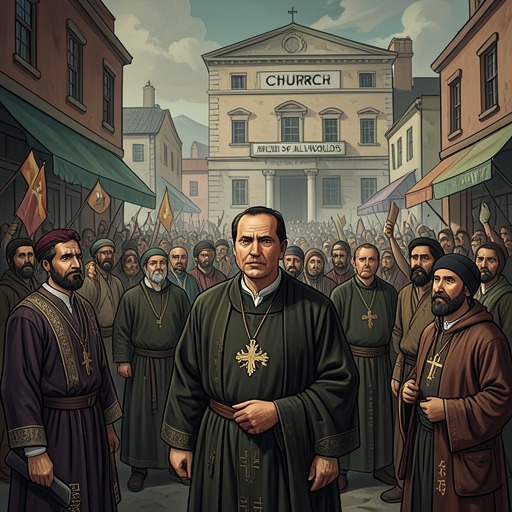
Stranger in a Strange LandThe Church of All Worlds Temple is the changing home of Mike’s congregation and the setting where its private rites become a lived community. Its Innermost Temple—a circular, sparsely furnished room centered on a pool—serves as the place where new brothers are received into the Nest. Here, water-sharing is more than ceremony: it binds participants through trust, mutual responsibility, and a promised permanence. The Temple’s destruction by fire later tests whether that community depends on a building or can survive through the people who have learned to belong to one another.
A House Organized Around Ritual
The Temple’s rooms accommodate both the practical and sacred work of the congregation. Patricia Paiwonski shows Ben Caxton a large, circular room with a soft floor and a pool at its center, identifying it as the Innermost Temple, where new brothers enter the Nest. The invitation to share water is also an invitation to enter a relationship; Ben declines for the moment, and Patricia accepts his hesitation with the community’s maxim, “Waiting is.” The room therefore marks a threshold, but not one newcomers must cross before they are ready.
The central pool gives a physical form to the church’s recurring language of water, trust, and growing closer. When Patricia herself is invited to share water with Mike and Jill, they explicitly tell her that the bond means mutual trust, openness, and partnership “now and forever,” while emphasizing that she must not accept if doing so conflicts with her faith or her own wishes. She chooses to take part. The scene makes consent integral to the rite: the Temple’s promise of lasting kinship is offered seriously, but it is not imposed.
The Temple is also a working religious center with distinct spaces and repeated activities. Its Seventh Temple holds circle services, while the Innermost Temple is associated with receiving members into the Nest. During a ceremony advancing candidates to the Eighth Circle, Mike and Jill lead the rites, and the congregation makes room for participants to continue into the next stage without interruption. The scene joins formal progression to communal care: the rite matters enough that visitors are taken around the long way so the candidates can leave and continue in the Temple of the Eighth Circle without Mike having to restore the atmosphere of the service.
From Initiation to Belonging
The Temple’s ceremonies give its members a route from study and preparation into fuller participation. Mike may recognize readiness unusually early: Sam and Ruth, for example, were offered water when they had only just entered the Third Circle. Such an exception is associated particularly with Mike’s judgment; Dawn and Patricia may sometimes identify people for special advancement and training, but the account says they generally consult him. The sequence nevertheless remains a process rather than a single admission. The Eighth Circle involves beginning to share and grow closer, while the Ninth Circle and the Nest are joined through a formal Sharing Water service, usually welcoming a couple as permanent members.
For Sam and Ruth, that progression is recalled as difficult as well as welcoming. Ruth describes learning the language and advancing through the inner circles while struggling to discipline herself and fearing the final act of joining a larger group. At the Innermost Temple, a spotlight falls on her, the pair’s robes disappear, and they enter the pool among people calling them to share the water of life. Her account ends not with the anxiety of arrival but with her sense of having entered a belonging from which she does not wish to emerge. The pool thus marks a social transformation: hesitation gives way to a commitment experienced as home.
The Temple’s life is sustained by labor as well as ceremony. Mike may go more than twenty-four hours without eating while leading a crowded day of circle transitions, then eat heavily once he is no longer needed. Jill and Dawn also become tired, and the congregation attends to practical necessities such as replacing the vanishing robes used in the Seventh Temple. These details keep its sacred space from becoming abstract: rites require time, food, clothing, attention, and people willing to serve one another.
Destruction and Dispersal
The Temple becomes a target after authorities arrest eight members of the Ninth Circle on John Doe warrants. During the arrests, Mike arranges bail for the others but remains in jail. The building is empty when an incendiary attack sets it alight with gasoline and dynamite; the fire follows an explosion and causes millions of dollars in property damage. No one is injured or scorched. The community had already accumulated enough experiences at the site that Mike planned to abandon it, but that planned departure does not make the attack inconsequential: the congregation loses a substantial center and its possessions, even as it escapes with its members safe.
Those inside the building at the time are gathered in the Innermost Temple for a special Sharing Water in Mike’s honor. The congregation is cut off by the fire and shifts to an emergency Nest. Members later explain that Mike had prepared for the possibility of flight: nearly two weeks earlier, he moved most parents and children to other cities, leaving Maryam and her baby behind because she was needed for her work. When the crisis came, only about a dozen people required immediate relocation. The group loses items such as language tapes and a typing device, but Mike secures clothes and cash; the physical losses are real, yet the preparation prevents the Temple’s destruction from becoming a mass casualty event.
Mike’s absence from the burning building is a point of uncertainty for Jubal Harshaw, who knows he is in jail and cannot understand how he could have acted there. The account of the Temple’s fall thus carries two simultaneous facts: Mike is still imprisoned, and the congregation has somehow managed to escape with essential supplies. The building’s vulnerability contrasts with the organization’s prior planning and with its members’ ability to regroup beyond its walls.
A Movable Congregation
After the fire, the Temple is described as finished and the local organization as broken up. The congregation will not tell Jubal where its members are, nor does it pretend that he can rescue the institution by coming to the ruins; if he travels to them, they will find him. The physical center is gone, and the group is through in that town, but its communication, mutual recognition, and shared commitments remain active.
Sam frames the Temple’s closure as one stage in a broader pattern of founding, moving, and beginning again. If the Church of All Worlds is shut down, the congregation can reopen elsewhere under another name, including the One Faith, the Temple of the Great Pyramid, or the Brotherhood of Baptism. Each new location and public identity may attract opposition, but repeated relocation also gathers a disciplined core and brings other pilgrims into contact with the community. The Temple therefore matters as both a concrete sanctuary and a temporary form: its rites establish durable ties, while its destruction exposes the difference between a religious institution’s address and the congregation that can carry its practices onward.