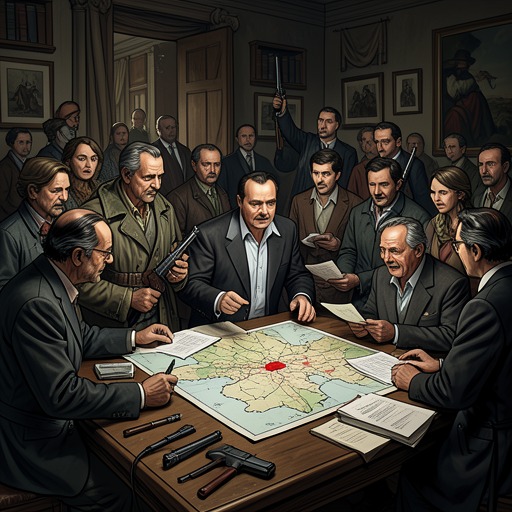
Foster
Stranger in a Strange LandFoster, founder of the Church of the New Revelation, is both a powerful religious organizer and the source of the movement’s central ambiguity: his followers promise salvation and happiness, while their institution depends on hierarchy, selective admission, and forceful defense. His charisma gives the church its public reach, but the planned deaths associated with its promise of ascension leave open the possibility that its language of going to Heaven conceals murder. At the novel’s end, Foster departs on a long assignment and places Mike in charge of his work, passing the organization’s authority to a figure whose own teaching has taken a different path.
Identity and Religious Authority
Foster’s authority is presented as inseparable from his ability to read and exploit the religious climate of his time. In a culture described as publicly restrictive but privately fascinated by sex, with established religions tending toward restraint and revivals toward emotional excess, he built a movement that turned that division into an opportunity. He had a magnetic personality, and opponents often called him a hypnotist; the account also emphasizes that he was not celibate, unlike some prominent religious leaders. His leadership thus joined personal attraction to a distinctly embodied challenge to conventional religious respectability.
Foster’s claim to religious authority was deliberately flexible in its origin. He was self-ordained, or directly ordained by God, depending on whose account was accepted. That uncertainty suits a movement whose authority rests less on a publicly verifiable chain of office than on the founder’s conviction, performance, and the loyalty he inspires. Jubal, although intellectually willing to consider religions on equal terms, finds the Fosterites’ claim to direct access to Heaven especially objectionable: their certainty is accompanied by intolerance and persecution of rival faiths. Yet he cannot prove them wrong, and his grudging recognition of that possibility underscores the novel’s refusal to make religious truth easy to settle.
Building the Church
Foster did not begin with a fully formed institution. After being driven out of towns more than once, he refined both his methods and his organization until the movement could expand. He borrowed organizational techniques from Freemasonry, Catholicism, the Communist Party, and Madison Avenue, as well as ideas from earlier scriptures, then presented the result as a return to primitive Christianity. The eclectic construction of the church is part of its effectiveness: familiar forms lend it legitimacy, while its carefully managed spectacle gives it a distinctive appeal.
The church offered an outer level where anyone could attend and remain a seeker for years while receiving some benefits. Beyond it stood the middle church, the visible body of saved members who paid tithes, participated in the organization’s growing business connections, and shared in its exuberant culture of happiness. The public message did not explicitly encourage adultery; instead, it treated sexual conduct in mystical terms. Behind the overt church was an unnamed Inner Church, made up of priests, lay leaders, record keepers, and policy makers. Its members were regarded as reborn and beyond sin, and only they were candidates for direct admission to Heaven. The tiers turned religious commitment into a graded system of belonging, with each advancement promising a deeper privilege.
Foster selected the inner membership personally until the operation grew too large. He sought dynamic, convinced people who could be freed from jealousy, and he required married candidates to apply with their spouses. He also insisted that men equal or outnumber women. The account connects these rules to a practical awareness of how possessiveness and jealousy had contributed to the failure and violence of comparable movements. Foster’s arrangements were therefore not merely doctrinal: they were an organizational answer to a danger he believed could break the group from within.
Methods, Miracles, and Conflict
The church’s public practices combined emotional spectacle with controlled access to its inner life. At meetings Mike performed apparent miracles, including sleight-of-hand, while presenting the wonders as a reason for seekers to enter the church’s circles and undertake further training. Patty explains that the meetings also served to assess the audience: Mike identified possible candidates, while the organizers managed seating and decided whom to advance. Foster’s established movement and Mike’s later church are not identical, but this scene shows how the earlier model of charismatic display and selective recruitment can reappear in the new institution.
Foster’s organization also used its members as a force against attempts to suppress it. When a community opposed a developing Fosterite movement, members from elsewhere converged on it in numbers, overwhelming local capacity and damaging the institutions enforcing the suppression. Later prosecutions were difficult to sustain: the church framed them as persecution under the law, and no conviction of a Fosterite as such was upheld by the national Supreme Court or, later, the High Court. The church’s survival thus depended on a combination of mass mobilization, legal positioning, and the state’s difficulty in distinguishing religious organization from unlawful conduct.
The promised ascent to Heaven carries the sharpest uncertainty. Foster himself was the first to die publicly at a time he had predicted. After that, a scheduled ascent became a mark of special grace among Fosterites. Yet Jubal suspects that the practice may amount to murder, while acknowledging that this has not been proved and has rarely been publicly alleged. Coroners and prosecutors had long been reluctant to investigate such deaths. The gap between the public account of voluntary passage and Jubal’s suspicion is never resolved into a demonstrated charge; it remains a consequential doubt at the heart of Foster’s legacy.
Succession and Significance
Foster’s influence persists beyond his own appearances. Patty, a member of Mike’s Church of All Worlds and a teacher of Martian language, explains that she and other leaders work to show Fosterites that the newer church need not conflict with their faith. Foster’s kiss remains a recognizable sign of standing among them, and Mike’s miraculous companion mark helps make the two traditions intelligible to potential recruits. The scene suggests not simple replacement but a negotiated relationship: adherents can carry their Fosterite identity into a separate spiritual organization.
The Church of All Worlds faces repeated closures and expulsions, but its members treat each new congregation as a stage in building a more disciplined core. Sam recounts a sequence of possible names and locations, from the Church of All Worlds to the One Faith, the Temple of the Great Pyramid, and the Brotherhood of Baptism; each setback, in his account, leaves them with trained members and reachable advanced pilgrims. He contrasts this position with Mike’s uncertain beginnings, when he had only three untrained priestesses-by-courtesy, and points to the solid Nest that has since formed. The parallel with Foster’s success is clear in the use of religious names, recruitment, and organization, but the scene presents the newer group’s endurance as gradual preparation rather than a claim that the two churches are the same.
In the final scene, Foster tells Digby that he will be away for a few eons and introduces Mike as the new supervisor. He describes Digby as a steady assistant who knows the studio, while Mike accepts the work and begins to consider changes. Their exchange of the greeting that each is God links the handover to Mike’s religious language, but Foster immediately dismisses the formality: everyone, he says, is God. His departure makes the succession explicit without suggesting that his work is finished or that the institutions he built have vanished. Foster leaves the stage, but the authority and machinery he assembled continue in the hands of the successor he has chosen.