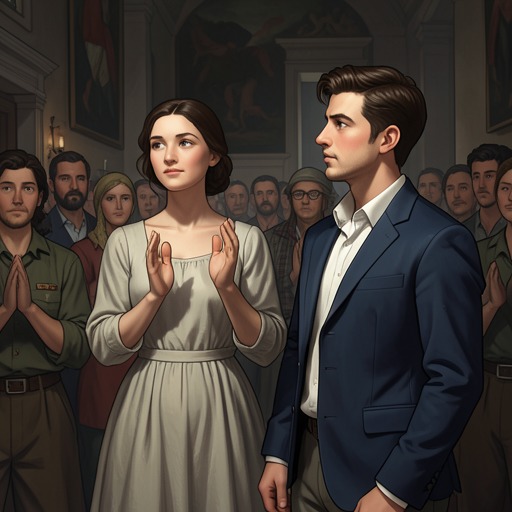
George Paiwonski
Stranger in a Strange LandGeorge Paiwonski is a tattoo artist and devoted Fosterite whose surviving place in the narrative is bound to a work of unusual scale: a religious biography of Reverend Foster inscribed across his wife Patricia’s already tattooed body. By adapting the images that were there before, George turned her skin into both a testament of faith and a record of the church’s history.
Identity and Background
Patricia was already a seeker when Reverend Foster preached in San Pedro. She persuaded George to attend several Sundays, but he had not yet accepted the faith. Foster’s preaching brought them both to conversion; when he returned six months later, the couple had made their confessions and were sufficiently devoted to receive his personal attention. George continued to drink, but Patricia described him as doing so in church and never to excess.
After George saw the holy light, he began what Patricia called his Great Project. The work was intended to record milestones in Foster’s earthly life, and the couple hoped to show it to their religious leader when he visited. Patricia’s account makes the project an expression of George’s conversion as well as an artistic undertaking: his new religious commitment took the form of painstaking work on the body of the person closest to him.
The Great Project
George did not begin with an untouched canvas. Patricia already had extensive tattoos, so he had to find and adapt available images rather than compose the sequence on bare skin. With effort and what Patricia characterized as inspired ingenuity, he transformed a tattoo of the attack on Pearl Harbor into an image of Armageddon, and a New York skyline into the Holy City. The old images remained physically present but acquired new religious meanings within the larger design.
The resulting scenes trace Foster’s life as a sacred chronology. Near Patricia’s chin appears his birth, surrounded by angels; another image depicts his first miracle, when he heals a bird that a schoolboy has shot. The scenes continue around her body: Foster preaching on the steps of the theological seminary that rejected him, his arrest and the beginning of the Persecution, his destruction of idolatrous images, and his imprisonment beneath a holy light. The design even reaches around Patricia’s spine, requiring her to turn so that she can guide viewers through its sequence. Each event, she explains, is dated.
The project’s arrangement is necessarily discontinuous: George had to move from one available patch of skin to another, and Patricia says that the pictures jump as a result. That constraint gives the work its distinctive form. It is at once a personal tattoo composition, a material archive of Fosterite belief, and a narrative whose order must be reconstructed by looking across the body.
Marriage, Devotion, and Legacy
Patricia’s memories present George’s conversion as the foundation of their shared religious life. Once he had seen the light, she says, she never had trouble with him; his drinking continued, but within limits she accepted. His lasting devotional act was not merely to adopt Fosterism but to make its leader’s biography visible on his wife, incorporating the couple’s former, worldly imagery into a sacred account.
The work continued beyond George’s lifetime. In a later scene, Foster recognizes Patricia and notes that George has completed his great dedication since Foster last saw her. One scene portrays Foster being called up to Heaven; Foster judges the picture favorably and intends to find George and compliment him. He understands George to be working in the universe’s design section under the Architect. George’s artistic project thus becomes part of his remembered identity even after death, while Patricia remains its living surface and interpreter.
Narrative Significance
George is characterized indirectly, through the labor and design decisions that Patricia recounts and through Foster’s later recollection of the finished work. The account establishes him as a skilled, inventive believer without supplying an independent portrait of his life. His importance lies in the conversion of personal devotion into visible form: familiar images are repurposed, the body becomes a chronological record, and a private act of craftsmanship persists as evidence of the couple’s faith.