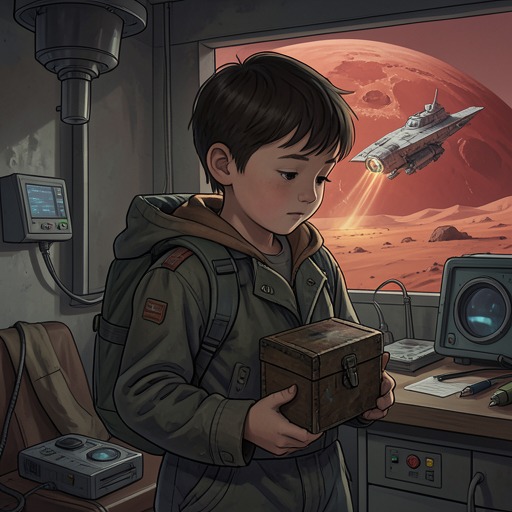
Institute for Social Studies
Stranger in a Strange LandThe Institute for Social Studies is commissioned to select the crew of the Envoy, a hazardous expedition whose success depends not only on technical skill but on whether eight people can live together for nearly three Terran years. Its work makes human compatibility a practical constraint on exploration: a crew can possess the required expertise and still be judged unfit to go.
Mandate and Selection Problem
The University of Edinburgh, the expedition’s prime contractor, subcontracts crew selection to the Institute. More than nine thousand remaining candidates have passed initial screening for age, health, mentality, training, and temperament, and each possesses at least one relevant specialty. The expectation is that the Institute will identify several suitable crews of four married couples.
That expectation proves unrealistic. The expedition needs sixteen kinds of expertise, including navigation, medicine, ship command, engineering, and the sciences. Since each person must bring multiple skills or acquire additional ones, the Institute searches for combinations that satisfy both technical and personal requirements. Hundreds of eight-person combinations meet the skill needs; only three consist of four married couples with the necessary health and intelligence, and group-dynamics evaluators reject all three on compatibility grounds.
Standards and Methods
When the prime contractor proposes lowering the compatibility threshold, the Institute refuses and offers to return its one-dollar fee. Its position treats psychological fit as integral to the mission rather than a convenience to be traded away when recruitment becomes difficult. The expedition’s isolation and duration make a technically qualified but unstable crew a serious operational risk.
Meanwhile, a computer programmer whose name is not recorded uses the machines to search for compatible three-couple crews. The resulting several dozen combinations each indicate what kind of additional couple would complete them. As deaths, withdrawals, and new volunteers change the candidate pool, the machines continue reviewing the data. This is not yet a final crew selection, but it turns an impossible search for four compatible couples into a set of evolving alternatives.
Role in the Envoy Expedition
Captain Michael Brant appears to have had access to someone at the Institute who could supply names of single female volunteers and test proposed pairings through the machines. That possibility is offered as an explanation for his journey to Australia and his marriage proposal to Doctor Winifred Coburn, a semantician whose specialty could help fill the expedition’s needs. The account also allows that Brant may have acted without inside information, relying instead on the audacity expected of an exploration commander.
The Institute’s computerized matching process ultimately forms part of the chain by which an Envoy crew is found. Its contribution is less a simple roster than a method for reconciling a demanding skills inventory with the social conditions of a long and dangerous voyage. The expedition’s fate gives that early deliberation added weight: the mission begins with the recognition that survival in space depends on people being able to function together, not merely on the ship and its equipment.