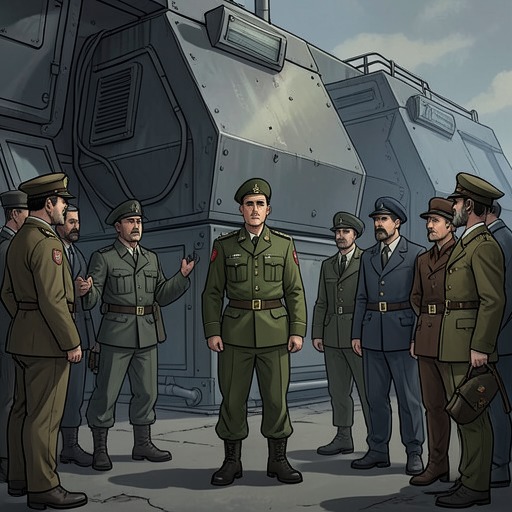
Jubal Harshaw
Stranger in a Strange LandJubal Harshaw is a physician, lawyer, writer, and celebrated individualist whose home becomes a refuge and school for Valentine Michael Smith. He meets force with tactical audacity, using reputation and legal ingenuity to defend Smith against confinement and political appropriation. Yet his importance is not only that of a protector: he pushes Smith toward an independent life, then discovers that the lessons and institutional ideas he supplied have helped shape a movement he finds both embarrassing and consequential.
Identity and Character
Jubal is known widely enough that, as Ben Caxton observes, his name itself makes him difficult to push around. His professional standing adds leverage: he is both a doctor of medicine and a lawyer. More decisive still is his reputation as a rugged individualist, the kind of man who would oppose the Federation Department of Security rather than yield to it. Caxton knows him from the disaffection trials and trusts him as a friend in a crisis.
That reputation is not mere bluster. Jubal treats confidence as a practical instrument, particularly when the facts are uncertain. He says that medicine taught him to appear confident when at a loss, while law taught him to impress a jury with relaxed certainty when a case seems hopeless. His self-description is backed by a history of improvisation: once, in a school debate, he won an argument by citing a British Colonial Shipping Board that did not exist. The anecdote anticipates his later diplomatic bluff on Smith’s behalf, where performance and legal protocol become tools for changing the balance of power.
Jubal’s household is a working community rather than a solitary retreat. Its members take part in the practical response to danger, and its informality helps create an atmosphere in which visitors can relax. He can be wry and irreverent, but his humor coexists with sustained attention to the people under his care. His later insistence that Smith must not remain an arrested infant makes clear that hospitality, for Jubal, cannot mean keeping someone dependent forever.
Shelter, Advocacy, and Political Strategy
When Caxton considers nursing Smith in his own flat, he rejects the plan as too vulnerable to a renewed legal intervention and arrest. He proposes instead that Smith be taken to Jubal’s home in the Poconos. Jubal’s public prominence, his legal and medical expertise, and his willingness to fight make him a harder target; Caxton also expects his own newspaper column and Jubal’s appetite for a fight to make renewed concealment difficult. The plan puts Jubal’s reputation and home directly into the struggle over Smith’s freedom.
That protective role becomes formal when Jubal confronts Joseph Douglas. He introduces himself as Smith’s attorney with full authority and suggests that he may be treated, in the spirit of the Larkin Decision, as a de facto ambassador from Mars. The claim shifts the conversation from the government’s control over an isolated captive to the standing of a client represented by counsel. At a later public meeting, Jubal also refuses to let an official exclude Dr. Mahmoud from Smith’s company, and takes over the seating chart himself: Smith is placed opposite Douglas, while Jubal claims the entire half of the main table for Smith’s side. The pencil marks turn a dispute over protocol into a visible assertion of standing.
Jubal’s most consequential maneuver follows the diplomatic meeting. He admits that he did not know the true situation on Mars when he began, beyond knowing that the government wanted Smith’s so-called Larkin rights. He inferred that the administration was also uncertain and exploited its fear that Smith might negotiate with Kung or another rival. By pushing the government to honor Smith publicly according to its own legal theory, Jubal helped secure unmistakable sovereign treatment for Smith.
The maneuver remains a bluff, not a discovery that the Larkin precedent truly governs an inhabited planet. Jubal explains that Smith’s new status could leave him exposed to demands for concessions and territorial rights, or permit those rights to devolve on the twenty-three men already on Mars, including Douglas. Jubal rejects both possibilities because they depend on applying the Larkin Decision to a planet with inhabitants. He therefore invents a legal theory in which Smith is not a human-law claimant but the ambassador of a Martian nation. The water brothers present with Smith do not challenge the claim, lending it social force; the government’s public honors have already become a fact the world has witnessed. Jubal risks the bluff because Douglas and Kung may be no more certain of the facts than he is.
After the negotiations, Jubal keeps his party away from the Palace while they await Douglas’s answer. At home, they can refuse to bargain under pressure. He explains that Douglas would prefer an irrevocable power of attorney, whereas Jubal has kept the arrangement conditional, with authority able to revert to Caxton. He also suspects Kung and other officials may try to propose a competing deal. His caution extends to food: he orders that nothing brought by a waiter be eaten, reasoning that political opponents know where they are and may have had time to act. His fear is not simply of an immediate attack; he says his principal concern is keeping Smith alive until his extraordinary power can be made stable enough that killing him would benefit no one.
Mentorship and Family
Jubal’s care for Smith includes the intention to send him away. When Jill worries that Smith does not want to go out into the world, Jubal says he will push him from the nest once he thinks Smith can manage it, while allowing him to return. He refuses to turn his home into a sterile laboratory or to preserve Smith in permanent innocence. Smith must learn how society works, including conduct Jubal considers objectionable, and make his own choices among the possibilities opened by his notoriety. The point is not to approve every choice in advance but to prepare Smith to live beyond the shelter that made his recovery possible.
The idea of a nest also defines the limits of Jubal’s protection. He recognizes that he may die long before Smith, and that the household itself will not last indefinitely. Keeping Smith there for life would therefore be neither practical nor kind. Jubal’s protectiveness is most substantial when it becomes a form of preparation: he wants Smith to acquire judgment and independence, not merely remain safe under another person’s authority.
Their relationship eventually becomes explicitly filial. When Smith and Jill prepare to leave, Jubal tells them that his home remains theirs and that they can return to share water. Smith answers that he has come to understand Jubal as his father, and Jill’s father as well, despite the absence of a Martian word for father. Jubal accepts the recognition, and Smith leaves with Jill. Their parting does not cancel the bond; it confirms that Smith can leave without losing his place in the family.
Jubal’s relationship with Caxton is another strand of that family-like circle. Caxton is the trusted friend who first directs Smith toward Jubal’s protection, but the two men do not always agree about what Jubal’s influence means. Caxton warns that many people imagine Jubal to be maintaining a grand harem and regard him as a lecherous old man, even while envying him. Jubal answers that the subject deserves respect rather than flippancy. The exchange exposes a gap between Jubal’s public reputation and the seriousness with which he treats his private life, without settling the matter into a simple defense or accusation.
Religion and the Movement Smith Builds
Jubal’s skepticism is tested when Smith takes Fosterite claims literally. Smith believes the Fosterites may be able to ask humanity’s supposed Old Ones for answers. Jubal realizes, to his disgust, that he has promised an interview with a Fosterite representative. He tries to explain that human religions make different claims to contact with Old Ones, but Smith cannot readily grasp deliberate falsehood: in Smith’s understanding, one speaks wrongly through accident or misunderstanding, while the Old Ones always speak rightly. Jubal’s frustration marks a limit to explanation. Smith’s difficulty is not a lack of words but a different framework for interpreting what a lie is.
Jubal nevertheless takes Smith to an Archangel Foster Tabernacle, warning him that the Fosterites want both his money and the prestige of gaining the Man from Mars as a member. The episode places Jubal’s practical suspicion beside Smith’s open attentiveness. The narrative’s account of Fosterism helps explain the institution Jubal is warning against: an outer church offers seekers access and benefits; a prosperous middle church combines tithes, business connections, and a public culture of Happiness; an undisclosed inner church reserves policy, priestly authority, and its mysteries for a carefully selected core. Foster’s organization draws on several established institutional models and protects itself by turning suppression into public persecution.
Jubal’s misgivings later become more personal when Smith founds the Church of All Worlds. He is horrified by Smith’s grand clerical titles and by the honorary degrees attached to them, and dislikes the prospect of Smith turning into a religious leader who interferes in other people’s souls. The discovery that Smith got the idea from something Jubal himself had said about what a church could do offers little comfort. Jubal concedes that he might have supplied the thought, while also recognizing Smith’s legal intelligence and ability to reach the same conclusion independently.
Yet the new church also carries traces of Jubal’s own habits of analysis. Smith’s meetings combine a public performance with a selective process of assessing who may be ready for deeper study. He uses practiced showmanship, including sleight of hand learned during his time with a carnival, but the spectacle is not the whole method: prospective members are observed, and admission proceeds through nine circles, with each stage disclosed only when a candidate is ready. Patty describes the performance as a way to engage the crowd while Smith evaluates its members. The organization grows through teaching, initiation, and careful progression rather than through a single public claim of revelation.
Jubal’s later account of the church’s expanding community is less dismissive than his first reaction. Nearly twenty people are involved, including novices who have not yet learned to think in Martian or been ordained. Patty teaches beginner classes in Martian and helps newer members; Dawn and Jill serve as High Priestesses. Patty and Dawn also use their standing as Fosterites to show that joining Smith’s church need not require abandoning the New Revelation, just as membership in one institution need not exclude membership in another. The narrative thus contrasts Foster’s established structure with the developing circles of Smith’s church, while showing Jubal’s household and associates helping sustain the latter.
Later Judgment and Narrative Role
Jubal watches Smith’s public life with mixed amusement and concern. He is not troubled when Smith is driven from a theological seminary, nor when Smith enlists under an assumed name in the Federation armed forces. He regards the first experience as education and believes that the military will not permanently harm Smith. He is less approving of Smith’s practical jokes: during a parade, the commanding general and staff lose their trousers, while the company’s top sergeant falls when his shoes briefly stick to the ground. Jubal calls the jokes atrocious but treats them as part of Smith’s delayed boyhood and his acquisition of a sense of humor.
The church’s growth, by contrast, weighs on him more seriously. Jubal has treasured Smith and Jill’s visits and taken an interest in Smith’s development, especially after Smith begins to show humor. He is troubled that news about Smith has become depressing, and sees the founder and pastor of the Church of All Worlds as a major departure from the young man he helped shelter. His response is characteristic: he can mock institutional pretension while still confronting the consequences of his own influence and Smith’s independent choices.
The final account of the movement’s strategy emphasizes endurance rather than a decisive victory. Sam proposes closing the Church of All Worlds when trouble grows, then reopening under other names and in other places. Each new congregation can be driven out, but each also leaves behind a disciplined core and advanced members who may rejoin later. Smith began with only three untrained priestesses-by-courtesy; now, the account says, there is a solid Nest and a wider circle of pilgrims. Jubal allows that the plan could work, comparing the movement’s small beginnings to the early following of Jesus. The comparison gives his earlier anxiety a broader frame: the church he dislikes has become an organization capable of surviving persecution, in part through the patience, legal intelligence, and institutional thinking that have long defined Jubal himself.