Martian Non-Ownership
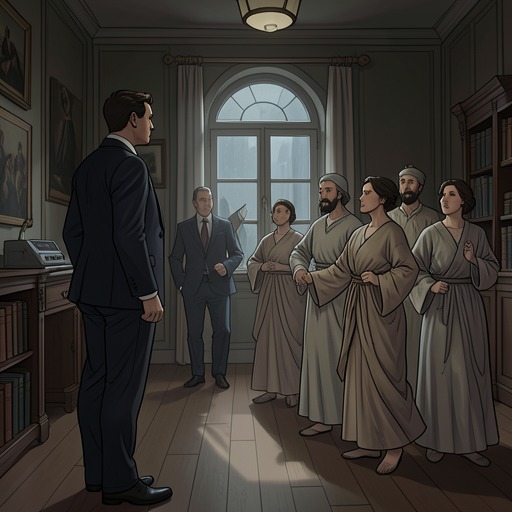
Stranger in a Strange LandMartian Non-Ownership is the Martians’ refusal to treat property as a natural, self-evident relation between a person and a thing. As Jubal Harshaw explains it, the principle reaches beyond wealth and possessions: Martians do not own anything, “not even their own bodies.” Its force in the story lies in the collision between that outlook and Earth’s legal system, which makes Valentine Michael Smith heir to vast assets while leaving him unable to recognize them as his to control.
Definition and Contrast
Harshaw presents ownership not as an obvious fact but as a sophisticated abstraction, a “mystical relationship” made more intricate by legal theory. Learning the Martian perspective has made him see that the human sense of property is culturally contingent rather than inevitable. The contrast is not simply between an advanced civilization and a primitive one: Harshaw acknowledges that animals can behave as though they recognize territory, with a watch dog particularly alert to the distinction between what is “mine” and what is “yours.” Yet he argues that Martians do not organize their understanding of the world around that distinction.
The exception Harshaw entertains is collective possession by the Old Ones. If the dead elders’ relation to everything were called property, he suggests, it would be an undistributed joint ownership held by millions or billions of them. This is a deliberately destabilizing comparison: what looks, from a human viewpoint, like unclaimed wealth may already belong to a community whose members remain authoritative after death. Smith’s deference to the Old Ones therefore follows the Martian framework rather than a human calculation about inheritance.
Smith’s Inheritance and Its Paradox
The doctrine becomes consequential because Smith is not merely an observer of Martian custom. He is the indisputable heir to immense wealth, including more than a million shares of Lunar Enterprises, the Lyle Drive, and assorted chattels and securities. Harshaw says the ownership problem is intensified by the fact that the original owners are dead: Smith understands them as Old Ones and would not intrude on their affairs. Human law assigns the assets to him; his Martian understanding makes treating them as his own seem unwarranted.
The toothbrush Harshaw gave Smith makes that conflict concrete at the smallest scale. Harshaw says that it is the only thing Smith currently owns, and even that Smith does not know it is his. If someone took it, Smith would neither object nor mention the loss; he would assume that the Old Ones had authorized the change. The example shows that Smith’s difficulty is not simply ignorance of legal vocabulary. He can recite property law verbatim, yet the concept does not carry the ordinary force that would let him claim, defend, or administer possessions.
Legal Capacity and Political Risk
To Harshaw, that gap makes Smith legally incompetent to manage property, despite his intellectual ability to state the law. The problem is institutional as well as personal: a formal competency examination could bring the wealth and Smith’s disputed political standing under official scrutiny. Harshaw warns that a guardian might be appointed, potentially placing Smith’s life or liberty at risk. The prospect of a protected but confined existence recalls how difficult escape could be even from Bethesda Medical Center.
Harshaw therefore refuses to allow Smith’s competency to be tested or even discussed. The danger is not that Smith will misuse property in the familiar sense, but that human institutions will interpret his inability to perform ownership as incapacity and use that judgment to take control of him. Martian Non-Ownership turns a philosophical difference into a point of vulnerability within Earth’s legal order.
The Attempt to Dispose of Power
Harshaw describes Smith’s nominal power as too dangerous and cumbersome for Smith to handle, and proposes throwing it away. But transferring the wealth is not a simple solution. Giving it away would itself be an exercise of the very authority Smith does not understand; it would alter the balance of power and could trigger an immediate competency examination. The inheritance is thus a trap: Smith cannot comfortably exercise control over it, but exercising control in order to relinquish it could invite others to seize control of him.
Harshaw’s image of letting the tiger run while holding tightly to its ears captures the strategy he must devise. He plans to present Joseph E. Douglas with a fait accompli that Douglas will prefer not to obstruct, asking Ben Caxton to test the proposal’s political feasibility rather than its legal drafting. The passage frames Martian Non-Ownership as more than an exotic belief: it exposes how property can operate as power even when its supposed owner rejects the underlying idea. The immediate answer is not to make Smith believe in ownership, but to maneuver around the consequences of a system that assumes he does.