Martian conceptual framework
Stranger in a Strange LandThe Martian conceptual framework is the inherited system of thought through which Mike makes sense of experience, and the novel presents it as more than a collection of alien customs. It determines how he understands time, language, knowledge, and the boundaries between religion, philosophy, and science. His encounters with humans expose not only what he does not yet understand, but also the assumptions built into human speech and social life.
Foundations and Language
Mike’s thoughts do not begin in English. Although he has freshly learned to speak it, he uses it laboriously, translating each symbol as if consulting a codebook. His underlying thoughts remain Martian abstractions formed by an alien culture, so some of them cannot be carried into human language at all. The gap is not just vocabulary: English phrases can suggest distinctions or assumptions that have no Martian equivalent.
His early conversation with Doctor Archer Frame shows how that gap affects ordinary social exchange. Mike turns the greeting and question over carefully: one phrase sounds like a formal expression that may be repeated without requiring an answer, while the question has several possible meanings depending on who says it. Even after he has learned the words, their social function remains uncertain. He feels dismay at the difficulty of communicating, but keeps his body calm and risks the brief response that he feels good.
The episode also reverses the usual hierarchy between speaker and learner. Mike’s difficulty does not make English self-explanatory; instead, it reveals how much human conversation depends on conventions that speakers do not normally notice. A fluent phrase may carry a social expectation that its literal wording fails to explain.
Time and Waiting
The Martian attitude toward time makes waiting a substantive part of the framework. A Martian who needs a period of contemplation simply takes it; a friend who wants to speak waits as long as necessary. Hurry is not merely discouraged but has no symbolic counterpart in the Martian language and is presumed to be unthinkable. Mathematical ideas such as speed, acceleration, and simultaneity exist, but do not produce the emotional urgency that governs human daily life.
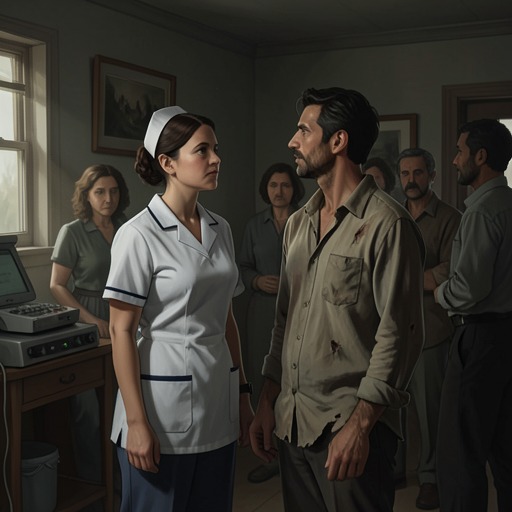
Mike’s own waiting makes this difference visible in the hospital. He is content to remain still because a water brother has promised to return, and he is prepared to wait for years if necessary. The duration is difficult to measure from his perspective: the unfamiliar place distorts sequences of experience, and his nest’s sense of time differs from the human one. The difference is not explained by the Martians’ longer lifespans, but by a fundamentally different attitude toward time.
Human sayings about lateness and haste therefore do not translate cleanly. The thought expressed by “It is later than you think” is inconceivable in Martian, while the warning against haste expresses something so basic that it need not be stated. Conversely, a human formula about the beginning, present, and eternity is close to the Martian sense of time and translates more readily than a simple mathematical truism. The comparison shows that translation depends on shared assumptions, not just equivalent words.
This patience contrasts with human urgency, which the narrative connects to human sexual bipolarity and the restless pressure of human existence. Jubal Harshaw has deliberately tried to remove hurry from his own life, but knows that he has little time and does not share the Martians’ confidence in immortality. His wish to inhabit each moment as if it were eternity draws a pointed contrast with a culture for which there is no reason to hurry.
Learning, Authority, and Human Categories
Mike approaches knowledge through what he has learned from the Martian Old Ones. He can recall information without understanding it, and he treats learning as material to be considered later rather than as something that must immediately be classified or tested. When asked about the television service he has watched, he accurately remembers its words and actions, including the commercials. He has also read encyclopedic entries on religion and several traditions, yet has grokked none of them.
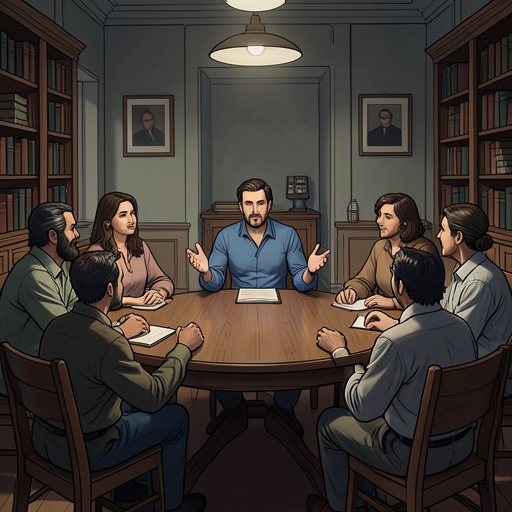
Jubal’s questioning brings the limits of this knowledge into focus. Mike can quote all nine dictionary definitions of religion, but he has only a confused notion of what the word means. He does not recognize the Fosterite service as religious, and the ceremonies Jubal has described to others as Martian religious practices are, to Mike, ordinary facts of life. The mismatch is not solved by adding definitions, because the Martian language offers no concept that he can equate with those definitions.
More broadly, Mike cannot yet separate the human concepts of religion, philosophy, and science. In Martian they do not form distinct ideas; they belong among the learnings received from the Old Ones. Doubt and research are likewise absent from his conceptual vocabulary. Within his experience, the Old Ones are omniscient and infallible, whether the subject is the weather or the purpose of the universe. He even assumes that human forecasts and reference works carry the authority of human Old Ones, an assumption that reveals how readily he fits unfamiliar institutions into the structure he already knows.
Jubal’s discussion of ultimate questions makes the underlying difference still clearer. When asked how the Old Ones explain the world’s origin, Mike says he does not grok that these are questions. His attempted explanation resists ordinary human ideas of making or putting things into existence; he describes the world as being, having been, and being now. The scene does not present a missing answer to a familiar question so much as a difference over whether the question itself makes sense.
Adaptation and Narrative Significance
The framework shapes Mike’s conduct as well as his explanations. Under severe physical strain after arriving in the human world, he regulates his breathing and heart rate, checks that they will continue without his attention, and withdraws inward to review the new events. He must fit these experiences to himself and then cherish them, lest they overwhelm him. This disciplined process shows that his adjustment is neither passive nor immediate: he actively works to incorporate experience using the practices available to him.
Humans around him interpret that difference through their own professional categories. Jubal judges that Mike would be called legally insane and medically psychopathic by normal standards, but regards those labels as irrelevant to the unusual circumstances of his upbringing and sudden displacement. He asks whether Mike, having adapted to an alien society as an infant, can make another radical adjustment as an adult. The question places cultural adaptation, rather than simple correction, at the center of Jubal’s concern.
That adjustment continues through relationships. Mike credits Mahmoud, Jubal, and many others with teaching him how people behave, but says Jill has taught him most of all. His comparison to a puppy raised apart from its own kind makes clear that he has not lacked intelligence; he has lacked the experience that would make human conduct familiar without conscious effort. When he later understands why people laugh, he describes the discovery as learning something Jill already understands automatically because she grew up among people. His human education is thus gradual and relational, while the Martian framework remains the ground from which he interprets it.
The novel also shows that communication can become more than the exchange of words. When Jill receives the stranger’s emotions through Mike, the circuit unexpectedly turns her attention back upon herself: she experiences how the stranger sees her, and Mike catches and steadies her when she falters. The moment extends the problem of translation beyond speech, presenting perception itself as something that can cross between people and alter what is understood. Across such episodes, the Martian framework makes human habits newly visible while requiring Mike to learn them without assuming that human categories are universal.