Martian discorporation
Stranger in a Strange LandMartian discorporation is the transition from bodily life to the state of a ghost, ordinarily chosen at an appropriate moment and understood through a communal Martian practice. It is not presented as an act of violence: a Martian considers death with friends, receives the consent of ancestral ghosts, and leaves the body behind when ready. The distinction between this deliberate completion and rare accidental discorporation reveals how differently Martians organize life, death, and social belonging from humans.
Definition and Martian Context
The Martian life cycle encompasses more than the contrast between living body and dead body. The nymphs learn to live, with eight of every nine dying in the process; those who survive their apprenticeship are gathered in, cared for, and eventually persuaded to leave childish life and become adults. Adult Martians, in turn, maintain the planet and guide this cycle. Against that long process of care and transformation, discorporation is described as a death that occurs at a selected instant, part of a life considered most properly a rounded whole.
The Martians' quiet adult existence and their rich life of the mind contrast with the nymphs' exuberance, but neither should be mistaken for human social organization. The novel describes Martian reproduction as an efficient bipolar pattern in which nymphs are female and adults male, yet emphasizes that it differs so radically from the human pattern that calling it sex would make sense only to a biologist. This difference matters to the larger account of discorporation: human assumptions about bodies, death, and religious ceremony do not provide a reliable translation of Martian experience.
Chosen Death and the Old Ones
In Jubal Harshaw's account to Duke, a Martian does not get seized and killed by another. Instead, a person decides to die after discussing the decision with friends and receiving their advice, as well as the consent of the ghosts of ancestors. The change is immediate: the Martian is alive and well, then becomes a ghost, with a body left behind. The account explicitly distinguishes this from murder, which Harshaw says he has found no evidence of as a Martian concept.
The body is then eaten by the deceased Martian's closest friends, who praise the person's virtues as they share the remains. The new ghost attends the feast. Harshaw interprets the rite as a bar mitzvah or confirmation: through it, the ghost attains the status of an Old One, an elder statesman. This is Harshaw's explanatory analogy for Duke, not evidence that the Martians themselves divide human ideas into religious and secular categories. Duke reacts with disgust, while Harshaw insists that the ceremony is solemn and joyful to Mike. The same practice can therefore appear repellent from a human standpoint and meaningful within the Martian framework Mike knows.
Accident and Artistic Creation
Deliberate, selected death is not the only route to discorporation. Unexpected discorporation is rare, because Martian custom favors life reaching a rounded whole and physical death occurring at the proper, chosen instant. An artist once became so absorbed in composing that he failed to come in from the cold. When his absence was noticed, his body was no longer fit to eat; the artist himself had not noticed his discorporation and continued composing.
The work was an intricate sequence of emotions, equally describable to humans as a poem, musical work, or philosophical treatise, though the narration stresses that human categories cannot adequately convey it. Its completion raised a question in Martian artistic judgment: living adults produce vigorous, often radical and primitive art, while the Old Ones' work is conservative, extremely complex, and held to higher technical standards. This work crossed that boundary. Its final form had been set by an Old One, even as its maker remained unaware that he had become discorporate and continued to work as if still bodily alive. The Old Ones discussed for centuries whether such a work constituted a new kind of art, and whether other artists might produce similar works through unexpected discorporation. The rare accident thus became a sustained matter of aesthetic inquiry, not simply a cautionary tale about death.
Human Translation and Mike's Understanding
Mike's account of Martian life does not map neatly onto human terms. He thinks in Martian even after becoming fluent in English, and Jubal realizes that Mike cannot separate religion, philosophy, and science as distinct concepts: Martian has no word or concept he can equate with those human categories. For Mike, such matters belong to learnings received from the Old Ones. What Jubal describes to Duke as religious ceremony is, to Mike, as ordinary as a grocery market is to Jubal.
That gap becomes consequential when Mike watches a Fosterite service. He understands it to announce the impending discorporation of two humans who are about to join the human Old Ones, and is excited at the prospect of meeting them and asking questions. Jubal is uncertain whether Mike has understood the announcement correctly, given his imperfect English, and recognizes that Mike is interpreting a human ceremony through the framework of Martian death and ancestral authority. His response shows that discorporation is not merely a custom he has learned to describe; it shapes what he expects death to mean and what kind of encounter he hopes it will permit.
Ritual, Trust, and Community
The book places the idea of discorporation alongside water-sharing, a rite that makes enduring mutual trust concrete. When Jill, Mike, and Patricia Paiwonski share water, Jill explains that the bond means the three can tell one another anything and remain partners forever. She warns that breaking it would require death, while also making clear that Patricia need not accept and can remain their friend. Mike reinforces the seriousness of the offer and tells Patricia not to drink if her faith or her heart gives her any reason to refuse. Patricia chooses to join, and each participant drinks in turn.
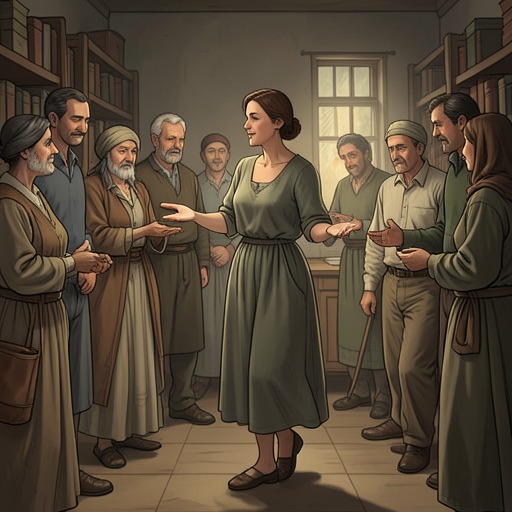
That scene does not make the water rite identical to discorporation. Rather, it demonstrates how Martian-derived social commitments bind people through explicit choice, shared participation, and lasting obligations. The Nest's Innermost Temple, a circular room with a pool at its center, is where new brothers are received. Patricia invites Ben Caxton to share water there or simply swim; when he declines for the moment, she accepts his hesitation with the response that waiting is. The room and its invitation show the community making space for a person who is not yet ready, rather than treating entry as automatic.
The same community distinguishes ordinary sharing from formal admission. Mike may identify someone as ready to share water early in the circle progression; Sam and Ruth, for example, received his offer when they had just entered the Third Circle, and later became a priest and priestess. Eighth Circle practice includes sharing and growing closer, while the Ninth Circle and the Nest mark a further incorporation, normally through a ceremony attended by the whole community. These rites are not accounts of death, but their language of transition and reception helps explain why death and the joining of ancestors can be described as a solemn communal passage rather than a private biological termination.
Significance and Limits of the Human View
Martian discorporation unsettles Duke because he measures the practice against human disgust at eating the dead and against the fear of being killed. Harshaw answers by separating the ritual from predation: the deceased chooses the time, friends advise, ancestral consent is sought, and the body is consumed only after the person has become a ghost. The contrast is not simply between one culture's manners and another's. It concerns the different meanings assigned to choice, the body, death, and membership among the living and the dead.
The novel also preserves limits on human understanding. Harshaw repeatedly presents his explanation as something he has pieced together from what Mike has told him; Mike is vague about time, while Jubal's comparisons to human rites are approximations. The accidental death of the artist further complicates any tidy account: Martians prefer a chosen ending, but an unexpected passage can occur and may generate consequences lasting centuries. Discorporation therefore joins biological change, social ritual, and an unresolved question about what a completed life—or work—can become beyond the body.