Mike's transition from nestling to adult selfhood
Stranger in a Strange LandMike's transition from nestling to adult selfhood is the moment he recognizes that guidance and intimacy cannot relieve him of choosing for himself. After the visit to the Archangel Foster Tabernacle, he withdraws into a trance to examine an action Jill had forbidden. He concludes that he chose rightly, accepts the consequences as his own, and emerges no longer a nestling: his new independence makes closer fellowship possible rather than ending it.
The Cusp and the Solitary Choice
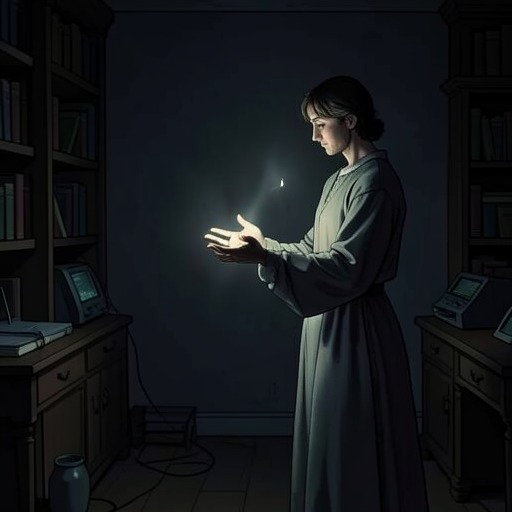
After returning home, Mike goes directly to his room, closes the door, curls into a fetal position, rolls his eyes upward, swallows his tongue, and slows his heart almost to nothing. Jill dislikes his withdrawing during the day, though she tolerates it in private; the trance is his way of making sense of what happened at the church and of an action he took despite her prohibition. The bodily stillness marks not a retreat from the decision but an effort to understand it.
Mike feels the human temptation to tell himself that circumstances forced the action and that he is not responsible. His Martian discipline leaves him no such escape. He understands that he had reached a cusp, a point at which action was required and the choice belonged to him. He decides he chose correctly, while also recognizing that Jill had forbidden the choice. To follow her instruction would not have made the decision disappear: at a cusp, choosing is unavoidable, and spirit grows through choice.
He tests the reasoning against an alternative, asking whether Jill would have approved if he had taken a different action that did not waste food. He realizes that her prohibition covered that possibility too. The conflict therefore cannot be resolved by finding a version of events that preserves both obedience and choice without consequence. Mike's adulthood begins in his acceptance that the cusp was his, not Jill's.
From Nestling to Self
The narration presents the decision as a completed stage of growth. Mike, formed from human genes and shaped by Martian thought, cannot be wholly one kind of being or the other; at this cusp, however, he ceases to be a nestling. With freedom comes the loneliness of an individual will that cannot delegate its responsibility. He also gains the Martian serenity to embrace that loneliness, cherish it, and accept the bitterness and consequences attached to his action.
The passage makes ownership the image of this responsibility. Mike's choice is not something another can sell, give away, or transfer; he and the action are inseparable. He eternally is what he did at the cusp. The emphasis is not merely on becoming independent of Jill, but on becoming answerable for an act that cannot be made someone else's by invoking love, advice, or authority.
That self-possession does not isolate him from his community. Once Mike knows himself as a self, he can move closer to his brothers and merge with them without losing integrity. He cherishes the fulfilled triads on Mars, whether their members remain embodied or have discorporated, and turns with renewed openness toward the few brothers he has on Earth and the further relationships still to come. Waiting has culminated not in separation from others, but in a more durable capacity to join them.
The Change Others See
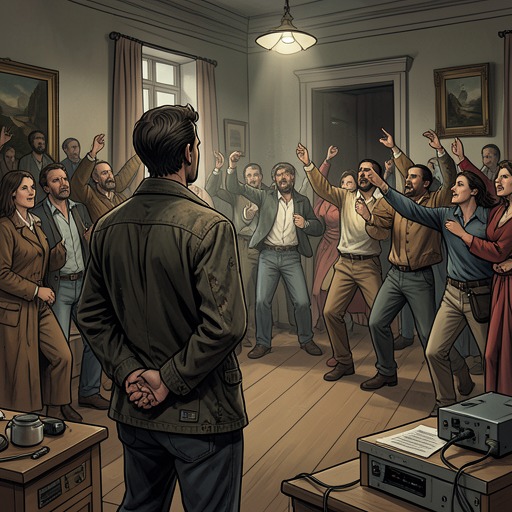
Mike remains in withdrawal for most of the week after the church visit, long enough that Jubal would have thought him dead without prior experience of the trance. The household feels the absence: the women repeatedly check whether Mike is all right, their attention unsettles their work, and even normally composed Anne becomes distracted and tearful. When Mike wakes late on Thursday, the household's shifting alliances settle into a united service around him. The change in him is private in origin but visible in the rhythms of the home.
Jubal notices that the formerly docile Mike now seems self-confident, though his politeness and consideration remain intact. Mike accepts the women's homage as if it were natural, appears older than his calendar age, and speaks with a deeper voice and a disciplined forcefulness that contrast with his former timidity. Jubal interprets this as Mike having joined the human race and considers him cured, while refusing to take credit for the change himself.
The transformation is not presented as the end of Mike's development. Jubal still observes that Mike does not laugh: he can smile at a joke and may no longer need it explained, but he remains cheerful without laughter. The distinction leaves one aspect of human understanding unfinished even as Mike's new confidence convinces Jubal that he is sane, healthy, and human. Selfhood is a threshold, not a claim that every difference has vanished.
Choice, Trust, and Initiation
Mike's later relationships show how decisiveness and trust work together in his conception of adulthood. When Jill explains the Martian water-sharing commitment to Patricia Paiwonski, Mike confirms that it is as serious as marriage and more, but urges Patricia not to accept if faith or conscience gives her any reason to refuse. Patricia chooses the bond for herself. Mike then provides the water through an act of telekinesis, passing the glass to Jill and then to Patricia. His insistence on consent echoes the lesson of the cusp: a bond is meaningful because a person chooses it, not because another person's authority makes refusal impossible.
The same emphasis on readiness shapes the Nest's initiation practices. The Innermost Temple is a circular room with a central pool, where newcomers are received into the community. Mike may judge that someone is ready to share water before that person reaches the Seventh Circle; he chose Sam and Ruth for the bond when they had only entered the Third Circle, and they later became priest and priestess. Others, including Dawn and Patricia, can sometimes identify candidates for special advancement, but Mike is described as the one able to be certain so early.
The ceremony moves participants from the Eighth Circle toward the Ninth and the Nest itself, where the whole community gathers to welcome the new brothers, usually a couple, as members for life. Sam and Ruth's account gives the transition a bodily and emotional form: after learning the language and struggling through the circles, they received water from Mike and Jill; later, frightened by the prospect of merging with seven others, they entered the Innermost Temple, shed their robes, and stepped into the pool as the Nest called them in Martian. Their initiation parallels Mike's maturation without making it identical: his decisive cusp is solitary, while their incorporation depends on a chosen communal rite.
Mike's adulthood thus joins two principles that might seem opposed. No brother, even Jill, can make his choice at the cusp for him; yet once he has accepted responsibility for his own action, he can share himself more fully. The Nest's rituals make belonging a commitment rather than an assumption, while Mike's own transformation shows that community cannot replace individual choice. Selfhood is the condition that allows intimacy to deepen without turning it into obedience or possession.