Senator Tom Boone
Stranger in a Strange LandSenator Tom Boone is both a political figure and a prominent Fosterite leader, introduced as a genial host who receives Mike, Jill, and Jubal at the temple. He welcomes Mike back, recognizes Jill from the Palace, and invites her to attend the seekers’ service, while directing Mike and Jubal toward the Sanctuary. Boone’s tour makes him more than a greeter: he explains how the church’s public spaces and rituals work, and his easy command of them exposes the close fit between religious performance, business, and political influence.
Identity and Introduction
Boone meets the arriving party on a landing flat on a Sabbath, greeting them warmly and addressing Mike and Jubal as familiar guests. He recognizes Jill as someone he had seen at the Palace, then asks whether she is saved. When she says she is not, he offers to have a Guardian guide her to the seekers’ service in the Outer Tabernacle. The exchange establishes Boone’s characteristic mixture of personal welcome and institutional sorting: Jill is invited in, but the church’s distinctions between seekers and those admitted farther inside remain clear.
Boone accommodates Mike’s wish for Jill to accompany him into the Sanctuary. He whistles for a young attendant dressed as a cherub and requests another pilgrim’s badge for the Sanctuary gate. The password is Mars. The attendant’s dramatic leap, assisted by a concealed jump harness, belongs to the temple’s atmosphere of orchestrated marvels. Boone treats the badge system as ordinary administration, explaining that access must be controlled because visitors might try to enter and experience the church’s pleasures without first undergoing its prescribed preparation.
The Temple as a Public Institution
While waiting for Jill’s badge, Boone leads the group through a large building and points out the slot machines lining a long hallway. He explains the economic design bluntly: every tourist must pass through the hall, and the bar and quick-lunch counter are at the far end, so visitors encounter the machines before they can get a drink. The church, he insists, does not take money without giving something in return. His account frames the temple as an institution in which religious hospitality and commercial solicitation are deliberately interwoven.
Boone’s role also connects the church’s local spectacle to public life. He is addressed as Bishop by church members, although he is introduced to the visitors as Senator Tom Boone. The two titles place him across political and religious arenas; he can welcome a public figure’s guests, direct a temple attendant, explain the institution’s revenue practices, and move comfortably among worshippers. The narrative does not reduce him to a single office: his authority is shown in the way he handles access, introductions, and the temple’s practical arrangements.
The Service and Its Performances
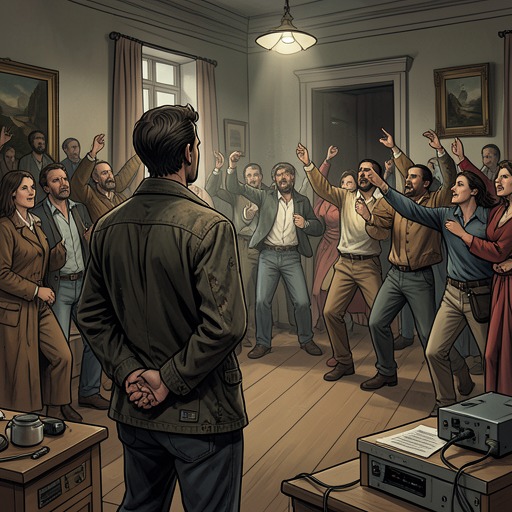
During the service, the crowd’s attention turns to Mike, who is acclaimed as the Man from Mars. Mike follows the proceedings without understanding the sermon, and the noise and excitement leave him confused. When the sermon ends, Boone takes charge of the visitors again, urging them to slip out ahead of the crowd. The maneuver shows his command of the temple’s movement and timing: he can guide the group away from the public gathering and toward a more private destination.
The contrast between the noisy service and Boone’s brisk transition is significant. The temple presents itself through collective enthusiasm, while Boone operates as a practiced intermediary who knows where guests should go next. He leads Mike, Jill, and Jubal through an arched tunnel. When Jubal assumes the route goes to the parking lot, Boone corrects him: they are going to see the Supreme Bishop first. Boone’s directions reveal an internal hierarchy behind the public carnival, with access to senior leadership arranged through trusted guides.
Fosterite Organization and Boone’s Context
The account of the New Revelation describes an outer church open to visitors, a middle church of saved members, and an undisclosed Inner Church composed of dedicated leaders and keepers of policy and records. Its public services, business connections, and lively revival atmosphere coexist with a more selective structure of initiation and authority. Boone’s work with visitors takes place at the boundary between those layers: he welcomes seekers, regulates entry, and escorts selected guests toward the Sanctuary and senior officials.
The church’s broader methods clarify the institutional setting in which Boone operates. Its founder, Foster, assembled organizational techniques from several traditions and built an outer church where seekers could remain for years while receiving benefits. The middle church supplied committed members and, when needed, organized direct action against attempts to suppress the movement. The Inner Church reserved its mysteries and leadership functions for a carefully selected core. Boone’s hospitality is therefore not merely personal charm: it serves a system that makes public access inviting while preserving controlled stages of admission.
Later Influence and Narrative Significance
Later, Patty describes the growing Church of All Worlds and explains that she, Dawn, and Jill work to show Fosterites that the newer church need not conflict with their faith. Foster’s kiss and Mike’s associated mark can prepare interested Fosterites to undertake the discipline of a higher circle. This later account does not establish Boone’s personal role in that outreach, but it places his temple within the larger religious world whose members encounter Mike’s movement and its organized paths of instruction.
Boone’s significance lies in the way his scenes make institutional power legible through ordinary acts of welcome and guidance. A badge, a hallway lined with machines, an invitation to a seekers’ service, and a route to the Supreme Bishop all belong to the same managed environment. His political title and his standing within the church are presented together, while his friendliness makes the temple’s layers of access feel hospitable rather than abstract. Through Boone, the novel shows how a mass religious organization can turn spectacle and warmth into an ordered system of entry, participation, and advancement.