Supreme Bishop Short
Stranger in a Strange LandSupreme Bishop Short is a Fosterite leader whose call for a holy war against Mike makes him a principal institutional opponent of the Church of All Worlds. Though he appears only through reports of his actions, his intervention connects religious rivalry to prosecution and intensifies the pressure on Mike’s growing movement.
Identity and Institutional Position
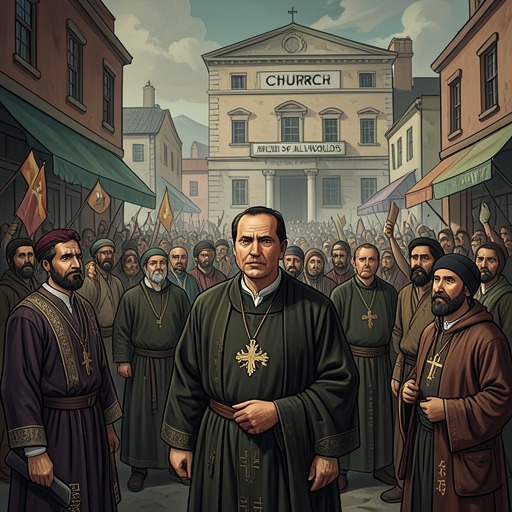
Short is identified as a Supreme Bishop within the Fosterite hierarchy. His title marks him as a figure with authority in an established religious organization, in contrast to Mike’s newer church, whose members are still building a disciplined community and teaching its practices. The narrative supplies little about Short’s personal history or character; it defines him through the public consequences of his authority.
The Fosterite organization operates within a culture shaped by a tension between restrictive public norms and strong private interest in sex. Its structure extends from an accessible outer church, through a prosperous middle church, to an undisclosed Inner Church of dedicated leaders and keepers of policy and records. That established hierarchy provides the institutional setting for Short’s intervention, although the evidence does not specify his precise place in the inner structure.
Holy War and Legal Pressure
Short’s campaign emerges amid a broader contest over religious legitimacy. A prosecutor in a southern resort city is approached by complainants seeking action against a pastor and associates. Their spokesman assures him that the effort will have backing because Short is determined to prevent the supposed Antichrist from flourishing. The prosecutor is less interested in theological claims than in the political advantage of a coming primary, but he agrees to proceed if support materializes. Short’s declaration thus has a practical effect: it helps turn a local complaint into a prosecution effort.
The conflict is not simply a disagreement over doctrine. The account describes Fosterite methods of expansion and defense: the church draws on varied organizational models, cultivates a public-facing congregation, and can mobilize members when authorities attempt suppression. Past prosecutions have often failed to secure lasting convictions, since Foster’s organization carefully framed such cases as persecution under the law. Against that background, Short’s determination to pursue Mike represents a renewed attempt to use legal pressure against a religious rival.
The Campaign Against Mike
Short publicly identifies Mike as the Antichrist and proclaims a holy war against him. When Jubal later travels south, a television insert shows Short making that declaration alongside images of a building reduced to ruins. The broadcast’s commentary presents the destruction through equivocal language, assigning apparent blame to the Man from Mars without explaining how the people involved survived. Short’s pronouncement consequently reaches the public not as an isolated sermon but as part of a charged media account of the conflict.
The declaration also coincides with Mike’s arrest on a sweeping set of accusations. As Dawn recounts the events to Jubal and Ben, she describes Mike’s response: he leaves the county jail after removing its barriers, does the same at a nearby state prison, and disarms city, county, and state police forces. Ben interprets these actions as an expression of Mike’s opposition to imprisonment, not as evidence of simple gentleness. Short’s denunciation and the arrests help frame the confrontation in which Mike answers institutional force with a challenge to confinement and authority.
Conflict and Narrative Significance
Short’s role is largely offstage, but his actions expose the machinery behind the public conflict. His religious charge gives the prosecution campaign a moral vocabulary; the prosecutor’s attention to political backing shows how that vocabulary can converge with ordinary electoral calculation. The novel therefore presents the holy war as both doctrinal denunciation and an exercise of institutional influence.
The campaign also sharpens the difference between the two religious organizations without making their organizational forms wholly unrelated. Mike’s Church of All Worlds is built through teaching, initiation, and successive circles of practice; Patty and Dawn work with Fosterites to show that membership in the new church need not conflict with their existing faith. Against this patient effort to accommodate and recruit, Short’s public call for war signals a more adversarial response. The later expectation that Mike’s followers may need to close one congregation, relocate, and reopen under another name shows how persecution threatens the church’s continuity, even as its leaders treat dispersal and rebuilding as steps toward a stronger community.