Valentine Michael Smith
Stranger in a Strange LandValentine Michael Smith, the Man from Mars, is at once a human being of Martian upbringing and, in the story’s opening formulation, a “race of one.” Found as the sole survivor of the Envoy expedition, he arrives on Earth without the cultural assumptions that make human society legible to its inhabitants. His decisive journey is not simply from Mars to Earth, but from dependence to self-authored choice: he learns to encounter humanity without surrendering the Martian discipline through which he understands it.
Identity and Background
Smith is introduced as a Martian named Smith, then identified by his full name, Valentine Michael Smith. The apparent contradiction is foundational: his ancestry is human, yet the people who raised him were the Martian Old Ones, and his habits of thought and feeling were formed in their world. One account of his difference insists that he is a man by ancestry but Martian by environment, and emphasizes that before meeting his rescuers he had never seen a human being. That account also describes his upbringing as isolated from human sexual and social customs; it reflects how others attempt to explain him, rather than making their categories an adequate description of his identity.
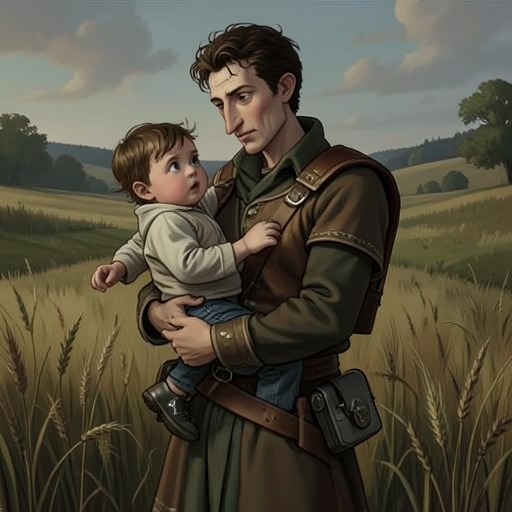
The lost expedition’s record reduces the discovery to a terse correction: one survivor of Envoy has been located. For Smith, however, survival is not the whole story. His Martian keeper and the keeper’s water brothers had educated him with unusual care, while the Old Ones took an interest in how much a human child could learn. His education was far beyond that of ordinary nestlings in some respects, yet far short of an adult’s in others. The result, the narrative observes, taught his Martian guardians about human potential even as Smith himself reached Earth without knowing the political crisis surrounding Mars.
Arrival and First Encounters
Smith’s first encounter with Jill Boardman becomes a moment of recognition across radically different conceptual worlds. He notices that she differs from the other visitors and compares her with pictures Dr. Nelson had shown him to explain a puzzling configuration among human beings. He identifies this person as a woman: a new category he can perceive, though not yet understand through ordinary human experience. The scene makes his unfamiliarity concrete. He is not merely an outsider to Earth’s customs; he has to learn the human map one encounter at a time.
When Smith reaches Jubal Harshaw’s home, his withdrawal leaves his body stiff and folded in the back of a car. Harshaw and Larry carry him out and lay him on the grass beside the pool; Dorcas brings out Harshaw’s stethoscope. Jill kneels beside him, gently straightens his limbs, and cradles his head. She identifies herself as his water brother and asks him to wake. Their established bond gives him a point of contact at a moment when he cannot respond, while the scene also shows how care, trust, and familiar language—not interrogation—form the basis of his return to the human world.
His trust in those bonds is strikingly literal. When Jubal tells him to hide beneath the diving board in the deepest part of the pool and wait for Jill, Smith obeys without knowing that he is hiding. Jubal’s instruction and Jill’s promised arrival are sufficient. The episode presents dependence not as simple weakness but as a learned relation: Smith can rely on people he recognizes as water brothers even before he grasps the dangers and intentions that shape their actions.
Learning, Power, and Public Life
Smith’s education on Earth proceeds through a mixture of human explanation and direct discovery. When Jubal asks him to explain how he makes something disappear, Smith can describe the troubling object as something that should not be there and must go, but cannot yet find the words for the process. He apologizes for the gap in his vocabulary and plans to search for the explanation in his Martian texts. His difficulty is not that he regards the ability as complicated: he says it is easier than tying shoelaces. Rather, he has experience without a corresponding human explanation.
Jubal’s observation of a disappearing box supplies a precise account of what the effect looks like from outside. The box appears to shrink rapidly, though Jubal can see it until the instant it disappears; the process takes a measurable fraction of a second. In another demonstration, a gun simply vanishes from a man’s hand, with no shock, jolt, or twisting movement. These moments establish that Smith’s abilities are not only abstract claims: they abruptly alter what other people can hold, see, or treat as secure. They also make the political fear around him tangible. At one point Jubal tells Sven that he fears for Smith’s survival while powerful interests know where they are, and says his aim is to make Smith’s power stable enough that nobody would benefit from his death.
Smith’s public arrival is staged through a television call with Joseph E. Douglas. Jubal brings Mike into the camera’s view and introduces him as the Man from Mars, with Anne also visible in her white Fair Witness cloak. When Smith answers Douglas, his voice carries through the room and into a billion rooms around the planet. The contrast is sharp: a person who began as the sole survivor, unfamiliar with human society, becomes a worldwide public presence, while the broadcast cannot by itself make him intelligible to the people watching.
The public encounter also becomes a lesson in language. Smith explains that the literal meaning of the Martian word “grok” is “to drink,” while suggesting that the word reaches back to the Martian race’s beginnings as thinking, speaking beings and illuminates their whole map of understanding. For him, a word is not merely a label detached from experience; its basic meaning opens onto a way of apprehending the world. When Dr. Mahmoud voices the recognition that Smith has been expressing, Smith affirms it through the human phrase “Thou art God.” The exchange shows him carrying Martian thought into human speech without treating the two as interchangeable.
His legal position creates a different kind of pressure. Under the Larkin precedent, he is for the time being acknowledged as Mars’s sovereign and can grant concessions, trading rights, or enclaves. Jubal argues that Smith is not equipped to withstand the pressure this authority invites. He must either make those decisions himself or relinquish his titular position so the rights devolve to the twenty-three men already on Mars, including Douglas. Smith’s apparent power thus arrives inseparably from obligations and political maneuvering that he did not seek and is poorly prepared to manage.
Choice, Relationships, and Growth
Smith’s most consequential development is the point at which instruction gives way to choice. His water brother can teach, warn, and guide him, but cannot make a decision at the Martian cusp in his place. When Smith reaches that threshold, the choice belongs to him alone. The narrative describes him as completing a stage of growth and ceasing to be a nestling. What follows is not freedom without cost: he accepts the loneliness of predestined free will, along with the consequences of the action he chooses. The passage defines selfhood not as an inherited status or a gift from another person, but as responsibility for an act that cannot be separated from its actor.
Jill remains central to Smith’s movement into the wider world, but he does not confuse intimacy with ownership. After Jubal has repeatedly encouraged him to go out and see the world when ready, Smith announces over breakfast that he is leaving. He asks for a companion because he still makes mistakes and does not yet know how people conduct themselves. He chooses Jill because she wants to continue learning Martian, though he offers alternatives if Jubal cannot spare her. The decision is mutual and practical: Smith acknowledges the limits of his knowledge, and Jill’s interest in learning gives them a reason to travel together.
Their relationship also changes Smith’s understanding of human closeness. He comes to see physical human love as more than reproduction or a ritual of growing closer: the act itself is a form of growing closer, and a profound good. He remains curious about its fullness and comes to believe that human beings possess spiritual depths unknown even to the Old Ones. This is a significant reversal in his perspective. Earth is not simply the deficient, confusing world from which he must learn; it contains forms of human experience that extend his understanding beyond what his Martian upbringing had supplied.
From Learner to Teacher
After visiting the Palace, Smith responds to the flood of correspondence that reaches him—including insurance advertisements and marriage proposals—not with Jubal’s annoyance but with delight. The trip has revealed the variety of the human world, and he resolves to understand it. He imagines that learning will take centuries, yet feels no urgency, because he understands eternity and the ever-changing present as identical. His patience is not withdrawal from life; it is a willingness to keep growing without demanding that the world become complete at once.
That expanding curiosity eventually takes institutional form. Smith decides to be ordained and becomes founder and pastor of the Church of All Worlds. Jubal reacts with exasperation to the formal title Smith adopts, “The Reverend Dr. Valentine M. Smith,” and to the degrees appended to it, but his disapproval also registers a major change: the once-dependent newcomer now claims the work of teaching others. Smith’s declaration to Jill, “Jill... I grok people!”, marks the emotional and intellectual turn behind that vocation. His education has not made him simply more human by Earth’s standards; it has enabled him to recognize people through an understanding that joins experience, relationship, and the long labor of learning.
Smith’s trajectory therefore resists a simple return-to-normal pattern. He does not erase the difference created by his Martian upbringing, nor does he remain merely an object of scientific and political attention. He becomes an independent moral chooser, a student of Earth, a partner to Jill, and a religious teacher. His hybrid identity is not resolved by choosing one world over the other. Instead, the novel makes his continuing capacity to learn—and his acceptance that choice carries consequences—the measure of his growth.