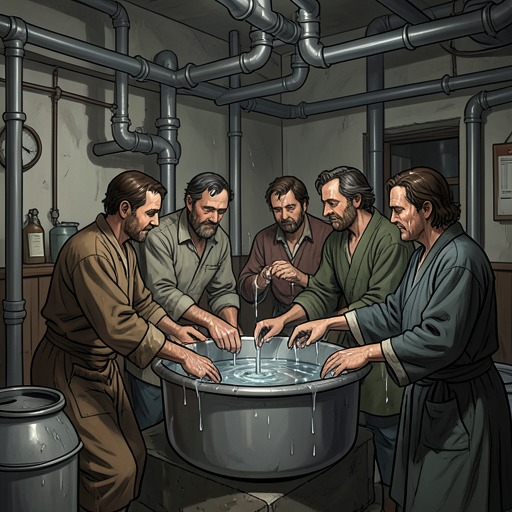
Water-Brother Obligations
Stranger in a Strange LandWater-Brother Obligations define the ethical force of the Martian water bond: to share water is to accept a serious, enduring responsibility to another person. The commitment requires truth, trust, and loyalty under any circumstances; its ceremonies welcome people into the Nest, but the bond is not merely symbolic. The novel shows it changing relationships through considered consent, mutual dependence, and incorporation into a community.
The Bond as a Rule of Conduct
Jubal explains the obligations to Duke before Duke approaches Mike with an offer of water. Mike, Jubal believes, would accept: his unusually strong desire to be liked makes the bond appealing, but also makes its seriousness easy for a newcomer to underestimate. Jubal therefore sets out what acceptance entails: Duke must never lie to Mike or mislead or deceive him, and must stand by him whatever happens, because Mike will do the same in return. Jubal warns Duke to think carefully before committing. The rule thus joins a demanding ethical standard to reciprocal protection; it is not a promise of loyalty that only one party must keep.
Jubal speaks from experience rather than from detached knowledge. He had accepted water brotherhood with Mike before understanding its full implications, and says that he has become more deeply entangled in its responsibilities as he has come to understand them. Duke, for his part, has already spent the day considering the offer. He says that something about Mike makes him want to take care of him. Jubal connects this impulse to Mike’s complete honesty and innocence, qualities that people shaped by ordinary knowledge of good and evil may find difficult to understand. His warning frames the bond as a commitment made in response to another person’s vulnerability, while leaving Duke to decide whether he is ready to assume its obligations.
Consent and Reciprocal Trust
The bond is enacted through offering and accepting water, but the action carries consequences beyond the exchange itself. When Mike recognizes that Jill and Ben are already water brothers, he consults Jill and then solemnly offers water to Ben. Ben accepts after Jill has explained the commitment. His acceptance follows a period of reflection: he concludes that his destiny is already interwoven with Mike’s, through his own choices even before their meeting. The ritual gives that existing sense of responsibility a form that both men can share.
Ben also has to confront jealousy before he can accept without reservation. During his recovery, he discovers that he resents the closeness between Mike and Jill and that he now wants marriage with Jill, not simply the bachelor life he had previously embraced. He recognizes the feeling as jealousy and decides it must be cauterized. The text places that inward reckoning beside his water-bond with Mike: the obligations depend not just on making a solemn gesture, but on confronting impulses that could compromise trust among the people involved.
The seriousness of informed consent appears again when Jill offers water to Mahmoud at the conference. She tells him, “Who shares water shares all.” After Mahmoud takes a sip, he offers the glass to Jubal rather than returning it to Jill, and the ceremony begins to draw others in. Dorcas pauses to ask whether Mahmoud understands how serious the commitment is to Mike; she then stresses that it is just as serious to them. Mahmoud answers that he understands its fullness and otherwise would have refused to drink. His response makes refusal part of the rule’s moral structure: participation matters because it is deliberate, not because the group has made acceptance unavoidable.
A Lasting Promise, Not a Casual Welcome
Jill states the stakes plainly when she offers water to Patricia Paiwonski. She compares the bond to baptism and marriage, explaining that it means mutual trust, openness, and partnership lasting forever. Once made, she says, it cannot be broken: to break it would require the participants to die at once. She also makes clear that Patricia may refuse and remain their friend, and cautions her not to accept if the commitment conflicts with her faith. Mike reinforces Jill’s warning, saying that this is everything marriage is and more, and urging Patricia not to drink if her religion or her heart gives her any reason not to.
Patricia chooses to accept. She remembers having made a difficult decision once before while her husband watched, and resolves not to falter now. Jill drinks first and passes the glass to Mike; Mike thanks Patricia for the water, drinks, and offers it to her with a wish that she always drink deep. In this scene the words and gestures do more than express affection: they establish the partners’ obligations and transform Patricia’s relationship to Mike and Jill. The solemn option to refuse makes her acceptance meaningful, while the warning that the commitment cannot be broken makes its cost unmistakable.
The Nest’s Rituals and Community
The water bond also operates at the scale of the Nest, where shared ceremonies turn individual commitments into communal belonging. Patricia shows Ben the Innermost Temple, a round room with a pool at its center, and explains that new brothers are received there. The space is reserved for a ritual welcome, not simply for an ordinary drink or swim. When she asks whether Ben wants to share water and grow closer, he declines for the moment; she accepts his hesitation with the response, “Waiting is.” The exchange shows that entry depends on readiness rather than pressure.
The Nest’s progression through its circles gives the welcome a broader structure. Duke explains that Mike may sometimes judge someone ready to share water before that person reaches the Seventh Circle: Mike chose Sam and Ruth when they had only entered the Third, and they later became a priest and priestess. On occasion, Dawn or Patricia may identify someone for special promotion and training, but Mike is the one able to judge readiness so early, and they generally consult him. After the Eighth Circle, sharing and growing closer begins; later, members enter the Ninth Circle and the Nest itself. The formal Sharing-Water service is attended by the whole Nest, and a new brother—usually a couple—becomes part of it forever. Ordinary water-sharing happens throughout the day, but the named service marks a more decisive communal transition.
Ruth’s account of her and Sam’s entry shows that this transition can require sustained work and emotional discipline. They advanced to the Third Circle as Sam learned the language and Ruth studied to keep up with him. When they began to think in Martian, Mike recognized their progress; he and Jill gave them water after a Third Circle service. Ruth recalls that the commitment initially brought painful self-judgment, even as she longed to return and share water again. Their later movement through the inner circles was rapid, but not effortless: Mike understood that they needed help and wanted to bring them into the safety and peace of the Nest. Before the formal Sharing-Water rite, Ruth feared that she could not merge herself with the other members and nearly begged Sam to turn back.
The ceremony answers that fear with a bodily, collective welcome. In the Innermost Temple, a spotlight falls on Ruth and Sam and their robes vanish; already in the pool, the members call them in Martian to come and share the water of life. Ruth enters the pool and describes herself as never having come back up. Her account makes the obligations more than a list of prohibitions: they are lived as ongoing trust within a community that offers help, receives new members, and expects them to grow into a shared life.
Continuing Consequences
The obligations recur wherever characters decide whether a relationship is ready to become permanent. Jubal’s warning to Duke stresses honest loyalty between individuals; Ben’s acceptance makes explicit how that loyalty intersects with jealousy and attachment; the exchanges with Mahmoud and Patricia show that serious commitment must be understood and freely chosen. The Nest’s circle system adds a communal dimension, placing preparation, timing, and formal welcome around the bond without reducing it to a mere membership procedure.
Across these episodes, water signifies a promise whose force comes from what the participants owe one another afterward. The language of sharing and growing closer accompanies offers, but acceptance commits each partner to truthfulness and support, and the narrative repeatedly pauses over readiness and consent. The rule therefore binds intimacy to responsibility: closeness is not simply a feeling to claim, but a reciprocal practice that participants must understand, choose, and sustain.