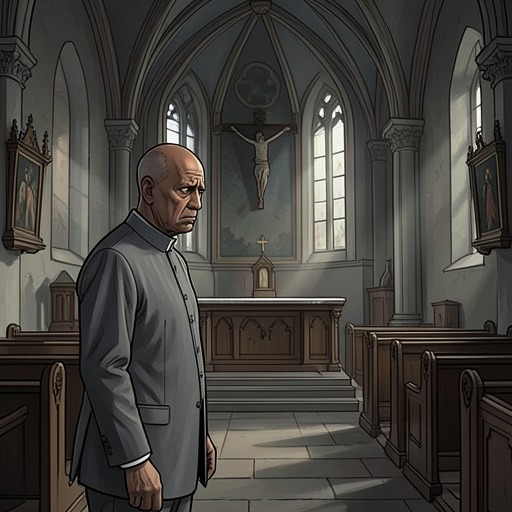
Brendan Cronin's outburst during Mass
StrangersBrendan Cronin’s outburst during Mass is the public breaking point of a priest’s profound crisis of faith. As he struggles through the liturgy, doubt becomes anger at himself and the Church; he hurls the chalice across the sanctuary, scatters communion wafers, casts off his stole, and runs from the altar. The scene makes the sacred objects of the service witnesses to a collapse that Brendan can no longer contain within himself.
Background and Ritual
The outburst takes place during an early service on December 1, attended by fewer than a hundred people. Before entering the sanctuary, Brendan holds the chalice close to his breast, his right hand covering the burse and veil. The act is careful and reverent, a striking contrast to what follows. As he approaches the altar, the face of Christ on the cross seems, for a moment, to look at him accusingly: the sanctuary is not merely the setting for the crisis but a place where his spiritual distress takes on the force of judgment.
The service proceeds through an ordered sequence of gestures and words. Brendan begins with the Introibo ad altars Dei, and Kerry McDevit transfers the missal from the Epistle side to the Gospel side of the altar. Yet the ritual’s regular progression does not steady him. Each step instead compounds his misery, while the worshipers’ unusually pale, radiant faces seem to him like a deputation of judgmental angels. That impression belongs to Brendan’s distressed perception; it conveys how the congregation, ordinarily present for worship, has become in his mind an audience to his failure.
The Crisis Deepens
By the time the Mass reaches the Gospel, Brendan can barely focus or find enough strength to raise his arms. The worshipers’ faces blur into featureless shapes, and he can only mutter the words of the sacred text. At the Canon of the Mass, his voice has dwindled to a whisper. He is sweating and shaking, conscious that Kerry is staring at him and convinced that the congregation recognizes that something is wrong.
The description of his despair shifts from heaviness to darkness. An awful grayness within him grows black, and he feels himself spiraling into a frightening void. This inward movement matters to the scene’s structure: Brendan’s visible loss of control follows an increasingly severe private struggle, rather than arriving as an unexplained interruption of the service. At the moment he elevates the Host, he is angry with himself for being unable to believe, with the Church for failing to arm him against doubt, and with a life that now seems to him misdirected and wasted. His anger gathers until it becomes fury, the one protection he has against suicidal despair.
The Outburst in the Sanctuary
The breaking point comes as Brendan holds the Host and speaks the five words associated with transubstantiation. A cry bursts from him, and he pitches the chalice across the sanctuary. It strikes the wall with a loud clank, sprays wine, rebounds from a statue of the Blessed Virgin, and comes to rest against the foot of the podium where he had earlier read the Gospels. The vessel’s passage carries the violation across the sanctuary, from the altar to the place of proclamation.
Kerry stumbles backward in shock. In the nave, about a hundred people gasp together, but their reaction does not reach Brendan. Still consumed by the rage protecting him from despair, he sweeps a paten of communion wafers onto the floor. He gives another cry, now described as half anger and half grief, reaches beneath his chasuble, tears off the stole around his neck, and throws it down. The sequence is both physical and ritual: the chalice, the wafers, and the stole are successively displaced or rejected as Brendan turns away from the altar and races into the sacristy.
Aftermath and Significance
In the sacristy, the anger vanishes as abruptly as it came. Brendan stops and stands swaying in confusion. That sudden change does not resolve the crisis; it exposes how little the outburst has settled. The fury that gave him temporary protection has passed, leaving him disoriented after a public rupture with the rite he had been attempting to perform.
The incident’s force lies in the contrast between ceremony and rupture. The Mass depends on ordered movement, sacred speech, and objects handled according to their purpose; here, Brendan’s exhaustion makes each stage of that order harder to sustain, until the chalice becomes a projectile, the communion wafers are swept away, and the stole is cast off. The congregation witnesses the breach, but the scene remains centered on Brendan’s collapse: the gestures register not a considered rejection explained from a distance, but the moment when doubt, grief, and anger overwhelm his ability to continue the service.