Event 1
Ginger Weiss confronts an armed mugger
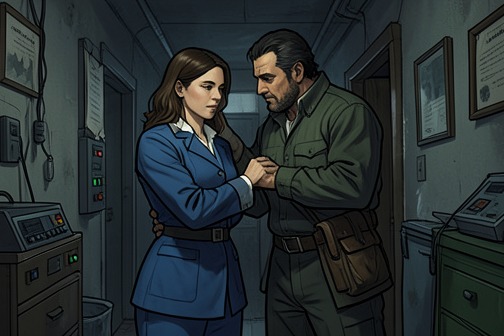
[Ginger Weiss](entity:character-recall-character-ginger-weiss-c0c2e7ef6acc)’s mugging turns an apparent attack on a vulnerable woman into a reversal of control: after being seized and threatened in an isolated passage, she recognizes that her assailant is unarmed, incapacitates him, and brings him into public view. The episode makes concrete the gap between her slight, easily underestimated appearance and her capacity for decisive action under threat.
## Background and Threat
Four years before the trouble at [Bernstein's Delicatessen](entity:location-recall-location-bernstein-s-delicate-965a78c8a924), Ginger was an intern at Columbia Presbyterian, where sixteen-hour shifts and longer were routine. On a hot, humid Saturday night in July, after an especially punishing tour of duty, she left shortly after ten and headed home. A hulking man accosted her, seized her arm, and threatened to break her teeth if she screamed. The passage offered little immediate help: no pedestrians were close, and the nearest cars were two blocks away, stopped at a traffic light.
The attacker pushed Ginger into a recessed doorway, where the faint light let her see that he had no weapon. While he emptied the purse she had willingly handed over, he made repetitive sexual threats. Ginger judged that his size was doing more work than any demonstrated fighting skill; recognizing that he was unarmed gave her an opening, but did not remove the danger of resisting.
## Reversal and Escape
Ginger struck at the point where she could hurt him most: she kicked him in the crotch, seized one of his hands, and bent his index finger backward. The attack exploited the intense pain produced by forcing the finger back and straining the nerves of the hand. His strength and size no longer gave him control; pain overcame him, and he gagged, choked, and vomited as she forced him along the passage.
She did not release him. Ginger feared that, if given the chance, he would beat or kill her, so she urged him onward despite her disgust and terror. Reaching the sidewalk without finding anyone who could call the police, she pushed her subdued assailant into the middle of the street. Passing traffic stopped at the unexpected sight, turning an isolated assault into a public spectacle and bringing the witnesses she had lacked in the passage.
## Aftermath and Significance
The police eventually arrived, to Ginger’s relief and, even more, to the relief of the man who had attacked her. The ending reverses the encounter’s opening imbalance: the assailant who had seized and threatened her was now being kept in motion by her, exposed to public attention and awaiting police intervention.
The story became a legend at the hospital where Ginger had served her internship. Its force lies partly in the contrast between the impression she made and what the crisis disclosed. Ginger was slight and often underestimated on first encounter; here, quiet assessment—not physical size—lets her identify the opening, act with precision, and survive. The mugging is thus both a violent incident and a revealing instance of the competence others could take weeks or months to recognize.
Event 2
The black-glove episode at Bernstein's Delicatessen
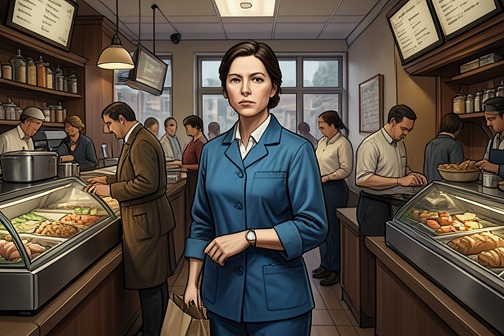
[The black-glove episode at Bernstein's Delicatessen](entity:event-recall-event-f2cf365b97b5) turns [Ginger Weiss](entity:character-recall-character-ginger-weiss-c0c2e7ef6acc)’s familiar Tuesday routine into a disorienting flight. When a stranger’s gloves provoke an inexplicable terror, the deli and its customers seem to vanish around her; she runs without knowing what she is escaping, then comes to on Mount Vernon Street unable to recall the journey. The episode’s force lies in the contrast between an ordinary errand and a fear so absolute that it breaks her continuity with the world and with her own recent past.
## A Familiar Tuesday Interrupted
Ginger’s visit begins within a routine she has gradually learned to enjoy. Tuesdays are her day off: she sleeps an extra hour, reads the morning paper over coffee, and walks to [Bernstein's Delicatessen](entity:location-recall-location-bernstein-s-delicate-965a78c8a924) for food to eat at home while reading. On this November Tuesday, the weather is cold but brisk rather than bitter, and she reaches the crowded shop at ten-twenty-one. She moves along the counter and display cases, choosing from the baked goods and other delicacies before paying and carrying her paper bag toward the door.
The scene is unusually abundant and busy. Hot dough, cinnamon, garlic, cloves, roasted hazelnuts, sauerkraut, pickles, and coffee mingle with laughter, silverware, and conversations in English inflected by Yiddish, [Boston](entity:location-recall-location-ccccb9ca0ba9) accents, and rock-and-roll slang. Ginger is absorbed in choosing food, not anticipating danger. At the exit, looking down as she tries to put her wallet into her purse, she collides with a man entering the deli. He catches the grocery bag and steadies her. Nothing in the encounter initially distinguishes it from a commonplace accident in a crowded shop.
## The Gloves Become the Focus
After the man returns the bag, Ginger notices his black leather gloves. Their material offers no ordinary explanation for her reaction: they are expensive, neatly stitched, and close-fitting, while the man himself appears unthreatening, with kind eyes behind thick tortoiseshell glasses. Yet the sight of the gloves makes Ginger feel threatened. Her breath catches and her heart pounds.
As she looks at them, the surrounding deli seems to lose its reality. Customers, shelves, display cases, clock, pickle barrel, tables, and chairs shimmer and recede into a pale haze, while the gloves remain sharply present and seem to grow more vivid. The shift is not simply from calm to fear: the familiar objects that had made up the room cease to hold her attention, and this single object takes command of it. The gloves are still only gloves, but in Ginger’s perception they have become an urgent threat without a known source.
The man asks whether something is wrong and raises a gloved hand toward her. Ginger, dizzy and disoriented, suddenly feels that she must run or die. She cannot identify the danger or explain why flight seems necessary. Her fear instead supplies an absolute command, and she pushes past the man with the grocery bag clutched to her chest, scarcely aware that she nearly knocks him off balance.
## Flight and Missing Time
Outside, Ginger runs along Charles Street. The traffic sounds and deli windows pass around her, but her awareness soon narrows to escape. The world fades into featureless grayness; she is temporarily blind and deaf to what surrounds her, and she runs as though pursued despite seeing no pursuer. Other people may be on the sidewalk, but she has no conscious recollection of them. The episode strips the flight of its ordinary bearings: she acts, but cannot later account for the route or the moments that compose it.
Minutes later, the haze clears on Mount Vernon Street, partway up the hill. Ginger is gripping the iron balusters of a railing beside a red-brick townhouse, her forehead against the metal. She is sweating and gasping; her throat burns, her chest aches, and her mouth is dry and sour. The physical aftermath is present, but the journey that caused it is not. She knows that something frightened her, yet cannot remember what it was or how she reached the railing.
## The Errand’s Aftermath
An elderly couple across the street watches Ginger, making her aware that her behavior has become visible to others even though its cause remains inaccessible to her. Embarrassed, she turns back down Mount Vernon Street. Near the corner, she finds the grocery bag lying on its side on the pavement. She stands over it for several seconds, trying to recover the moment when she dropped it, but finds only blankness where that memory should be. A few items have spilled, though none is torn open; she puts them back in the paper sack.
The abandoned groceries make the missing interval concrete. Ginger has not merely lost track of a thought: her purposeful errand has been interrupted, her food has been dropped, and she has covered an unexplained stretch of street without retaining the experience. The episode leaves her with consequences she can inspect but no memory that would connect them to her own actions. Her confusion about what is wrong with her follows directly from that split between evidence and recollection.
## Significance
The episode establishes the black gloves as a recurring fear image in Ginger’s story, while withholding any explanation for their power over her. The ordinary man is explicitly not the apparent source of danger; the gloves themselves become the focus, and the distinction between object and threat remains unresolved. The narrative makes that uncertainty part of the event rather than supplying an answer Ginger does not possess.
Its structure also makes the reader experience the break in continuity. A specific errand, crowded room, and accidental collision give way to a narrowed, nearly featureless flight; only afterward does Ginger recover a location and the bodily cost of running. The episode is therefore both a public scene of panic and a private failure of memory: observers can see that something has happened, and Ginger can find the dropped groceries, but neither fact restores the missing minutes. What remains is the unexplained command to flee and the unsettling gap between what Ginger did and what she can remember doing.
Event 3
Dominick Corvaisis writes “I'm scared” in his sleep
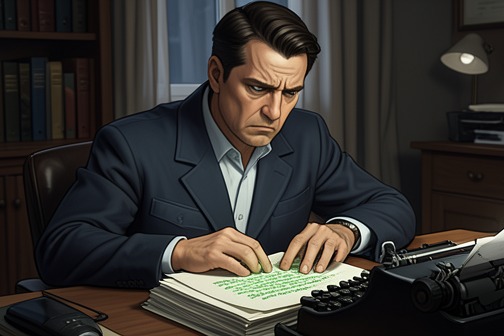
[Dominick Corvaisis](entity:character-recall-character-dominick-corvaisis-5f0bc1572735) discovers that, while sleepwalking, he has filled pages of his unfinished novel with a message of fear. The episode turns a private anxiety into a baffling physical record: his sleeping self has acted with obsessive persistence, while his waking self can neither recall the act nor confidently explain what it means.
## Context and Discovery
Corvaisis is already preoccupied with the approaching publication of *Twilight*. He wonders whether the novel will justify Random House’s investment or fail, whether he can repeat his success, and whether his rise will be followed by an equally swift descent. These questions circle through his waking hours and, he suspects, continue through his sleep; he understands his sleepwalking as an attempt to escape them and find a place where worry cannot reach him.
At his desk, he switches on the [IBM Displaywriter](entity:object-recall-object-ibm-displaywriter-9048da2d8017) and opens chapter eighteen on the first disk of his new, still-untitled book. The previous day he had stopped halfway through the chapter’s sixth page. Now the screen displays a full sixth page of unfamiliar green text, followed by pages seven and eight, although he had not created either page. His first response is disbelief; the discovery leaves the back of his neck cool and damp.
## The Message on the Screen
The new material consists of one short sentence repeated hundreds of times: “I'm scared.” Its force lies partly in the contrast between the smallness of the words and the scale of their repetition. The message occupies page six in double spacing, indented four times, with four sentences to a line and thirteen lines on the page. Pages seven and eight each contain twenty-seven lines. Together, the pages record 268 repetitions.
The computer, Corvaisis reasons, could not have composed the text by itself: it did only what it was instructed to do. Nor does he find signs that anyone broke into the house to tamper with the manuscript, and he can think of no likely prankster. He concludes that he must have come to the word processor while sleepwalking and typed the sentence repeatedly, despite having no memory of doing so. The machine has preserved an action that his conscious recollection cannot supply.
## Fear and Competing Explanations
Corvaisis can account for some of the fear through his career worries, but he doubts that sleepwalking itself explains the intensity of the message. The episode is disorienting, yet he does not consider it an ordeal sufficient to produce such terror. More troubling is the possibility that the words concern something beyond his professional future: a threat his conscious mind has not recognized, but that his subconscious has tried to communicate while he sleeps.
He immediately resists that interpretation, dismissing it as the overactive imagination of a novelist and deciding that work is the best remedy. His explanation therefore remains divided. He has a concrete account of how the sentence reached the screen—he typed it while sleepwalking—but no settled account of what the sentence means. The words may reflect the pressures he already knows, or point toward a danger he cannot yet consciously identify.
## Recurrence and Significance
Corvaisis tries to contain the incident with what he knows about adult sleepwalking: most adult sleepwalkers, he believes, have only a short run of episodes, and few experience more than half a dozen, usually within six months or less. He takes comfort in the likelihood that the midnight wandering will stop and that he will not again wake huddled and tense in the back of a closet. That reassurance does not resolve the message; it only offers the hope that the behavior producing it will end.
As a narrative event, the episode makes sleepwalking more than an unexplained disturbance. The manuscript becomes an involuntary record of a mind divided between conscious denial and an unrecognized fear. Its exact repetition gives that fear a voice without clarifying its source, leaving the reader with the same uncertainty that unsettles Corvaisis: whether the message is an expression of known pressures or a warning whose meaning has not yet surfaced.
Event 4
Ernie Block faces the darkness at night and panics
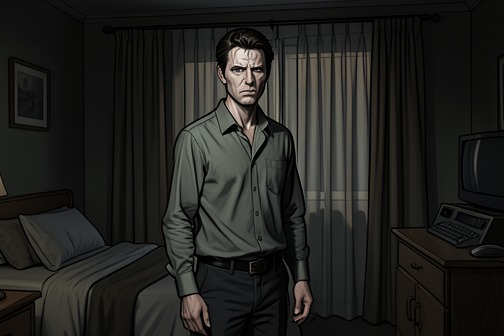
[Ernie Block faces the darkness at night and panics](entity:event-recall-event-ernie-block-47c87dc77ffa) in a scene where an attempt at deliberate courage turns into a more overwhelming fear. On November 22, with [Faye Block](entity:character-recall-character-faye-block-43b77274239e) away in Wisconsin, he opens the motel curtains to confront the unlit Nevada landscape. The effort meant to prove that he could endure the dark instead leaves him gasping, on his knees, and unable to trust the strategy that has served him before.
## The Need to Be Dependable
Ernie’s decision is bound up with how he understands his place in his marriage. He has always been strong for Faye Block, a dependable rock, and he believes a man should fill that role. With her due to return from Wisconsin, he feels he must overcome what he calls a bizarre affliction before she comes back. The pressure is not simply to tolerate the night; it is to preserve the identity of the person on whom [Faye](entity:character-recall-character-faye-ad32954c4aae) can depend.
That expectation shapes his response. Ernie has learned to meet difficulty through action: be bold, confront the enemy, engage in battle. He trusts this philosophy because it has worked for him in other circumstances, and he treats the window as a boundary he must cross psychologically. Pulling the curtains aside becomes his chosen test of strength, a private effort to make the fear yield before Faye returns.
## The View Beyond the Curtains
The window looks out from the back of the motel across broad meadows and hills in the uninhabited uplands. Beyond the glass, starlight is the only illumination. Ernie initially tries to name what he sees as harmless: the blackness is deep, pure, vast, and cold, but he tells himself it is neither malevolent nor a personal threat. His first response is an act of interpretation, an effort to reduce the night to something impersonal and therefore bearable.
As he watches, however, the darkness seems to move. Patches of it gather into denser shapes within the surrounding black, not clearly visible but seemingly solid enough to threaten the fragile window. Ernie clenches his jaws and presses his forehead against the ice-cold glass. The gesture brings him close to the boundary he has chosen to face, but it does not make the scene more manageable: the night’s apparent shapes seem to give form to a danger he cannot identify or measure.
## Fear Takes Control
The scale of the landscape then changes in Ernie’s perception. Although he cannot see the mountains, he senses them receding; the plains appear to extend hundreds, then thousands, of miles, expanding toward infinity. He finds himself at the center of an immeasurable void, empty and lightless in every direction. The progression carries the fear beyond the visible forms at the window. What had begun as an effort to look at a dark landscape becomes an encounter with an emptiness that seems to exceed his imagination and even his ability to breathe.
The episode is more profound and powerful than anything Ernie has previously known, and its defining reversal is a loss of control. The immense darkness seems to slide inward, its walls collapsing and pressing down on him. He screams and throws himself back from the window. The curtains fall closed; the view disappears, and the room’s light becomes a relief. On his knees, he hangs his head, shudders, and gulps air. The physical response makes clear how completely the confrontation has overwhelmed the resolve with which he began it.
## Aftermath and Significance
Ernie crawls to the bed and lies listening to his heartbeat slow from a sprint to a fast walk. The attempt has not purged his fear or restored his confidence. Instead, he recognizes that bold confrontation has made the problem worse. His questions about what is happening to him, and what is wrong with him, give the scene an unresolved ending: he can name the distress but cannot explain it.
Dated November 22, the episode marks a sharp contrast between Ernie’s belief in facing an enemy and the experience of a fear that does not behave like an ordinary opponent. The dark is not shown to be an actual attacker; its threatening shapes and immense expansion belong to Ernie’s perception. Yet the panic is bodily and consequential, not a fear he can dismiss by reasoning that the night is harmless. The scene establishes both the limits of his familiar toughness and the cost of measuring himself against an ideal of being unshakably strong for Faye Block.
Event 5
Dom tries to seal the windows and hide while sleepwalking
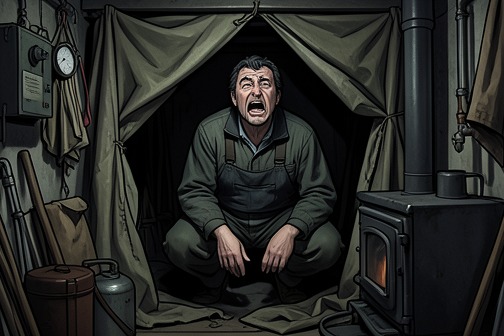
[Dom Corvaisis](entity:character-recall-character-dom-corvaisis-d9ce4fde805e)’s attempt to seal his windows and hide while sleepwalking turns advice meant to quiet his mind into a scene of unexplained terror. In the morning, he finds the physical traces of a nocturnal effort to fortify his home—and of a flight from whatever he believed was outside.
## The Advice and the Night
After Dr. Cobletz advised him to step away from his writing and exhaust himself with physical activity, Dom began the regimen on Saturday. He pursued it with more single-minded intensity than the doctor had suggested. The exertion sent him into deep sleep as soon as he went to bed, but it did not prevent his sleepwalking: instead of waking in bed or in a closet, he came to in the garage.
Dom was gasping, terrified, and sore. During the night, he had taken two folded canvas dropcloths from a shelf above the workbench and squeezed into a narrow service space behind the furnace. He lay concealed beneath the tarps. The makeshift shelter was not simply a way to keep warm; his actions indicated that he had been hiding from something.
## Evidence of a Barricade
Later, in the bedroom, Dom found steel finishing nails scattered across the carpet. A partly emptied box of nails and a hammer lay beside the baseboard beneath the window, whose drapes had been drawn aside. Three more nails rested on the windowsill. Together, these objects supplied a material record of what he had done while asleep: he had begun preparing to nail the windows shut.
The attempted barricade had not been completed. The evidence suggests that Dom was overcome by fear before he could finish, abandoned the bedroom, and fled to the garage, where he hid behind the furnace. The episode thus joins two defensive acts—trying to close off the house and then concealing himself when that effort failed.
## The Unseen Threat
By daylight, the view beyond the window offered no visible explanation for the terror: rose bushes, a strip of lawn, and an ivy-covered slope leading to another house. The landscape appeared peaceful, and Dom could not believe it had looked more threatening the night before. Yet the nails, hammer, displaced dropcloths, and cramped hiding place remained as evidence of the fear that had governed him while he slept.
The episode makes Dom’s unconscious behavior more legible without identifying its cause. His sleeping mind responds as if danger is approaching from outside, first by trying to seal the boundary of the home and then by retreating to a concealed space. The threat itself remains unknown, leaving the ordinary bedroom window and the garage furnace as the physical traces of an anxiety Dom cannot explain while awake.
Event 6
Brendan Cronin throws the chalice during Mass

[Brendan Cronin throws the chalice during Mass](entity:event-recall-event-brendan-cronin-e7050f737b0d) on December 1, in a public outburst that makes his crisis of faith impossible to conceal. As despair gives way to fury, he hurls the sacred vessel across the sanctuary, scatters communion wafers, tears off his stole, and runs from the altar. The scene’s force lies in that reversal: the objects and gestures through which he has been serving the Mass become instruments of a rupture he can no longer contain.
## The Mass and the deepening crisis
Fewer than a hundred people have gathered for the early service. To Brendan, their pale, radiant faces seem less like the faces of ordinary worshipers than witnesses to a judgment. The congregation’s presence sharpens the exposure of the moment: he is trying to continue a public ritual while inwardly losing the convictions that give it meaning.
His despair deepens as the Mass proceeds. Each step of the ceremony adds to his exhaustion. When the missal is moved from the Epistle side to the Gospel side of the altar, he is already struggling to lift his arms, concentrate on the Gospel, and speak its lines. The worshipers blur in his sight; he can barely whisper by the Canon of the Mass. Sweating and shaking, he senses that Kerry McDevit is watching him and believes the congregation can see that something is wrong. The description makes the crisis both spiritual and physical: the rite continues around him, but his ability to inhabit it is failing.
## The outburst in the sanctuary
The decisive break comes as Brendan holds and elevates the Host. Instead of finding reassurance in this central act of the Mass, he turns his anger against himself for being unable to believe, against the Church for leaving him without stronger protection from doubt, and against the apparent waste of a life spent pursuing what now seems to him like foolish myths. His anger swells until it becomes a fury that, for the moment, shields him from suicidal despair.
A cry escapes him, and he throws the chalice across the sanctuary. It strikes the wall with a clank, sprays wine, rebounds from a statue of the Blessed Virgin, and comes to rest against the foot of the podium from which he had earlier read the Gospels. The vessel’s trajectory carries the disruption across the sacred space: it passes from his hands, strikes the sanctuary, and ends far from the altar. Its material impact makes visible what his nearly inaudible speech and inward collapse had concealed.
Kerry stumbles backward in shock, while the congregation gasps together. Brendan does not stop. He sweeps a paten of communion wafers onto the floor, gives another cry combining anger and grief, reaches beneath his chasuble, tears off the stole around his neck, and throws it down. He then turns away from the altar and races into the sacristy. In quick succession, the acts undo the composure and vestments of the celebrant: the Mass is interrupted not by a debate about faith but by the physical rejection of its sacred objects and his own priestly attire.
## Aftermath and public meaning
The fury disappears as abruptly as it came. In the sacristy, Brendan stops and stands swaying in confusion. The scene ends not with a settled conviction or a declaration of a new position, but with disorientation after the violent release. That abrupt reversal leaves the outburst as an expression of a crisis he cannot master, rather than a reasoned rejection of the Church.
By December 5, the incident has become parish talk in [Chicago](entity:location-recall-location-chicago-eb77a855d5aa). [Father Stefan Wycazik](entity:character-recall-character-father-stefan-wycaz-8bcbf4db75a8), rector of the [Church of St. Bernadette](entity:location-recall-location-church-of-st-bernade-3cd71cebe328), thinks of Brendan through a string of scandalized labels: the rogue curate, the chalice-hurler, and the parish’s Berserk Priest. Wycazik’s long experience as a priest has not prepared him to understand the doubt behind the spectacle. The event therefore has consequences beyond the damaged ritual: Brendan’s private spiritual anguish becomes a public identity, while the priest who hears about it finds the crisis itself baffling.
## Ritual rupture
The scene is organized around the widening gap between the Mass’s ordered gestures and Brendan’s loss of belief. He follows the ceremony even as his strength and concentration fail; at the elevation of the Host, the ritual reaches its formal center at the same instant his inward conflict breaks into action. The chalice, paten, stole, and sanctuary are not incidental furnishings. Their successive displacement gives the collapse a concrete sequence: first the vessel is hurled, then the wafers are swept away, then the vestment is stripped off, and finally the celebrant leaves the altar.
The congregation’s collective gasp and Kerry’s recoil register the public breach, but they do not interrupt Brendan’s momentum. Only after he reaches the sacristy does the rage vanish, leaving him swaying and confused. The contrast between the Mass’s measured progression and the sudden, material disorder makes the episode a decisive exposure of his crisis: doubt, previously interior, now alters the ritual in front of its witnesses.
Event 7
Ginger's ophthalmoscope-triggered blackout at Hannaby's office

Ginger’s ophthalmoscope-triggered blackout at Hannaby’s office turns an ordinary medical instrument into the focus of a sudden, bodily terror. On November 27, alone after a twelve-hour day, she sees the ophthalmoscope on [George Hannaby](entity:character-recall-character-george-hannaby-fb6a7ba2531f)’s desk and experiences a fugue: she runs from the office under an imperative to escape, then regains awareness on a stairwell landing with no memory of taking the stairs. The event transforms a familiar professional setting into a place of danger while leaving Ginger, and those around her, without an immediate explanation for what happened.
## The Late Return to the Office
Wednesday has been busy, but Ginger is not tired when her workday ends. At six-thirty, after twelve hours at the hospital, she has no practical reason to stay. Nevertheless, she lingers, talking with patients and checking charts. She eventually goes to Hannaby’s office because she intends to look again at Viola Fletcher’s file. Her decision begins the episode as an extension of her work: she is not seeking danger, but returning to a patient’s records after the day’s duties are over.
The professional offices occupy a separate wing behind the hospital, and the corridors are nearly deserted. Ginger moves through the polished halls into the dark waiting room, examining rooms, and private office without turning on all the lights. She uses the keys Hannaby has given her to open the locked file room, retrieves Fletcher’s records, and takes them to his desk. The small pool of desk-lamp light isolates the folder and the object beside it, while the surrounding rooms remain dark and quiet. The setting’s emptiness becomes important as the episode unfolds: when Ginger later needs help, there is no one else on the floor.
## The Instrument and the Flight
Only after sitting in Hannaby’s leather chair and opening the file does Ginger notice the ophthalmoscope lying on the green blotter. It is a routine instrument for examining the interior of the eye, and there is nothing inherently ominous about it. Yet its appearance arrests her. Her breath catches; she breaks into a cold sweat, and her heart pounds so forcefully that its sound seems to come from outside her body. The lens takes on the appearance of an alien eye. The contrast between the instrument’s ordinary medical purpose and the danger Ginger feels gives the object a new, disturbing presence: what should be familiar and usable becomes impossible for her to face.
Ginger tries to hold her ground, but her resolve gives way as terror overtakes her. The words [“Run or die”](entity:expression-recall-expression-run-or-die-08dcd5bb1ee5) repeat within her, and a cry escapes her before she turns from the desk. She stumbles around it, nearly falls over a chair, and races through the outer office into the empty corridor. Her flight is not a considered decision to leave work. It is a desperate response to a threat that seems to draw nearer, although the ophthalmoscope itself remains a harmless instrument. She runs down the hallway seeking help and a friendly face, but the deserted office wing offers neither.
## The Lost Interval
Then the mist descends, interrupting Ginger’s awareness. Minutes later, when it clears, she finds herself sitting in the emergency stairwell at the end of the office wing, on a concrete landing between floors. She cannot remember leaving the corridor or taking the stairs. She is pressed into a corner with her back against the cinderblock wall, staring toward the railing across the steps. A bare bulb burns inside a wire cage overhead; flights rise and descend into shadow toward other lit landings. Her ragged breathing is the only sound breaking the silence.
The stairwell offers little reassurance. Its gray walls, stark light, and looming shadows seem to echo Ginger’s distress, while the brightness and company she wants are absent. Her flight and whatever other behavior occurred during the interval have apparently gone unseen. She recognizes this as a small relief: at least no one knows. The episode therefore ends not with an explanation or assistance, but with Ginger alone and conscious again, aware both of the frightening gap in her memory and of the possibility that her behavior has escaped notice.
## Significance of the Episode
The scene makes the blackout legible through a sharp sequence of changes: routine work gives way to alarm, alarm becomes flight, and flight gives way to a blank in Ginger’s recollection. Its details keep that shift grounded in the physical world—the file she came to review, the green desk blotter, the instrument’s lens, the locked file room, and the stairwell’s bare bulb—without explaining why the ophthalmoscope provokes such an extreme response. The object is ordinary; Ginger’s experience of it is not.
The date and location place the event firmly in [Chicago, Illinois](entity:location-recall-location-chicago-illinois-e6a0319a66fa), in Hannaby’s workplace, but the fugue leaves a gap within the scene itself. Ginger can remember the sudden terror and the place where she comes to, yet not the passage between them. That missing interval makes the episode more than a frightening encounter with an object: it shows her losing control of her own actions and memory in a setting where her medical competence and professional routine had seemed secure.
Event 8
Ginger Weiss leads her first aortic transplant surgery
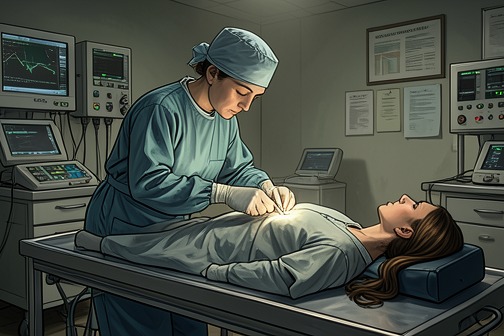
[Ginger Weiss leads her first aortic transplant surgery](entity:event-recall-event-ginger-weiss-ddc780e0b67f) in [Boston, Massachusetts](entity:location-recall-location-boston-massachusetts-493b99d3d022), operating as senior surgeon for the first time on Viola Fletcher, a fifty-eight-year-old elementary-school teacher whose dissecting aortic aneurysm threatens her life. Ginger completes the demanding graft repair successfully, but the scene makes achievement inseparable from risk: the patient’s survival depends on precise work, while Ginger’s confidence rises just before the strain of the operation catches up with her.
## A First Major Responsibility
Viola lies unconscious on the operating table, a mother of two daughters and the wife of a devoted husband. The narration recalls her as wry and witty, with an infectious laugh, setting the stillness of the anesthetized patient against the personality and family life temporarily entrusted to the surgical team. Ginger understands the scale of that responsibility. Years of arduous education and accumulated hopes have led to this moment, her first time assuming the senior-surgeon role in a major, complicated procedure. Pride in reaching it coexists with dread: she is not merely demonstrating technical skill but taking responsibility for a patient’s life.
A team stands ready around the table. Agatha Tandy, the surgical technician, has the instruments at hand; scrub nurses, a circulating nurse, the anesthesiologist, and his nurse are prepared to assist. [George Hannaby](entity:character-recall-character-george-hannaby-fb6a7ba2531f) is present on the other side of the table. His broad, reassuring appearance and air of calm competence help steady the scene, but the operation is Ginger’s to lead. When she extends her right hand, Agatha places a scalpel in it. The small exchange marks the passage from preparation to action: Ginger accepts the instrument and begins.
## Finding and Repairing the Aneurysm
After opening the abdomen, Ginger examines the colon, finds it healthy, and has the intestines held aside so that the aorta is exposed. The vessel runs through the abdomen and divides near the groin into the iliac arteries, which lead to the femoral arteries in the legs. Ginger identifies a dissecting aneurysm just above the aortic saddle, matching what was shown in the X-rays. The aneurysm has weakened the aortic wall and pushed it outward into a blood-filled, dumbbell-shaped bulge that beats like a second heart. The account emphasizes the danger in physical terms: the condition can cause difficulty swallowing, shortness of breath, severe coughing, and chest pain, and a rupture can bring swift death.
Ginger’s work proceeds through controlled exposure and reconstruction. Once the operative area is ready, she uses a Dacron graft, a bifurcated artificial vessel with two branches for the arteries leading toward the legs. She flushes the graft, tunnels its twin limbs beneath the flesh of the groin, and brings them into the incisions in the femoral arteries. She stitches both ends in place and releases the restricted circulation. The pulse returns to the repaired aorta. Rather than treating that first sign of success as sufficient, she spends twenty minutes searching for leaks and closing them with fine, strong thread, then watches the graft for another five minutes. It throbs like a healthy artery, with no sign of continuing seepage.
## A Successful Close, Then Exhaustion
Only after that close inspection does Ginger announce that it is time to close. George praises the work. Beneath her surgical mask, Ginger is smiling so broadly that she imagines she must look foolish; the success of her first major solo operation has brought relief and pride into the same instant. She closes the incisions in Viola’s legs, takes the intestines back from the tired nurses, returns them to the body, and runs them once more to check for irregularities. Finding none, she replaces the fat and muscle and closes the incision layer by layer, drawing the original opening shut with heavy black cord.
When the anesthesiologist turns off the anesthesia, Ginger calls to Viola. The patient’s eyes remain closed, but her lips move and she answers in a fuzzy voice, establishing that she can respond as she emerges from the operation. Ginger accepts congratulations and leaves with George. The scene then shifts from the concentration of the operating room to the body that has sustained it: as they remove gloves, masks, and caps, Ginger feels almost buoyant, but that sensation ebbs with every step toward the scrub sinks. Her neck and shoulders ache, her back is sore, her legs are stiff, and her feet are tired. The operation has lasted from seven-thirty until past the lunch hour. Her exclamation that she is exhausted meets George’s confirmation that an aortic graft is debilitating work.
## Pride, Skill, and the Cost of the Work
The operation’s successful outcome is framed by a warning from Ginger’s father, whose collected aphorisms included the reminder that pride goes before a great fall. Ginger ought to have recalled it: the procedure is going well, she is pleased with her performance, and pride in her first major solo effort has made her forget the possibility of a reversal. This does not undo the competence the scene has shown. Instead, the warning draws a distinction between justified confidence in the craft and the danger of believing success has made the work invulnerable to risk.
The operation’s value shift is therefore twofold. Viola’s life is in immediate danger because of the aneurysm; careful placement and testing of the graft restore a pulse and leave no observed leak. For Ginger, the moment brings professional arrival, followed not by effortless triumph but by fatigue severe enough to make her body register the cost of the achievement. The scene establishes both her capability and her vulnerability: she can perform the work, but neither preparation nor pride removes the stakes that accompany it.
Event 9
Ginger panics over a sink drain after surgery and flees into the snowy night

[Ginger panics over a sink drain after surgery and flees into the snowy night](entity:event-recall-event-ginger-f072877ea668) when an ordinary scrub sink becomes the focus of a sudden, overwhelming terror. The episode carries her from a hospital wash station to a freezing service alley, where she wakes confused, fears she has destroyed her medical future, and accepts help from [George Hannaby](entity:character-recall-character-george-hannaby-fb6a7ba2531f). Its decisive turn is both physical and relational: Ginger loses command of her actions, but George refuses to treat that loss as a failure of character or a reason to withdraw his care.
## The drain and the onset of panic
After surgical work, Ginger and George go to the sinks, remove the gowns worn over their hospital greens, and open packets of soap. George has just praised her work in expansive terms, describing her as having faced death and won. At the sink, however, her attention fixes on the water and soap bubbles circling the stainless-steel basin before funneling down the drain. The familiar motion becomes intolerable: the drain seems to throb and widen, as if it possessed a hostile life of its own.
The change overtakes her with less warning than her earlier episodes at [Bernstein's Delicatessen](entity:location-recall-location-bernstein-s-delicate-965a78c8a924) and in George Hannaby's office. She drops the soap, recoils, and collides with Agatha Tandy. She hears George calling her, but the people and surroundings seem to recede, while the sink grows larger and more solid in her perception. Ginger attempts to hold on to the ordinary explanation—that it is only a scrub sink and drain—but the effort cannot restore her sense of safety. The contrast is stark: moments after George has celebrated her command in the operating room, she cannot make herself trust an everyday object in the room where she washes her hands.
## Flight and the return to awareness
Ginger runs from the sink. The narration marks a break in her conscious control: as the mist closes around her, she loses awareness of what she is doing. When awareness returns, she is outside in falling snow, in hospital greens, her hair and eyebrows whitening with flakes. She is already crying, though at first she is confused about where she is and what has happened. Only gradually does the cold register: the air bites her face, her hands are numb, and she shivers uncontrollably.
She is huddled with her knees drawn to her chin and her arms locked around her legs, pressed against an ice-cold brick wall on freezing concrete. Her posture makes visible the terror that had overwhelmed her at the sink; she is in a defensive curl and cannot find the strength or will to get up and go indoors. The location is a blind service alley leading into the hospital complex. Double metal doors open to the furnace room, and beyond them lies the exit from the emergency stairs. These concrete features establish that the flight has carried her out of the clinical space where she had been working and into a hidden, exposed corner of the hospital grounds.
## A reversal of the earlier alley encounter
The alley recalls Ginger's earlier encounter with a mugger during her internship at Columbia Presbyterian in New York. That night, she had been dragged into a similar place but remained in command and emerged victorious. Here, the resemblance becomes an unnerving reversal: rather than ascending from danger through action, she feels reduced, weak, and lost. The familiar setting gives shape to her fear that she has reached the lowest point of her life.
From the alley, Ginger interprets the episode as a possible end to everything she has built. Premedical study, medical school, the hardships of her intern year, and her hopes for a surgical career seem, in her despair, to have been for nothing. She believes she has failed George, Anna, [Jacob](entity:character-recall-character-jacob-9a0fda5e8753), and herself, and wonders whether something is desperately wrong with her, naming psychosis and a brain tumor as possibilities before considering a cerebral aneurysm. These are fears and questions she forms in the aftermath, not diagnoses established by the episode. Her terror is sharpened by the timing: the career she has worked toward seems almost within reach when she fears she may no longer be able to resume it.
## George's response and the event's consequence
George comes through the emergency-stair door into the snow, breathing hard, and stops when he sees Ginger. She reads his shocked expression as regret for having invested time, guidance, and trust in her. Because his support matters to her, she experiences the episode not only as a threat to her career but as a betrayal of his confidence, although she has not chosen what happened. When she can speak, she says she does not know what is wrong and believes she has ruined everything and disappointed him.
George answers by challenging the isolation built into her self-reliance. He acknowledges that she is proud of managing difficulties without assistance, but tells her she cannot handle this alone and does not have to. He offers to help as the father she has lost, calling her a special woman rather than a disappointment. Ginger grasps his outstretched hand tightly. That gesture is the scene's modest but decisive change: she does not recover an explanation or regain control of the episode, but she accepts the support she had been unable to ask for.
The event is dated Monday, December 2. Its ending offers no immediate medical answer and does not resolve what caused Ginger's panic or loss of awareness. Instead, it closes on George's presence and Ginger's willingness to lean on him. The narration also places her experience within a larger, still-unknown pattern: many weeks will pass before she learns that strangers elsewhere are undergoing eerie variations of the same nightmare. For now, the reader sees the episode as a private crisis, rendered through the sharp contrast between professional mastery and bodily helplessness, and through a relationship that proves sturdier than Ginger's fear that she has forfeited George's trust.
Event 10
Jack Twist's crew robs a mob warehouse and fights its way out
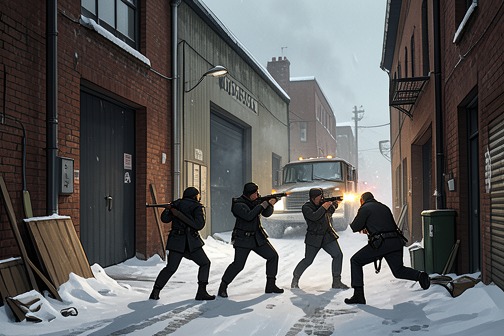
[Jack Twist](entity:character-recall-character-jack-twist-b2feffa09d4e)’s crew turns a meticulously planned robbery of a [Fratellanza](entity:organization-recall-organization-fratellanza-638ae8298b7b) money depot in Trenton into a desperate escape through gunfire and oncoming vehicles. The heist succeeds because Jack has exploited the warehouse’s legitimate business to defeat its security; the getaway depends on his ability to improvise when the mob’s reinforcements close in. By the end, the three men are free, their stolen cash intact, and Jack’s insistence that he is no hero has been set against a later recognition that he was wrong.
## The target and the plan
The warehouse serves two economies at once. It is a functioning storage business for legitimate clients and a collection point for narcotics proceeds from across New Jersey. Couriers bring cash in suitcases, flight bags, cardboard boxes, and Styrofoam coolers, especially on Sundays and Mondays. On Tuesdays, mob accountants calculate the week’s profits; on Wednesdays, tightly banded stacks of bills leave for cities including Miami, Las Vegas, Los Angeles, and New York, where the Fratellanza’s investment advisers put the money to work. The scale and routine of this operation make the warehouse a major way station in the mob’s cash network, not merely a convenient stash.
To get past its nighttime alarms and locked doors, Jack uses the overlap between the warehouse’s criminal purpose and its legitimate shipments. Working from his apartment, he accesses the warehouse’s computer systems and those of a reputable client, then prepares electronic paperwork authorizing delivery of a large crate. The crate arrives that morning and is stored according to the instructions. Jack, Mort, and Tommy are concealed inside it; five hidden exits allow them to get out even if other crates surround them. Shortly after eleven that night, they emerge and surprise the tough men in the office, who had trusted the alarms and locks to make the building invulnerable. The crew ties up three of them and takes four heavy bags of cash. Jack’s joke that they are merely another layer of middlemen turns the mob’s own chain of financial intermediaries into a description of the robbery.
## The getaway turns dangerous
A few minutes before midnight, Jack leaves the warehouse and encounters an unexpected enforcer stepping from a gray Ford van. A passing freight train has masked the van’s arrival. Outside, the night is dark apart from four weak, grime-dimmed security lamps; one throws enough sickly light to reveal the passenger getting out. Jack recognizes the man as serious trouble but hesitates instead of drawing his .38 and shooting. He backs into the warehouse, shuts the door, and moves aside in case someone fires through it.
Inside, [Mort Gersh](entity:character-recall-character-mort-gersh-a7b77c200dca) and [Tommy Sung](entity:character-recall-character-tommy-sung-def6ecc555d0) have been following Jack. Their earlier satisfaction at the successful robbery has given way to alarm. Jack is the organizer, and when a plan meets an unforeseen problem, the others expect him to improvise. Tommy proposes hiding again inside the crate and waiting until the search has passed. That suggestion offers concealment rather than an immediate fight, but the escape that follows is made by force: Jack puts the Mack truck in motion while its heavy rolling door is only about two-thirds raised.
Jack tells his companions to keep their heads down, releases the brakes, pops the clutch, and accelerates beneath the partly open door. Gunfire erupts as the men outside realize the break is coming from the first bay. Bullets strike the truck, but do not pierce its cab or shatter the windshield. A Dodge van sweeps to the bottom of the ramp to block the exit. Jack does not brake. He drives the Mack into it, shoving the smaller vehicle backward until it tips onto its side and slides fifteen or twenty feet across the macadam. The collision throws Mort and Tommy forward against the dashboard and into the cramped space below; both cry out in pain. Jack, held by his safety belt, wrestles the truck around as it lurches and threatens to tip during the turn toward the road.
## The pursuit is broken
At the corner of the building, Jack brakes and waits for the next opening. The Ford’s headlights appear from the right, approaching from the front of the factory. He holds until the beams pass across the Mack’s front, then accelerates. The truck cannot move quickly from a standstill, and the Ford passes directly across its path. Jack catches its rear end. The impact sends the van spinning twice around on the icy parking lot before it crashes nose-first into a mustard-colored cargo trailer.
Jack judges that the men in the wrecked Ford cannot immediately emerge and shoot, but does not linger to find out. He turns the Mack past Harkwright Custom Foam Packaging, reaches the main service road, and heads away from the Fratellanza warehouse toward the industrial park entrance and the city streets beyond. The crew is not followed. The escape has depended on a series of abrupt reversals: the quiet, concealed entry gives way to exposed flight; the intended route is replaced by a truck’s momentum; and the vehicles sent to stop the crew instead become obstacles Jack drives through or into.
## Aftermath and significance
The time is 1:12 a.m. on Wednesday, December 4. Tommy observes that the lanes are heavily covered with salt and cinders and expects the route into the city to be all right. Mort remains glum, calling it a bad night. Jack counters that they are all millionaires and reminds Mort that he is sitting on a fortune. Mort blinks in surprise and admits that this takes some of the sting out of the ordeal; Tommy laughs. Their exchange does not erase the danger or the pain of the collisions, but shifts the immediate measure of the night from survival alone to the enormous cash reward.
A few miles later, Jack says, “I'm no damn hero.” The narration returns to that judgment from the vantage of days to come: when Jack remembers saying it, he will wonder how he could have been so wrong about himself. The robbery therefore closes on more than a successful escape. Its action establishes Jack’s capacity to command under pressure, while its retrospective turn marks his own understanding of that capacity as unfinished. The man who hesitates at the first sight of the enforcer nevertheless leads the truck through gunfire, rams the blocking van, and breaks the pursuit; the later reassessment is already contained in the contrast between his self-description and what he has just done.
Event 11
Dom arms and barricades his bedroom while sleepwalking; Parker comes to the rescue
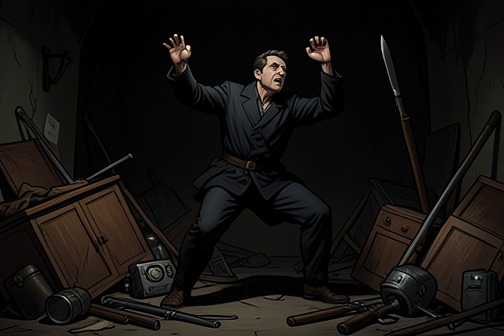
[Dom arms and barricades his bedroom while sleepwalking; Parker comes to the rescue](entity:event-recall-event-dom-parker-313e2c370931) is a night-time crisis in which [Dom Corvaisis](entity:character-recall-character-dom-corvaisis-d9ce4fde805e)’s private terror becomes a physical obstacle to his own safety. After a day at Las Brisas that yields no answers, he wakes from a nightmare in darkness, surrounded by overturned furniture and weapons he does not remember gathering. [Parker Faine](entity:character-recall-character-parker-faine-0e53d8b2c0c1) forces his way inside, answers a help call Dom cannot recall making, and recognizes that the sleepwalking has become serious enough to require another medical examination.
## Dread Before Sleep
Dom and his companions leave Las Brisas late in the afternoon without finding answers. That night, as he goes to bed, he is already filled with dread, wondering where he will find himself in the morning. The episode’s danger therefore begins before the nightmare: sleep, ordinarily a period of unconsciousness and rest, has become for Dom an uncertain passage into actions he cannot remember or control.
He wakes with a shrill scream in total darkness, convinced that something cold, clammy, strange, and alive has hold of him. He strikes out, claws, twists, and kicks until he gets free, then scrambles on hands and knees and ends with his back against a corner. The room offers no clear view of what he is fleeing. Noise builds around him—shouting, hammering, crashes, and splintering wood—while his grogginess and panic distort its source. He believes the imagined creature has finally found him, despite his earlier attempts to hide by sleeping in closets and behind the furnace. The dream’s unseen threat and the real pounding outside his room arrive together, leaving him unable at first to distinguish nightmare from rescue.
## A Bedroom Turned into a Stronghold
The voice calling his name eventually cuts through the confusion. Someone shouts, “Dom!” and then, “Dominick, answer me!” Dom does not immediately understand that the caller is Parker. By the time he wakes fully, the clammy creature has resolved into a figment of a dream, but the physical damage around him is real: Parker has battered down the locked bedroom door and destroyed its lock. The hall light enters only after another crashing sequence, making the opening of the room a literal breach in the darkness Dom has tried to seal off.
The door was not the only barrier. While asleep, Dom had pushed a dresser in front of it, stacked both nightstands on top, and placed the bedroom armchair in the way. Parker’s forced entry has toppled the improvised barricade into a heap on the floor. Dom had also drawn the draperies tightly shut and moved a highboy in front of the window, blocking a second route into the room. These are not arrangements he remembers making; they are evidence of purposeful activity carried out beyond his waking awareness. The room has been reorganized as a defensive enclosure, with the doors and window treated as possible points of entry.
The bed reveals a more dangerous escalation. When Parker’s shocked reaction draws Dom’s attention to it, Dom sees the .22 automatic he usually keeps in his nightstand, a butcher’s knife, two other meat knives, a cleaver, a hammer, and the ax used for splitting firewood. The ax, as far as Dom remembers, had been in the garage. The objects belong to ordinary domestic and household use, but together they form an arsenal arranged for an attack Dom cannot identify. Parker asks whether Dom expected a Soviet invasion and what frightened him; Dom can only connect the weapons to something in his nightmares. He cannot recall what the nightmare was.
## Parker’s Intervention
Parker has not come by chance. He tells Dom that Dom phoned him no more than ten minutes earlier, shouted for help, said that “they were here and were going to get you,” and then hung up. The call had carried the same threatening conviction as the nightmare, but it reached Parker as an urgent plea. Dom has no memory of making it, just as he has no memory of moving the furniture, closing off the window, or collecting the weapons. When he understands that he called in his sleep, humiliation settles over him; the episode has exposed to another person a loss of control he had not chosen to disclose.
Parker, a painter who suspected that the call was connected to Dom’s sleepwalking, decides against calling the police. He believes Dom would not want the matter exposed to strangers, including a group of officers. Instead, he stays with him and responds to the immediate physical and medical danger. The intervention is practical and personal: Parker breaks through the barricade, checks whether Dom is all right, and helps him move from the corner toward the next steps. His presence turns the scene away from the imagined invasion and toward care from someone Dom trusts.
## Aftermath and Significance
Dom remains on the floor at first, too exhausted and weak-kneed to stand. He cannot remember the dream that produced the terror, and the account he can give Parker is limited to the uncertainty that something in his nightmares frightens him. The gap between the elaborate precautions made in sleep and the missing memory that follows is central to the incident: Dom’s body has acted with apparent purpose, while his waking self cannot explain the action or recover its immediate cause.
Parker tells him to shower and get dressed, offers to prepare breakfast, and proposes that they visit Dom’s doctor as soon as the office opens so that the doctor can take another look at him. Dom nods. The date is December 2. The episode ends not with an explanation for the nightmare, but with a concrete change in the response to Dom’s condition: the sleepwalking is no longer merely a disturbing private symptom. It has led him to barricade himself, gather an assortment of weapons, and summon help without remembering it. Parker’s rescue makes that escalation visible, while the planned medical visit leaves its cause unresolved.
Event 12
Fratellanza warehouse heist
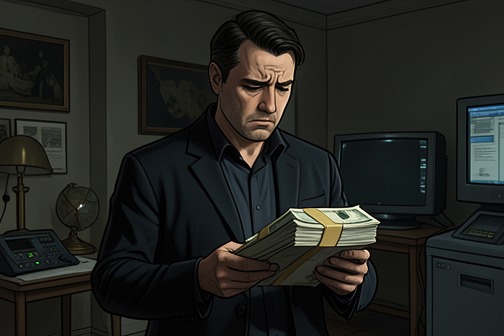
The [Fratellanza warehouse heist](entity:event-recall-event-fratellanza-ae169030242e) was a major robbery carried out by [Jack Twist](entity:character-recall-character-jack-twist-b2feffa09d4e) and his associates five days before he visited [Jenny](entity:character-recall-character-jenny-0118fe89ab5a) in her private sanitarium. They escaped with more than $3.1 million, yet the haul brought Jack neither triumph nor the familiar exhilaration of a successful crime. The heist therefore matters as both a financial windfall and a measure of how far his inner life had shifted.
## The Robbery and Its Proceeds
The group managed to open one of the warehouse’s two safes. It contained more than $3,100,000 in untraceable twenty-, fifty-, and hundred-dollar bills, leaving each participant with more than a million dollars. The scale and ready anonymity of the cash made the robbery a spectacular success by ordinary criminal standards.
Five days later, Jack still had not begun converting his share into cashier’s checks and other negotiable instruments for deposit by mail in his Swiss accounts. He kept the money instead, taking thick, tightly banded stacks from the bag and turning them over in his hands. The cash was not simply unspent; he was waiting for possession of it to produce a satisfaction that had not arrived.
## A Windfall Without Triumph
Jack’s response to the warehouse proceeds echoed his reaction to the jewelry stolen in an earlier job. He had delayed disposing of the jewels because he wanted to extract some satisfaction from them, but their possession had left him troubled by his lack of feeling. The cash offered no better reward. Its scent, usually exciting to him, stirred nothing; he felt neither clever nor lawless, nor superior to the people whose orderly lives he had once scorned. What remained was emptiness.
The robbery also followed unusually soon after Jack’s previous operations. He normally committed one job every three or four months, but only five weeks separated the jewelry-store robbery and the warehouse heist. His dissatisfaction after the jewelry job had prompted him to move on sooner than usual. Because the same absence of pleasure persisted after the warehouse job, he could not explain it away as discomfort at stealing from fellow thieves rather than from a legitimate business.
## Significance in Jack’s Arc
Jack considers whether money had always been the real purpose of his work, with rebellion and defiance serving merely as rationalizations. He has already set aside enough to support himself in comfort and to care for Jenny even if she lived out a normal lifespan in her coma, which he considers unlikely. The two recent robberies thus confront him with a question that wealth cannot settle: if he has already secured the money he needs, what was the crime supposed to give him?
He cannot accept that the thrill had been only a means to an end. He remembers the feelings he once had and recognizes that he misses them now. The heist’s outcome is consequently an inversion of its material success: Jack has gained more than a million dollars, but the expected emotional reward has disappeared. The unconverted money and unused jewels become evidence of a changed relationship to the criminal life that once defined him.
Event 13
Ginger Weiss's blackout after the aortic transplant surgery
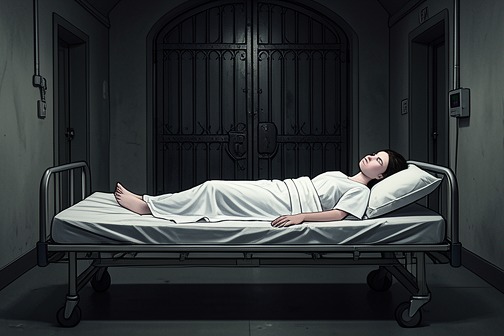
[Ginger Weiss's blackout after the aortic transplant surgery](entity:event-recall-event-ginger-weiss-87a740d1a996) becomes a crisis not because doctors discover a lesion, but because they find nothing at all. After a fugue following the aortic graft on Viola Fletcher, Ginger is admitted to [Boston Memorial](entity:location-recall-location-boston-memorial-85b81dd3f87c); the absence of a physical explanation leaves her facing a psychological illness that may end the surgical future she had nearly reached.
## After the [Fugue](entity:concept-recall-concept-fugue-b854bb03ebe0)
On Friday, four days after the episode, Ginger remains a patient at Boston Memorial. [George Hannaby](entity:character-recall-character-george-hannaby-fb6a7ba2531f) had led her out of a snowy alleyway where she had regained consciousness, and she was admitted to the hospital. For three days, her colleagues subject her to an exhaustive investigation: an EEG, cranial X-rays, sonograms, pneumoventriculography, a lumbar puncture, an angiogram, and repeated procedures to cross-check the results.
The tests search for a wide range of possible causes, including tumors, cysts, abscesses, clots, aneurysms, abnormal intracranial pressure, and signs of infection or bleeding. The breadth of the workup makes the eventual answer more unsettling: this is not a case in which a hidden physical problem has simply escaped a cursory examination.
## The Results
At two o'clock Friday afternoon, George comes to Ginger's room with the final test results and the consultants' opinions. His decision to deliver the news himself, rather than leave it to the oncologist or brain specialist overseeing her case, makes her fear that the findings are bad. She is sitting in bed in blue pajamas [Rita Hannaby](entity:character-recall-character-rita-hannaby-0552fc62d74f) fetched from Ginger's Beacon Hill apartment, reading a paperback mystery and trying to believe that her seizures have an easily corrected cause.
Instead, the tests reveal no disease, injury, or congenital defect. When George explains that her fugue flights have no discernible pathological cause, Ginger loses the composure she has maintained since crying in the alley. She weeps quietly, with anguish. The blankness of the medical results does not reassure her: it removes the possibility that an identifiable bodily condition can be treated and cured.
## Consequences for Ginger
The specialists' conclusion is that Ginger's problem is psychological, beyond the reach of surgery, antibiotics, or drugs intended to control a physical disorder. The narrative presents psychotherapy as the remaining hope for ending repeated fugue episodes, while stressing that its cure rate for such patients is low. A fugue may also indicate incipient schizophrenia, and the prognosis offered to Ginger includes a small chance of managing the condition and living normally alongside a dismayingly high risk of institutionalization.
The diagnosis strikes at the point when Ginger is closest to the career she has pursued: she is only months away from establishing her own surgical practice. Even if psychotherapy allows her to control the episodes, she will not be able to obtain a medical license. The distinction between a potentially correctable physical ailment and a psychological condition therefore becomes a reversal in her prospects: surviving the crisis does not mean she can return to the profession that has shaped her ambitions.
## George's Care
After the diagnosis, George responds to Ginger's distress with practical gestures rather than further explanation. He takes tissues from the box on the nightstand, pours her a glass of water, and gives her Valium despite her initial resistance. He holds her hand and speaks softly until she gradually calms. His care offers immediate comfort, but it cannot resolve the uncertainty the tests have exposed or undo the threat to Ginger's independence and career.
Event 14
Ginger Weiss's negative test results
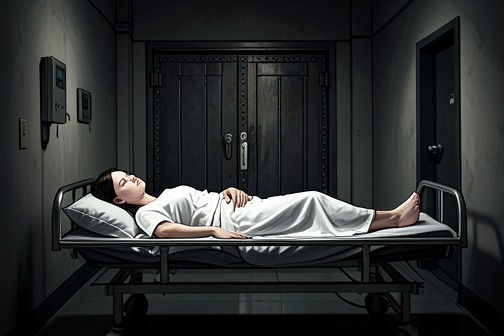
[Ginger Weiss](entity:character-recall-character-ginger-weiss-c0c2e7ef6acc)’s negative test results at [Boston Memorial](entity:location-recall-location-boston-memorial-85b81dd3f87c) turn an exhaustive search for a physical explanation into a devastating uncertainty: her fugue episodes had no discernible pathological cause, and the prospect of a medical career seemed to vanish with the diagnosis. The results arrived four days after the fugue that followed her operation on Viola Fletcher, when [George Hannaby](entity:character-recall-character-george-hannaby-fb6a7ba2531f) had led her out of a snowy alley where she had regained consciousness.
## The Search for a Physical Cause
For three days, Ginger’s doctors subjected her to an extensive battery of tests, repeating several procedures to cross-check the findings. The workup included an EEG, cranial X-rays, sonograms, pneumoventriculography, a lumbar puncture, and an angiogram. They examined her brain for tumors, cystic masses, abscesses, clots, aneurysms, and other abnormalities; considered malignancies affecting the perineural nerves; and checked for chronic intracranial pressure. They also analyzed spinal fluid for abnormal protein, bleeding, low sugar that might indicate bacterial infection, and signs of fungal infection.
The rigor of the investigation reflected more than the availability of modern diagnostic tools. Ginger’s physicians were conscientious in their care, and she was one of their own colleagues. On Friday afternoon, George brought her the final results and the consultants’ last opinions himself, rather than leaving the news to the oncologist or brain specialist overseeing the case. Ginger, in blue pajamas [Rita Hannaby](entity:character-recall-character-rita-hannaby-0552fc62d74f) had fetched from her Beacon Hill apartment, was reading a paperback mystery and trying to believe the seizures had a readily correctable cause. George’s personal visit made her suspect otherwise.
## What the Results Meant
The tests found no disease, injury, or congenital defect. With no physical cause identified for Ginger’s fugue episodes, the specialists’ conclusions pointed toward psychological illness rather than a condition that surgery, antibiotics, or medication could straightforwardly correct. Psychotherapy offered the only hope of ending the episodes, but the prospects were uncertain: the doctors could not claim a high cure rate for patients with recurring fugues, which could also be an early indication of schizophrenia. The assessment left open the possibility that Ginger might manage the condition, while making institutionalization a serious risk.
That distinction made the negative findings more frightening, not less. A physical ailment might have proved treatable, allowing Ginger to return to surgery after recovery. Even if psychotherapy helped her control the fugues, she believed the illness would prevent her from obtaining a license to practice medicine. The results arrived when she was within months of beginning her own surgical practice, turning a period of professional promise into an abrupt threat to the future she had worked toward.
## George’s Response
As George explained the findings, Ginger’s composure gave way. She wept quietly, with the anguish of someone confronting not a single diagnosis but the loss of a reassuring, repairable explanation. George took tissues from the bedside box, poured her water, and gave her Valium after she initially resisted. He held her hand and spoke gently to reassure her. His care could not undo the medical conclusion or its consequences, but it answered the moment with practical tenderness rather than clinical detachment.
Event 15
Dom Corvaisis sleepwalks to the bathroom sink

[Dom Corvaisis sleepwalks to the bathroom sink](entity:event-recall-event-dom-corvaisis-8ffb6eaab40b) in an episode that changes the pattern of his nights: for the first time, he remembers part of the nightmare that drives him from bed. The remembered scene makes an ordinary sink seem like the instrument of an attempted killing, while his waking discovery that he is actually at home does not explain why the dream’s room feels different. Before returning to sleep, he whispers about the moon, an unexplained phrase that gives the episode an unsettling final turn.
## Context and escalation
By Thursday, [Dom Corvaisis](entity:character-recall-character-dom-corvaisis-d9ce4fde805e) had resumed work on his novel, and on Friday his editor in New York reported excellent prepublication reviews and rising bookseller excitement. The news briefly restored a sense that his life was back on course. Against this outward improvement, however, his sleepwalking continued: on earlier nights he had been unable to recall even the smallest detail of the nightmares that sent him wandering. Saturday brings a change not because the behavior stops, but because the dream breaks into waking memory.
The change has two possible meanings for Dom. Remembering more might help him identify the anxiety behind his nocturnal wandering, as he later reasons; yet the memory arrives as a vivid scene of helplessness and terror. The episode therefore offers the possibility of insight without providing comfort. His increasing access to the dream is also inseparable from the frightening image it restores.
## The remembered nightmare
In the final minute or two of the dream, Dom is in a blurred, half-glimpsed bathroom. One unseen person holds him upright against his weakness while another forces his head toward the sink. He feels physically unable to resist: his knees quiver, his stomach turns, and he cannot speak or draw breath. The dream gives him the conviction that he is dying and that he must escape, but denies him the strength to do so.
The description narrows from his failing body to the sink only inches from his face. He can make out the smooth porcelain and chrome-plated rim of an old-fashioned drain, with its rubber plug removed and set aside. Water runs from the faucet, circles into a miniature whirlpool, and disappears. The detail of the drain becomes the dream’s focus: to Dom it seems like a mouth that will suck him down, and he imagines that the people holding him intend to dispose of him there, perhaps through a garbage disposal. Their shouting remains unintelligible. The scene supplies no names, explanation, or confirmed real-world assailants; its two attackers belong to the nightmare as he remembers it.
## Awakening at the sink
Dom wakes screaming in his own bathroom, bent over the sink and shouting into its drain. He recoils from the opening, stumbles, nearly falls over the edge of the bathtub, and steadies himself on a towel rack. The body that had seemed unable to flee in the dream has, in waking life, carried him into the room that the nightmare made threatening.
When he finds the nerve to look again, the actual fixtures offer a concrete contrast: glossy white porcelain, a brass drain rim, and a dome-shaped brass stopper. Nothing in the basin is the imagined disposal he feared. But the contrast does not settle the episode. Dom recognizes that the bathroom in the nightmare was not this bathroom. The familiar room explains where he woke, not why his dream placed him somewhere else or why its violence brought him to the sink.
## Return to sleep and the moon
Dom considers that remembering the dream might mark improvement, since a fuller recollection could let him discover the source of his anxiety. Even so, he does not want to return to bed and risk going back to the strange place in the dream. He knows he is not supposed to take more than one Dalmane tablet in an evening, but decides that one indulgence will not hurt. He pours Chivas Regal in the living room, takes a pill with a shaky hand, drinks, and returns to bed.
As the medication and whiskey carry him toward sleep, he reassures himself that he is improving and that the sleepwalking will soon end. Then, in the darkness, he hears himself murmuring and becomes alert to the words: "The moon," he whispered thickly. "The moon, the moon." He tries to understand what he means, repeats the phrase once more, and then loses consciousness. The scene ends at three-eleven on Sunday morning, December 8, without explaining the words or establishing a connection between them and the nightmare. That unresolved utterance follows the episode’s pattern: bodily behavior and remembered images break through, while their cause remains out of reach.
Event 16
Ernie Block's strange experience beside the interstate

[Ernie Block](entity:character-recall-character-ernie-block-f9eb5d1128b4)’s strange experience beside the interstate is a moment of near-recognition: an unremarkable stretch of Nevada ground seems to call up the buried source of his recent fear of the dark, but the memory slips away before he can recover it. The scene turns a familiar drive toward the [Tranquility Motel](entity:location-recall-location-tranquility-motel-17316482b285) into a brief confrontation with a past Ernie cannot consciously reach, then lets darkness overwhelm the tantalizing possibility of understanding.
## The roadside summons
As Ernie approaches the motel, its blue and green neon sign shines against the twilight. He is close enough to home that he begins slowing down, unwilling to risk being stopped by a police officer. A mile ahead, the motel is the only building in the broad landscape. Then, three-quarters of a mile from home, Ernie looks south, away from the road, and finds himself seized by the conviction that a particular piece of land across the interstate matters to the changes taking place in him.
Nothing visibly distinguishes the half-mile-ahead plot from the surrounding acres. Ernie has passed it countless times without interest. Yet its sloping contours, arroyo, sagebrush, grass, and scattered rock outcroppings now seem to demand investigation. The land’s apparent significance is not an explanation he can articulate; it is an urgent, bodily certainty. He even imagines that the place is pointing toward part of the answer to his fear of night, though he immediately recognizes how irrational that idea sounds.
He pulls onto the shoulder about a quarter-mile from home, near the exit ramp to the county road leading past the motel. Leaving the van idling, he crosses the interstate to get a better view. He clambers down into the twenty-foot-wide median gully, scrambles up the far slope, waits for three large trucks to pass, and crosses the eastbound lanes in their wake. His heart pounds with excitement, and for a moment the approaching night drops out of his attention. On the far berm, the cold wind brushes his exposed, close-cropped gray hair beneath his bulky suede jacket.
## A memory that will not return
The promise of an impending revelation gives way to a more disturbing possibility: perhaps something has already happened to Ernie at this place, and that forgotten experience explains his recent fear of the dark. He cannot reconcile the thought with his sense of himself. He considers himself neither forgetful nor someone who represses unpleasant memories. Yet the prickling at the back of his neck persists, as if the site were stirring something deeply buried in his subconscious.
Ernie plants his feet wide on the berm and strains to resurrect the place’s supposed memory. The harder he tries to grasp the revelation, the more quickly it recedes; then it disappears altogether. The tingling subsides, his racing heart gradually settles, and the extraordinary landscape becomes ordinary again. The land that had seemed charged with meaning now looks indistinguishable from countless other stretches of high plain between [Elko](entity:location-recall-location-elko-6d564a531c69) and Battle Mountain. Ernie is left bewildered and somewhat dizzy, unable to explain why he crossed the highway in such a state of expectation.
The experience offers no recovered scene and identifies no definite past event. What it does establish is a troubling connection in Ernie’s own mind: this particular patch of ground seems linked to his recent fear, and the link feels like the return of something his conscious memory cannot supply. The scene therefore brings him to the threshold of recognition without allowing him to cross it. Its central revelation remains incomplete, held in the gap between his powerful sense that the place matters and his inability to say why.
## Darkness forces his retreat
Ernie’s attention shifts abruptly when he realizes how little daylight remains. The eastern sky is purple-black, and only a few minutes of vague light linger in the west. For a short time, the mysterious pull of the land had proved stronger than his fear; now the approaching darkness takes command. He bolts across the eastbound lanes in front of a motor home, heedless of the horn and of the danger because he feels the dark pressing in on him.
He falls as he enters the shallow divider gully, scrambles upright, and flees across its far side and the westbound lanes without checking for traffic. In his panic, darkness seems to rise from the hollows in the land and from beneath the rocks. At the van, even the black space under the vehicle feels threatening to him, as though it might seize his feet and pull him underneath. He yanks open the door, climbs into the cab, slams it shut, and locks it.
The van makes him feel better, but not safe. Because the motel is only a quarter-mile away, he can continue; otherwise, he believes the fear might have left him frozen in place. Headlights push the gloom back enough to encourage him, but his shaking is so severe that he does not trust himself to rejoin traffic. He drives along the interstate shoulder to the exit ramp, passes the sodium lamps there, and turns onto the county road rather than stopping in their yellow light. After two hundred yards he reaches the Tranquility Motel, pulls into a space in front of the office, and switches off the headlights and engine.
## Significance of the episode
The scene sets two opposing forces against each other: the pull of a possible explanation and the immediate force of Ernie’s fear. At the roadside, bodily excitement briefly interrupts his established terror of night; as soon as darkness becomes undeniable, the search for understanding gives way to flight. His near-revelation therefore does not cure or resolve his fear. Instead, it leaves a precise but unanswered suspicion—that the past he cannot remember and the darkness he cannot bear may meet at this stretch of ground.
Event 17
Ernie Block receives an anonymous photo of Room 9
An anonymous Polaroid of a smiling family outside Room 9 turns an ordinary shift at the [Tranquility Motel](entity:location-recall-location-tranquility-motel-17316482b285) into a quiet disturbance: the photograph seems to presume that [Ernie Block](entity:character-recall-character-ernie-block-f9eb5d1128b4) and [Faye Block](entity:character-recall-character-faye-block-43b77274239e) know its subjects, yet neither can remember them. The couple soon forgets the picture as well. Later evidence of false memories and repeated brainwashing makes that disappearance more than a passing oddity, while leaving the sender and the family’s identity unresolved.
## The photograph and its arrival
The photograph reaches Ernie in a plain white envelope with no return address. It shows a man, a woman, and a little girl standing beside the door to Room 9, all smiling at the camera. Their shorts and T-shirts, together with the bright quality of the sunlight, lead Ernie to place the picture in midsummer. The image has the casual completeness of a family snapshot, but its arrival offers none of the ordinary context that might explain it: there is no letter, card, business card, or message on the back.
The postmark identifies [Elko](entity:location-recall-location-elko-6d564a531c69) and December 7, the previous Saturday. That small piece of ordinary postal information sharpens the mystery rather than resolving it. The photograph appears to have been taken at the motel, but the envelope supplies no date for the stay and no name for the people pictured. The objects surrounding Ernie at the desk—routine mail, advertisements, [Christmas](entity:time-recall-time-christmas-a573265d0167) cards, and his pension check—make the anonymous image feel all the more abruptly out of place.
## Recognition without recollection
Ernie studies the family and cannot recall them. Even so, his body reacts: his skin prickles, his pulse accelerates, and he turns the picture aside. The response resembles his unease after an unusual experience beside the interstate, although he cannot connect that experience to the people in the snapshot. The photograph thus produces a divide between what he consciously remembers and what his involuntary reaction seems to register. The scene does not explain the sensation; it makes the absence of an explanation part of the evidence.
When [Faye](entity:character-recall-character-faye-ad32954c4aae) is free to look, she recognizes the doorway as Room Nine but not the guests. She considers the possibility that the family stayed there, perhaps for several days, long enough for the Blocks to become acquainted with them. Ernie points out the contradiction: if the sender expected them to remember the family because of such a stay, he and Faye should remember it. He also notes that a Polaroid develops almost immediately. If the guests had intended the couple to have it, they could have left it at the motel when they were there. The image’s apparent familiarity and its missing history pull in opposite directions.
## The Blocks’ unease and the lapse
Ernie remains with the photograph after Faye returns to serving guests. He has meant to collect the mail and go upstairs, but instead stands at the desk studying the faces. Before that, he had put the picture aside and kept his eyes on Faye, whose calm presence helped him stop shaking. The contrast matters: ordinary hospitality and the reassuring routine of the motel briefly steady him, while the family image draws him back into an anxiety he cannot name.
The photograph does not lead the Blocks to a solution. On the following Saturday, near dawn, Faye is confident that she and Ernie will get through their current difficulties by working together, as they have before. By then, however, both have forgotten the unidentified Polaroid they received earlier in the week. The lapse reverses the scene’s original tension: an image that seemed difficult to look at simply vanishes from their conscious account of events. The narration does not identify the cause of this forgetting at that moment, but its timing becomes significant as the novel reveals how readily memories can be obscured.
## Later revelations about manufactured memory
[Ginger Weiss](entity:character-recall-character-ginger-weiss-c0c2e7ef6acc) later considers what brainwashing would mean for a person’s past. She reasons that captivity would leave an empty stretch of time, but [Pablo Jackson](entity:character-recall-character-pablo-jackson-48e95f0b1940) explains that false recollections could be implanted to cover the missing days. In her own recalled stay at the motel, Ginger can describe the place in detail while failing to remember the books and television programs she says she used to pass the time. Pablo recognizes those activities as artificial memories: they fill a gap but do not have the convincing texture of experiences that actually happened. When he presses her for specifics, her voice stays flat and her face tightens with anxiety.
Pablo does not force the issue at once. He understands that abruptly challenging Ginger’s imposed recollections or pushing her toward the memories behind the [Azrael Block](entity:rule-recall-rule-azrael-block-05e13f0af70c) could precipitate a coma or worse. Instead, he carefully establishes the span of time taken from her. His caution clarifies the stakes of apparent remembering: a person may sincerely repeat a recollection that has been planted, while the truth remains inaccessible and potentially dangerous to recover.
[Dom Corvaisis](entity:character-recall-character-dom-corvaisis-d9ce4fde805e) later applies the same suspicion to the Jamisons, visitors whom Faye remembers offering the Blocks a place to stay during an evacuation. He doubts that their recollection can confirm what happened, since they may have witnessed the same event and then had their memories scrubbed; what they remember may be what they were instructed to remember. Still later, [Parker Faine](entity:character-recall-character-parker-faine-0e53d8b2c0c1) finds members of the [Salcoe family](entity:character-recall-character-6f0127ab7d97) lying blank-eyed with earphones connected to a tape recorder. A soothing recorded voice supplies a detailed account of a hotel stay, while new false memories are being implanted to cover a fresh period of brainwashing. These later scenes do not identify who sent the Polaroid or establish that its family is connected to any particular operation. They do, however, place the Blocks’ forgotten photograph within a broader pattern in which memory can be replaced, rehearsed, and made to disappear.
Event 18
The first appearance of the ring-shaped marks on Brendan Cronin's palms
[The first appearance of the ring-shaped marks on Brendan Cronin's palms](entity:event-recall-event-brendan-cronin-e3f6fb1940b2) interrupts a quiet act of care with a physical mystery that will not stay put. While he settles [Emmy Halbourg](entity:character-recall-character-emmy-halbourg-ba50d86bb861) into bed, he discovers two precise, raised red rings on his hands; after a doctor finds them inexplicably gone, they return in the darkness following another black-glove nightmare, then fade as he watches. The episode makes his body itself a site of uncertain evidence: visible, tangible, and yet unstable.
## The marks appear while Brendan cares for Emmy
Brendan has just stroked Emmy's hair, lifted her from her wheelchair, and tucked her into bed. As he draws the covers over her thin legs, his tenderness coexists with a surge of anger. The feeling recalls the rage that overtook him during Mass at St. Bette's two Sundays earlier, when he threw a sacred chalice; in this moment he thinks that, had a chalice been nearby, he would have thrown it against the wall again. The recurrence links the marks' first appearance to an emotional state already associated with an earlier loss of control, without establishing that the anger caused them.
Emmy notices something Brendan has not. She asks whether he has hurt or burned his hands, prompting him to look down and turn his palms upward. Each bears a sharply bounded ring of inflamed, swollen flesh, two inches across. The irritated band is no more than half an inch wide; inside and outside it, the skin looks normal. The circles are so exact that they resemble paint, but Brendan can feel the raised tissue when he touches one. Their crisp geometry makes them more than a vague sensation: they are a concrete alteration of his body, available to another person’s notice as well as his own.
The moment also occurs amid Brendan's unresolved crisis of faith. [Father Stefan Wycazik](entity:character-recall-character-father-stefan-wycaz-8bcbf4db75a8)'s remembered appeal to the courage of suffering children has moved him, but it has not restored his belief in a compassionate God. Brendan remains deeply affected by the children's courage rather than persuaded by the religious explanation offered to him. His angry thoughts and the physical marks therefore arrive together in a scene where care, suffering, faith, and doubt are already in tension; the narrative presents that conjunction, but does not explain it as a supernatural sign or a bodily response to emotion.
## A medical examination cannot account for them
Brendan seeks medical attention, and Dr. Heeton tests ordinary explanations against the marks' appearance and circumstances. A burn seems unlikely because Brendan would remember contact with something hot and would have felt pain; acid contact is also set aside. A radiation burn does not fit, and Brendan explains that although he had taken a little girl to radiology, he had not remained in the room during the X-rays. Dr. Heeton also considers a fungal infection in the ringworm family, but the marks lack scaling and itching, while their edges are unusually well defined for that kind of inflammation.
The examination produces no diagnosis. When Dr. Heeton looks at Brendan's palms once more, he reacts with surprise: the rings have disappeared. Their disappearance occurs in the presence of the person attempting to inspect them, turning a visible symptom into an absent one before the medical inquiry can settle what it is. The doctor’s inability to match the marks to likely causes does not prove an extraordinary explanation; the episode leaves the cause unresolved.
## The marks return with the nightmare
That night, in his room at the Holiday Inn, Brendan again has the nightmare he had already experienced twice during the preceding week. He dreams that he is lying in an unfamiliar place, his arms and legs restrained by straps or braces. Hands emerge through a haze, covered in shiny black gloves. The recurrence supplies a disturbing pattern around the palm marks, but not a confirmed explanation for them: the dream features gloved hands, while the waking episode concerns Brendan's own hands, and the narrative does not establish a direct connection.
Brendan wakes in sheets soaked with sweat and sits against the headboard while the dream recedes. In the dark he brings his hands to his face to wipe away the sweat; when his palms touch his cheeks, he goes rigid. He switches on the lamp and sees the swollen, inflamed rings again. This time they do not simply vanish between examinations: he watches them fade. The event's rhythm—appearance, disappearance under a doctor's scrutiny, return after the nightmare, and fading in the light—makes visibility itself unreliable. The marks are not merely reported from memory; they repeatedly become present and absent within Brendan's experience.
## Significance and unresolved cause
The episode introduces the red rings as a recurring bodily phenomenon associated in sequence with Brendan's caregiving, his continuing turmoil over faith, and a nightmare of restraint and black gloves. It offers no settled link among those elements. Emmy's attention first makes Brendan inspect his palms; Dr. Heeton's examination fails to identify a cause; and the nighttime recurrence gives the marks a place in the same unsettling pattern as the dream. Each shift changes the status of the evidence without resolving its meaning.
The rings' exact dimensions and palpable raised edges give the scene a clinical specificity, while their sudden disappearance frustrates the very process that might make them medically legible. Their return does not turn the event into a diagnosis, and the nightmare does not establish a memory or encounter behind them. By ending with the marks fading as Brendan watches on Thursday, December 12, the episode leaves him with neither a stable symptom nor an explanation—only the knowledge that the rings have appeared, vanished, and appeared again.
Event 19
Brendan Cronin hurls the chalice during Mass
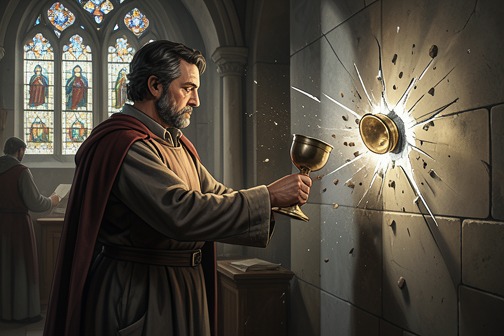
[Brendan Cronin](entity:character-recall-character-brendan-cronin-2fbbbf142f5f)’s chalice-throwing during Mass turns his crisis of faith into a public, physical act of protest. Remembered later while he cares for Emmy, the outburst links his anger at innocent suffering to a deeper conflict: he is profoundly moved by children’s courage, but that feeling does not persuade him that a compassionate God exists.
## Causes and Background
Two Sundays before Brendan’s later visit with Emmy, he had been at Mass at St. Bette’s when his rage over suffering broke through. His anger was not simple indifference to faith: he was deeply affected by what innocent children endured. Yet their courage did not restore his belief in God, nor did the possibility of divine compassion console him. The gap between his response to human resilience and his inability to believe becomes the pressure behind the outburst.
## The Outburst
At Mass, Brendan hurled a sacred chalice against the wall. The act gave outward force to a conflict otherwise carried inwardly: anger at suffering, grief for those who endure it, and a faith that could not make that suffering intelligible to him. The chalice, an object of worship, became the instrument of his defiance; the gesture made his crisis visible within the ritual setting where belief might ordinarily be affirmed.
## Aftermath and Significance
The memory returns when Brendan is caring for Emmy. He strokes her hair, lifts her from her wheelchair, and settles her into bed, taking care as he draws the covers over her bent legs. Her courage has moved him, but it has not answered his doubts. As he feels the same rage that filled him at Mass, he thinks that if a chalice were near, he would hurl it at the wall again. The recurrence shows that the outburst was not a resolved episode: compassion draws Brendan toward the suffering child, while anger at the suffering itself continues to strain his faith.
Event 20
Ginger Weiss's blackout at the intersection
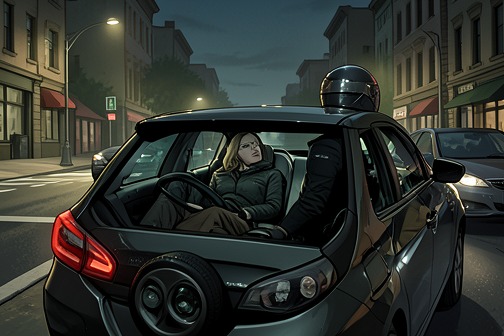
[Ginger Weiss's blackout at the intersection](entity:event-recall-event-ginger-weiss-d572fb14a8bb) turns an ordinary traffic stop into a frightening loss of control. Triggered by a motorcyclist's dark visor, Ginger disappears into a fugue and later returns to find that her episode has endangered both herself and [Rita Hannaby](entity:character-recall-character-rita-hannaby-0552fc62d74f).
## The trigger and onset
The incident begins with Ginger and Rita stopped in a Mercedes, third in line at a crowded intersection. Traffic surrounds them—cars, trucks, buses, taxis, and delivery vans—while the vehicle's muffling does little to shut out the city's noise. Searching for the source of a particularly loud engine, Ginger looks through her window and sees a large motorcycle. Its rider turns toward her, his face concealed by a helmet with a tinted visor covering him down to the chin.
The sight precipitates a sudden collapse in Ginger's awareness. For the first time in ten days, the amnesic mist returns, arriving faster than it did when she encountered black gloves, an ophthalmoscope, or a sink drain. Looking into the visor's blank, shiny surface, she feels terror take hold so completely that her breath catches and she is swept away. The ordinary surroundings remain, but Ginger is no longer consciously present within them.
## Return and immediate consequences
Ginger comes back to awareness to the sound of horns. The Mercedes is still at the intersection, but the traffic has moved on: with its engine running and gearshift in park, the car has crept ten feet toward the crosswalk and sits angled into the next lane. Other drivers are sounding their horns as they try to get around it. The lapse has lasted a couple of minutes, long enough for the stopped car to become a hazard in the crowded intersection.
Rita Hannaby is leaning across the console, gripping Ginger’s hands to keep her there. Blood stains Ginger’s skirt and jacket sleeve, but the blood is Rita’s. One of Rita’s nails has been torn, her hands are scratched and bleeding, and a long scratch marks her cheek. Rita explains that Ginger panicked and tried to leave the car; she held her back because Ginger might have been struck by traffic. Ginger’s first response is horror at having hurt the woman who has been caring for her. Rita minimizes her own injuries as scratches, then uses handfuls of tissues to move the car without spreading blood onto the steering wheel and gearshift.
## The fifth fugue in prospect
The attack marks Ginger’s fourth psychotic episode in five weeks. After the earlier triggers—the black gloves, the ophthalmoscope, and the sink drain—this episode makes the danger of another fugue immediate not only to her but to someone trying to protect her. Rita’s care has become a practical safeguard, yet Ginger is depressed by needing it and devastated that her panic has injured Rita.
On Monday, December 16, Ginger refuses to remain passively at the mercy of another attack or wait for a psychiatrist to explain what is wrong. She cannot yet say what she will do, but she resolves to act before a fifth fugue, believing she has reached bottom and has nowhere to go but up. The episode thus ends not with an explanation or cure, but with a change in stance: after being swept away by terror, Ginger determines to claw her way back toward the light.
## Narrative significance
The episode turns Ginger’s fugue from a private crisis into a danger enacted in shared space. The visor draws her attention inward, but the consequences are outward and measurable: while she is absent, the Mercedes rolls ten feet toward a crosswalk and angles into another lane, forcing the surrounding traffic to react. The car’s small displacement gives physical form to a larger loss of control; Ginger’s missing minutes have altered the position of both her body and the people around her.
Rita Hannaby’s intervention makes care simultaneously protective and costly. She holds Ginger back from the traffic, preventing a possible collision, but emerges scratched and bleeding herself. When Ginger returns, the blood on her clothes first confronts her with the harm done to someone who has committed herself to helping her. The scene therefore changes the meaning of dependence: Rita’s presence keeps Ginger safe, yet Ginger experiences that protection through humiliation and fear of becoming dangerous to her caregiver.
The return to consciousness offers no explanation for the visor’s power and no immediate relief from recurrence. Instead, the count of four episodes in five weeks gives the blackout a forward pressure: another attack is no longer an abstract possibility. Ginger’s resolve on December 16 to act before a fifth fugue marks the scene’s decisive shift. It does not restore control, but it replaces passive waiting with a determination to seek a way back from the crisis.
## Care and dependence
Rita Hannaby’s intervention at the intersection grows out of a commitment already established during [Ginger Weiss](entity:character-recall-character-ginger-weiss-c0c2e7ef6acc)’s recuperation. Rita has treated the rehabilitation as a cause of her own, rolling up her sleeves and devoting herself to seeing Ginger through the crisis. Ginger is moved by that concern, but the care also weighs on her: needing such sustained help leaves her depressed. At the intersection, that tension becomes physical. Rita restrains Ginger to keep her from entering traffic, and in doing so is scratched and left with bloodied hands and a cut cheek. Her protection is indispensable in the moment, while Ginger’s horror at having injured her exposes the emotional cost of dependence. The episode ends with Ginger’s decision to act before another fugue, a first assertion of agency within a crisis she still cannot explain.
Event 21
Ginger Weiss's first encounter with the man in black gloves
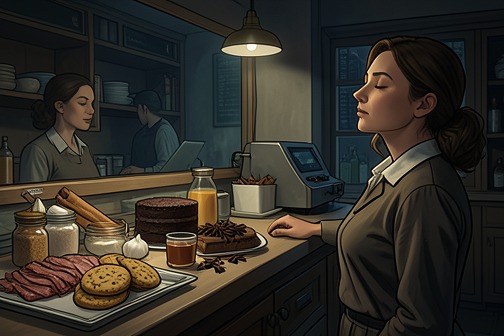
[Ginger Weiss's first encounter with the man in black gloves](entity:event-recall-event-ginger-weiss-082985f4a8df) takes place not as a present-tense meeting but as a scene recovered under hypnosis. Guided backward through time by [Pablo Jackson](entity:character-recall-character-pablo-jackson-48e95f0b1940), Ginger revisits [Bernstein's Delicatessen](entity:location-recall-location-bernstein-s-delicate-965a78c8a924) and reconstructs an ordinary collision at the counter. The moment the stranger's gloves come into view, the everyday memory breaks open: her fear arrives instantly, while its deeper cause remains beyond her grasp.
## Regression and setting
Pablo Jackson leads Ginger through a deliberate reversal of time, moving her from December 24 back through earlier dates until he places her on November 12 in Bernstein's Delicatessen. His induction gives the recollection a specific, bounded setting rather than treating her distress as a free-floating symptom. He asks her to attend to the bakery and spice smells. Ginger responds with a vivid inventory: pastrami, garlic, honey cookies, cloves, cinnamon, and chocolate pound cake. With her eyes closed, she lifts and turns her head as though surveying the shop around her.
That sensory detail establishes how fully the past has become present to her in the session. Pablo then directs the remembered action forward: Ginger has paid for her groceries and is heading toward the door, distracted by her purse. She mentions needing to clean it out. The small interruption matters to the scene's sequence: she is preoccupied, carrying the groceries in one arm, and not watching where she is going when the encounter occurs.
## The encounter
Ginger bumps into a doughy-faced man wearing a Russian hat. He catches her grocery bag before it can fall and returns it to her, apologizing for the collision. Ginger responds to him rather than to Pablo, apologizing that she was not looking where she was going. Pablo observes that, in the trance, the stranger is as real to her as he had been in the deli. The scene thus moves beyond a report about an old incident: her speech and attention are directed into the reconstructed encounter itself.
As the man holds out the groceries, Ginger notices his gloves. The detail changes the emotional register of the memory without changing its outward action. Until that point, the meeting consists of a bump, a caught bag, and mutual apology—an unremarkable exchange between strangers. The gloves transform it into a source of alarm. Their importance does not come from any threatening act by the man described here; rather, the sight of them produces Ginger's abrupt and disproportionate distress.
## Fear breaks through
Ginger sits upright and opens her eyes, exclaiming in alarm at the gloves. When Pablo asks her to describe them, she identifies them as black and shiny, then speaks in a small, quavering voice. The physical change is immediate: a memory that had been rendered through familiar smells and mundane movements gives way to visible fear. The contrast makes the gloves the scene's decisive detail, and her reaction sharper than anything in the man's conduct so far would explain.
Pablo tries to calm her, but his usual authority over a subject in trance does not restore his expected control. He ordinarily maintains total and instantaneous command; Ginger remains distressed despite his repeated effort to relax her. He is surprised and uneasy, and his questioning returns to the gloves. Her reaction shows that the memory is not simply available for orderly narration: it resists the procedure that had enabled her to revisit it.
## An unresolved connection
Asked whether this particular pair is truly what frightens her, Ginger says that it is not exactly. Pablo proposes that the gloves in the deli remind her of another pair from an incident long ago. She confirms the connection, but cannot say when that earlier incident happened or explain why it frightens her. The recollection therefore uncovers a link without recovering the event to which it leads. The man in the Russian hat is the immediate trigger, not an identified source of the original fear.
The scene's suspense lies in that partial return. Hypnosis restores the deli's sensory world and the sequence of the encounter, yet the most consequential part of Ginger's response remains inaccessible. She can recognize that these gloves recall other gloves; she cannot supply the missing history. The episode makes that gap legible without closing it: an ordinary moment of distraction and apology becomes the threshold to a deeper fear, while its origin remains outside the recovered memory.
Event 22
Ginger Weiss undergoes hypnotic regression with Pablo Jackson

[Ginger Weiss undergoes hypnotic regression with Pablo Jackson](entity:event-recall-event-ginger-weiss-pablo-jack-0bd669cefe62) in an attempt to discover why a pair of black gloves frightened her in Bernstein’s Delicatessen. The session moves backward from December 24 to November 12 and then toward an earlier, unidentified encounter. Instead of yielding a clear account, that deeper regression brings Ginger to a frightening physical crisis, forcing Pablo to abandon his questions and return her to the present.
## Purpose and Preparation
On December 24, Ginger asks Pablo to take her back to the morning of November 12, when she encountered a man wearing black gloves in Bernstein’s Delicatessen. She wants to be held at that moment and questioned until she can explain why the gloves terrified her. Her request is unusually forceful: she is not merely seeking relaxation or an account of the deli incident, but trying to reach whatever earlier experience made the sight of the gloves so disturbing.
The conversation takes place after a sleepless night. Pablo observes that Ginger has been awake for hours and treats the afternoon as a reasonable time for a drink; they settle into their chairs and sip brandy before she asks for the regression. He initially calls the procedure impossible, but eventually offers help. The episode thus begins with both a determined patient and a practitioner who is not fully confident that her request can be met.
## The Regression to November 12
Pablo prepares the room by drawing the drapes over a three-bay window and switching off the lights except for a lamp beside Ginger’s chair. Under hypnosis, she is instructed to relax and answer his questions. He then guides her backward through the calendar, moving from December 24 through the preceding days until she reaches November 12 and imagines herself waiting for an order in Bernstein’s Delicatessen.
At first, the regression produces an animated, sensory recollection. Asked what she can smell, Ginger names pastrami, garlic, honey cookies, cloves, cinnamon, and chocolate; she becomes absorbed in the imagined bakery and turns her head as if looking around it. Pablo then directs her through the deli scene toward the exit, where she is preoccupied with her purse. The sequence brings the remembered encounter with the black-gloved man back into view, but does not explain the depth of her fear.
## The Earlier Memory and the Crisis
Pablo presses Ginger to identify what other pair of gloves the deli gloves recall. When she says she does not know, he takes her farther backward, instructing her to return to the first time and place she was frightened by black gloves. Ginger’s attention fixes on a horror that is neither in the room nor in the delicatessen, but elsewhere. The setting remains unidentified; when Pablo demands to know where she is, she answers that she is nowhere, then that she is no place. She abruptly stops shaking, slackens in the chair, and says in an emotionless voice that she is dead.
Pablo discovers that Ginger’s breathing is extremely shallow, her hand cold, and her pulse weak and slowing. He recognizes that she is withdrawing beyond the ordinary hypnotic trance, and fears that the attempt to force the memory into speech is endangering her. He has encountered accounts of psychological barriers around traumatic memories, but not a reaction like this. The episode makes the limit of his method immediate: the deeper the questioning goes, the less accessible Ginger becomes, until the search for an answer appears to threaten her life.
## Abandoning the Questions
Pablo changes course and tells Ginger that she no longer has to answer. He promises to stop questioning her and concentrates instead on bringing her back to the present. Her pulse initially falters, then grows steadier; her breathing improves and color returns to her face as he reassures her. Within less than a minute, he returns her to December 24 and wakes her.
Ginger assumes the attempt failed and that Pablo could not hypnotize her. His response makes clear that the danger was not a failure to induce hypnosis: she had gone too far under. The session ends without identifying the place, event, or person behind her first terror of black gloves. Its outcome is therefore both a rescue and a failure of recollection. Ginger returns safely, but the central memory remains beyond the reach of the questions that began the session.
Event 23
Ernie Block encounters a helmeted figure in the bathroom
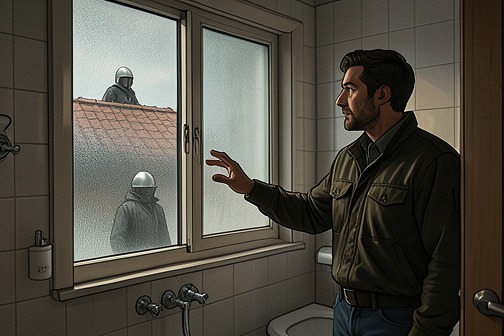
[Ernie Block](entity:character-recall-character-ernie-block-f9eb5d1128b4)’s bathroom encounter begins as an inexplicable impulse to escape and ends with a black-gloved hand reaching through an open window. A helmeted figure appears on the roof of the [Tranquility Motel](entity:location-recall-location-tranquility-motel-17316482b285), but disappears before Ernie can confirm what he saw. The scene makes the threat both vivid and uncertain: Ernie’s fear is unmistakable, while the figure itself may have been a hallucination.
## The bathroom and the urge to escape
Ernie slips out of bed quietly, first checking that [Faye](entity:character-recall-character-faye-ad32954c4aae)’s breathing has not changed. In the bathroom, he turns on the light and sits for fifteen minutes, content simply to be in its brightness. He is trying not to make Faye suspicious by staying away too long. The room is private and familiar, but the window above the bathtub will abruptly recast it as a possible route out.
After flushing the toilet as cover, Ernie washes his hands. His attention fixes on the frosted window, a pane about three feet wide and two feet high, hinged at the top to open outward. Though its opaque glass offers no view of the night, it brings a shiver and a sudden sequence of urgent thoughts: he could climb out onto the utility-room roof, reach the arroyo behind the motel, go up into the hills, and head east for help at a ranch. The imagined escape has a route and a timetable, even though Ernie cannot explain what he needs to escape from.
He realizes he has moved from the sink to the bathtub without remembering the movement. The thought of escape gathers force as he stares at the window; he steps into the tub and stands directly beneath it. The cold porcelain against his bare feet makes the scene physically immediate, but does not restore his sense of control. He is aware of a dreamy state and cannot shake it off. The window has ceased to be merely part of the room: in Ernie’s thoughts, it is an opening onto freedom, and he is already acting as though he must use it.
## The figure at the window
Ernie slides the bolt from the latch and pushes the window open without understanding why he is doing it. On the roof outside is a figure wearing a white helmet with a dark, tinted visor that hides the face. A black-gloved hand reaches through the opening as if to seize him. The moment overturns the escape fantasy: the window he had imagined as a way out has become the point through which a possible threat can enter.
Ernie recoils, steps backward, and falls over the edge of the tub. He grabs at the shower curtain, tearing it from several rings, but cannot stop his fall; he hits the floor and feels pain in his right hip. The crash brings Faye to the bathroom door. Ernie warns her to stay back and says someone is outside. Cold air comes through the open window and stirs the damaged curtain. When Ernie looks again, however, there is no one on the roof.
## Doubt and disclosure
The pain in Ernie’s hip breaks the dreaminess. Clearer-headed, he wonders whether the helmeted figure was imaginary, a hallucination. That possibility does not erase the experience: he has opened the window, fallen, injured himself, and frightened Faye. He steps back into the tub to look out again, but sees no one. At Faye’s request he shuts the window, doing so with his eyes squeezed closed against another glimpse of the night, and struggles to fasten the latch with unsteady hands.
Faye reads more in his reaction than his first explanation admits. Ernie expects concern and surprise in her eyes; what catches him off guard is her penetrating awareness. When she asks if he is ready to tell her about it, he begins by saying he thought he saw a man on the roof. Faye presses him to tell her everything. Ernie recognizes that he has underestimated her and agrees, relieved to share the burden.
They go to the kitchen in robes and slippers, where Faye makes coffee and listens while Ernie recounts what has been happening. He is embarrassed and slow to disclose the details, but she remains patient and lets him tell the story in his own way. The episode thus changes from a frightening, solitary experience into something he can share with his wife, even though the central uncertainty remains unresolved.
## Significance of the encounter
The scene’s suspense depends on the gap between Ernie’s certainty of feeling and his uncertainty about what he saw. His urge to flee is urgent and detailed, but has no clear cause; the figure is sharply described, yet vanishes before it can be verified. The physical consequences—the open window, torn shower curtain, bruised hip, and rush of cold air—give the experience weight without proving that an intruder was present.
The window concentrates that ambiguity. First it seems to offer escape; then it frames the helmeted stranger and admits the reaching hand; finally, it becomes an opening Ernie must close while shielding his eyes. Faye’s response supplies a different kind of certainty. She cannot identify the figure, but she recognizes that Ernie’s explanation is incomplete and invites him to speak. The encounter leaves its cause unsettled while ending his attempt to bear the fear alone.
Event 24
Brendan Cronin helps Winton Tolk during the sandwich-shop shootout
[Brendan Cronin helps Winton Tolk during the sandwich-shop shootout](entity:event-recall-event-brendan-cronin-winton-t-b730021e5df5), a violent crisis that turns Brendan’s anger at death into a desperate act of care. As Tolk lies gravely wounded, Brendan discovers that the raised rings on his palms have returned—an unexplained sign accompanying the officer’s unexpected survival.
## Assignment and the Shootout
[Father Stefan Wycazik](entity:character-recall-character-father-stefan-wycaz-8bcbf4db75a8) had arranged for Brendan to spend five days riding with [Chicago](entity:location-recall-location-chicago-eb77a855d5aa) police officers [Winton Tolk](entity:character-recall-character-winton-tolk-f08f71997413) and Paul Armes. Disguised in an ordinary suit, tie, and topcoat as a Church consultant studying Catholic charity outreach, Brendan had grown fond of the two officers and sympathetic to the people living in Uptown, a poor, crime-ridden neighborhood. The sandwich-shop shootout was the worst incident of his patrol so far.
The attack erupted as Winton entered the shop. Gunfire and shattering glass broke across the [Christmas](entity:time-recall-time-christmas-a573265d0167) street; two armed young men burst through the entrance, and one aimed a sawed-off shotgun toward the police cruiser. Brendan believed he had been hit, then realized the blast had shattered the front window instead. He dropped to the floor as Paul took the riot gun and moved outside, using the cruiser for cover. Another shotgun blast struck the car while Brendan tried, unsuccessfully, to pray. In the noise and confusion, he felt isolated from God and doubted that the promise of an afterlife could answer the brutal reality of death.
## From Fear to Responsibility
The gunfire and shouting outside eventually gave way to a silence so complete that Brendan could not tell what had happened. When Paul opened the car door, Brendan was still trapped between shock and helplessness. He knew only that Winton might be inside the shop, badly hurt, and that the violence had made his crisis of faith sharper: death seemed immediate and material, while the promise of an afterlife offered no comfort. The thought of Winton lying there changed his fear into anger. Brendan left the cruiser and crossed the snowy sidewalk despite Paul’s warning, intent on reaching him before it was too late.
At the entrance, Brendan passed a dead gunman and went into the shop without stopping to check whether another attacker might be hiding behind the overturned tables. The familiar order of a small lunch counter had collapsed: chairs and tables were overturned, napkin dispensers and condiment bottles lay scattered, and Winton was down among the debris. Brendan found two wounds in the officer’s chest and saw that ordinary first aid could not address their severity. Winton did not respond when Brendan spoke to him.
Brendan felt for a pulse at Winton’s neck and at first found none. The photographs of Winton’s wife, Raynella, and their children came back to him, deepening his fury at what seemed the universe’s indifference. Then he sensed a faint beat, checked again, and found a pulse that was still irregular but more definite. His certainty that Winton could not be allowed to die was not a medical judgment; it was the force driving him to remain beside the officer and keep trying.
## The Turn from Despair to Survival
Winton choked, coughed, and opened his eyes. His breathing was still wet and strained, but the pulse Brendan felt at his throat had grown stronger and more regular. Brendan lifted Winton’s head and turned it to one side so the blood and mucus could drain from his mouth; the change was immediate. Winton expelled bloody mucus and managed an unobstructed breath, then continued breathing shallowly but steadily. He remained in critical condition and needed urgent medical care, yet the scene had turned from apparent death toward survival.
The reversal mattered in a story where Brendan had just confronted the limits of prayer against violence. His response was practical and intimate: he stayed beside Winton, checked for life, and adjusted his position to help him breathe. The narration does not establish that Brendan’s touch caused the improvement, but the sequence places his hands at the center of the crisis, between the officer’s wounds and the renewed signs of life. Brendan’s conviction that Winton could not die gives way, for the moment, to the harder fact that he is alive.
## The Rings Return—and Vanish
As sirens approached, Brendan’s hands were wet with Winton’s blood. He blotted them on his coat and noticed the raised, inflamed rings on his palms: one on each hand, returned for the first time in nearly two weeks. He had previously used cortisone prescribed by Dr. Heeton at St. Joseph’s, but stopped when the marks failed to reappear. Their return at the moment Winton began to breathe again connects the physical sign to the scene’s sudden reversal without explaining what it means or how it operates.
Police officers and paramedics rushed into the shop, stepping over the dead gunman. Brendan moved aside and leaned against the service counter, exhausted, staring at his palms. As Winton was taken out on a stretcher, Brendan looked again: the rings had disappeared. The marks’ brief recurrence leaves the rescue with an unresolved second mystery. Winton’s survival is visible to everyone responding to the shooting; the signs on Brendan’s hands are fleeting, noticed in the immediate aftermath and gone before the scene ends.
## From Outrage to Care
The scene echoes [Brendan Cronin](entity:character-recall-character-brendan-cronin-2fbbbf142f5f)’s earlier act of hurling the chalice against the wall during Mass, but turns the same furious refusal of suffering toward a living person. The photographs of Winton Tolk’s wife and children sharpen that response: Tolk is not an emblem in Brendan’s argument with an indifferent universe, but a man whose life is bound to others. The shift does not resolve Brendan’s crisis of faith; it gives his anger a concrete task, as he attends to Tolk when prayer has failed him and ordinary first aid seems inadequate.
Event 25
Dom Corvaisis receives an anonymous letter urging him to search his past
At The Cottage in [Laguna Beach](entity:location-recall-location-66ef5b67f681), an unsigned note turns [Dom Corvaisis](entity:character-recall-character-dom-corvaisis-d9ce4fde805e)’s private sleepwalking into a question about his past. It arrives beside the advance copy of his first novel, but its two sentences unsettle him more deeply than the book delights him: “The sleepwalker would be well-advised to search the past for the source of his problem. That is where the secret is buried.” The message offers no sender, evidence, or explanation. Its force lies in naming the possibility that Dom’s present condition has a buried cause—and in leaving him to decide whether the warning can be trusted.
## The first warning
The note reaches Dom while he is having breakfast at The Cottage, a popular restaurant on Pacific Coast Highway. He has just opened the padded envelope containing his advance copy of *Twilight in Babylon* and is absorbed by the book when he turns to the rest of his mail. The contrast is immediate: the novel is a tangible achievement he can hold beside his plate; the anonymous sheet directs him toward a past he cannot remember. On reading it again, he feels a tremor and coldness at the back of his neck.
The message follows him after breakfast. Sitting in his car, with the novel forgotten on the seat beside him, Dom reads the note repeatedly and becomes so nervous that he nearly takes a Valium from his jacket pocket. He stops before swallowing it. To consider what the letter might mean, he decides, he needs a clear mind; for the first time in weeks, he puts chemical relief aside. At South Coast Plaza, while waiting for [Christmas](entity:time-recall-time-christmas-a573265d0167) gifts to be wrapped, he continues to take the note from his pocket and reread it. Its anonymity does not diminish through repetition. It makes the ordinary acts of shopping and waiting into intervals in which the message keeps returning.
## An authorship he cannot establish
Dom initially considers whether [Parker Faine](entity:character-recall-character-parker-faine-0e53d8b2c0c1) sent the note to shock him out of his drug-induced haze. He rejects the theory: theatrical amateur psychotherapy might seem possible, but such manipulative maneuvering does not fit Parker’s character. The question becomes more disturbing when Dom lists the only people who know he sleepwalks: himself, Parker, and Dr. Cobletz. He has ruled out Parker and is sure that Dr. Cobletz did not send it. That leaves the possibility that he wrote the warning himself without remembering it—or that someone else knows more about his condition than he thought.
At home, Dom tests the self-authorship possibility rather than accepting or dismissing it. He types the two sentences on his [IBM Displaywriter](entity:object-recall-object-ibm-displaywriter-9048da2d8017), prints them, and uses the three additional printwheels he owns to make four copies in different typefaces: Prestige Elite, Artisan 10, Courier 10, and Letter Gothic. He labels and compares them against the original. Courier 10 appears to match, a suggestive result that still proves little: the same typeface is widely available. The paper is similarly inconclusive. Both sheets are ordinary twenty-pound, 8 1/2-by-11-inch stock, with no watermark or identifying feature that would show whether the original came from his supply. His painstaking comparison narrows nothing to a secure answer. The letter can be made to look like his work, but it cannot be traced to him.
The uncertainty sharpens into two questions: who besides Parker, Dr. Cobletz, and Dom could know about the sleepwalking, and what suppressed trauma or forgotten event might lie behind it? Dom grows tense while staring out at the night beyond his study window, and the desire for Valium returns. He resists again. The note has not supplied a memory, but it has changed the terms of his anxiety: instead of merely seeking escape from his symptoms, he has begun to look for their source.
## A second message and a widening pattern
That night, Dom realizes he has not collected the mail from the curbside box. Among advertising flyers and Christmas cards is another plain white envelope without a return address. He opens it in his study and finds a single sheet bearing just two words: “The moon.” The abruptness of the message shocks him. It offers no explicit connection to the sleepwalking note, yet its arrival from the same anonymous, untraceable world makes the first letter feel less like an isolated provocation and more like the beginning of a sequence.
A later envelope postmarked New York contains no note, only two [Polaroid photographs](entity:object-recall-object-polaroid-photographs-3353f6f84d16). One shows a young priest with an unnaturally empty expression; the other shows a woman Dom recognizes without being able to recall where they met, restrained in a narrow bed with an IV in her wrist. Their appearance intensifies the unease already set in motion by the letter. The succession of a written instruction, the cryptic lunar phrase, and disturbing photographs provides Dom with fragments, not a reliable account. Their meaning must be assembled, and the possibility that his own recollections have been compromised becomes part of the investigation.
## From private suspicion to an investigation
When Dom later discusses the possibility of brainwashing with [Ginger Weiss](entity:character-recall-character-ginger-weiss-c0c2e7ef6acc), she initially reasons that an imposed memory gap ought to reveal the days spent in custody. The answer undermines that assumption: false recollections could be implanted to cover the missing interval. In a hypnosis session with [Pablo Jackson](entity:character-recall-character-pablo-jackson-48e95f0b1940), Ginger cannot genuinely recall books and television programs she claims to have used to fill time at the [Tranquility Motel](entity:location-recall-location-tranquility-motel-17316482b285). Pablo concludes that these are artificial memories, reinforced by post-hypnotic suggestions, rather than convincing recollections of lived experience. Pressing her for details makes her tense; her voice remains flat as she supplies programmed responses. The scene gives the anonymous warning a framework: a person may have a past concealed not by a clean blank, but by a substitute story.
Dom and Ginger then search old issues of the *[Elko](entity:location-recall-location-elko-6d564a531c69) Sentinel*, looking beyond the reported toxic spill and evacuation for seemingly unrelated stories that might point toward what happened during the closure of [Interstate 80](entity:location-recall-location-interstate-80-09dbb90e2ea2). They identify [Thunder Hill](entity:location-recall-location-thunder-hill-b1ea42221a8b) as a likely source of the crisis and [Shenkfield](entity:location-recall-location-shenkfield-0e9d5a5eb820) as a misdirection. At the motel, Dom also argues that witnesses such as Elroy and Nancy Jamison may remember being evacuated because that is what they were made to remember; in his account, they too could have been held and brainwashed with the others. These claims are presented as an investigation’s developing theory, not as proof supplied by the anonymous letter. The note’s lasting importance is that it directs attention away from symptoms alone and toward the possibility of a deliberately obscured history. As the witnesses reunite, their similar nightmares of restraint and decontamination-suited attendants, and their attempts to recover events together, turn Dom’s solitary suspicion into a shared search for the truth.
Event 26
Dom Corvaisis receives the anonymous “Moon” letter
[Dom Corvaisis](entity:character-recall-character-dom-corvaisis-d9ce4fde805e)’s receipt of the anonymous “Moon” letter turns a private symptom into an apparent message from beyond his own knowledge. Its two words match a phrase he has heard himself repeat in panic and typed while sleepwalking, though he has told no one about either episode. A postmark from New York, dated while he was in [Laguna Beach, California](entity:location-recall-location-laguna-beach-califor-d9891d68a1e1), makes the note harder to dismiss as his own doing and leaves him with a question he cannot yet see how to investigate.
## Finding the Letter
Carrying the earlier note and thinking as he paced through the house, Dom eventually stopped at a front window overlooking his curbside mailbox. The brick column and its metal receptacle stood under the bluish light of a mercury-vapor streetlamp. Because he kept a post-office drawer in town, the mail delivered to his house was usually limited to items addressed to “Occupant” and occasional correspondence from friends who forgot that his letters were meant to go to the other address. He realized he had not collected that day’s delivery.
Outside, with only the breeze rustling the trees and the scent of the sea in the chilly air, Dom unlocked the box. Under the lamp he could make out six advertising flyers and catalogs, two [Christmas](entity:time-recall-time-christmas-a573265d0167) cards, and a plain white business-size envelope without a return address. The contents were ordinary except for the unmarked envelope; the absence of a sender’s name made it an immediate mystery, but the message inside made it something more personal.
Dom hurried back to his study, excited and afraid, opening the envelope as he went. He pulled out a single sheet and unfolded it at his desk. It contained only two words: “The moon.” The abruptness mattered: there was no explanation, signature, or surrounding text to soften or clarify them. Dom’s response was not merely surprise. He felt as though he had entered a realm where ordinary logic no longer applied, because the note named something he believed no one else could know.
## A Phrase Kept Secret
The words echoed his recent experiences. He had awakened from bad dreams with them on his lips, repeating them in panic, and while sleepwalking he had typed them on his Displaywriter. Yet he had told neither [Parker Faine](entity:character-recall-character-parker-faine-0e53d8b2c0c1) nor Cobletz. Both episodes had happened after Dom began drug therapy, when the medication seemed to be working, and he did not want to appear to be relapsing. The phrase frightened him even though he did not understand why it held such power over him.
That secrecy had been deliberate, if also uncertain. Dom instinctively felt it unwise to discuss the development before he understood it better. He feared Cobletz might conclude that the drugs were not helping and stop them in favor of psychotherapy; Dom believed he needed the drugs. The note therefore strikes at a concealed part of his life, not a fact he had casually shared or a subject anyone around him had been invited to discuss. In the moment, he can identify no plausible person who would know both the words and their connection to his sleepwalking.
## The Postmark and the Break in Explanation
In the streetlamp’s dim light, Dom had not checked the postmark. At his desk he saw that this envelope, unlike the letter that had arrived that morning, had a legible point of origin: New York, New York, and a date of December 18, the preceding Wednesday. That date makes the postmark more than a clue about where the letter entered the mail. Dom had been in [Laguna Beach](entity:location-recall-location-66ef5b67f681) the previous week, around three thousand miles from the mailbox in which this note—and, he concludes, probably the earlier strange message—had first been deposited.
The distance sharply alters what he can believe about the letters. He had almost laughed with relief: he could not have sent the notes to himself from New York while he was in Laguna Beach. But disproving that possibility does not identify the sender. Instead, it enlarges the mystery. Someone in New York seems to have known that Dom sleepwalked and repeatedly typed the phrase, yet he cannot think of how such knowledge could have been obtained.
## An Unanswered Message
The letter offers no explicit request, explanation, or route to an answer. Dom is left asking who sent the notes and why, but sees no logical direction for an inquiry: the situation is too bizarre for him to know where to begin. The message thus changes the meaning of the sleepwalking without resolving its cause. What he had regarded for two months as the strangest and most frightening thing that had happened to him now appears to be only part of a larger, still less comprehensible disturbance.
The scene’s force comes from the collision between a commonplace delivery and an intensely private phrase. The mailbox contains routine advertisements and Christmas cards alongside the anonymous envelope; the message itself is reduced to two words, while the consequences of recognizing them multiply. The postmark gives Dom one firm fact—the letter came from New York—yet that certainty only deepens the central uncertainty. The episode ends not with discovery of a sender, but with his recognition that the unexplained messages may be connected to something stranger and more frightening than his nightwalking.
Event 27
Marcie Rykoff recalls being treated by doctors
[Marcie Rykoff recalls being treated by doctors](entity:event-recall-event-marcie-rykoff-c22047901e9f) in an account that unsettles the adults around her and exposes a sharp divide between her memory and [Jorja](entity:character-recall-character-jorja-cc334f0a308c)’s understanding of her past. The recollection is not presented as independently verified: [Marcie](entity:character-recall-character-marcie-12363d0e1b68) insists the hospitalization happened, while Jorja says she was never hospitalized. What the scene makes unmistakable is the force of Marcie’s fear, and the fragmentary, changeable way she says the memory returns.
## The account Kara hears
The episode first reaches Jorja through Kara, who raises it after asking whether Marcie is seriously ill. Jorja answers that her daughter is exceptionally healthy and has never been in a hospital. Kara explains that the subject came up while she and Marcie were making cookies. Marcie had been talking about the Little Ms. Doctor kit and said she wanted to become a doctor so she could treat herself when she became sick. As Kara recounts it, Marcie said she had once been hurt badly by doctors and did not want one to touch her again.
Kara says Marcie described being strapped into a hospital bed so she could not get out, then being stuck with needles and having lights flashed in her face. The description gives the recollection a clear shape, but it remains a child’s account repeated by an adult: the scene does not establish when or where the alleged treatment occurred, or what medical circumstances might have surrounded it. Jorja’s immediate response is categorical denial. She says the story is not true and cannot explain why Marcie would invent it.
Kara’s concern is not only the content of the story but Marcie’s reaction when gently questioned. In the kitchen, Marcie began crying and shaking; Kara says that attempts to calm her made the crying worse. Marcie pulled away, ran to the living room, and crouched behind the large green Lay-Z-Boy as if hiding from someone. Kara says it took about five minutes to stop the crying and another ten to coax her out. Marcie then asked Kara to promise that, if the doctors ever came for her again, Kara would let her hide behind the chair and would not tell them where she was. The promise turns a past-tense account into an immediate fear of recurrence.
## Jorja challenges the memory
On the drive home, Jorja confronts Marcie about what she told Kara. When Jorja asks why she made up the story about being strapped into bed, Marcie answers, “It's true.” Jorja counters that it is not. Marcie does not supply a fuller explanation; the exchange instead establishes that the disagreement is direct and unresolved. Her voice is described as little more than a whisper, so the insistence is quiet rather than argumentative.
Jorja presses for details, asking when the hospitalization happened and where it was. Marcie cannot answer either question. Asked when, she says she does not remember. Asked where, she says, “I'm not sure.” These gaps give Jorja reason to doubt the account, but they do not make Marcie retract it. When Jorja suggests she does not remember very well at that moment, Marcie agrees that her recall is incomplete, while maintaining that the experience itself is real to her.
## A memory that comes and goes
Marcie describes her access to the memory as uneven. Sometimes she remembers it better than at other times; sometimes she can hardly remember it at all. When it comes back clearly, she says, she becomes scared. On this particular day, she had remembered it vividly enough to frighten herself. The distinction matters: her uncertainty concerns the memory’s details and accessibility, not whether she believes the event happened.
The scene therefore holds two forms of uncertainty together. Jorja has no knowledge of a hospitalization and treats the account as fabricated; Marcie has no stable date or location to offer, yet speaks with conviction about the fear. Neither adult explanation nor child recollection resolves the discrepancy. The narrative reports what each knows and says, leaving the underlying history open rather than confirming that doctors did, or did not, treat Marcie in the way she describes.
## Fear, concealment, and the scene’s ending
Marcie’s hiding place gives her account a physical consequence beyond speech. Behind the chair, she behaves as though the doctors might return and find her; her request that Kara conceal her makes that imagined danger concrete within the moment. Kara’s description also shows how difficult it is to soothe her: reassurance and questioning do not quickly restore calm. The episode is not simply a story about an unusual claim, but about a child whose distress becomes visible before she can explain the memory fully.
Jorja, meanwhile, is left unsure how to understand her daughter. The narration describes her wondering how best to handle the situation and reflects that a parent cannot assume she understands her child. That uncertainty does not produce an immediate resolution. After Marcie has admitted that remembering clearly frightened her, she abruptly asks, “Why were all Santa Claus's kids deformed?” The sudden return to an unrelated, startling question leaves the medical account suspended: the fear has been disclosed, but its source remains unknown, and the conversation does not settle what happened.
Event 28
The Tranquility Motel incident
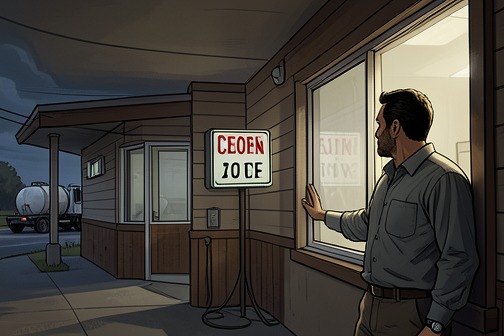
[The Tranquility Motel incident](entity:event-recall-event-08f5d61f12b5) is the buried event that turns the witnesses’ scattered psychological symptoms into a shared mystery. Recovered memories place [Ginger Weiss](entity:character-recall-character-ginger-weiss-c0c2e7ef6acc) at the motel on [July 6](entity:time-recall-time-july-6-664e6e27c147), when a disturbance at the [Tranquility Grille](entity:location-recall-location-tranquility-grille-0a6b2303c557) abruptly interrupted dinner; subsequent recollections suggest that the motel’s guests were kept there during a highway closure and that their memories were altered. Yet the event is never fully explained: the toxic-spill account may describe a real emergency, a cover story, or both, while what the witnesses saw and who controlled their confinement remain unresolved.
## The closure and its official account
The motel stood in [Elko County, Nevada](entity:location-recall-location-elko-county-nevada-500bca0898e6), near [Interstate 80](entity:location-recall-location-interstate-80-09dbb90e2ea2). In a later examination of the old guest registry, [Faye Block](entity:character-recall-character-faye-block-43b77274239e) and [Ernie Block](entity:character-recall-character-ernie-block-f9eb5d1128b4) identified Friday, July 6, as the night the interstate was closed because of a toxic spill. They said a truck carrying dangerous chemicals had been headed to the [Shenkfield Army Testing Grounds](entity:location-recall-location-shenkfield-army-test-1a511553800f), an isolated military site about eighteen miles southwest. According to their account, the motel closed until Tuesday while the situation was brought under control.
The Blocks described roadblocks and an evacuation order for the danger zone. Guests supposedly left in their own vehicles; [Ned Sarver](entity:character-recall-character-ned-sarver-8226efdc1143) and [Sandy Sarver](entity:character-recall-character-sandy-sarver-5f80709b9fa1) were allowed to go to their trailer near Beowawe because it lay outside the quarantine area. The Jamisons, who were visiting, were said to have taken [Faye](entity:character-recall-character-faye-ad32954c4aae) and Ernie in for the duration. This explanation had the shape of a public emergency: a hazardous shipment, a controlled evacuation, and a temporary closure. But its neat chronology did not match every witness’s recollection.
Faye and Ernie remembered the closure and the toxic spill, and Ernie recalled that newspaper clippings about it had once been kept. Their account was not simply a private delusion, he insisted; people in the area still wondered what might have happened if strong winds had carried the top-secret material toward them before the evacuation order. Yet the surviving witnesses’ memories diverged. The Blocks, the Jamisons, and the Sarvers appeared to remember versions of the evacuation, while [Dom Corvaisis](entity:character-recall-character-dom-corvaisis-d9ce4fde805e) recalled being at the motel and had only thin, unconvincing memories of reading and researching geography for short stories. A Polaroid of Dom at the motel supported his sense that he had been there, even as his account failed to fit the others’ story.
## Ginger’s recovered timeline
The incident’s most carefully traced sequence emerges during [Ginger’s hypnotic regression with Pablo Jackson](entity:action-recall-action-ginger-pablo-jackson-870f14c90478) in [Boston](entity:location-recall-location-ccccb9ca0ba9). Ginger initially described a cross-country vacation, but the name Tranquility made her shudder; as Pablo led her back through the journey, her muscles tightened and her hands clenched on the chair. She could describe the twenty-unit motel and its adjoining grille, yet the place frightened her in a way that the bland account of a restful holiday could not explain.
Her timeline contradicted the story she had been prepared to tell. Rather than arriving on Monday, July 9, she recalled reaching the motel on Friday, July 6, and staying through Monday night. The discrepancy established a four-night stay at a small roadside motel, not a brief stop on the way to Utah. Ginger’s explanation that she had lingered because the place was peaceful came in a wooden, increasingly flat voice. Pablo judged that her memories of books and television were artificial: she could not recall those supposed pastimes because, in his view, she had not actually spent the time doing them. Post-hypnotic suggestions had supplied a plausible, if unconvincing, substitute for whatever had happened.
At the same time, some memories remained vivid and particular. Ginger remembered signing the register a little after eight on Friday, while it was still about an hour before sunset. Exhausted, she wanted dinner, a shower, and bed. She described the people behind the check-in counter and named them as Faye and Ernie; she also recalled the Tranquility Grille in convincing detail. Her memories became thin and colorless only after she left the restaurant. Pablo therefore narrowed the interval of interference: the genuine recollection continued through her arrival and the beginning of dinner, then gave way to something imposed before she left the motel and drove east toward Utah on Tuesday morning.
## The disturbance at the grille
In regression, Ginger reconstructed the restaurant as a crowded but ordinary place. She counted eleven other people: a cook and waitress, three men she took to be truck drivers at the counter, three people at a table, a chubby priest, and a man in a booth. She moved through Pablo’s apartment with her eyes closed, imagining herself threading between the tables. At first she seemed relaxed, even smiling vaguely at someone; then she twitched in surprise and touched her face, as though brushing something away.
After ordering homemade vegetable soup and a cheeseburger with all the trimmings, Ginger’s remembered scene changed. Before the food arrived, she noticed a noise and looked toward the imagined window. She described a shaking restaurant, a toppled beer glass, and a sound she could not identify. She tottered, reached out as if to steady herself against a booth or table, and became frightened. Her attention fixed on the door; she began running toward the exit, then stopped, swaying and gasping. These are Ginger’s recovered perceptions, not an independent account of what caused the disturbance. The narration does not establish whether the shaking was an earthquake, another physical event, or an experience altered by the memory block.
The moment of flight was also the boundary of what Pablo could recover that day. When he pressed Ginger to continue, she reverted to the hollow assertion that she was merely having dinner. Pablo concluded that the [Azrael Block](entity:rule-recall-rule-azrael-block-05e13f0af70c) began as she ran for the restaurant door and remained in place until she left for Salt Lake City the following Tuesday. He believed it might be possible to reduce the block gradually, but not to force it open safely at once: a direct attack on the false memories risked plunging Ginger into a coma or worse. The recovered scene thus establishes both a break in her memory and the danger of treating that break as an ordinary lapse.
## Confinement, competing explanations, and consequences
From Ginger’s reconstructed stay, Pablo inferred that she had seen something she was not meant to see on the night of July 6. He believed she was probably detained at the motel and subjected to sophisticated brainwashing over the following three days, then released on Tuesday with sanitized recollections. That sequence is a conclusion drawn from the mismatch between her authentic and programmed memories, not a complete eyewitness account of the detention. The event’s central secret remains just beyond the recovered scene: Ginger remembers the disturbance and her attempt to escape the restaurant, but not what she saw or what happened to her afterward.
Dom offered a possible explanation for how such a detention could have occurred. If the toxic or biological hazard was real, he reasoned, the military might have used the emergency to contain contamination and avoid public exposure of a dangerous operation. If the spill was a pretext, the announced closure and evacuation could still have provided time to isolate the witnesses and keep outsiders away. In his more specific, deliberately tentative scenario, those who were not evacuated in time might have been treated at the motel, had their memories erased, and been supplied with false ones. Dom acknowledged that he did not know whether the spill itself was real. The quarantine made his brainwashing theory more plausible to him because it supplied both time and concealment, but it did not prove the theory.
The witnesses’ different false memories complicate any simple account of a coordinated cover story. Ernie pointed out that if officials had wanted to make everyone’s recollections conform to the evacuation, they had done so for the Blocks, the Jamisons, and the Sarvers, but not for Dom. The inconsistency seemed irrational and risky; to him, it supported the conclusion that one or more parties had been brainwashed. At the same time, Ernie resisted turning suspicion into certainty about a wicked conspiracy. He argued that officials might have believed they were doing what circumstances required, even if their actions were wrong. The group’s investigation therefore began with a credible pattern, not a settled identification of perpetrators or motives.
Later episodes show how the suppressed interval returned in fragments and with costs. Ernie’s apparent vision of a helmeted figure on the roof was reinterpreted by Dom as a memory flash: a brief return of the lost days, when Ernie may actually have been a prisoner in his own home and attempted to escape. The helmeted man who stopped him remained unexplained. In [Reno](entity:location-recall-location-reno-4b008eafa488), [Zebediah Lomack](entity:character-recall-character-zebediah-lomack-bd96015ca4da)’s lunar obsession gave way as the memory block broke: he remembered the summer, the people, Interstate 80, and the [Tranquility Motel](entity:location-recall-location-tranquility-motel-17316482b285) just before he died by suicide. That sequence does not solve the motel’s mystery; it shows how the buried experience could resurface with overwhelming force. The incident’s lasting significance lies in the collision between public explanations and private memory: a closure that looked administrative becomes the possible instrument of confinement, while the witnesses’ symptoms and contradictions turn remembering into both evidence and danger.
Event 29
Zebediah Lomack's suicide
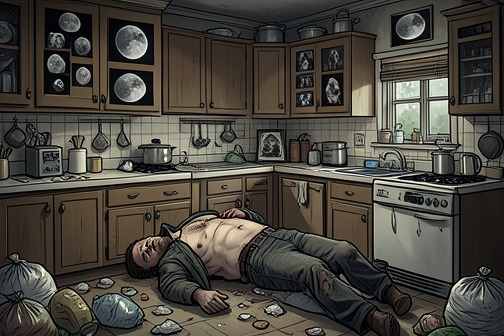
[Zebediah Lomack's suicide](entity:event-recall-event-041139060203) turns a local newspaper story into a disturbing point of connection for [Dom Corvaisis](entity:character-recall-character-dom-corvaisis-d9ce4fde805e): the dead gambler's moon fixation appears to echo Dom's own nightmares and sleepwalking, while the cause of Lomack's death remains uncertain. The discovery of his body exposes the scale of his isolation, but it does not settle whether despair, madness, or the return of a buried memory finally drove him to die.
## Background and Discovery
On [Christmas Day](entity:time-recall-time-christmas-day-08a71908c479), a neighbor reported hearing shotgun fire at [Lomack's house at 1420 Wass Valley Road](entity:location-recall-location-1420-wass-valley-roa-688b406fcafc). [Reno](entity:location-recall-location-reno-4b008eafa488) police officers who responded found Lomack dead in the garbage-strewn kitchen. Their investigation uncovered thousands of photographs of the moon, fixed across the walls, ceilings, and furniture. His suicide thus brought a concealed private world abruptly into public view: the photographs were not a passing curiosity but evidence of an obsession that had occupied the house and, increasingly, the man who lived there.
The news reached Dom on January 7, when, after a long winter drive to Reno, he read a newspaper account in his hotel room. The article described Lomack as a fifty-year-old professional gambler and reported that his estate was worth more than half a million dollars. Most of the money was held in savings-and-loan accounts and Treasury bills; the modest house itself was appraised at only $35,000. The contrast between substantial accumulated wealth and a small, secluded home gives the report an unsettling plainness: the estate can be counted, while the private experience that preceded the suicide remains unexplained.
## The Gambler's Retreat
Lomack had made most of his money playing poker. Another professional gambler, Sidney Garfork, remembered him as exceptionally gifted, with a natural aptitude for cards. Yet poker winnings did not translate into steadily increasing wealth: Lomack also lost more than half his winnings at craps, and taxes took another portion. The article presents a public identity legible through skill, money, and gambling habits, but those details cannot account for the moon-covered rooms or his death.
Neighbors described a change in his manner over time. Lomack had once been sociable; later he became a recluse. His fascination with the moon had apparently begun the summer before last, and no one besides Lomack had entered the house for more than a year before his suicide. The long absence of visitors helps explain how the images could spread across the interior without anyone intervening. It also marks a progression from withdrawal to a world sealed around a single, increasingly dominant image.
## The House and Its Images
When Dom entered the house, the moon pictures made the scale of the obsession physically immediate. Large posters covered the living-room walls, ceiling, and windows; hundreds of smaller and larger images crowded the hallway and both bedrooms. They were attached with glue, Scotch tape, masking tape, and staples, overlapping until every inch seemed claimed. The variety of pictures did not lessen their force. Together, they made the house feel less like a home than a space taken over by repeated lunar faces.
Dom could not explain the behavior that had produced this display, and he did not experience the pictures as Lomack apparently had. But he recognized a troubling resemblance between Lomack's fixation and the moon imagery in his own dreams. He sensed that some experience shared by the two men had made the moon matter to both of them, whether as part of what happened or as a symbol of it. Their lives had intersected at the same place and time during the summer before last, though the precise nature of that connection was not yet known.
## What the Suicide Leaves Unresolved
The account frames Lomack's deterioration as the consequence of stress caused by repressed memories. That explanation gives the moon obsession a possible psychological source without revealing what Lomack remembered or establishing the immediate motive for his suicide. For Dom, the uncertainty is frightening precisely because it leaves more than one possibility open. Lomack may have been overwhelmed by the obsession itself; Dom also considers whether he killed himself after finally remembering what had happened during that earlier summer.
That possibility changes the newspaper report's significance. Lomack is no longer merely a stranger whose eccentricity resembles Dom's symptoms; he becomes a warning that the return of memory might be more terrifying than the nightmares and sleepwalking that precede it. The suicide does not prove that Dom will meet the same fate, nor does it disclose what either man experienced. Instead, it converts a local death into a question Dom cannot dismiss: whether the moon fixation and the buried memory belong to one shared, still-unaccounted-for event.
Event 30
Alan Rykoff's suicide

[Alan Rykoff](entity:character-recall-character-alan-rykoff-cbc2e8b3504f)’s suicide is first presented through the news it delivers to his ex-wife, [Jorja Monatella](entity:character-recall-character-jorja-monatella-98b7ee510e90), and the practical demands that follow. The call finds her amid the noise of a Las Vegas casino, where shock and pity—not grief—shape her immediate response to his death.
## News at the Casino
On Friday afternoon, [Jorja](entity:character-recall-character-jorja-cc334f0a308c) is working at the casino when [Pepper Carrafield](entity:character-recall-character-pepper-carrafield-05384c9f8749), the woman with whom Alan has been living, calls with news of his suicide. Jorja takes the emergency call at a phone in the blackjack pit, cupping one hand over an ear against the voices, the clack of cards being dealt and shuffled, and the ringing slot machines. The ordinary racket of her workplace surrounds the disclosure: Alan shot himself that morning, about two hours before Pepper called.
Jorja is shocked and sickened, but she feels no grief. Alan’s selfish and cruel behavior, as she understands it, has left her without a reason to mourn him; pity is the only feeling she can summon. The distinction matters to the scene: his death reaches her as a painful fact, but not as the restoration of affection or an uncomplicated bereavement.
Pepper’s urgent request is practical rather than ceremonial. She tells Jorja that the police are at the residence and asks her to come, but clarifies that they do not want to see her: Alan had made Jorja executor, and Pepper wants his belongings removed as soon as possible. The call thus draws Jorja toward the immediate work of sorting through his effects even as she is still taking in the news of his death.
## The Scene and the Work of Removal
The task took Jorja from the telephone call into the aftermath. As an elevator opened, uniformed policemen and morgue employees emerged with a gurney carrying a corpse sealed in an opaque plastic body bag. Jorja and Pepper rose from the sofa; from another elevator came more officers, including plainclothes detectives, one of whom asked Pepper a few final questions. The procedure around the body was brisk and official, but Jorja’s own assignment was intimate and degrading: because Alan had named her executor, she had to go through the belongings he had left behind.
Halfway down the hall, Pepper opened the bathroom door and complained that the police had left it as they found it. The room made the manner of Alan’s death impossible to treat as an abstraction. Blood covered the beige tile floor and spattered the shower door, sink, towels, wastecan, and toilet; behind the toilet, dried blood marked the wall in a pattern likened to a Rorschach blot. The image seems to invite interpretation, as though the scene might disclose the meaning of Alan’s death, but it offers Jorja no answer—only the physical evidence of violence. The account also makes clear that Alan shot himself twice: first in the genitals, then in the mouth. Jorja could smell the blood, while Pepper supplied the details she did not want to hear.
That gruesome sequence turns the executor’s duty into a confrontation with the private collapse behind the official fact of suicide. Jorja loathes having to search through Alan’s things, yet understands that the task must be done. The room’s scattered blood and the body carried away by strangers place death before her as both a material scene and an unanswered question; the orderly work of removal cannot make either aspect easier to bear.
## The Moon and the Unanswered Cause
While sorting Alan’s belongings, Jorja found an unexpected clue to the months before his death: he had become interested in astronomy. Pepper said the interest had begun only a couple of months earlier. Asked whether Alan had dreamed about the moon, she confirmed that he had. The dreams began around late October, but he could never remember their details after waking. They were not simply nightmares: Pepper sometimes heard him sound afraid in his sleep, but at other times he smiled.
The discovery troubled Jorja because Alan’s recent history echoed [Marcie](entity:character-recall-character-marcie-12363d0e1b68)’s. His compulsive sexual drive and his daughter’s irrational fear of doctors were opposite forms of obsession, and Marcie’s phobia appeared to have been relieved while Alan had received no comparable help. More disturbing still, father and daughter had developed an interest in the moon around the same period. Alan had not seen Marcie for six months; their last telephone conversation was in September, before either had become fascinated by it. Jorja could identify no contact through which one might have passed the fixation to the other, leaving its apparent emergence in both unexplained.
The moon links the suicide to a mystery rather than supplying a motive. Jorja wonders whether father and daughter could have shared a dream, but has no answer; Pepper’s account offers only fragments of sleep, fear, and smiling. The bathroom’s bloody pattern had seemed to invite someone to read the meaning of Alan’s death, yet the new clues do not resolve it. They sharpen Jorja’s fear for Marcie: something had driven Alan to kill himself, and she cannot know what that connection might mean for his daughter.
## An Unresolved Pattern
Alan’s death leaves its cause deliberately unsettled. The account moves from the practical obligations of his estate to details that resist explanation: an abrupt change in his behavior, moon dreams he could not recall, and a parallel fascination in Marcie despite the absence of recent contact between them. None establishes what drove him to suicide, and the dream fragments offer no reliable account of what he experienced. Instead, the event changes the question facing Jorja: beyond making sense of Alan’s death, she must consider whether the unexplained pattern also places Marcie at risk.
Event 31
Dominick Corvaisis witnesses a lunar apparition at the Lomack home
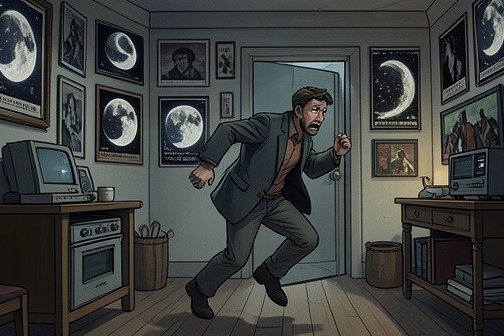
[Dominick Corvaisis witnesses a lunar apparition at the Lomack home](entity:event-recall-event-3a1d6c0e2ab6) when a room filled with moon images becomes the scene of an inexplicable assault and apparent display of psychic force. The episode turns a private investigation into a physical encounter with Dominick’s missing past: his own name appears alongside three others on the walls, and the moons seem to offer a way back to a shared, frightening experience that none of them can remember.
## The erased interval and its clues
Before the apparition, Dominick has been trying to understand what happened during the summer before last, including the drive from Portland to [Mountainview College](entity:location-recall-location-mountainview-college-cae421b64964). At [Zebediah Lomack](entity:character-recall-character-zebediah-lomack-bd96015ca4da)’s house, the moon images initially intensify his fear rather than clarify it. Their crowded presence feels oppressive, and he flees the room, wondering whether Lomack’s suicide might have followed the recovery of a memory more terrible than the nightmares and obsession that had already troubled him. The possibility gives the missing episode a new weight: remembering might be more frightening than remaining ignorant.
A fall in the living room changes what Dominick can see. Among the identical moon posters, one bears the handwritten name Dominick. The writing appears to be Lomack’s, although Dominick knows of no connection between himself and the gambler. He then finds three more names across four lunar images: Ginger, [Faye](entity:character-recall-character-faye-ad32954c4aae), and Ernie. He cannot remember sharing an experience with any of them, but the names make that possibility difficult to dismiss. The posters link four people who, as far as Dominick knows, have no reason to be joined in this house.
The names also reshape two clues already troubling him. He recalls a Polaroid showing a priest and wonders whether the man could be Ernie; he thinks of a blonde restrained on a bed and wonders whether she could be Ginger or Faye. These are questions, not identifications, but they show how the writing on the moons draws scattered evidence into a single, still-unreadable event. As Dominick studies the names, a dark memory stirs without resolving into a scene. He knows someone has interfered with his mind, yet cannot reach what has been taken from him.
## The moons break free
Dominick’s frustration becomes a physical confrontation with the image bearing his name. Though he does not touch it, the poster tears away from the wall, its strips of masking tape peeling loose, and hangs unsupported in front of him. The movement is not confined to that one sheet: the other posters detach from the ceiling, walls, and windows and rush toward him. Then they stop, suspended in the air. For a moment, the room is silent, with roughly fifty moon images hanging motionless around him.
The lull gives way to a much larger display. Posters in the hall and other rooms begin to come loose as well. Images by the thousand detach from their fixed places; more follow, until the paper moons swirl around Dominick in layers. Magazine and book pictures catch the flashlight beam, while black-and-white images spin through the air. The scene’s ordinary materials—paper, tape, staples, and glue—seem to have abandoned their usual limits. The house is no longer simply decorated with moons: its images have become a moving environment that closes around him.
Dominick senses that the storm may be trying to break through his missing recollections. He has no explanation for who or what is behind it, but believes that surrendering to its mesmerizing motion might let him understand his nightmares and what happened on the road eighteen months earlier. The desire for an answer does not overcome his terror. He covers his ears, shuts his eyes, and cries for the display to stop. The tumult cuts off abruptly. When he looks again, the pictures are still suspended, but no longer moving.
## The aftermath in the house
Dominick tests one of the pictures in his hand. It is an ordinary image, yet it had been held in midair with thousands of others. Then, as if a spell has broken, the moons fall together and scatter across the floor, piling over his winter boots. The corridor walls have been stripped bare. He kneels among the paper, sifting through it with trembling hands, trying to make sense of what has happened.
The event supplies no easy verdict about its cause or moral character. Dominick swings between fear and amazement, horror and awe; he cannot decide whether the force he encountered was evil, good, both, or neither. What he does conclude is that the experience from the summer before last was far stranger than he had imagined. The apparition thus yields no recovered narrative, but it changes the status of the mystery: the missing past is no longer merely a suspected explanation for his nightmares. Something in the present has responded to the names and memories surrounding it, while the truth remains out of reach.
As he examines the debris, Dominick notices a ring of swollen red skin on each palm. The marks are sharply defined, as though drawn with a compass, but fade and disappear while he watches. Their brief appearance adds a bodily trace to an event otherwise made of impossible movement and paper images. The date is Tuesday, January 7; the marks do not remain long enough to provide a lasting physical explanation.
## Memory, corroboration, and significance
The encounter belongs to a wider pattern of missing time and manufactured recollection. In a separate discussion, [Ginger Weiss](entity:character-recall-character-ginger-weiss-c0c2e7ef6acc) reasons that brainwashing would require a period in custody and might leave a blank interval; Pablo explains that false memories could be implanted to cover it. His examination of Ginger’s account distinguishes her detailed memories of the [Tranquility Motel](entity:location-recall-location-tranquility-motel-17316482b285) from hollow, repetitive responses about books and television programs she may never have experienced. He concludes that the supposed activities are artificial memories masking what really happened there. He also recognizes that directly attacking the block could send Ginger into a coma, so recovering the truth requires caution rather than a sudden command.
That pattern gives the names in Zebediah Lomack’s house particular force. At the Tranquility Motel, Ernie confirms that the evacuation and reported toxic incident were real, while Dominick doubts that visiting witnesses could reliably remember what they saw: in his view, their minds may have been scrubbed along with those of the others. Later, a girl in the Salcoe household lies blank-eyed with earphones attached to a tape recorder playing a soothing account of a hotel stay. Dominick has already described parts of the conspiracy to Parker, but hearing the recording makes the process of replacing lost time with scripted memories tangible. These episodes do not explain the lunar apparition, but they establish why its scattered names and the inability to remember matter.
The event’s central reversal is that a familiar image becomes both threat and possible invitation. The moons first press in on Dominick as a suffocating, frightening presence; then their motion seems to offer access to the very memories he is desperate to recover. He refuses that invitation because he is afraid of what it might reveal. The marks on his palms fade, the papers lie still, and the crucial memory remains blocked. What survives is a more concrete connection among Dominick, Ginger, Faye, Ernie, and Lomack—and the unsettling knowledge that the past has begun to announce itself without yet becoming tellable.
Event 32
Dominick reunites with the Blocks and discovers their memories were altered
[Dominick Corvaisis](entity:character-recall-character-dominick-corvaisis-5f0bc1572735)’s reunion with [Ernie Block](entity:character-recall-character-ernie-block-f9eb5d1128b4) and [Faye Block](entity:character-recall-character-faye-block-43b77274239e) turns a shared set of nightmares into evidence of a wider assault on memory. At the [Tranquility Motel](entity:location-recall-location-tranquility-motel-17316482b285), recognition begins with the moon names and deepens through photographs, a guest register, and the Blocks’ oddly rehearsed account of an evacuation. Their conversation does not settle exactly what happened, but it exposes a crucial divide: the Blocks remember a coherent public cover story, while Dominick’s past has been furnished with different, thin recollections that leave the same missing days unexplained.
## Recognition at the motel
After leaving the [Tranquility Grille](entity:location-recall-location-tranquility-grille-0a6b2303c557) in fear and confusion, Dominick goes to the motel office, where he finds a scene that first looks like a domestic quarrel. Ernie is shaking, and [Faye](entity:character-recall-character-faye-ad32954c4aae) is trying to persuade him not to flee into the darkness. The apparent anger in Ernie’s face resolves into terror. His fear of the dark recalls the nightmares and sleepwalking that have troubled Dominick himself, making the stranger’s distress disturbingly familiar.
The name Ernie immediately recalls the moon posters in [Zebediah Lomack](entity:character-recall-character-zebediah-lomack-bd96015ca4da)’s living room in [Reno](entity:location-recall-location-reno-4b008eafa488), where names had been scrawled across lunar images. Dominick remembers Faye among them as well. He chooses to address her by name, surprising her, then identifies himself as Dominick Corvaisis. The connection is not yet an explanation, but the names turn an encounter between strangers into a recognition between people whose problems may share a source.
When Ernie tries to get upstairs so he can shut out the darkness, Faye urges him not to run from it. Dominick steps in front of him and describes the pattern of Ernie’s nightmares: Ernie wakes unable to remember their contents, but they have something to do with the moon. Faye gasps, and Ernie is astonished that Dominick could know this. The detail makes their resemblance more specific than a general fear or a passing coincidence. It links Ernie’s private symptoms to the moon imagery already associated with Dominick’s investigation.
## Photographs and the registry
The three sit in the Blocks’ kitchen above the motel office, with the blinds shut against the night, while Dominick tells the story of his own experiences. The paper moons moving in Lomack’s house are the account they find hardest to believe. But his precise description conveys the force of what he saw, and the photographs sent by an unknown correspondent provide a more material point of contact.
The Blocks recognize the motel in a photograph of a priest sitting at a writing desk, and identify the floral bedspread in a close-up of a blond woman lying in bed with an intravenous line. The bedspread had been used in some motel units until ten months earlier. Their own anonymous photograph, received by Ernie in a plain envelope on December 10, shows a man, woman, and child standing in sunshine by Room 9. The pictures do not by themselves establish what was done to the people shown, but they attach the group’s questions to particular rooms, furnishings, and people rather than to memory alone.
Faye retrieves the motel register from the summer two years earlier and opens it to Friday and Saturday, [July 6](entity:time-recall-time-july-6-664e6e27c147) and 7. The guest list gives Dominick a concrete way to compare his recollections with the motel’s record. He remembers checking in, but cannot remember leaving that night, despite the account that all guests had been evacuated. His remaining recollections of research into local geography feel insubstantial to him; the photograph of himself at the motel makes the discrepancy harder to dismiss.
The register also locates other possible witnesses. Dr. [Ginger Weiss](entity:character-recall-character-ginger-weiss-c0c2e7ef6acc) signed in four spaces above Dominick. [Cal Sharkle](entity:character-recall-character-cal-sharkle-c69f0f3f108b) checked in just before her, and Dominick recognizes him as the trucker friend of the Blocks whose zombie-eyed face appears in one of the photographs. The first guests listed that day are [Alan Rykoff](entity:character-recall-character-alan-rykoff-cbc2e8b3504f), his wife, and their daughter; Dominick suspects they are the family photographed outside Room 9. Zebediah Lomack is absent from the register, leading Dominick to infer that he may have stopped at the Grille while traveling between Reno and [Elko](entity:location-recall-location-elko-6d564a531c69) rather than lodging at the motel.
## The evacuation account comes apart
Faye and Ernie explain that a toxic spill on the Friday in question closed the interstate. A truck carrying dangerous chemicals was headed toward [Shenkfield](entity:location-recall-location-shenkfield-0e9d5a5eb820), described by Ernie as an isolated chemical and biological weapons testing ground. Faye says roadblocks were erected and people in the danger zone were ordered to evacuate. The guests left in their own cars; [Ned Sarver](entity:character-recall-character-ned-sarver-8226efdc1143) and [Sandy Sarver](entity:character-recall-character-sandy-sarver-5f80709b9fa1) were allowed to travel to their trailer near Beowawe because it lay outside the quarantine area. Faye and Ernie, in their account, stayed with friends Elroy and Nancy Jamison at a ranch northeast of the motel until the Army allowed them to return on Tuesday morning.
As Faye recites these details, her voice becomes stiff and expressionless. Dominick notices that she sounds as if she has been programmed with a speech. Ernie then gives an account of the overturned truck and the Army’s concern that wind might spread the chemicals in the same unnatural, by-rote tone. Faye also hears the change in her husband’s voice. The moment makes the evacuation story double-edged: it may describe a real event, but the Blocks’ delivery suggests that their memories of their own part in it have been shaped into a script.
The Blocks maintain that the spill happened and recall newspaper coverage in the Elko Sentinel. They remember the Jamisons as the people who hosted them, and Faye says the couple had been visiting the motel that night. Dominick counters that witnesses might have been given memories of an evacuation whether or not that was what actually happened to them. If the Jamisons were present, he reasons, they may have undergone the same brainwashing as the others. His claim is an interpretation, not something the conversation proves, but it gives the group a way to account for why an apparently shared past feels so unstable.
## A theory of altered memory
Dominick proposes that people at the motel might have been exposed to a chemical or biological weapon before they were evacuated. In his reconstruction, the Army and government could have covered up a failure to remove everyone in time, used the motel as a clinic, decontaminated those affected, and erased or replaced their memories to avoid lawsuits, public scrutiny, and disclosure of secret weapons information. The Blocks’ accounts, including their memories of evacuation and shelter with the Jamisons, would then be an implanted cover story rather than an intact record of what they experienced.
The explanation remains a hypothesis, and the Blocks themselves see a problem in it. If their memories were programmed to fit the public account of the spill, they ask, why was Dominick given a different set of recollections, unrelated to the evacuation? The contrast does not resolve the mystery; instead, it becomes evidence that one or more accounts may have been tampered with. Dominick has already considered how false memories could cover a period of captivity without leaving an obvious blank in someone’s past. In Ginger Weiss’s hypnosis session, [Pablo Jackson](entity:character-recall-character-pablo-jackson-48e95f0b1940) identifies her detailed but hollow recollections of motel pastimes as artificial: she can describe the place, yet cannot remember the books or television programs she supposedly used to fill the days. When pressed for detail, her anxiety rises and her voice remains flat. Together, these cases show how an apparently continuous memory can conceal a missing experience.
The episode’s later illustration of the same method makes that danger more concrete. At the Salcoe home, [Parker Faine](entity:character-recall-character-parker-faine-0e53d8b2c0c1) finds a girl wearing earphones connected to a tape recorder. A soothing voice feeds her a detailed account of sleeping late and walking around a hotel’s grounds. The narration indicates that a Salcoe had begun to remember the Tranquility Motel, that those memories were repressed again, and that new false recollections were being installed with repeated recordings. The scene does not independently prove Dominick’s theory about the Army, but it shows memory replacement operating as an active technique within the larger conspiracy.
The reunion therefore changes the significance of the motel register and the witnesses’ symptoms. A dark-room panic, a moon nightmare, a photograph, and a strangely fluent evacuation story become separate clues to a shared disruption. The registry connects Dominick, Ginger, Cal, and the Rykoff family to the same July 6 stay, while the Blocks’ rehearsed memories suggest that even apparently corroborating testimony may have been manufactured. Rather than closing the investigation with a single answer, the meeting establishes the central problem: the people searching for the truth may be using memories deliberately built to keep it from them.
Event 33
Ernie Block's apparent recovery from his fear of the dark

[Ernie Block's apparent recovery from his fear of the dark](entity:event-recall-event-a07a042ba000) looks, at first, like a swift return to ordinary life: after four weeks in Milwaukee, he and [Faye Block](entity:character-recall-character-faye-block-43b77274239e) fly home to reopen the [Tranquility Motel](entity:location-recall-location-tranquility-motel-17316482b285). But the cure proves incomplete in a revealing way. Near home, Ernie feels the same inexplicable attraction to a piece of ground south of the highway that he experienced before treatment; later, a cloud passing over the sun is enough to startle him. The episode shifts the question from whether he can endure darkness to whether his fear is tied to a particular place—and whether the improvement will last.
## The reported cure and return home
On Thursday, a physician treating Ernie in Milwaukee concludes that his disabling fear of darkness has been cured, calling the recovery the fastest he has seen. By Saturday, January 11, Ernie and [Faye](entity:character-recall-character-faye-ad32954c4aae) are on their way back to Nevada. Their return is practical as well as emotional: because Ernie’s recovery had seemed likely to be unusually quick, Faye had decided not to fly home early to find a motel manager. They had instead left the business closed, and now must unlock it, raise the thermostat, and clear away the dust that has accumulated.
The journey home proceeds in stages. Ernie and Faye fly on United to [Reno](entity:location-recall-location-reno-4b008eafa488), then take a ten-seat commuter plane to [Elko](entity:location-recall-location-elko-6d564a531c69), arriving at 11:27 in the morning. [Sandy Sarver](entity:character-recall-character-sandy-sarver-5f80709b9fa1) meets them at the small airport. Ernie does not recognize her immediately: the familiar slouch and neglected appearance have given way to a more carefully tended look. She has gained ten pounds, wears makeup, and has glossy hair and unbitten nails. Her transformation is a visible sign of change during the couple’s absence, and she is pleased, despite pretending otherwise, when Ernie and Faye praise it.
[Sandy](entity:character-recall-character-sandy-457b75877fae) drives the couple back in her pickup. Faye notices the unusual ease and boldness with which she handles the vehicle, while Ernie is initially absorbed by her change in appearance. The homecoming carries the warmth of reunion: Sandy hugs them both outside the motel and says that she missed them. Against this renewed sense of ordinary connection, Ernie’s returning unease will feel all the more abrupt.
## The Nevada ground remains a call
Less than a mile from the motel, Ernie’s attention is pulled away from the conversation. He recognizes the feeling from December 10, when he had been driving home from Elko with new lighting fixtures: a particular plot of land, half a mile ahead and south of the highway, seems to be calling him. He associates it with something strange that happened to him there. The sensation is both absurd and gripping, like the dreamlike attraction of a talismanic place.
The return of this feeling unsettles him because he had assumed that the place’s peculiar magnetism belonged to the same disturbance as his disabling dread of darkness. If treatment had cured that fear, he expected the other symptoms to disappear with it. Instead, as the pickup approaches the ground, the ordinary conversation between Faye and Sandy fades from his attention. He squints through the sunlit windshield, anticipating an epiphany and experiencing both fear and awe, as though something of monumental importance is about to happen.
The pickup slows to under forty miles an hour as it passes the site, then accelerates again. Ernie wonders whether Sandy, too, has been briefly spellbound by the landscape, but cannot be sure: by the time he looks at her, she is watching the road and listening to Faye. He sees what might be a strange expression on her face, yet she is smiling when she turns toward the motel. He allows that he may be mistaken about her reaction. The uncertainty leaves the place’s pull intact without establishing that Sandy shares it.
## A narrower fear, not a settled cure
After they reach the motel, Ernie’s unease becomes bodily. He feels cold in his bones and notices damp sweat on his palms and scalp. He checks his watch not because he needs the time but to calculate how long remains until sundown: about five hours. That gesture makes the apparent cure newly fragile. He asks himself whether he fears darkness in general, or a specific darkness—the night over the Nevada plains. Perhaps the night in Milwaukee frightened him less, allowing his phobia to seem gone while its deeper, localized form remained. He considers whether such a narrow, place-bound fear is possible, but cannot dismiss the possibility. He checks his watch again.
At the motel office, the distinction is tested by a small change in light. As Faye puts the key in the door, a large cloud moves across the sun. The scene does not become dark; the light falls by no more than twenty percent. Even so, Ernie twitches and jumps, startled and unnerved. He looks at his watch and toward the east, where night will come from. The trigger is not full darkness, and the reaction is not evidence that the earlier treatment had no effect; instead, it shows how little reassurance the label of cure can provide when a modest shadow revives his vigilance.
## What the episode leaves unresolved
The event does not establish why the Nevada site attracts Ernie, what happened there, or whether his fear will return in its former disabling intensity. It does establish that the physician’s conclusion and Ernie’s own experience do not fully coincide. The trip home supplies a concrete test: the old pull survives treatment, and a cloud’s shadow still provokes alarm. His recovery may be real as far as his previous phobia was concerned, yet it has not resolved the uncanny association with the Nevada landscape or his apprehension about darkness there.
That gap gives the episode its significance. A dramatic improvement invites the assumption that an entire disturbance has ended; Ernie’s return instead separates the symptoms. The motel’s closed rooms, the journey through familiar Nevada, the slow passage by an apparently ordinary plot of ground, and the brief dimming at the office door each mark a different degree of reassurance failing. His cure remains apparent rather than secure, and the question of what, exactly, he fears is carried forward.
Event 34
The strange summons at the St. Bernadette rectory
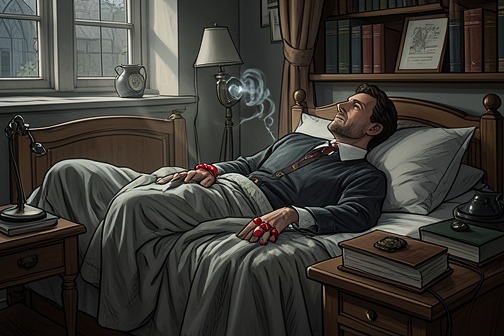
[The strange summons at the St. Bernadette rectory](entity:event-recall-event-35b5df56f918) turns an unexplained disturbance into a direct call to [Brendan Cronin](entity:character-recall-character-brendan-cronin-2fbbbf142f5f). In the early hours of Thursday, January 9, a pounding shakes the rectory while Brendan sleeps through it; when [Father Stefan Wycazik](entity:character-recall-character-father-stefan-wycaz-8bcbf4db75a8) wakes him, the noise ends, and Wycazik sees angry red rings on Brendan’s palms. Brendan understands the sound as a summons back toward the golden light in his dream, though he cannot say what is calling him or where it leads.
## The disturbance in the rectory
Father Stefan Wycazik wakes in his second-floor bedroom to a beat he first understands as the sound of a drum. Its rhythm resembles a heartbeat, but with an extra beat: “LUB-DUB-dub.” The clock reads 2:07 on Thursday morning, an hour when a parade would make no sense. The contrast between the familiar pulse and its uncanny repetition gives the sound a bodily quality without making it recognizable.
[Father Michael Gerrano](entity:character-recall-character-father-michael-gerr-34b3db8952fe), the other curate, comes out of his room asking what is happening. Before either priest can identify a cause, the triple thuds grow louder. The house reverberates under impacts likened to gigantic hammers, muffled rather than sharp. The lights flicker with each blow, and the floor trembles. The sound comes in such quick succession that one echo has scarcely faded before another impact arrives.
The disturbance is not confined to the walls. Windows rattle; drapery hooks click against their rods; a hairbrush bounces on the dresser; coins clink together; and Brendan’s breviary slides from side to side. Above his bed, a crucifix jolts on its picture hook. These ordinary objects register the force of the event, while the religious setting and the breviary and crucifix make its location unmistakable: this is happening in the rectory, in the room of a sleeping priest.
## Brendan at the center
The two priests locate the pounding in Brendan’s room, directly across the hall from Father Gerrano’s. Brendan remains asleep despite the explosions. The spectacle recalls mortar fire to Father Wycazik, a veteran of Vietnam, but Brendan dreams on, apparently undisturbed; in the pulsing light, Wycazik even sees a faint smile at his lips. The difference between the waking priests’ alarm and Brendan’s sleep makes him the event’s inexplicable center rather than merely another person caught in it.
As the pounding accelerates and the house continues to shake, Father Gerrano retreats toward the doorway, wide-eyed. Father Wycazik instead crosses to the bed, calls Brendan’s name, and shakes him by the shoulders. Brendan opens his eyes. At that instant, the hammering stops abruptly. The sequence makes waking him the decisive change in the scene: the noise ceases not after an explanation or an intervention against the room, but when the person at its center is roused.
Brendan says he had been close to something and wishes Wycazik had not awakened him. His sleepy disappointment contrasts with the priests’ fear and suggests that, from within the dream, the experience had been approaching a meaningful threshold. But neither priest can establish what that threshold was. When Wycazik asks what made the sound, Brendan describes a calling, then admits he does not know what called him.
## The marks and the golden light
Father Wycazik pulls aside the covers, takes Brendan’s hands, and turns them palms-up. An angry red ring marks each palm. The marks transform an otherwise unexplained noise into a visible sign associated with Brendan’s extraordinary experiences. Wycazik has heard about the rings before, but this is the first time he has seen them himself. Father Gerrano asks what caused them; the question remains unanswered, while Wycazik presses Brendan about the sound.
Brendan supplies a partial answer rather than a source: the call was drawing him back. Asked where, he identifies the golden light of a dream he had previously told Wycazik about. His account links the nocturnal event to an existing dream experience, but leaves open whether the summons is religious, supernatural, or something else. Father Gerrano, shaken and unfamiliar with the pattern, asks the others to explain. They continue speaking to each other, absorbed in what Brendan has experienced.
When Wycazik asks whether the calling will happen again, Brendan answers yes with certainty. The scene therefore ends not with an explanation, but with the expectation of recurrence. Its last concrete markers are the date, the rings, and Brendan’s prediction: the event has happened once in the rectory and, in his understanding, is not finished.
## Faith, healing, and uncertainty
The episode deepens a question already troubling Father Wycazik: whether the extraordinary events around Brendan point to a force beyond ordinary human agency. Earlier, Wycazik told surgeon [Bennet Sonneford](entity:character-recall-character-bennet-sonneford-0dddf3519207) that he sensed a Presence behind events and believed its concern was chiefly with Brendan, the priest who first reached [Winton Tolk](entity:character-recall-character-winton-tolk-f08f71997413) after the sandwich-shop shooting. To explain why he suspected a connection, Wycazik referred to [Emmy Halbourg](entity:character-recall-character-emmy-halbourg-ba50d86bb861)’s formerly crippled limbs mending, without naming her. The rectory pounding gives that theory a new, startling form, but does not prove it.
Brendan’s story is also set against his crisis of faith. At [St. Joseph's Hospital for Children](entity:organization-recall-organization-st-joseph-s-hosp-b30b7540d74c), severely ill children retain a strong belief in God’s goodness; Brendan is moved by their courage, but their example does not restore his own faith. The rectory scene does not settle that struggle. It supplies a dream of golden light, red rings, and an answer that something is calling him back, while leaving the meaning of those signs unresolved.
That uncertainty matters to how other characters interpret Brendan. Winton Tolk later asks whether Father Cronin is a saint, having been healed by him; Wycazik answers that he is a good man, but no saint. Much later, [Parker Faine](entity:character-recall-character-parker-faine-0e53d8b2c0c1) argues that Brendan’s crisis may be connected to a suppressed memory of encountering a vastly different and superior race, and that compassion and love, not physical resemblance, should guide judgments about the divine. That is Parker’s interpretation, not an explanation supplied by the rectory scene. The summons establishes the pattern and its human focus; its source remains unknown.
Event 35
The frost moon and red-light apparition at Brendan's window
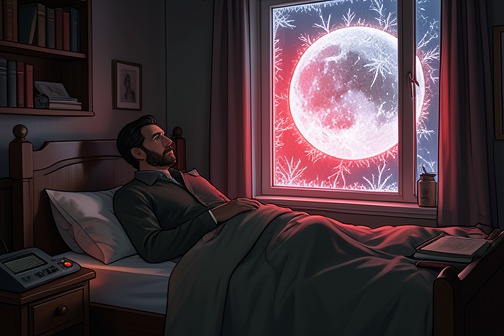
[The frost moon and red-light apparition at Brendan's window](entity:event-recall-event-208da377bb9d) turns an ordinary winter pane into an unexplained sign. In the darkness of the [Chicago](entity:location-recall-location-chicago-eb77a855d5aa) rectory, [Brendan Cronin](entity:character-recall-character-brendan-cronin-2fbbbf142f5f) watches frost gather into a ten-inch lunar circle, sees it blaze red, and recognizes the light as something he has encountered before. The experience deepens the mystery of the golden light that has called to him in dreams, while leaving its source beyond his understanding.
## Setting and Approach
At ten-ten, Brendan Cronin lies in bed with the lights out, waiting for sleep and watching the frost on his window. The pane faces the courtyard, where no lights are burning. He reasons that its pale glow must be indirect moonlight: earlier, the moon had been visible from the study windows on the opposite side of the rectory, so it could not now be above the courtyard unless it had abruptly changed course. The scene begins with his effort to account for what he sees, not with an immediate declaration of the supernatural.
As he studies the ice, its patterns become increasingly absorbing. Light seems to splinter at the points where one crystal meets another, each beam dividing into further beams. Brendan Cronin whispers, "The moon," then repeats the words, surprised to hear his own voice. His heartbeat quickens and he begins to tremble. Before he understands what the frost is becoming, the response is already physical: the image catches his attention, and apprehension takes hold.
## The Frost Moon Appears
The frost changes before him. Rime melts away from the edges of the pane toward its center, until the glass is clear except for a perfect circle of ice about ten inches across. Brendan Cronin recognizes the shape as a moon and decides that it is a sign, although he cannot tell who or what has sent it, where it has come from, or what it means. The circular image is definite; its interpretation remains open.
The circle grows brighter in stages. While Brendan Cronin holds a hand toward the glass, the frost-moon shifts from milky light to a sharper white, then shines like silver. Its brilliance no longer seems proportionate to ordinary moonlight refracted by ice. A shaft leaps from the circle and falls across the bed, intense enough to resemble a spotlight. The familiar materials of window and frost have become the source of an event he cannot explain, and his attempt to understand their appearance gives way to shock.
## Scarlet Light and Recognition
The beam changes from pale red through darker red to crimson and scarlet. In its glow, the blankets look like molten steel, and Brendan Cronin's outstretched hand appears wet with blood. He experiences déjà vu and becomes absolutely convinced that he has once stood beneath a scarlet moon, bathed in its bloody light. That conviction is a recognition, not an explanation: the scene gives him no account of when the earlier experience happened or what it was.
The apparition also unsettles the relation between two recurring images in his life. Since [Christmas](entity:time-recall-time-christmas-a573265d0167) night, when he cried out in a dream at his parents' home in [Bridgeport](entity:location-recall-location-a1fe1df2c343), Brendan Cronin has been unable to remember a dream about the moon. As far as he knows, his subsequent dreams have instead centered on a place full of dazzling golden light, toward which he feels called as if toward an extraordinary revelation. Now he wants to know how the red light relates to that golden radiance, but the question does not bring clarity. As the room fills with red light and shadows, fear rises into terror; the summons he associates with revelation has become frightening.
## The Light Fades and the Sign Remains
When Brendan Cronin pulls his hand back, the scarlet rapidly fades to silver, and the silver dims until the frost circle reflects only the natural January moon. He switches on the lamp and approaches the window, damp with sweat and still shaken. The circle remains on the otherwise unfrosted pane. He had wondered whether the light might have been a dream or hallucination, and almost wishes that it had been; the surviving frost image persuades him that what he saw was real. It verifies the strange shape on the glass, even as the source and nature of the red beam remain unexplained.
Touching the pane reveals nothing unusual beyond the winter cold on its other side. Then Brendan Cronin notices the swollen rings in his palms and watches the stigmata fade. Their appearance and disappearance place a second bodily anomaly alongside the frost-moon, without clarifying how either is connected to the other. He returns to bed but sits upright against the headboard with the light on, waiting until he can summon enough courage to lie down in darkness.
The event therefore ends not in discovery but in a changed balance between evidence and fear. The circle persists after the red illumination has vanished, while the palm rings fade as he watches; neither leaves him with an explanation. The scene makes the moon motif tangible in the room and links it, through Brendan Cronin's startled recognition, to an experience he feels he has already lived. Yet the sign's sender and meaning remain unknown, and the golden summons that precedes it remains unresolved.
Event 36
Guardmaster armored-car robbery

The [Guardmaster armored-car robbery](entity:event-recall-event-guardmaster-62c6130e29e5) is a carefully engineered heist whose smooth execution contrasts with the change taking place in [Jack Twist](entity:character-recall-character-jack-twist-b2feffa09d4e). In New Haven County, Jack and his crew disable the transport, overcome its security systems without resorting to explosives, and take the money. Yet the operation’s success no longer gives Jack what he once sought from crime: by the time the cargo doors open, he feels empty and without purpose.
## Setting and Preparation
The truck approaches across snow-covered fields on a dark, cloudy night, with no stars or moon. A cold, moist wind drives patchy fog across the county road. Jack has watched the route from a knoll on [Christmas Eve](entity:time-recall-time-b5d8d2702b17), and the Guardmaster vehicle now comes toward that same rise from the northeast. The landscape is quiet and exposed, but the crew has arranged the conditions so the truck will have nowhere to go and no one to call.
[Branch Pollard](entity:character-recall-character-branch-pollard-7a2aeefb464e) is positioned halfway down the knoll with a [Heckler & Koch HK91 rifle](entity:object-recall-object-heckler-koch-hk91-3d8b4b9028d2). [Chad Zepp](entity:character-recall-character-chad-zepp-909d7c27bf62) waits concealed in the snow north of the road. Hart and Dodd, the last two members of the team, block both ends of the road with stolen vans repainted and fitted with Department of Highway signs. Their emergency beacons and roadside sawhorses lend the false impression of an accident, while they turn back anyone approaching with a story about a tanker-truck crash. Each member’s position serves a separate part of the plan: stop the vehicle, cut off communication, control the road, and open the cargo hold.
The scene’s recurring image is clockwork. Jack’s heists are described as mechanisms that tick along, and this one is organized around precise timing rather than improvisation. That precision is not merely a boast: the plan anticipates the truck’s security, the possibility of outside traffic, and the danger that explosives might make the lock harder to open.
## Stopping the Transport
When the truck is about two hundred yards away, Pollard fires. The shot blows out its right front tire, sending the vehicle into a wild swerve on the ice. Jack runs down the hill, crosses a ditch, and steps into the road in front of the truck. It slides toward the ditch before the driver regains control and brings it to a stop about thirty feet from Jack.
A crewman tries to summon help by radio, but Zepp has already switched on a battery-powered transmitter that jams the Guardmaster frequency with shrill static. Jack then aims a tear-gas rifle at the truck’s grille. The British-made weapon, obtained from a black-market arms dealer in Miami, fires a steel-jacketed shell capable of penetrating barriers. Its use here turns the truck’s own ventilation system against its crew: the shell breaks through the grille into the engine compartment, and yellow gas begins to spread into the cab.
The guards have been trained to remain inside their secure compartment, protected by steel doors and bulletproof glass. By the time they switch off the heater and close the vents, however, the cabin is already filling with gas. They emerge coughing and choking. The driver still manages to draw his revolver, but Jack kicks it away, pulls him to the truck’s front bumper, and handcuffs him to a support strut. Pollard restrains the other guard at the opposite end of the bumper. The men are left alive and shackled, their attempts to identify the masked robbers defeated by the ski masks worn by Jack, Pollard, and Zepp.
## Opening the Cargo Hold
With the guards secured, Jack and Pollard hurry to the rear of the truck, where Zepp is already removing the faceplate from the cargo-door lock under a small battery-powered light attached by a magnet. The crew has brought explosives, but using them is a last resort: on a well-built armored vehicle, a blast might fuse the lock pins and seal the cargo compartment more securely. Their preference for a quieter technical solution is another expression of the operation’s careful control.
The lock has a ten-digit keypad and a three-number code. The driver alone knows the code, which changes every morning. Instead of forcing the doors, Jack uses SLICKS, an electronic-lock intervention system. He inserts its tap-wand, a slender instrument with a soft mesh tip, through a narrow gap in the mechanism. He moves it around until the device beeps and displays that an intervention has begun. While Jack holds the wand in place and Zepp steadies the computer, Pollard types instructions on its programming board. The display confirms that system control has been established, allowing SLICKS to send commands directly to the chip controlling the lock and its steel bolts.
Pollard sets the device to test combinations that use 4 as the known middle digit. SLICKS sends a new three-number sequence every six-hundredths of a second and finds the code, 545, in nine seconds. The bolts retract together with four thumps. Jack switches off the computer and puts away the tap-wand. Only four minutes have passed since Pollard’s shot disabled the truck. The rear doors open, and the money is theirs; Zepp laughs while Pollard climbs inside and pushes out bulging canvas bags.
## Success and Its Cost
The robbery’s practical outcome is decisive: the crew defeats the truck, its radio, and its advanced lock, restrains the guards, and reaches the cash without the explosives they had carried. The operation fulfills the expectation established by its clockwork image. Its timing, equipment, and division of labor work as planned, down to the brief interval between the first shot and the opening of the cargo doors.
Jack’s response breaks that pattern. While Zepp and Pollard celebrate, Jack feels cold and empty. A change that began weeks earlier has reached completion: he no longer cares about getting even with society and feels adrift, without a purpose. The heist therefore succeeds outwardly at the same moment that its old motive fails inwardly. The money is secured, but it cannot restore the meaning Jack once attached to revenge. A few snow flurries appear in the wind as the scene closes, echoing his sense of being carried along rather than directed by a goal.
Event 37
Jack Twist donates the proceeds of a robbery

[Jack Twist donates the proceeds of a robbery](entity:event-recall-event-33c8c2ca00b4) in a two-stop journey through Manhattan that turns stolen cash into an attempted act of restitution—and exposes how far his moral self-understanding has changed. Seventeen days after [Jenny](entity:character-recall-character-jenny-0118fe89ab5a)'s death, he expects grief or loneliness to surface; instead, the money in his trunk brings guilt. He gives away $30,000 at two churches, but the gesture does not erase his shame or resolve what has become of his purpose.
## The return and the onset of guilt
On the drive back from Connecticut, Jack finds that his familiar emotional numbness is giving way to an unfamiliar feeling. The stolen money in the trunk weighs on his conscience, although for eight years he has carried out carefully planned thefts, some larger than the armored-car robbery, without feeling even a mild pang of guilt. He had understood himself as a just avenger, taking from others to redress wrongs done to him and to Jenny. Now that account of his work no longer holds.
The change is sudden in its force, but not in its history. Jack recognizes that dissatisfaction has been accumulating for months. The jewelry-store job the previous October had made the change noticeable, yet his retrospective search reaches further back: the last enterprise to give him untainted satisfaction was the McAllister burglary in Marin County, more than eighteen months earlier. The discovery reframes the donation. It is not simply a reaction to one stolen haul; the guilt makes visible a longer retreat from the pleasure and justification that had sustained his criminal life.
## Giving the money away
As he enters Manhattan, Jack drives without a destination and does not want to return directly to his apartment. He stops illegally on Fifth Avenue before St. Patrick's Cathedral, despite having more than a third of a million dollars in stolen money, an illegally obtained [SLICKS electronic-lock intervention system](entity:object-recall-object-slicks-07a9ed0c8b4d), and guns in the car. He takes several banded stacks of twenty-dollar bills from the trunk and carries them inside. Though he is not Catholic, he enters the nave, where a few people are praying and an old man is lighting a votive candle, and puts the money into the poor-boxes after breaking the paper bands.
The donation is an act, not an explanation: Jack gives the cash without seeking a public account of his reasons. Outside, he notices that Fifth Avenue seems to have regained some of the glitter, glamour, and mystery it once held for him. He recognizes that the city has not changed in the few minutes he was inside. Rather, his return from Central America had left him unable to see anything good in the metropolis or in the society he hated; its apparent dreariness had partly reflected his own inner condition. The altered view of the city accompanies, but does not cancel, his recognition of himself as a thief.
Jack then drives to the [Fifth Avenue Presbyterian Church](entity:location-recall-location-5ff97b0ea0d7). With no poor-box there, he gives bundles of ten- and twenty-dollar bills to a young assistant minister who is closing the building, claiming that he won a fortune at Atlantic City casinos. The explanation conceals the money's origin from the startled recipient. Across the two churches, Jack gives away $30,000. The money comes from the same stolen cache that prompted his shame, and the difference between his concealed account and his private knowledge keeps the gesture from becoming a clean resolution.
## What the donation changes—and cannot repair
After the two stops, more than $330,000 remains. Jack's conscience is not quieted by the $30,000 he has given away; his shame grows stronger. The remaining money still seems to him an accusing presence, compared in the narration to the heartbeat beneath the floorboards in Poe's story. The image makes the cash more than loot or a practical burden: it is an incriminating reminder he cannot silence by disposing of part of it.
The narration makes the donation part of a more consequential reversal. Jack can no longer regard himself as a melancholy, romantic bandit with a just mission. He sees himself instead as a thief and recognizes that, for eight years, he had deceived himself about his purpose. The insight is devastating not only because it changes his view of past crimes, but because he realizes he has been without a worthwhile purpose for that entire period. The donations are therefore neither proof that his guilt is settled nor a complete restitution: they show that the old defense has broken down, while the large remainder and the intensifying shame keep the moral reckoning open.
## A belated act of restitution
The episode places Jack's change in the ordinary, concrete choices of a winter night: where to stop, how much to give, and what story to tell the person accepting the money. He gives at two churches, first through poor-boxes and then directly to a minister, but does not disclose that the cash is stolen. The contradiction matters. His actions turn away from the self-justifying identity he had maintained, even as his secrecy and the money still in the trunk show that the turn is incomplete.
The money also gives his moral recognition a measurable scale. Thirty thousand dollars has left his possession, yet $330,000 remains; the first sum does not outweigh the second or make the guilt disappear. What changes decisively is Jack's understanding of his own past. He had believed his crimes served a just mission. On the road home and at the churches, that belief gives way to a recognition that he has mistaken theft for justice and activity for purpose. The scene's significance lies in this unsettled conversion: giving the money away begins a response to guilt, but it cannot by itself undo the history that guilt has brought into view.
Event 38
The Event
[The Event](entity:event-recall-event-the-event-37e5b1b174a3) is the suppressed occurrence of Friday, [July 6](entity:time-recall-time-july-6-664e6e27c147), in the summer before last: a night that witnesses could not remember plainly, but whose effects kept breaking through their replacement memories. At the [Tranquility Motel](entity:location-recall-location-tranquility-motel-17316482b285), an extraordinary light, sound, and shaking left a mark that the witnesses later recognized; on [Interstate 80](entity:location-recall-location-interstate-80-09dbb90e2ea2), a military blockade appeared to precede the official explanation of a toxic spill. The Event matters both for what it may have been and for the deliberate effort to make its witnesses doubt that anything unusual had happened at all.
## The night and its fractured return
The surviving account is assembled after the fact, not presented as a complete, continuous recollection. In the motel office, [Ginger Weiss](entity:character-recall-character-ginger-weiss-c0c2e7ef6acc) recognized the moonlike light, blood-red radiance, and pounding sound as something she had experienced before. The sound had a distinctive, repeated three-part rhythm. It also recalled an earlier disturbance described by [Brendan Cronin](entity:character-recall-character-brendan-cronin-2fbbbf142f5f): a noise that had arisen in his bedroom and shaken [St. Bernadette's](entity:organization-recall-organization-st-bernadette-s-b7ec8a2c30d4). The recognition did not restore the night as a whole; it established that the present manifestation belonged to a remembered but inaccessible event.
Another fragment returned to Ginger and [Dom Corvaisis](entity:character-recall-character-dom-corvaisis-d9ce4fde805e) at a stretch of ground they visited together. Ginger heard Dom’s voice as if it were behind her, then understood that the voice came from within her: an echo of something he had said on July 6, perhaps at that very place. The memory carried no image or smell, only the urgent words, “[It's inside me](entity:expression-recall-expression-it-s-inside-me-e2e74a625ff7). It's inside me.” It brought an immediate, nameless fear. Ginger fled toward the highway, unable to explain herself until she and Dom were back inside the locked, heated car. The fragment shows the Event returning first as bodily alarm and isolated speech, not as a coherent scene.
The people who witnessed the wider occurrence did not all experience it in the same way. Ginger sensed an unusually powerful connection with Brendan when he arrived at the motel, as if the two shared an experience more shattering than the one she shared with the Blocks and the Sarvers. The narrative distinguishes the Event witnessed by the larger group from a [Second Event](entity:event-recall-event-second-event-c8dcac92207d) experienced by only some of them. This difference helps explain why recognition and affinity clustered among certain witnesses even while the full nature of what they shared remained unresolved.
## Erased time and manufactured memories
The gaps in the witnesses’ accounts were not treated as ordinary forgetfulness. In discussion with [Pablo Jackson](entity:character-recall-character-pablo-jackson-48e95f0b1940), Ginger reasoned that a period of detention and brainwashing should have left an unaccounted interval in her past. Pablo explained that false recollections could be implanted to fill such a gap, concealing both the missing time and the place where someone had been held. The possibility changed the meaning of a continuous-looking memory: an apparently complete past could itself be evidence of intervention.
Ginger’s account of the four days at the Tranquility Motel gave Pablo grounds to suspect that the replacement memories were artificial. She could describe the motel in detail but could not remember the books and television programs she had supposedly used to pass the time. When pressed about meals at the [Tranquility Grille](entity:location-recall-location-tranquility-grille-0a6b2303c557), she supplied a general description of the restaurant rather than recalling what she had eaten; her answers became flat, while anxiety hardened her expression. Pablo concluded that the supposed activities had not happened. Post-hypnotic suggestions had instead taught Ginger to report them, and the resulting recollections were a cover for what had really taken place.
Pablo believed the underlying memories were locked behind an [Azrael Block](entity:rule-recall-rule-azrael-block-05e13f0af70c). Forcing the barrier open or directly telling Ginger that her motel memories were false risked driving her into a coma or worse, because she had been programmed to react that way. He chose instead to identify how much time had been taken from her, tracing the inquiry back to her registration at the motel on Friday, July 6. The cautious method underscores the cost of the concealment: recovering the truth was not simply a matter of asking the right question.
The apparent toxic spill and evacuation had also become part of the cover story. [Ernie Block](entity:character-recall-character-ernie-block-f9eb5d1128b4) remembered that newspapers had reported the spill and that residents had worried about contamination if strong winds arrived before the evacuation order. [Faye Block](entity:character-recall-character-faye-block-43b77274239e) recalled visitors who had offered to take her and Ernie to their home during the evacuation. Dom Corvaisis argued that these visitors’ memories could not independently confirm events: if they had been at the motel, they too might have been brainwashed and instructed to remember taking the Blocks away. In this account, plausible memories and public reports do not automatically verify the official explanation; they may be among the means by which it holds together.
## The timeline and the suspected source
Dom Corvaisis and Ginger Weiss compared their recollections with back issues of the [Elko](entity:location-recall-location-elko-6d564a531c69) Sentinel. They remembered the Tranquility Grille filling with a strange sound and shaking in earthquake-like tremors about half an hour after full darkness. Because summer sunset came late at that latitude, they estimated the disturbance began at approximately 8:10. Their memory blocks began at the same time, giving the remembered onset a point of comparison with the newspaper record.
That comparison produced a serious discrepancy. A Sentinel report placed the roadblocks on Interstate 80 at almost 8:00, five or ten minutes before the supposed toxic spill. At dinner, Dom and Ginger shared the finding with the group. If the newspaper’s timing and their estimate were right, soldiers had been dispatched from distant [Shenkfield](entity:location-recall-location-shenkfield-0e9d5a5eb820) at least half an hour earlier, and the Army had sealed the road before the crisis was officially said to have begun. Brendan Cronin noted that closing the highway in advance would also explain why fewer motorists than expected were present in the ten-mile danger zone: traffic could have been cleared before the occurrence.
The witnesses considered whether the Army had anticipated an accident but failed to prevent it. Dom found that explanation inadequate: an ordinary leaking vehicle would not account for the need to entrust the security operation to [DERO](entity:character-recall-character-dero-bc813f57d1bd) forces. A further search of the Sentinel, including stories published in the weeks after the spill, directed the group’s attention to [Thunder Hill](entity:location-recall-location-thunder-hill-b1ea42221a8b). Dom proposed that the installation there was the source of their trouble and that Shenkfield had served as a misdirection. Faye Block placed Thunder Hill ten or twelve miles north-northeast of the motel and identified the Army’s [Thunder Hill Depository](entity:location-recall-location-thunder-hill-deposit-2a2f832ed9fe) in its limestone caves. Ernie Block described local rumors that the facility stored not only records but also supplies for a major war. These details support the witnesses’ lead; they do not, by themselves, establish what occurred at the installation.
## Consequences and continuing concealment
The Event left the witnesses with more than lost time. Its memory returned in discontinuous sensory impressions, while the official spill-and-evacuation account offered a ready-made chronology that could be repeated without explaining the strange light, sound, tremors, or advance roadblock. The gap between those accounts made investigation necessary, but it also made certainty difficult: the witnesses had to test recollection against public records while allowing that both memory and record could have been shaped by the cover-up.
The suppression was not confined to the original witnesses or to the first period after July 6. When [Parker Faine](entity:character-recall-character-parker-faine-0e53d8b2c0c1) entered the Salcoe home, he found a girl wearing earphones connected to a tape recorder. The soothing recording supplied an elaborate account of an ordinary hotel stay, complete with activities and conversational details. Parker understood the scene as evidence that memories of the Tranquility Motel had resurfaced in one or more Salcoes and been repressed again, while new false memories were being implanted to cover the current brainwashing session. The repeated use of scripted recollections makes the Event’s central conflict extend beyond the original night: the witnesses’ past can be overwritten again whenever it threatens to return.
The account therefore remains a reconstruction rather than a settled explanation. Its strongest conclusions are specific: the witnesses’ motel memories were inconsistent with their behavior under questioning; their recollections connected the night with extraordinary phenomena; and the newspaper timeline placed the Interstate 80 blockade before the reported spill. Thunder Hill emerged as a suspected source, while the exact nature of the occurrence remained concealed. The Event’s significance lies in that collision of evidence and erasure: the truth survives in fragments, but even the memories that seem to fill the gaps may have been planted to keep those fragments apart.
Event 39
Second Event
The [Second Event](entity:event-recall-event-second-event-c8dcac92207d) is an additional, more intimate experience within the larger Event witnessed on a Friday in July. It was shared by only some of those present, and its existence first becomes legible through the powerful recognition between [Ginger Weiss](entity:character-recall-character-ginger-weiss-c0c2e7ef6acc), [Dominick Corvaisis](entity:character-recall-character-dominick-corvaisis-5f0bc1572735), and [Brendan Cronin](entity:character-recall-character-brendan-cronin-2fbbbf142f5f). Rather than arriving as a clear account of what happened, it appears in reunion: strangers meet, embrace without hesitation, and discover that the others feel the same bond. The larger Event supplies the shared past; the Second Event marks a narrower, still unexplained connection within it.
## Causes and Background
The evidence identifies the Second Event as something that occurred within the Friday-in-July Event, but does not explain its mechanism or provide a separate sequence of actions from that day. Ginger senses that she, Dominick, and Brendan underwent something more shattering than the experience shared with the Blocks and Servers. That distinction matters: the Second Event is not presented as an experience common to everyone who witnessed the larger Event. It separates a smaller group by an intensity of recognition they cannot yet account for.
The later reunions make this distinction felt before anyone can establish it intellectually. Each recognition begins with uncertainty and becomes physical contact; each person discovers that the apparent strangeness is reciprocated. The text therefore gives the event a double shape: a hidden experience in July, and its delayed disclosure when the people connected by it meet again. The encounters do not explain what happened, but they make the existence of a shared secret harder to dismiss.
## Recognition at the Airport
When Dominick goes to the [Elko](entity:location-recall-location-elko-6d564a531c69) airport to collect Ginger, storm clouds have been gathering over Nevada since the motel group began boarding up the diner's broken windows. He waits outside the small terminal rather than remaining indoors, on the windswept tarmac in a heavy winter jacket. The ten-seat commuter plane descends through low clouds and taxis to within eighty feet of the terminal. Ginger is the fourth passenger to disembark. These concrete details place their reunion amid a landscape already charged with apprehension, but the decisive change occurs between the two people, not in the weather.
Dominick hurries toward Ginger; she puts down her bags. They pause and stare at each other, caught between amazement, excitement, pleasure, and apprehension. Then they throw themselves into an embrace as if they were dear friends long separated. Dominick feels Ginger's heart beating as fast and hard as his own. Neither has a reasoned explanation ready. The body registers the connection first; thought follows, and even then cannot contain it. Their sudden intimacy is not treated as ordinary attraction or a considered choice. It is the first visible sign that they share an experience neither has fully recovered or understood.
In the car, with the heater blowing warm air toward them, Ginger asks what the embrace meant. Dominick can only suggest that they went through something shattering together, creating a powerful bond of which they had not been fully aware until they met face to face. Ginger describes the sensation more precisely: seeing him seemed to make them more completely known to each other than either had been to anyone else, as if they shared a tremendous secret. She recalls that his photograph on a book jacket had affected her, but not with the force of seeing him in person. The difference between image and presence gives the reunion its particular force: recognition becomes overwhelming only when they occupy the same space.
## Brendan's Arrival
At the [Tranquility Motel](entity:location-recall-location-tranquility-motel-17316482b285) office, Ginger has not yet told the others what she and Dominick uncovered when Brendan enters through the front door. He is the young priest from the Polaroid sent anonymously to Dominick. Ginger is immediately drawn to him with the same force she felt toward Dominick, and recognizes a shared experience more shattering than the one linking her to the Blocks and Servers. Although Brendan is virtually a stranger and a priest, she rushes to embrace him. He returns the embrace without hesitation; for a moment, they hold one another like siblings reunited after a long separation.
Dominick then comes forward and embraces Brendan as well. Brendan asks not to be addressed as Father: at that moment he does not want or feel worthy of the deference associated with the priesthood, and asks to be called Brendan. He greets [Ernie Block](entity:character-recall-character-ernie-block-f9eb5d1128b4) and [Faye Block](entity:character-recall-character-faye-block-43b77274239e) with affection, then welcomes [Ned Sarver](entity:character-recall-character-ned-sarver-8226efdc1143) and [Sandy Sarver](entity:character-recall-character-sandy-sarver-5f80709b9fa1) too. Yet the emotional pull among Ginger, Dominick, and Brendan is described as more powerful and inexplicable than his warmth toward the others. The contrast gives the Second Event a discernible social pattern: it produces a broad sense of fellowship, but within that fellowship is a particularly strong bond among these three.
Brendan recognizes the room as a kind of family and says that its members seem to have shared the most important moments of their lives and undergone something that will always distinguish them from others. He also feels that coming there was the right decision, and that something has begun to transform them. His language makes the private recognition at the airport communal, but it does not turn the gathering into an explanation. Instead, his arrival confirms that the connection is not confined to Ginger and Dominick. The sensation passes between the three before they can define its cause.
## The Call and Its Limits
Brendan describes the group as called back to this place. The word gives their reunion a sense of purpose, while leaving the nature of that purpose unresolved. To Ginger, Brendan's warmth and spiritual presence recall the wonder she felt as a medical student seeing a patient's exposed, beating heart in the operating room. That comparison joins the scene's spiritual charge to a concrete bodily image: the extraordinary is approached through a response rooted in physical life, not through a completed doctrine about what the event means.
Dominick answers Brendan by raising his hands and showing the swollen red rings that have appeared in his palms. Brendan raises his own hands, marked by the same strange stigmata. Their matching marks make the connection visible, and the air in the office seems to thicken with an unknown power. Yet the scene preserves uncertainty: a previous conversation had established that Brendan doubted a religious explanation for the miraculous cures and other changes in his life, while Ginger can only judge that the force in the room exceeds ordinary human understanding. The Second Event thus reveals a bond, a shared summons, and matching bodily signs, but not a settled account of their cause. Its decisive effect is to turn isolated recognition into a group beginning to understand itself as bound together by something that happened before they could name it.
Event 40
The I-80 quarantine crisis
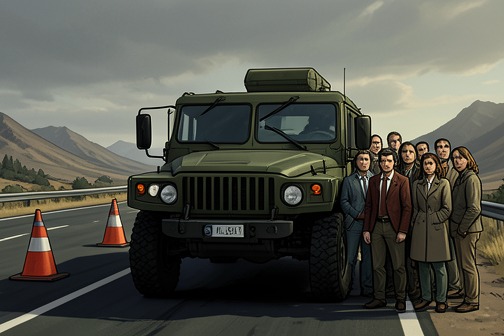
[The I-80 quarantine crisis](entity:event-recall-event-i-80-5416308e3f7c) is the military emergency that the authorities present as a toxic spill, but which [Dom Corvaisis](entity:character-recall-character-dom-corvaisis-d9ce4fde805e) and the other survivors come to suspect concealed a different event at the [Tranquility Motel](entity:location-recall-location-tranquility-motel-17316482b285). Its roadblocks, evacuation orders, and restricted airspace make a public-health explanation look increasingly like a mechanism for sealing off a secret; the later effort to suppress memories and Falkirk’s plan to destroy the witnesses reveal how far that logic can extend.
## The evacuation story
The motel registry gives the crisis a mundane official outline. Recalling the summer before last, [Faye Block](entity:character-recall-character-faye-block-43b77274239e) identifies Friday, [July 6](entity:time-recall-time-july-6-664e6e27c147), as the night a truck carrying dangerous chemicals toward [Shenkfield](entity:location-recall-location-shenkfield-0e9d5a5eb820) was said to have suffered a toxic spill. Shenkfield was a military installation about eighteen miles southwest of the motel. The interstate was closed, the motel shut down until Tuesday, and guests were ordered out of the danger zone in their own cars. [Ned Sarver](entity:character-recall-character-ned-sarver-8226efdc1143) and [Sandy Sarver](entity:character-recall-character-sandy-sarver-5f80709b9fa1) were allowed to return to their trailer near Beowawe because it lay beyond the quarantine boundary. [Ernie Block](entity:character-recall-character-ernie-block-f9eb5d1128b4) adds that Shenkfield was an isolated site for chemical and biological weapons testing, making the alleged cargo especially alarming.
That account does not settle what happened to the guests. Dom proposes that the people at the motel may have been contaminated and that the Army and the government used the motel as a clinic, treated them in decontamination suits, and erased or altered their memories. The suggestion is not established fact: it is an attempt to explain the group’s psychological troubles and photographs showing apparently drugged people. Ernie and [Faye](entity:character-recall-character-faye-ad32954c4aae) immediately note a difficulty. Their own memories, and those of other guests, fit the evacuation story, while Dom’s do not. To them, the discrepancy makes the possibility of brainwashing more—not less—plausible, while leaving its precise purpose unresolved.
## What the records reveal
Dom and [Ginger Weiss](entity:character-recall-character-ginger-weiss-c0c2e7ef6acc) test the official chronology against the [Elko Sentinel back issues](entity:object-recall-object-elko-sentinel-0395d4edc4f3). Because the paper published no Sunday edition and did not report the Friday-night emergency until its Monday, July 9 issue, the first Saturday edition contains no account of the spill. Monday and Tuesday’s increasingly urgent headlines describe a toxic spill, an Army quarantine, a possible nerve-gas leak, and the Army’s claim that everyone had been evacuated. Wednesday, July 11, brings reports that [Interstate 80](entity:location-recall-location-interstate-80-09dbb90e2ea2) has reopened, the quarantine has been removed, and the first evacuees have been located. The sequence explains when the public learned the official story; it does not establish that the story explains the motel guests’ missing memories.
The distribution of authority is more revealing than the headlines. Army units attached to Shenkfield closed a ten-mile stretch of Interstate 80 and established the roadblocks before notifying the [Elko County](entity:location-recall-location-elko-county-b64ae78f502b) Sheriff or Nevada State Police. They kept civilian officers out of the quarantine operation and its contingency planning. The Army also closed eight miles of a north-south county road, restricted civilian air traffic above the area, and patrolled the perimeter with helicopters, searchlights, and, according to local rumors, soldiers equipped with infrared surveillance gear. The cordon covered eighty square miles. Local authorities objected that the Army was overriding civilian jurisdiction, but the dispute became moot when the emergency ended before a judge could rule.
The survivors’ reconstruction makes the timing particularly troubling. They remember an earthquake-like shaking and strange sound at the [Tranquility Grille](entity:location-recall-location-tranquility-grille-0a6b2303c557) about half an hour after full darkness. The weather report gives sunset as 7:31 p.m.; allowing for the short twilight, Dom estimates that the disturbance began at about 8:10. Yet the newspaper places the Army’s roadblocks at almost 8:00. Even if the witnesses’ estimate is off, the cordon appears to have been in place before the supposed accident. Dom and Ginger infer that the Army had some advance warning, though not enough to prevent whatever followed. Ginger further argues that calling in a [DERO](entity:character-recall-character-dero-bc813f57d1bd) company makes little sense for an ordinary spill: the specialized team suggests that the Army wanted only personnel with exceptional clearance to see what was inside the restricted zone.
## Memory, evidence, and renewed fear
The toxic-spill account becomes one competing explanation for the survivors’ damaged recollections, not a memory they can confidently recover. After they regroup at the motel, Dom, Ginger, Ernie, and [Ned](entity:character-recall-character-ned-160602ecacc7) have strikingly similar nightmares of being strapped to motel beds and attended by people in decontamination suits. [Sandy](entity:character-recall-character-sandy-457b75877fae)’s dream is pleasant but indistinct; Faye does not dream. Ned is so shaken that he and Sandy move into a motel room rather than remain alone at their trailer. He worries that Falkirk may come for them, and Dom recognizes that Ned has had little time to build defenses against the vivid nightmares that others have endured for weeks.
The threat is not merely an inference drawn from dreams. A separate investigation has led Dom from anonymous correspondence to a sequence of alarming clues: he tests a note on his [IBM Displaywriter](entity:object-recall-object-ibm-displaywriter-9048da2d8017) against four print styles, and Courier 10 appears to match; another envelope contains only the words The moon; a later, postmarked envelope contains two Polaroids. One shows a young priest with an unnervingly empty expression; the other shows a woman Dom recognizes, strapped to a narrow bed with an IV in her wrist. These clues do not independently prove what happened during the quarantine, but they deepen his suspicion that the witnesses’ lost time, their apparent treatment, and the people shown in the photographs belong to a larger operation.
The suppression campaign reaches beyond the original motel group. The [Federal Bureau of Investigation](entity:organization-recall-organization-c3b9c0848e8c) and [Central Intelligence Agency](entity:organization-recall-organization-central-intellig-55def823fc61) are illegally holding the [Salcoe family](entity:character-recall-character-6f0127ab7d97) incommunicado in Monterey and subjecting them to another course of memory repression and alteration. The operation’s handlers had expected their conditioning to keep the witnesses silent, but Falkirk learns that the memory blocks are deteriorating. He regards a further three-day session as a doubtful remedy. With multiple agencies involved, and with the suppressed experience pressing back into memory, the original cover-up is becoming harder to contain.
## From quarantine to a plan for destruction
The crisis returns as an instrument of control when Falkirk decides to isolate the Tranquility Motel again. He intends to close Interstate 80 under the pretense of a toxic spill, take the witnesses into custody, and transport them to the [Thunder Hill Depository](entity:location-recall-location-thunder-hill-deposit-2a2f832ed9fe). There, behind massive blast doors with Dr. [Miles Bennell](entity:character-recall-character-miles-bennell-fd741f9d1a85) and other suspected workers, they would be trapped inside the mountain. Falkirk plans to detonate two five-megaton backpack nuclear weapons, killing the witnesses and himself. He expects General [Maxwell D. Riddenhour](entity:character-recall-character-maxwell-d-riddenhou-a9ec000bc395) to follow his example and eliminate the other possible sources of contamination, including the Tolk and Halbourg families. In his reasoning, the quarantine has ceased to be a temporary response to a spill and become a justification for exterminating people classified as a threat.
[Foster Polnichev](entity:character-recall-character-foster-polnichev-986f8ed898bb) contests that escalation. In a call with Falkirk, he argues that the cover-up has spread beyond control and that killing the Halbourgs, the Tolks, and the Nevada witnesses would make containment too costly. He favors going public and doubts that the newly manifested abilities prove that the people involved are dangerous. Falkirk answers with a more extreme claim: disclosure would invite political interference and jeopardize the species’ survival. Their disagreement exposes a central contradiction in the crisis. Polnichev treats secrecy and violence as decisions that require limits; Falkirk treats them as necessary defenses against a danger he has come to see as existential.
[General Bob Alvarado](entity:character-recall-character-general-bob-alvarad-728d00bffb3a) and Bennell, meanwhile, recognize that Falkirk is acting in the name of Riddenhour and higher authorities, and that killing him will bring consequences. Alvarado nevertheless intends to resist and take the news to the world, even if the men who oppose Falkirk must dismantle the Depository’s exit to escape. Their plan makes the conflict about more than control of the witnesses: it is also a struggle over who has the right to decide whether the event remains secret.
## Significance
The quarantine’s public explanation is concrete—dangerous cargo, a closed highway, an evacuation, and a cleanup—but the evidence recovered by the witnesses repeatedly strains that account. The Army’s early roadblocks, its exclusion of civilian officials, the scale of surveillance, and DERO’s presence make secrecy visible through the machinery of emergency management. Yet the records do not by themselves disclose what the Army was protecting or prove the survivors’ theory in full. The crisis sustains suspense through that gap between documented controls and an incompletely recovered event.
As the story develops, the language of protection becomes a route from evacuation to coercive memory treatment, illegal detention, and threatened nuclear destruction. The reported spill supplies a reusable official pretext; the same form of emergency can first separate witnesses from the public and later gather them inside a place from which Falkirk intends that none will leave. The crisis therefore marks both the origin of the survivors’ investigation and the escalating political conflict over whether the truth will be concealed, disclosed, or destroyed with its witnesses.
Event 41
The Tranquility Grille tremor and window implosion
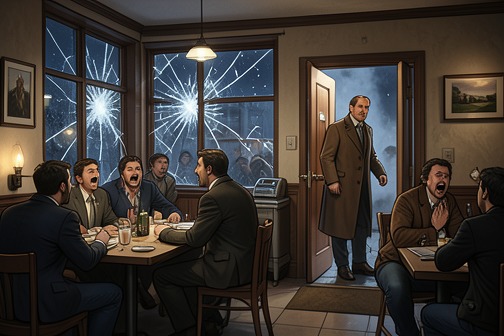
[The Tranquility Grille tremor and window implosion](entity:event-recall-event-tranquility-grille-16ea774d3773) is the moment when [Dominick Corvaisis](entity:character-recall-character-dominick-corvaisis-5f0bc1572735)’s attempt to recover a missing memory appears to make the past physically recur. On a Saturday night at the [Tranquility Grille](entity:location-recall-location-tranquility-grille-0a6b2303c557), a remembered rumble becomes an audible and violent disturbance in the room. The windows burst inward, but the event does not restore the witnesses’ lost account of what followed on [July 6](entity:time-recall-time-july-6-664e6e27c147). Instead, it gives them a startling fragment of recognition—and gives the government surveillance team evidence that the phenomena surrounding the witnesses may be active again.
## The attempt to recover July 6
The disturbance begins during a conversation about the summer-before-last incident and the memories the group cannot retrieve. [Ned Sarver](entity:character-recall-character-ned-sarver-8226efdc1143) suggests that Dominick retrace what he did on Friday night, July 6, up to the point where his memory was erased. Dominick remembers more of the evening than the others and had come close to recalling something important earlier that night. But the approach of the memory had frightened him so intensely that he had run for the door. He expects that forcing himself toward it again could provoke the same uncontrollable reaction.
Rather than recount the missing event, Dominick reconstructs the ordinary details around its edge. He describes [Ginger Weiss](entity:character-recall-character-ginger-weiss-c0c2e7ef6acc) sitting in a corner booth near the window, the sunset making the diner glow orange, and the darkness spreading across the plains. He remembers having a second beer, partly because it let him keep looking at Ginger. Then comes a sound: first distant, then growing louder. His account breaks off at the point where the memory should continue. The scene’s pressure lies in that gap. A small, concrete recollection—the beer, the booth, the approaching night—has brought him to the threshold, but the crucial sequence remains inaccessible.
## The sound returns in the present
[Ned](entity:character-recall-character-ned-160602ecacc7) urges Dominick to concentrate on the sound itself. As Dominick gets up and tries to locate where it came from, the rumble ceases to be merely an image in his recollection. Ned hears it in the diner, not as a series of thunderclaps but as one sustained, hollow roll that swells without stopping. The others hear it too. Its increasing volume becomes physical: Ned can feel the vibrations in his bones, and he understands that this is where the astonishing events they endured began.
The room responds before anyone can explain what is happening. Chairs jitter and bump across the floor; one slides into Dominick, startling him. The rumble rises alongside an oscillating, electronic-sounding shriek until the noise reaches an ear-splitting peak. Then the large front windows implode with a crash like a bomb blast. [Faye](entity:character-recall-character-faye-ad32954c4aae) throws her arms over her face and screams; Ernie stumbles backward; [Sandy](entity:character-recall-character-sandy-457b75877fae) presses herself against Ned. The closed blinds shield them from the direct rush of flying glass, though the force throws the blinds upward and sends glittering shards into the booths, over Ned, and across the floor. The eruption is followed by an abrupt, profound silence, broken only by small pieces of glass dropping from the frames.
## Recognition without recovery
Dominick emerges from the Grille bewildered, and Ned cannot explain what has happened. He recognizes the disturbance as part of what occurred in the summer-before-last, but only as the beginning of it. Neither man can remember what came after the windows blew in. The group has recovered a sensory fragment—the sound and its relation to the first disturbance—without recovering the missing narrative that would make it intelligible. The windows’ destruction is therefore both evidence and limit: something real has returned, but the witnesses still cannot say what happened next.
Ginger later proposes that the shaking and rumble may have been produced when Dominick struggled to remember the moment just before his memory block took effect. On this reading, he unconsciously used a power to recreate the effects of the July disturbance. She connects the suggestion to Dominick’s earlier account of pulling paper moons from the walls of [Zebediah Lomack](entity:character-recall-character-zebediah-lomack-bd96015ca4da)’s house without touching them. The explanation remains a hypothesis, not a settled account of the Grille event; Dominick himself questions whether the strange light associated with the earlier events could also have been manufactured in this way. The episode thus introduces a possible link between memory, psychic power, and physical surroundings while preserving uncertainty about how much the witnesses understand.
## Surveillance and the loss of control
The event is also witnessed from outside the group. [Leland Falkirk](entity:character-recall-character-leland-falkirk-8c66510f5e4a) and his surveillance experts have been monitoring conversations at the Tranquility, and a hidden team south of the interstate, together with an [Infinity transmitter](entity:object-recall-object-infinity-transmitter-946b9c811cbc) tapping the Grille’s payphone, confirms that the shaking, rumble, electronic ululation, and window implosion have actually occurred. What had sounded to the government observers like Dominick’s fantastic account of animated moon photographs now sits beside a new, independently observed phenomenon. The event gives the scientists a reason to take the witnesses’ claims seriously, even as the implications unsettle the people charged with containing them.
Falkirk and the scientists cannot initially explain what they have observed. The disturbance, followed by the discovery of [Brendan Cronin](entity:character-recall-character-brendan-cronin-2fbbbf142f5f)’s healing ability, makes the situation seem newly unpredictable. Falkirk recognizes that the government’s apparent command of the earlier July operation may already have been an illusion: the incident at the Grille suggests that the forces involved could have exceeded official control before the witnesses themselves knew what had happened. A private attempt to remember has consequently become a public breach in the cover-up. It shakes the diner, but it also shakes the authorities’ confidence that the past can remain suppressed.
Event 42
The moonlight apparition in the Tranquility Motel office
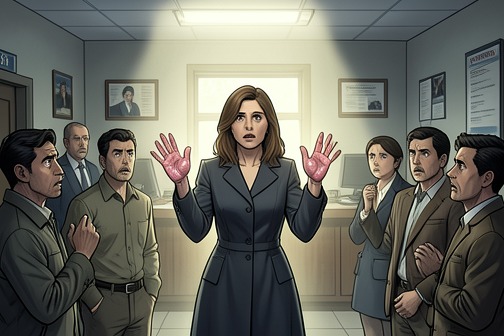
[The moonlight apparition in the Tranquility Motel office](entity:event-recall-event-tranquility-55ddb96f20d3) turns a gathering of witnesses into a vivid encounter with the past they cannot yet remember. Milky light, blood-red radiance, and a recurring three-part crash transform shared wonder into terror. For [Ginger Weiss](entity:character-recall-character-ginger-weiss-c0c2e7ef6acc), the event is more than an unexplained spectacle: it brings her close to the buried memory of the summer before last, and gives her a chance, for the first time, to resist the fugue that has repeatedly taken her away from herself.
## The Call and Its Signs
The office gathering is charged with expectation before the light appears. [Brendan Cronin](entity:character-recall-character-brendan-cronin-2fbbbf142f5f) calls the people there back to the motel, and [Dom Corvaisis](entity:character-recall-character-dom-corvaisis-d9ce4fde805e) answers by raising his hands to show rings of swollen flesh newly visible in his palms. Brendan bears the same strange marks. The two men face one another as though the air between them has thickened; to Ginger, the room seems charged with a force beyond ordinary human understanding. The marks connect the gathering to the recent miraculous events in Brendan’s life, although the signs do not explain what is happening or identify its source.
The witnesses are not all attending to the same fear. The office lamps are already lit because [Ernie Block](entity:character-recall-character-ernie-block-f9eb5d1128b4) is uneasy in deep shadows. [Faye Block](entity:character-recall-character-faye-block-43b77274239e) stands with Ernie behind her, his hands on her shoulders; [Ned Sarver](entity:character-recall-character-ned-sarver-8226efdc1143) and [Sandy Sarver](entity:character-recall-character-sandy-sarver-5f80709b9fa1) hold hands beside the postcard rack. When Ginger feels the skin prickle at the back of her neck, her anticipation is bodily before the apparition becomes visible. The company’s quiet suspense gives way almost at once to a phenomenon that involves the whole room.
## The Light Turns Red
A milky-white radiance fills the office, apparently springing from the air itself. It shimmers on every side but seems to pour most heavily from overhead, like a silvery mist. Ginger recognizes it as the light from her unremembered lunar dreams. She turns beneath it, hoping that seeing it again will unlock those dreams and, eventually, the long-lost events of the summer night that inspired them. The light initially offers the possibility of recognition rather than danger.
The other witnesses meet it with tentative wonder. [Sandy](entity:character-recall-character-sandy-457b75877fae) reaches into the glow as if she could take a handful; [Ned](entity:character-recall-character-ned-160602ecacc7) begins to smile, [Faye](entity:character-recall-character-faye-ad32954c4aae) smiles, and Ernie’s rugged face takes on a childlike expression. Ernie names the moon, and Dom echoes him, his marked hands still ablaze. For Ginger, this is the brink of understanding: the blank barrier in her memory trembles as a revelation presses against it. But the white light turns blood-red, and the emotional direction of the scene reverses with it. Ginger recoils from what she had wanted to remember; Sandy stops reaching, Ned’s smile becomes a grimace of repulsion, and Faye and Ernie press back against the counter.
A loud crash then repeats through the scarlet-lit office. Its three-part rhythm resembles a great heart beating, but has an extra stroke: LUB-DUB-dub. Ginger recognizes it as the sound [Father Stefan Wycazik](entity:character-recall-character-father-stefan-wycaz-8bcbf4db75a8) had described to Dom Corvaisis—the same noise that arose in Brendan’s bedroom and shook St. Bernadette’s. More important to her, the sound and the colored light belong to an event she has encountered before: together, they are part of something that happened the summer before last. Each repetition brings that recognition closer without yet supplying the memory itself.
## The Memory Block and Ginger’s Resistance
As the crash and the pulsing light continue, Ginger approaches a shocking recollection. Her fear rises with the prospect of remembering. The [Azrael Block](entity:rule-recall-rule-azrael-block-05e13f0af70c), which inhibits the return of what happened, pushes her toward a fugue instead. She recognizes the approaching blackout in familiar physical signs: difficulty breathing, trembling, a palpable sense of mortal danger, fading surroundings, and darkness seeping into the edges of her vision. The apparition is frightening, but her deepest terror is of the unremembered experience that it seems to repeat.
Ginger turns away from the office and grips the front-door frame with both hands, trying to hold herself in consciousness. Through the glass she looks out at Nevada’s winter landscape and somber sky, attempting to block the light and sound behind her. Panic makes escape into a fugue seem almost preferable, yet she continues to hold on, shaking and gasping. The three-stroke crash fades; the red light pales; eventually the office is silent again, lit only by its ordinary fixtures and the light from the windows. Ginger has not blacked out.
## Aftermath and Significance
This is the first time Ginger successfully resists a seizure. She cannot be certain why she manages it: perhaps the ordeals of the preceding months have strengthened her, perhaps being near the answers gives her resolve, or perhaps she draws strength from the people she now regards as a family. Whatever the explanation, the immediate consequence is a change in her expectations of herself. Having once fended off a fugue, she believes future attacks may be easier to withstand.
The scene also sharpens the conflict between relief and dread at the heart of her search. Ginger’s memory blocks are crumbling, and the display has linked her lunar dreams to the remembered summer night without fully disclosing that night. She now fears not knowing more than she fears facing [July 6](entity:time-recall-time-july-6-664e6e27c147). Once the apparition ends, she turns back toward the others; the rings have disappeared from Dom’s and Brendan’s hands, and Brendan sits trembling on the sofa. The event leaves no clear explanation, but it gives Ginger a concrete measure of change: revelation still terrifies her, yet fear no longer wholly determines what she can endure.
Event 43
Pablo Jackson's murder
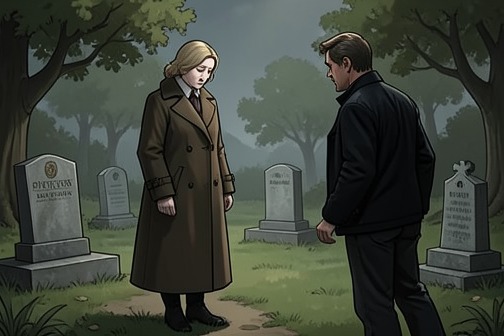
[Pablo Jackson's murder](entity:event-recall-event-pablo-jackson-dcff6109928c) is the point at which [Ginger Weiss](entity:character-recall-character-ginger-weiss-c0c2e7ef6acc)'s search for the truth becomes a question of survival. His death follows his work with her on her fugue episodes and hypnotic regression; after his burial, Ginger and [Dominick Corvaisis](entity:character-recall-character-dominick-corvaisis-5f0bc1572735) begin to suspect that the gunman belonged to the hard-line faction behind the effort to conceal what happened at [Tranquility Motel](entity:location-recall-location-tranquility-motel-17316482b285). The novel does not show the killing itself in these passages. Instead, it gives the death weight through Ginger's grief, the threat it suggests, and the uncertainty that surrounds the conspirators.
## Background and Aftermath
Pablo had been helping Ginger investigate her fugues through hypnotic regression. When she later tells Dom what she knows, she includes both Pablo's murder and her own narrow escape, linking his death to the danger surrounding her attempts to recover the past. The evidence does not establish the precise circumstances of the killing or identify its perpetrator; its significance emerges through what Ginger and Dom infer afterward.
The morning of Pablo's burial, Ginger remains at [Baywatch](entity:location-recall-location-baywatch-5a715099857f), where his memory stays with her through the afternoon and evening. She cannot concentrate on reading and worries about what will become of her. The contrast is stark: Pablo is physically gone, yet his presence persists in her thoughts as she faces the consequences of the work they shared.
## Ginger Tells Dom What Happened
In a later conversation, Ginger tells Dom about her fugue episodes, her regression sessions with Pablo, the mind-control technique called the [Azrael Block](entity:rule-recall-rule-azrael-block-05e13f0af70c), Pablo's murder, and her escape. These facts bring together the personal and the political dimensions of her situation: the episodes are not simply unexplained disruptions in her life, but part of an effort to keep her from remembering the motel incident. Pablo's role in helping her approach those memories makes his death especially consequential, although the evidence does not prove that his work was the motive for the killing.
Ginger asks whether the people responsible will allow them to uncover the truth, pointing to Pablo's death as evidence that the danger is not theoretical. Dom answers with a tentative account of two factions. He believes that the hard-liners associated with [Leland Falkirk](entity:character-recall-character-leland-falkirk-8c66510f5e4a) wanted the witnesses killed, while another group favored erasing or controlling their memories and allowing them to live. In this explanation, Pablo's gunman most likely belonged to the violent faction. It remains an inference, not a confirmed identification.
## Consequences and Significance
Neither Ginger nor Dom treats the factional explanation as proof that they are safe. Dom believes that the less violent group may still be trying to protect the witnesses, but he also acknowledges that Falkirk's side remains willing to kill anyone who threatens the cover-up. Ginger's question about whether they are being watched carries the uncertainty forward: Pablo's murder warns them that searching for answers may expose them to the same violence.
The conversation ends not with certainty but with resolve. Ginger and Dom agree that they cannot simply return to their previous lives while the events remain unexplained. Pablo's murder thus changes the investigation's stakes: the work of remembering and finding out what happened is now entangled with the risk of further deaths. His absence also sharpens the distinction between the competing methods of suppression they suspect—memory control on one side, lethal force on the other—without resolving who ordered the killing or why.
Event 44
Thunder Hill incident of July 6
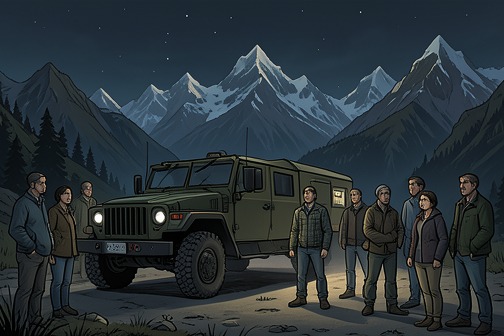
The [Thunder Hill incident of July 6](entity:event-recall-event-thunder-hill-incident-o-ee38c35ebf07) is the concealed event around which the [Tranquility Motel](entity:location-recall-location-tranquility-motel-17316482b285) witnesses’ fractured memories, recurring nightmares, and growing investigation converge. Its full sequence remains hidden, but evidence gathered afterward points toward an emergency at [Thunder Hill](entity:location-recall-location-thunder-hill-b1ea42221a8b), a military effort to isolate and control witnesses, and a secret whose disclosure could reach the highest levels of the [United States federal government](entity:organization-recall-organization-6ef11274049c).
## The incident behind the erased memories
[The summer before last](entity:time-recall-time-the-summer-before-last-09e3e748505e), a group of people encountered something during the [July 6](entity:time-recall-time-july-6-664e6e27c147) crisis that they could not later recall clearly. The Army imposed a temporary quarantine around the area where witnesses were being dealt with and, at the same time, enlarged the security zone around the [Thunder Hill Depository](entity:location-recall-location-thunder-hill-deposit-2a2f832ed9fe) in the mountains. The witnesses’ emerging interpretation is that the first measure contained them while the second protected the source of what had happened. [Dom Corvaisis](entity:character-recall-character-dom-corvaisis-d9ce4fde805e) suspects that the real explanation lies in the Army’s activities at Thunder Hill, not in the public account of a toxic spill at the [Shenkfield Army Testing Grounds](entity:location-recall-location-shenkfield-army-test-1a511553800f).
The crisis left its mark in fragments rather than a coherent recollection. When the witnesses gather again at the Tranquility Motel, Dom, [Ginger Weiss](entity:character-recall-character-ginger-weiss-c0c2e7ef6acc), [Ernie Block](entity:character-recall-character-ernie-block-f9eb5d1128b4), and [Ned](entity:character-recall-character-ned-160602ecacc7) experience vivid nightmares of being strapped to motel beds and attended by men in decontamination suits. They increasingly understand these episodes not as ordinary dreams but as memories resurfacing in disguised form. [Sandy Sarver](entity:character-recall-character-sandy-sarver-5f80709b9fa1) has a less distinct, pleasant dream, while [Faye Block](entity:character-recall-character-faye-block-43b77274239e) dreams nothing. The contrast does not resolve what happened; it makes the gaps and unevenness in the group’s recollections part of the evidence.
## Clues, correspondence, and the search for Thunder Hill
Dom’s investigation has already been shaped by anonymous messages whose origins he cannot establish. After receiving a note advising the sleepwalker to search his past, he tests whether he could have typed it himself: he reproduces its two sentences on an [IBM Displaywriter](entity:object-recall-object-ibm-displaywriter-9048da2d8017), prints versions in four typefaces, and compares them with the original. Courier 10 appears to match, leaving open the unsettling possibility that he sent himself the note. A later, unmarked envelope contains only the words The moon. Still another, postmarked from New York, contains Polaroids of a young priest and a restrained young woman, both pictured with vacant expressions. Dom recognizes neither person with confidence, though the woman seems familiar. These objects do not explain July 6, but they make his lost past feel actively connected to the present.
The more direct route to Thunder Hill comes through the [Elko](entity:location-recall-location-elko-6d564a531c69) Sentinel. Dom and Ginger Weiss search issues published in the weeks after the supposed toxic spill, then widen their reading to stories that appear unrelated to the highway closure. By looking for concealed connections rather than an explicit report, they identify Thunder Hill as a place whose appearances in the paper may point toward the real source of the crisis. Dom’s conclusion is that [Shenkfield](entity:location-recall-location-shenkfield-0e9d5a5eb820) was a diversion, designed to draw attention away from Thunder Hill. [Faye](entity:character-recall-character-faye-ad32954c4aae) confirms that the Army installation lies roughly ten or twelve miles north-northeast of the motel, where limestone caves and an underground records depository sit behind guarded access.
The scale of the post-July 6 restrictions sharpens the question. As Ned observes, an underground archive would not ordinarily require a vast surface security zone. Dom reasons that the Army took two emergency measures: a temporary quarantine near the motel and an immediate expansion of the restricted area around the Depository. The second quarantine remains in force. For the witnesses, the land-grab is not proof of what occurred, but it makes Thunder Hill a more compelling investigative target than the official explanation.
## The moon as a returning memory
Ginger offers a theory that links the group’s different symptoms without claiming to know the whole event. Their dreams share a lunar element; their other recurring details—decontamination suits, intravenous needles, beds, and restraining straps—have proved to derive from real experiences. She therefore proposes that the moon, too, may be a memory trying to surface. [Marcie](entity:character-recall-character-marcie-12363d0e1b68)’s fixation has shifted toward a scarlet moon, and [Jack Twist](entity:character-recall-character-jack-twist-b2feffa09d4e) has described ordinary moonlight turning bloody in a nightmare. Ginger interprets these red images as possible evidence that, on July 6, the witnesses saw something that made the moon appear to change color.
In her account, the strange light that sometimes fills [Brendan Cronin](entity:character-recall-character-brendan-cronin-2fbbbf142f5f)’s bedroom and that the group witnesses in the motel office may be a reenactment of that earlier sight—a message nudging the witnesses toward recollection. This remains Ginger’s explanation, not a recovered, shared memory of the event. Its importance lies in how it joins the group’s scattered experiences: bodily memories of confinement, the recurring moon, and uncanny light become parts of a single hypothesis that they can test together.
## Containment and the stakes of disclosure
The [Salcoe family](entity:character-recall-character-6f0127ab7d97)’s experience shows that the effort to suppress memories did not end with the original motel operation. Gerald Salcoe, his wife, and their two daughters had rented rooms at the Tranquility Motel on the night of the incident, and their memory blocks have since deteriorated. Experts in brainwashing from the [Central Intelligence Agency](entity:organization-recall-organization-central-intellig-55def823fc61), previously used in covert foreign operations, had been brought in to condition the witnesses. Now the [Federal Bureau of Investigation](entity:organization-recall-organization-c3b9c0848e8c) and the Central Intelligence Agency are holding the Salcoes incommunicado in Monterey and subjecting them to another program of memory repression and alteration. [Leland Falkirk](entity:character-recall-character-leland-falkirk-8c66510f5e4a), briefed on the operation, doubts it can preserve the secret.
Thunder Hill’s physical design embodies the force of that secrecy. Its twin blast doors are thirty feet high and twenty feet wide; a separate, heavily reinforced pedestrian entrance leads through an interlocking concrete tunnel. Falkirk regards the installation as an ideal vault for the secret of July 6. He also understands the political stakes: the cover-up involves rival government institutions, including the Federal Bureau of Investigation, the Central Intelligence Agency, the National Security Agency, the [United States Army](entity:organization-recall-organization-7d50e40c9fd9), and the Air Force. Senior officials, he knows, are fully informed, while most personnel involved do not know what they are concealing. The silence has held for more than eighteen months, but he fears the consequences if it breaks.
The incident’s narrative force comes from this imbalance: the witnesses possess vivid traces but no complete account, while the institutions that know more have built both physical barriers and renewed psychological ones. Each clue—from Dom’s typewritten comparison and the anonymous photographs to the nightmares, newspaper stories, and expanded quarantine—narrows the field without yet disclosing the decisive event. Thunder Hill therefore becomes not only a location to investigate but the guarded center of a struggle over who may remember, speak, and establish what happened.
Event 45
Tranquility Motel witnesses’ brainwashing
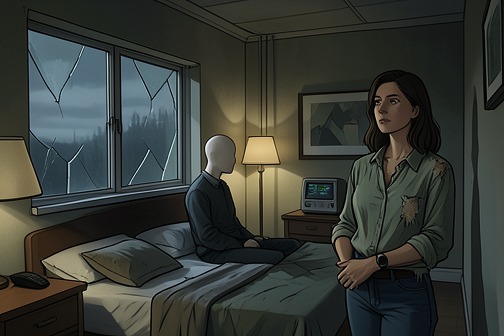
[Tranquility Motel witnesses’ brainwashing](entity:event-recall-event-tranquility-motel-witne-f8f74c30b009) was a government effort to erase what the motel’s guests had seen and to make the resulting gaps appear like ordinary time. Its importance lies not only in the original coercion but in the system built to maintain it: fabricated memories, renewed confinement, surveillance, and repeated attempts to suppress memories that would not stay buried. The effort’s failures turn private uncertainty into evidence of a wider cover-up.
## Origins and Design
The operation followed the extraordinary events at the [Tranquility Motel](entity:location-recall-location-tranquility-motel-17316482b285) two summers earlier. Gerald Salcoe, his wife, and their two daughters had rented a pair of rooms there on the wrong night. The [Salcoe family](entity:character-recall-character-6f0127ab7d97) was among the witnesses whose memories were later suppressed. [Leland Falkirk](entity:character-recall-character-leland-falkirk-8c66510f5e4a) recalls that the CIA’s brainwashing specialists, ordinarily used in covert foreign operations, had been borrowed for the motel assignment and had promised reliable results. Their task was not simply to make witnesses forget what they had seen, but to conceal the fact that time had been taken from them.
The method depended on filling the missing interval with false recollections. In a later conversation, [Ginger Weiss](entity:character-recall-character-ginger-weiss-c0c2e7ef6acc) reasons that a person held in custody for several days would notice an empty stretch in her past. [Pablo Jackson](entity:character-recall-character-pablo-jackson-48e95f0b1940) explains that fabricated memories could cover those days so completely that the subject might not recognize the gap. His explanation becomes more disturbing when Ginger’s supposed recollections of her stay are examined: she can describe the Tranquility Motel in detail, but cannot remember the books or television programs she supposedly used to pass the time. Pablo concludes that she had never done those things. They were a manufactured account, installed to disguise what had actually happened.
## How the False Memories Fail
The replacement memories are not equally convincing in every detail. Ginger can repeat that she ate at the [Tranquility Grille](entity:location-recall-location-tranquility-grille-0a6b2303c557) each night and describe its small menu, yet she cannot say what she ate or explain how she knows the food was good. As Pablo presses for specifics, her answers remain flat and hollow while her face tightens with anxiety. The scene distinguishes a rehearsed response from a lived memory: the cover story supplies details, but those details do not carry the texture of experience.
Pablo understands that abruptly telling Ginger the truth could be dangerous. Her apparent memories have been installed as part of an [Azrael Block](entity:rule-recall-rule-azrael-block-05e13f0af70c), and the genuine memories are locked behind it. He believes that directly ordering her to discard the false account and break through the block could trigger a coma or something worse. Instead of forcing the recovery, he proceeds cautiously, expecting that finding and using small openings may take days or weeks. For the time being, he tries to establish the exact number of hours stolen from her, returning to Friday, [July 6](entity:time-recall-time-july-6-664e6e27c147), and asking when she signed the Tranquility Motel register. The recovery process therefore exposes the brainwashing’s precision as well as its human cost: even the search for the truth must be measured against the danger of another imposed collapse.
The planted account also explains why a witness might remember the motel clearly while remaining unable to substantiate what she did there. Its details are not proof of ordinary experience; they are cover. The more insistently Pablo tests those details, the more visibly the scripted quality of Ginger’s answers emerges. The gap between what she says and what she can genuinely recall becomes a sign of the intervention itself.
## Renewed Repression and the Salcoe Family
The original conditioning begins to fail. Leland learns that the Salcoe family’s memory blocks have deteriorated markedly. The specialists, embarrassed by the number of subjects whose conditioning is breaking down, argue that another three-day session will ensure the witnesses’ silence. Yet Leland judges the operation a lost cause. He believes the experience was too profound and shattering to be easily suppressed, and that its forbidden memories continue to press against the blocks. The claim of guaranteed silence is thus less a solution than another promise from experts whose earlier assurances have already failed.
At that moment, the FBI and CIA are illegally holding the Salcoe family incommunicado in [Monterey, California](entity:location-recall-location-293b960f8134), subjecting them to another intricate program of memory repression and alteration. [Parker Faine](entity:character-recall-character-parker-faine-0e53d8b2c0c1) discovers what that renewed treatment looks like from inside the house: one of the daughters lies unresponsive, wearing earphones connected to a tape recorder. A woman’s soothing voice supplies a false account of a hotel stay, describing sleeping late and walking around the grounds. The hypnotic recording is being used to cover the time consumed by the current session, with audible speech and, Parker suspects, subliminal messages working together. The image makes the operation concrete: memory control is not only a secret held in officials’ files, but a voice repeated into a child’s ear while she cannot respond.
[Dom Corvaisis](entity:character-recall-character-dom-corvaisis-d9ce4fde805e) also disputes the public explanation that a toxic spill and evacuation account for what happened around the motel. [Ernie Block](entity:character-recall-character-ernie-block-f9eb5d1128b4) recalls newspaper clippings from the [Elko](entity:location-recall-location-elko-6d564a531c69) Sentinel and the community’s continuing questions about the supposed danger. Dom argues that visiting witnesses such as Elroy and Nancy Jamison may remember taking the Blocks away because that is what they were instructed to remember; if they were present during the motel events, he suspects they too were brainwashed. The newspaper story gives the cover a public shape, while Dom’s account suggests that even apparently corroborating memories may have been manufactured.
## Surveillance and the Limits of Secrecy
The memory program is supported by an extensive, fragile surveillance operation. The FBI agent speaking with Leland says that monitoring every witness visually for four days a month and listening to only about half of the recorded phone calls requires twenty-five agents, while the unit has only twenty. Only three of those twenty know why the witnesses are being watched, because the case is so highly classified. The agent argues that secrecy leaves staff feeling untrusted and makes them careless; in the resulting gaps, a witness’s memory block can begin to break down without anyone noticing until the situation reaches crisis.
The agencies’ coordination is itself a weakness. The operation involves the FBI, the CIA, an entire [DERO](entity:character-recall-character-dero-bc813f57d1bd) company, and other participants, creating what Leland sees as too many chiefs. He is responsible for the military side and intends to carry out his assignment even though he doubts the cover can last. When the FBI agent asks about moving against the motel witnesses, Leland refuses to authorize the operation until the separate crisis involving [Calvin Sharkle](entity:character-recall-character-calvin-sharkle-03a299e430b2) in [Chicago](entity:location-recall-location-chicago-eb77a855d5aa) is clarified. The plan to seal off the motel on short notice is therefore conditional, caught between the desire to contain witnesses and the competing demands of a sprawling security response.
[Jack Twist](entity:character-recall-character-jack-twist-b2feffa09d4e) later warns the group that their conversations are not private. He explains that surveillance need not require agents to enter a room and plant a device: a rifle microphone can listen from a distance, while an infinity transmitter can activate a telephone’s microphone without making it ring. He demonstrates the implication by pointing to the extension the witnesses use themselves. His warning changes where the group can safely talk; they move their discussion to the diner and plan to unplug its phone. The brainwashing effort therefore reaches beyond the treatment sessions, shaping the witnesses’ movements and forcing them to treat even familiar rooms and ordinary communications as potential instruments of observation.
## Failure and Significance
The attempted suppression becomes a contest between imposed accounts and returning experience. Leland recalls that the witnesses saw something so paralyzing, astonishing, humbling, and terrifying that he associates their response with religious encounters. The government’s label for them, witnesses, carries an unintended resonance: they are not merely people to be monitored, but people whose remembered experience threatens the official story. The more forcefully the agencies try to overwrite that experience, the more conspicuous the machinery of the overwrite becomes.
The failure is institutional as well as psychological. Leland and the FBI agent discuss the extreme possibility of killing thirty-one citizens to contain the secret, then reject that kind of barbarism as no real solution. Leland’s position is that the government should not have attempted to maintain an unlimited deception. Yet he remains a soldier assigned to carry out the operation, even while judging it hopeless. The renewed sessions, the taped false recollections, the gaps in surveillance, and the witnesses’ returning memories all point in the same direction: the state can impose a story for a time, but it cannot make that story indistinguishable from lived experience for ever.
Event 46
Poltergeist at Zebediah Lomack’s house
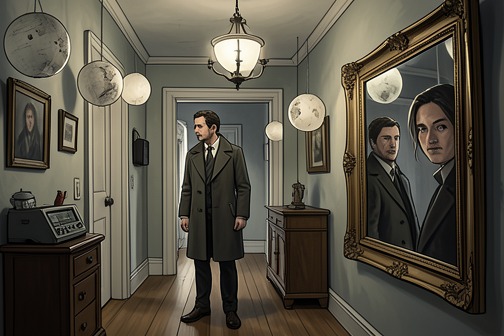
The poltergeist episode at [Zebediah Lomack](entity:character-recall-character-zebediah-lomack-bd96015ca4da)’s house turns an apparent haunting into evidence of [Dom Corvaisis](entity:character-recall-character-dom-corvaisis-d9ce4fde805e)’s own latent telekinetic ability. While wandering through the [Reno](entity:location-recall-location-reno-4b008eafa488) house, Dom was overwhelmed by the accumulating mystery and wanted to tear the paper moons from the walls; according to his later account, they came down without his touching them. [Ginger Weiss](entity:character-recall-character-ginger-weiss-c0c2e7ef6acc)’s reconstruction offers a striking reversal: what Dom had understood as an outside presence responding to him may have been his own unrecognized power taking effect.
## The episode in Reno
In recounting the first of Dom’s experiences, Ginger places it at Lomack’s house in Reno. Dom had been moving through its rooms as the mystery deepened and, in frustration, wanted to rush through them and pull down the paper moons. The moons’ movement appeared to fulfill that impulse, but not by any ordinary physical action: as Ginger recalled Dom’s account, he pulled them down without using his hands.
The episode’s decisive moment came when Dom shouted for the activity to stop. The pictures fell to the floor only then. Dom had taken this sequence to mean that something had heard him and relented. Ginger instead makes the timing the basis for a different explanation: the force that stopped the apparent haunting might have been Dom’s own, brought under control without his conscious awareness.
## From haunting to hypothesis
Ginger presents the incident as part of a wider, still tentative theory, not as a settled explanation. She connects Dom’s experience with the miraculous recoveries associated with [Brendan Cronin](entity:character-recall-character-brendan-cronin-2fbbbf142f5f) and with the later shaking and destruction at the [Tranquility Grille](entity:location-recall-location-tranquility-grille-0a6b2303c557), when Dom struggled to recall what had happened the previous summer. In her account, these events might not require a mysterious external force; they could arise from powers possessed by people who do not yet know they have them.
She identifies telekinesis—the ability to move objects without touching them—as one possible explanation. The image of the paper moons coming off Lomack’s walls becomes especially significant within that hypothesis: it is not merely a frightening effect, but a possible first demonstration of Dom’s power. Ginger also suggests that the power may have been connected to what Dom and others had been made to forget about the night of the red moon. The connection remains conjectural in her explanation; the house episode supplies a pattern to interpret, not a complete account of its origin.
## Reinterpretation and corroboration
The event reaches the reader through Dom’s later recollection, and its meaning changes as other evidence accumulates. [Leland Falkirk](entity:character-recall-character-leland-falkirk-8c66510f5e4a)’s surveillance team heard the story of the animated moon photographs and initially dismissed it as an implausible tale from someone unable to distinguish fiction from reality. The later events at the Grille unsettled that judgment: the room shook, a rumble and electronic ululation filled it, and the windows imploded while Dom was trying to recover his memory of the earlier July night.
Those later phenomena did not independently prove what happened in Lomack’s house. They did, however, make the possibility of an unusual power harder for Falkirk and the scientists to dismiss. Ginger’s reading therefore changes the episode’s place in the story: the apparent poltergeist may be an early, uncontrolled expression of an ability that becomes more consequential as Dom’s suppressed memories return. The paper moons are at once the haunting’s visible objects and the clue that the supposed presence might have been Dom himself.
Event 47
Brendan Cronin heals Emmy Halbourg

[Brendan Cronin heals Emmy Halbourg](entity:event-recall-event-f099c669a8d7), a child whose limbs had been crippled by disease, in a miracle that first makes his healing ability legible to others as more than an isolated rescue. The cure restores her damaged bones and interrupts an outlook of worsening pain and death; later, Emmy displays a startling new gift of her own. For [Father Stefan Wycazik](entity:character-recall-character-father-stefan-wycaz-8bcbf4db75a8), her recovery becomes evidence linking Brendan to a wider and still unexplained series of extraordinary events.
## The Cure and Its Circumstances
The scale of Emmy’s illness gives the cure its force. At St. Joseph’s Hospital for Children, she had been unable to dress herself, and her future had seemed to promise only further deterioration, pain, and death. A month later, Father Wycazik could look back on that condition beside a child whose damaged bones had reknit and whose illness had been cured. The contrast is not between discomfort and relief but between a life narrowed by progressive disease and a body restored beyond what the observers expected.
The book places the recovery within Brendan’s [Christmas Day](entity:time-recall-time-christmas-day-08a71908c479) activities. A later reconstruction of Father Wycazik’s movements records visits to [Emmy Halbourg](entity:character-recall-character-emmy-halbourg-ba50d86bb861) and [Winton Tolk](entity:character-recall-character-winton-tolk-f08f71997413), as well as a stop at the Metropolitan Police Laboratory to consult a ballistics expert. The operatives investigating the recoveries concluded that neither could be adequately explained by current medical knowledge. They also found that Father Wycazik had become convinced his curate, Brendan, was responsible. The account thus presents the cure both as a physical change in Emmy and as a clue assembled afterward from visits, medical outcomes, and the priest’s growing suspicions.
## Recognition of Brendan’s Power
Father Wycazik makes the connection explicit when he speaks with [Bennet Sonneford](entity:character-recall-character-bennet-sonneford-0dddf3519207), the surgeon who has asked why Winton Tolk should be saved when so many good people die. The priest says that he senses a force behind the events, one concerned not primarily with Tolk but with Brendan—the priest who first reached the wounded officer at the sandwich shop. He explains that this impression depends on Brendan being linked to another miraculous event, and recounts Emmy’s formerly crippled limbs mending without naming her. Her cure therefore changes the meaning of Brendan’s earlier intervention: it is no longer an unexplained recovery standing alone, but one instance in a pattern that Father Wycazik believes gathers around him.
The connection remains an interpretation rather than a settled explanation. When Winton later asks whether Brendan is a saint, Father Wycazik calls him a good man, not a saint; Winton presses the unresolved question of how Brendan healed him. The parallel between Winton’s recovery and Emmy’s cure gives the priest grounds for suspecting a shared source, but the available account does not describe a medical mechanism or establish that Brendan consciously chose or controlled what happened.
## Emmy’s Later Gift
Emmy’s cure is followed by a development that makes the episode more mysterious still. A month after she had been too disabled to dress herself, she is not only healed but able to make a flute hang in the air and play when she gives it her attention. When her concentration falters, the instrument bobs and dips and its notes deteriorate; when she attends to it again, it steadies and resumes playing. Father Wycazik also sees floating bears return to their dance. Emmy’s wonder at discovering that she is the cause makes the new ability her own visible experience, not merely a report of another person’s recovery.
Father Wycazik suspects that Brendan has somehow given Emmy this gift unwittingly. He cannot explain to the child or her family where Brendan’s own power came from, and leaves without resolving the question. His uncertainty preserves an important distinction: the cure is a completed bodily change, while the gift that follows opens a further question about how extraordinary abilities pass from one person to another.
## Faith and the Meaning of the Miracle
The children at St. Joseph’s Hospital for Children provide a sharp contrast to Brendan’s continuing crisis of faith. Emmy believes in God’s goodness and in the rightness of the created world despite the pain she has endured; the other children are likewise described as retaining confidence in a caring Father. Father Wycazik’s remembered challenge asks Brendan to consider what such faith might teach him. Yet the lesson does not restore Brendan’s belief. He remains deeply moved by the children’s courage, rather than persuaded that a compassionate God must exist.
Later, Father Wycazik offers a broader religious interpretation of the abilities associated with Brendan and the other extraordinary events. He argues that divine likeness should be understood through reason, compassion, love, and friendship, not physical appearance, and believes Brendan’s crisis may be connected to a remembered encounter with a vastly different and superior race. This is Father Wycazik’s interpretation, not a confirmed account of the cure’s origin. Emmy’s recovery nevertheless gives the question concrete stakes: it is at once a seemingly inexplicable healing, the evidence that leads the priest toward Brendan, and the beginning of a change whose effects appear in Emmy herself.
Event 48
Dom Corvaisis and Brendan Cronin’s telekinetic demonstration goes out of control
The telekinetic demonstration at the [Tranquility Grille](entity:location-recall-location-tranquility-grille-0a6b2303c557) turns an experiment into a crisis: [Dom Corvaisis](entity:character-recall-character-dom-corvaisis-d9ce4fde805e) and [Brendan Cronin](entity:character-recall-character-brendan-cronin-2fbbbf142f5f) discover that they can lift objects without touching them, but cannot reliably control what their shared power sets in motion. What begins with two small glass shakers ends with chairs smashing against the ceiling, a light fixture crashing down, and the room’s celebratory curiosity replaced by fear. The demonstration confirms their abilities while exposing their danger—and the distance those abilities may place between them and everyone else.
## The Test and Its Stakes
Dom and Brendan sit alone at opposite ends of the long table, while the seven adults, including [Jorja Monatella](entity:character-recall-character-jorja-monatella-98b7ee510e90), form a semicircle a few paces away to give them room to concentrate. [Jorja](entity:character-recall-character-jorja-cc334f0a308c)’s daughter, [Marcie Monatella](entity:character-recall-character-marcie-monatella-3dec810e2e8d), is asleep in a booth. In front of Dom stands a salt shaker; before Brendan is a pepper shaker. [Ginger Weiss](entity:character-recall-character-ginger-weiss-c0c2e7ef6acc) has proposed the test: each man is to try to move his shaker without touching it.
For Dom, the possibility of success is not straightforwardly welcome. He remembers spending most of his thirty-five years shy and ineffectual, then enjoying fifteen months of greater ease before his sleepwalking began the previous October. He fears that proof of psychic powers will end that brief normality and isolate him again—this time because others see him as superior, rather than because he sees himself as inferior. He hopes the test will fail.
Brendan’s hopes pull in another direction. Though he has denied that God is behind the miraculous cures and apparitional lights, Dom senses that the priest wants to find a divine Presence at work and to be drawn back toward his faith and the Church. Ginger’s suggestion that their abilities might instead have been conferred by a germ makes the test spiritually consequential for Brendan as well as personally startling. The two men approach the shakers with different longings, but neither knows what the experiment will establish.
## The First Levitation
At first, Dom’s shaker remains still. He thinks through the fact that matter is never entirely motionless: the glass is made of atoms already in ceaseless movement. As he becomes absorbed in the object, he forgets the watching group. Then he feels a sudden buoyancy, and the shaker rises—not by an inch or two along the tabletop, but vertically into the air. It climbs to four feet above the table and hangs there, above the eye level of the standing onlookers.
Brendan’s pepper shaker rises too, stopping at precisely the same height. He stares at it in amazement and fear, briefly looks away, and finds that the object stays aloft without his gaze. Dom is equally unsettled by how little conscious effort the act requires: he does not feel power surging through him or a deliberate grip on the shaker. The ability seems to work automatically, like breathing or a heartbeat. As Brendan raises his hands, the red rings on his palms reappear, an observable recurrence alongside the levitation.
At Ginger’s urging to try something else, the demonstration spreads beyond the original pair. Six, eight, then ten additional salt shakers lift from tables elsewhere in the room; matching pepper shakers follow, and the objects begin to spin. Dom makes no separate effort for each new movement. He finds that thought seems simply to become fact, while suspecting Brendan is just as unable to explain how it is happening.
## From Wonder to Panic
The spectacle grows into a circuit of all eleven sets of salt and pepper shakers: the paired halves orbit one another as the sets move around the room faster and faster, catching and scattering light. The room’s wonder turns abruptly into danger when twelve chairs shoot violently up to the ceiling. Two strike a wagon-wheel lighting fixture, bursting its bulbs; the fixture tears loose from its brackets and wires and crashes to the floor behind Dom. The chairs rattle overhead while shakers continue to whirl, and some objects begin to fall. One shaker hits [Ernie Block](entity:character-recall-character-ernie-block-f9eb5d1128b4)’s shoulder and hurts him.
Dom and Brendan have lost control, and neither knows how to recover it because neither understood how control began. The onlookers scramble beneath tables, recognizing the suspended chairs as the more dangerous threat. The crash wakes [Marcie](entity:character-recall-character-marcie-12363d0e1b68), who cries for her mother; Jorja pulls her from the booth and shelters with her under a table. The crowd gets out of the objects’ path, but Dom and Brendan remain exposed. To Dom, the power now feels like a live grenade wired to his hand.
The danger becomes physical and specific: the chairs gouge chunks from the ceiling, and a falling salt shaker strikes the table in front of Dom hard enough to crack into several pieces, scattering salt. Remembering the spinning paper moons in [Zebediah Lomack](entity:character-recall-character-zebediah-lomack-bd96015ca4da)’s house six days earlier, Dom raises both hands toward the chairs and shakers, closes his fists so that his [Palm-Ring Stigmata](entity:state-recall-state-35a9ba3fc1ce) are out of sight, and orders the objects to stop. The chairs cease vibrating; the shakers halt in midair. After a short, unnatural silence, all twelve chairs and the remaining shakers drop, bouncing off tables and other furniture before settling into tangled wreckage.
## Aftermath and Significance
Neither Dom nor Brendan is injured. Ernie is still massaging his shoulder, but is not seriously hurt; no one else has been injured, though the room is shaken. The fallen fixture leaves live wires dangling, while broken chairs and debris make the consequences of the uncontrolled display impossible to mistake. Marcie’s whimpering and Jorja’s quiet reassurance break the longer silence after the objects fall, and the others emerge from their shelter.
Dom recognizes wariness in the way the group looks at him and Brendan—the response he had feared if the test proved he possessed the power. Ginger is the exception: she embraces him enthusiastically and treats the discovery as hopeful, insisting that he has the ability and may eventually learn to use it. Dom cannot share her confidence without qualification. He points to the wrecked furniture and explains that he did not know how he was producing the movements or how to stop them once they ran wild.
The scene’s reversal is therefore not simply from doubt to proof. A small, almost ordinary object becomes conspicuous and dangerous: the shaker first appears immovable, then floats beyond the men’s conscious command, and finally breaks against the table. The power also changes the social arrangement of the room. The adults initially give Dom and Brendan space to demonstrate; when that demonstration becomes hazardous, they take shelter while the two men remain at its center. Their shared ability creates a bond between them, but its uncontrolled force produces the very separation Dom feared. The demonstration establishes both the wonder of their telekinesis and the urgent problem of living with a power that can act before its bearers understand how to direct it.
Event 49
Emmy Halbourg’s telekinetic powers emerge at home
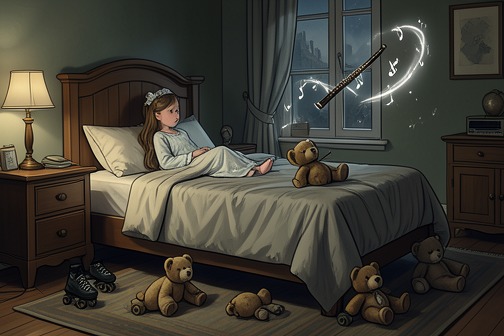
[Emmy Halbourg’s telekinetic powers emerge at home](entity:event-recall-event-37a1792047e6) in a bedroom where a frightening disturbance gradually becomes a revelation. When [Father Stefan Wycazik](entity:character-recall-character-father-stefan-wycaz-8bcbf4db75a8) arrives, objects are moving without touch: teddy bears waltz, roller skates travel across the room, hats jiggle, and a flute rises and plays. Emmy initially insists the activity is not hers. Yet it loses coordination when her attention wanders and steadies when she looks back. The scene turns a family’s fear of an inexplicable force into Emmy’s dawning recognition of her own ability, while leaving the power’s larger implications unresolved.
## The crisis in Emmy’s bedroom
Father Stefan comes directly from the Mendozas’ apartment Uptown, expecting something unusual at the Halbourg home but not the crisis he finds. On the second floor, Emmy’s father and an older sister stand at an open bedroom door, transfixed by something inside. A thump and rattle, followed by another pair of thumps and girlish laughter, makes the room sound both alarming and strangely playful. Her father is relieved to see the priest, explaining that the family had not known whether to call for help when there might be nothing to explain by the time help arrived.
The room is recognizably a girl’s bedroom: teddy bears, posters of teenage idols, thrift-shop hats on a wooden rack, roller skates, a tape deck, and a flute in its open case. But its familiar contents no longer behave as possessions at rest. Emmy, who is standing on her bed in pajamas, is healthier-looking than on [Christmas Day](entity:time-recall-time-christmas-day-08a71908c479). Her sister remains pale and nearly paralyzed with fear, while Emmy hugs a pillow and grins at the spectacle. The contrast is immediate: the same activity that leaves the other members of the family immobilized delights Emmy.
## Objects in motion
Two small teddy bears waltz in midair with a precision and formality close to that of real dancers. The rest of the room is animated too. Roller skates move along separate paths, passing the bed, closet, desk, and window at changing speeds. Hats jiggle on their rack, and a Care Bear bounces on a bookshelf. The episode does not present the objects as a single indistinct commotion; each follows its own movement, giving the bedroom the appearance of an improvised performance.
There are signs, however, that the disturbance has not always been harmless. A ceramic lamp has fallen and broken, a poster is torn, and the dresser mirror is cracked. Emmy acknowledges that the activity was scary at first, but says it has calmed and now seems fun. That change in her response does not erase the damage or the family’s unease. It marks a difference between Emmy’s growing ease with the spectacle and the alarm of those watching from the doorway.
The flute makes that difference especially clear. It rises from its case to about seven feet above the floor and begins playing a recognizable, well-executed tune, Annie’s Song. Emmy says she used to play it, but had to stop a year earlier because her knuckle joints became too bad. Although she is now cured, she explains, her hands are still not good enough to play. Father Stefan points out that she is not using them: the flute is playing in the air without her touch.
## Recognition and response
Emmy first asks whether the activity is hers with genuine surprise and denies that she is responsible. Father Stefan notices a pattern the others have not yet understood: when she turns her attention away from the dancing bears, their measured movements falter. They stay aloft, but bobble, turn, and bump into one another aimlessly. The flute provides a second, sharper demonstration. When Emmy looks directly at it, it steadies and resumes playing; when her attention shifts, it manages only a few poor notes, falls silent, and dips erratically while still suspended.
The change in the objects gives Father Stefan grounds to tell Emmy that she is playing the flute without her hands. The meaning takes time to reach her. Then she looks from him to her frightened sister and to her parents in the doorway, repeating her realization: the power belongs to her. Recognition arrives not as an explanation delivered from outside but through the interruption and resumption of the performance itself. Her attention appears to matter, though the scene does not establish how deliberately she can direct the objects or how much control she has over the ability.
Emmy’s parents interpret the event through a religious fear and ask for an exorcism. Father Stefan is incredulous at the request and laughs as he tells them that no exorcism is needed: this is not Satan at work. His response decisively reframes the family’s crisis. He does not deny that the event is extraordinary; rather, he rejects the explanation that it is demonic, even as the teddy bear continues tottering past him on stiff stuffed legs.
## A new ability, not yet mastery
Father Stefan compares Emmy’s apparent ease with the longer learning process [Winton Tolk](entity:character-recall-character-winton-tolk-f08f71997413) had anticipated for himself. Winton had sensed that understanding and controlling his powers would take a long time. Emmy’s case may be easier, Stefan considers, because children are more adaptable than adults. The comparison suggests that the ability can require learning and control, but it does not prove that Emmy has mastered it. Her attention visibly affects the objects, while the broken lamp, torn poster, cracked mirror, and family’s fear preserve the possibility of risk.
The scene therefore holds delight and apprehension together. For Emmy, the bedroom’s animated toys and airborne music transform an alarming disturbance into discovery. For her family, the same display remains awesome enough to prompt a plea for an exorcism; even Stefan, an unfaltering optimist, feels a tingle of fear at its primitive force. His reassurance changes the interpretation of what they are witnessing, but does not make the phenomenon ordinary. Emmy’s recognition is the event’s decisive turn: the apparent poltergeist is revealed as an emerging human power, intimate to the girl whose attention makes the room’s objects move.
Event 50
Calvin Sharkle’s siege and the resulting explosion
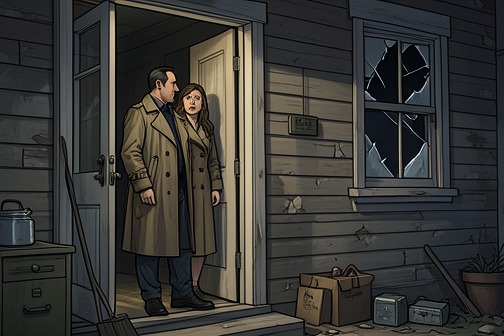
[Calvin Sharkle’s siege and the resulting explosion](entity:event-recall-event-312fddcced9f) are a turning point in which private terror becomes public catastrophe. In [Evanston](entity:location-recall-location-evanston-665c6693f85a), a once-peaceful man barricades himself against a threat he cannot explain; when the police try to force their way into his fortified house, an explosion kills Sharkle and others. [Father Stefan Wycazik](entity:character-recall-character-father-stefan-wycaz-8bcbf4db75a8) sees the tragedy not as an isolated breakdown but as a possible consequence of the same mysterious forces affecting the witnesses in Nevada.
## Background and Escalation
For months, Sharkle had been changing. A cheerful, well-liked bachelor who lived alone on O’Bannon Lane, he grew brooding and grim, telling neighbors he had “a bad feeling about things” and that something important and terrible was coming. He read survivalist literature, spoke of Armageddon, and suffered vivid nightmares, though he could not identify what he feared. On December 1, he quit trucking, sold his rig, and told his sister, Nan Gilchrist, that there was no time to move to remote property: he would prepare his existing house for a siege. A doctor found him fit and attributed his condition to work-related stress, but after [Christmas](entity:time-recall-time-christmas-a573265d0167) his sociable manner gave way to suspicion. In early January, he had his telephone disconnected because, he suggested, his pursuers might reach him through it.
Sharkle’s fear soon acquired a target, though not a clear identity. He told his neighbor Edward Wilkerson that he had prepared his house and wanted the Wilkerson family to hide there when “they” came. He did not know what the attackers would look like or what they would call themselves, but feared they might turn people into zombies. He had guns, ammunition, and a fortified home. Wilkerson, alarmed but not convinced Sharkle was dangerous, called Nan Gilchrist; she and her husband went to the house, and Wilkerson and another neighbor, Frank Krelky, followed to provide backup.
When the door opened, Sharkle was armed with a 20-gauge semiautomatic shotgun and nearly hysterical. He accused Wilkerson and Krelky of already having been changed, then fired. The first blast killed Krelky at close range. Wilkerson was shot in the legs as he fled, but survived by falling and pretending to be dead. Sharkle retreated into the house, leaving the authorities to contend with an armed man, possible hostages, and a structure he had prepared to withstand an assault.
## The Siege and the Blast
With the block evacuated and Sharkle unreachable by telephone or bullhorn, the police feared his sister and brother-in-law might be hostages and delayed a direct assault. When officers finally entered the house, they encountered traps: thin wires brought them down, and a deadfall injured one officer. Sharkle, waiting in a gas mask, opened fire, killing one officer and wounding another before retreating into the cellar. He had reinforced both cellar entrances with steel doors and covered the cellar windows with heavy metal shutters, turning the house into a fortified deadlock.
Father Stefan Wycazik heard the police plan over a radio in a recreational van. Officers would use carefully gauged charges to blow both cellar doors and storm the basement from opposite sides. He became convinced the attack would cause a slaughter and ran back toward the barricade, intending to reach Sharkle and talk to him. The surging crowd and police barriers kept him from getting through in time. Two small blasts announced the breach; a third, far larger explosion tore sections of the house into the winter sky. A police officer cried that Sharkle had a bomb. The blast left Father Stefan certain that Sharkle, his sister and brother-in-law, and many members of the SWAT team had been killed, though he could not tell how many.
## Aftermath and the Wider Mystery
The blast ended the siege but did not settle what had driven it. As Father Stefan Wycazik moved through the stunned crowd, he asked Roger Hasterwick to repeat what [Calvin Sharkle](entity:character-recall-character-calvin-sharkle-03a299e430b2) had shouted from the cellar window earlier that day. Hasterwick recalled the words with relish, treating them as the ravings of a madman; Stefan, however, heard them in the context of the events at the [Tranquility Motel](entity:location-recall-location-tranquility-motel-17316482b285), including the miraculous cures and telekinetic phenomena. He concluded that Sharkle might have been confused and terrified rather than insane, his mind damaged by brainwashing and by memory blocks collapsing. The account withholds the exact content of Sharkle’s shouted declarations here, preserving their force as a revelation Stefan must interpret rather than a neatly explained answer.
Stefan had already been drawn toward Nevada by the events involving the Mendoza and Halbourg families. After the explosion, that curiosity became an urgent responsibility: if even part of Sharkle’s warning was true, the people gathered at the Tranquility Motel were in danger, and Stefan believed he might be needed to protect both their minds and their lives. He left Evanston without returning to the rectory to pack, driving directly toward O’Hare to take the first available flight west. The catastrophe thus changes the direction of his journey: what had been a search for understanding becomes an attempt to reach people who may be threatened by the same hidden forces that left Sharkle terrified.
The siege also gives the novel’s otherwise hopeful account of extraordinary powers a lethal counterpoint. A man who had once been kind and peaceful armed his home against an unnamed enemy, mistook neighbors for transformed threats, and died in an explosion that also killed others. Stefan’s interpretation connects that private disaster to the suppressed history surrounding the Nevada witnesses, where a supposed toxic emergency had brought military roadblocks, a quarantine, and the use of specially cleared [DERO](entity:character-recall-character-dero-bc813f57d1bd) personnel to guard what they might see. Against that background, Sharkle’s breakdown suggests the human cost of concealed contact and manipulated memory; the event turns the mystery from a question of marvels into a question of who can be harmed when fear and secrecy reinforce one another.
## The Official Emergency and the Secrecy Around It
The Nevada emergency supplied the public explanation against which the siege’s hidden implications could be measured. At the Tranquility Motel, [Faye Block](entity:character-recall-character-faye-block-43b77274239e) recalled that the interstate had closed on Friday, [July 6](entity:time-recall-time-july-6-664e6e27c147), after a truck carrying dangerous chemicals toward [Shenkfield](entity:location-recall-location-shenkfield-0e9d5a5eb820) was said to have spilled its load; the motel remained closed until Tuesday while guests were evacuated. By the Wednesday, July 11, edition, the [Elko](entity:location-recall-location-elko-6d564a531c69) Sentinel announced that [I-80](entity:location-recall-location-80-c4cf3ea59949) had reopened, the quarantine had been removed, and the first evacuees had been located and had seen nothing. Yet the Army had closed a ten-mile stretch of the highway and established roadblocks before informing the [Elko County](entity:location-recall-location-elko-county-b64ae78f502b) sheriff or Nevada State Police, keeping civilian officials outside both the quarantine operation and contingency planning. The contrast between the reassuring headlines and the military’s extraordinary control of the scene sharpened the novel’s central unease: the danger surrounding Sharkle’s warnings could not be separated from the authorities’ determination to control what witnesses were allowed to know.
Event 51
July 6 Tranquility incident
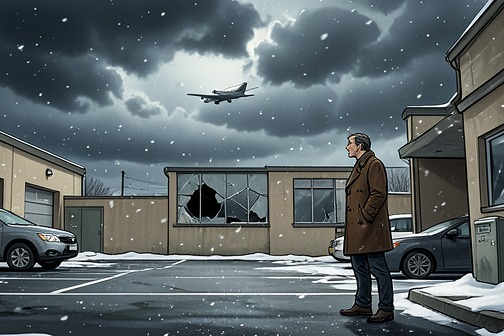
The [July 6 Tranquility incident](entity:event-recall-event-july-6-tranquility-inci-2f91577d872c) was the first contact at the [Tranquility Motel](entity:location-recall-location-tranquility-motel-17316482b285): an extraordinary descent witnessed by guests, then concealed through detention and the deliberate alteration of memory. The event returns in fragments as [Dom Corvaisis](entity:character-recall-character-dom-corvaisis-d9ce4fde805e)’s blocked recollections break through. Jets and a shuddering landscape initially seem to explain the night’s violence; the aircraft pass, but the roar continues, and the sky offers a stranger answer. What the witnesses experienced was then buried beneath manufactured memories and the public story of a toxic spill.
## The night of the encounter
On [July 6](entity:time-recall-time-july-6-664e6e27c147), two summers before the present events, people at the Tranquility Motel were caught in a night of noise, vibration, and uncanny light. Dom’s recovered memory does not arrive as a calm account. It surges back first through the falling snow outside the [Tranquility Grille](entity:location-recall-location-tranquility-grille-0a6b2303c557), where he briefly experiences the night as if he were there again: the demolished windows, the parking-lot lights, and the summer darkness replace the winter scene around him. The bodily force of the recollection—the roar hurting his ears and vibrations felt in his bones and teeth—makes the past more than a story he has been told.
In that memory, aircraft sweep low over the motel. The first two pass at greater altitude; a third roars over the Grille so close that Dom throws himself onto the parking lot, convinced it is about to crash. He sees its markings, including serial numbers and an American flag. A fourth aircraft follows over the motel, its red and white running lights visible as it turns toward the barrens beyond [Interstate 80](entity:location-recall-location-interstate-80-09dbb90e2ea2). Yet the sound and shaking do not subside when the jets pass. Instead, an electronic oscillation grows louder and stranger beneath the continuing rumble, and the peculiar frost-silver light draws Dom’s attention away from the aircraft.
Dom sees the moon and cries out to the others to look. [Ginger Weiss](entity:character-recall-character-ginger-weiss-c0c2e7ef6acc), [Jorja](entity:character-recall-character-jorja-cc334f0a308c), [Marcie](entity:character-recall-character-marcie-12363d0e1b68), [Ernie Block](entity:character-recall-character-ernie-block-f9eb5d1128b4), [Faye Block](entity:character-recall-character-faye-block-43b77274239e), [Ned](entity:character-recall-character-ned-160602ecacc7), [Sandy](entity:character-recall-character-sandy-457b75877fae), [Jack Twist](entity:character-recall-character-jack-twist-b2feffa09d4e), and other people from the motel have emerged as the noise and light intensify. Dom’s repeated alarm draws them toward the same sight. The jets are visible and identifiable, but they cannot account for the continuing disturbance. The encounter’s decisive turn lies in that gap between the apparent explanation and what remains unexplained.
## First contact and competing explanations
The recovered memories and the later account of the incident identify the event as the arrival of a spacecraft. [Father Stefan Wycazik](entity:character-recall-character-father-stefan-wycaz-8bcbf4db75a8) tells [Parker Faine](entity:character-recall-character-parker-faine-0e53d8b2c0c1) that something came down from the sky that night. He explains that the [Contact Impact Study Group](entity:organization-recall-organization-contact-impact-s-b4cb8bca284b), or [CISG](entity:organization-recall-organization-cisg-c60290a413d5), had been established to assess how contact with an intelligent extraterrestrial species might affect human beings and societies. Colonel [Leland Falkirk](entity:character-recall-character-leland-falkirk-8c66510f5e4a) was its only military member; its other members included biologists, physicists, cultural anthropologists, doctors, sociologists, and psychologists. The existence and remit of the group reveal that first contact was not simply an unforeseen event: its possible consequences had already been studied.
Stefan also offers an explanation for why some witnesses remembered imprisonment as an alien attack. [Calvin Sharkle](entity:character-recall-character-calvin-sharkle-03a299e430b2) had insisted that aliens were hostile and had tried to take control of him by strapping him to a bed and putting substances into his veins. Stefan concludes that Calvin confused two experiences: seeing the starship descend and being taken captive and brainwashed by government personnel. Those captors wore pressurized decontamination suits and used needles and memory blocks; the clothing and procedure, Stefan argues, became entangled in Calvin’s damaged recollection of the arrival. His explanation assigns the violence to human agents, not to the visitors, while acknowledging that memory loss left Calvin unable to separate the events clearly.
## The cover story and altered memories
The guests’ later beliefs about a toxic spill and evacuation show how the event acquired an official-seeming alternative history. Ernie and Faye Block recall saving newspaper clippings from the [Elko](entity:location-recall-location-elko-6d564a531c69) Sentinel and say the evacuation was real. They remember visitors, Elroy and Nancy Jamison, offering them shelter when people had to leave. Dom counters that the guests’ recollections—including those of people who might have taken the Blocks away—could themselves have been shaped by brainwashing. In his account, the supposed hosts may have been present at the motel and subjected to the same procedure. The dispute is not merely over whether an evacuation occurred; it concerns whether the memories and records that make the evacuation seem ordinary can be trusted.
Ginger Weiss’s hypnotic sessions expose the method behind the false account. [Pablo Jackson](entity:character-recall-character-pablo-jackson-48e95f0b1940) reasons that she had been told to remember books, television programs, and other activities during the days she spent at the motel, although she had not actually spent that time doing those things. The implanted recollections are vague and repetitive. When pressed for details about the food she supposedly ate at the Tranquility Grille, Ginger can only repeat that it was a small restaurant with a limited menu. Her voice stays flat while her face tightens with anxiety. To Pablo, that mismatch between the confident outline of a memory and its missing lived particulars suggests an artificial substitute for what really happened.
Pablo recognizes that the false memories cover a longer gap: the days when Ginger would have been held and brainwashed. Instead of leaving an obvious blank, her captors supplied recollections to fill the missing time. He identifies the duration of her stolen life and proceeds cautiously, believing that forcing her to confront the blocked memories too abruptly could trigger a coma or worse. The cover-up is therefore not only a public explanation; it is also a carefully constructed private past, maintained by suggestions that make an imposed account feel familiar.
The same process appears in Parker Faine’s discovery at the Salcoe home. A girl lies with blank, unresponsive eyes, earphones connected to a tape recorder beside her pillow. The soothing recorded voice describes sleeping late at a hotel and walking around its grounds, offering a ready-made account of time spent elsewhere. Parker recognizes the script as part of renewed brainwashing: at least one Salcoe had remembered the Tranquility experience, those memories had been suppressed again, and a new set of false recollections was being implanted to cover the current session. What Dom has explained to Parker becomes unmistakably concrete in the voice repeating into the girl’s ear.
## Belated recognition and significance
The incident is revealed not in one complete witness statement but through returns, contradictions, and failures of recollection. Dom’s memory first erupts from a later sensory scene and re-creates the sound and shaking; the jets emerge in that recollection, but so does the detail that their passage cannot explain the continuing roar. Ginger’s hesitant answers reveal the thinness of her supposed memories, while the tape in the Salcoe home makes the ongoing manufacture of substitute memories audible. Each fragment revises the apparent story of the night and shows that the witnesses’ confusion was not incidental to the cover-up: it was one of its effects.
By linking the strange sighting to the CISG, the decontamination suits, and the memory-reconditioning of motel guests, the novel distinguishes the arrival itself from the human response that followed. The encounter brings humanity face to face with an intelligence beyond Earth; the institutions meant to anticipate that possibility instead become entangled in secrecy and coercion. The false toxic-spill history offers a mundane explanation for evacuation, while the witnesses’ recovered memories expose what that explanation leaves out. The night’s most consequential image is thus not simply the moon above the motel, but the struggle over who gets to say what the witnesses saw—and what they are allowed to remember.
Event 52
Tranquility目击者记忆清除行动
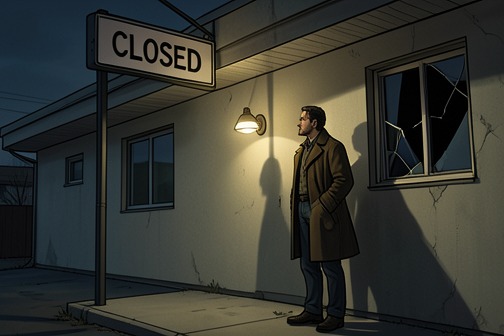
The [Tranquility Motel witnesses’ brainwashing](entity:event-recall-event-tranquility-motel-witne-f8f74c30b009) is the operation that turns a shared encounter into an apparently ordinary environmental emergency. Its method is not simply to erase a few hours: the perpetrators suppress the witnesses’ memories of captivity and install replacement stories, so the victims can recount an evacuation while remaining unaware of what they actually saw and where they were held. The operation’s failures become evidence in their own right, and the return of memory exposes both the violence of the cover-up and the limits of imposed recollection.
## The operation and its cover story
On Friday, [July 6](entity:time-recall-time-july-6-664e6e27c147), of the summer before last, witnesses checked into the [Tranquility Motel](entity:location-recall-location-tranquility-motel-17316482b285). The public explanation for their sudden departure was a toxic spill after a tanker overturned near [Interstate 80](entity:location-recall-location-interstate-80-09dbb90e2ea2). The road really was closed and an environmental emergency declared, and the witnesses had newspaper coverage to support that part of the story. The presence of a real emergency made it possible to hide a different event inside a believable account of evacuation.
When [Dom Corvaisis](entity:character-recall-character-dom-corvaisis-d9ce4fde805e) later examined the motel registry, it showed that eleven rooms had been rented before the interstate closed. His own signature and the Mountainview, Utah, address he was moving to confirmed that he had checked in. Yet he could not remember leaving the motel in response to an evacuation order that same night. The discrepancy made the familiar explanation unstable: the register preserved a trace of presence, while his recollection of what followed did not fit.
[Faye Block](entity:character-recall-character-faye-block-43b77274239e) and [Ernie Block](entity:character-recall-character-ernie-block-f9eb5d1128b4) initially defended the evacuation story. They remembered being taken to the mountain ranch of Elroy and Nancy Jamison, while the Jamisons were said to have hosted them during the emergency. Dom concluded that this memory, too, had been supplied: if the Jamisons were present, they would have witnessed the same event and likely undergone the same memory treatment. [Ned Sarver](entity:character-recall-character-ned-sarver-8226efdc1143) and [Sandy Sarver](entity:character-recall-character-sandy-sarver-5f80709b9fa1) likewise came to doubt their thin recollections of waiting out the crisis at their trailer. The group’s memories differed in their surface details, but shared the same function: to account for the missing period without revealing the motel captivity.
## How the false memories were made
[Pablo Jackson](entity:character-recall-character-pablo-jackson-48e95f0b1940) explains to [Ginger Weiss](entity:character-recall-character-ginger-weiss-c0c2e7ef6acc) that erasing the memory of captivity would leave an obvious gap unless the missing days were covered with invented recollections. In Ginger’s case, the replacement account described four days at the motel. She could recall the building in minute detail, but could not remember the books she supposedly read or the television programs she claimed to watch. Pablo recognized that the details were not genuine memories: she had been prompted to say she had spent time that way and had acquired only vague, artificial impressions of doing so.
The replacement memories were therefore not equally convincing. Ginger could identify the [Tranquility Grille](entity:location-recall-location-tranquility-grille-0a6b2303c557) as the place where she ate, and repeat that it was small, had a limited menu, and served reasonably good food. But when Pablo pressed her about what she had actually eaten, she could not supply the particulars that would make the judgment her own. Her voice stayed flat and hollow as she repeated programmed responses, while her face tightened with anxiety. The contrast between a fluent general account and absent lived detail gave Pablo grounds to suspect that the story had been installed rather than remembered.
He believed Ginger’s true memories were sealed behind an [Azrael Block](entity:rule-recall-rule-azrael-block-05e13f0af70c), and understood that abruptly ordering her to destroy the false account could be dangerous: the conditioning might drive her into a coma or worse. Instead of forcing an immediate breakthrough, he cautiously began identifying the precise stretch of time taken from her, returning her to the motel registration on July 6. The risk of undoing the operation shaped the investigation; recovering the truth required patience rather than a blunt command.
## Reconditioning and the evidence of captivity
The memory operation was not confined to the original witnesses or to a single treatment. When [Parker Faine](entity:character-recall-character-parker-faine-0e53d8b2c0c1) entered a room in the [Salcoe family](entity:character-recall-character-6f0127ab7d97) home, he found a girl with earphones connected to a tape recorder beside her pillow. Her blank stare was interrupted by sudden, rapid bursts of blinking. The recording fed her a soothing account of a Monday morning at a hotel, complete with a walk around the grounds with a companion named Chrissie. The story supplied ordinary activities and social details for the time being covered by the new brainwashing.
Parker understood the scene as a renewed suppression: one or more members of the Salcoe family had apparently recovered memories of the Tranquility Motel, and those memories had been repressed again. The tape was playing repeatedly and, he inferred, carried subliminal as well as audible suggestions. The earphones, recorder, and repeated hotel narrative made the process concrete: the false account was being rehearsed beside a captive who could not respond to her surroundings. Parker’s earlier understanding of the conspiracy, gained from Dom, had not prepared him for the intimacy of hearing the imposed story whispered into the girl’s ear.
Other evidence connects the treatment to government agents and the initial uncertainty surrounding alien contact. [Stefan Wycazik](entity:character-recall-character-stefan-wycazik-bda15ffb1ff0) reasons that some motel guests may have approached the spacecraft openly, and would therefore have been treated as possible contamination risks. Witnesses remembered soldiers and brainwashing specialists in decontamination suits. That memory helps explain why [Calvin Sharkle](entity:character-recall-character-calvin-sharkle-03a299e430b2) mistook his captors for hostile aliens: he had seen the spacecraft, then experienced imprisonment, needles, and decontamination suits, but a memory block confused the two events. Stefan distinguishes the alien landing from the abuse that followed it; the people who strapped Calvin down were fellow humans, not the visitors he had witnessed.
## Memory returns and the cover-up weakens
As the witnesses compared accounts, the artificial quality of their recollections became a collective problem rather than an isolated symptom. Dom noticed that Ernie spoke in the same by-rote tone as [Faye](entity:character-recall-character-faye-ad32954c4aae) had and told them they had been given the same script. Ernie’s insistence that the toxic spill had happened was not wholly false: the spill and evacuation were part of the public record. The deception lay in what that true event was made to explain, and in the fabricated destinations and activities used to cover the witnesses’ time at the motel.
The replacement stories also proved vulnerable to shared recollection. When Parker disclosed that something had come down, Sandy Sarver suddenly remembered fragments of the forbidden night: jets passing low over the motel, the ground and air vibrating, and Dom turning from the aircraft to call attention to the moon. She remembered it as unnaturally bright and seeming to fall toward them. Ernie then said that he remembered too. The memory block that had separated individual accounts began to give way under a fact that reoriented the group’s understanding of the event.
The operation’s central paradox is that its cover story uses real details—the road closure, the emergency, the newspaper reports—to make a false personal history durable. Yet the invented memories remain vulnerable where they lack the texture of experience, and their contradictions become visible when witnesses check records and listen to one another. The return of [Sandy](entity:character-recall-character-sandy-457b75877fae)’s memory does not immediately restore everything, but it turns the survivors’ shared attention into a counterforce against the imposed account.
Event 53
Dom与Jack恢复7月6日记忆

The recovery of the [July 6](entity:time-recall-time-july-6-664e6e27c147) memory by [Dom Corvaisis](entity:character-recall-character-dom-corvaisis-d9ce4fde805e) and [Jack Twist](entity:character-recall-character-jack-twist-b2feffa09d4e) turns a disorienting snowbound journey into the gradual recovery of a shared, suppressed event. Dom first experiences the past as a sensory rupture in the present: the shattered windows of the [Tranquility Grille](entity:location-recall-location-tranquility-grille-0a6b2303c557), the roar and shaking, and fighter jets passing at unnaturally low altitude. Jack later remembers the same aircraft from a different vantage point at the motel. Their overlapping recollections begin to establish what happened, but the memory remains fragmentary; even when Dom glimpses the moon again, he cannot recover enough to explain it.
## The past breaks through the storm
As Dom leaves the Tranquility Grille behind [Ginger Weiss](entity:character-recall-character-ginger-weiss-c0c2e7ef6acc), the driving snow briefly gives way to another scene. He sees, hears, and feels the remembered event: demolished glass still falling, parking-lot lights, summer darkness, a thunderous roar, and the ground shuddering. The contrast is not merely between winter and summer. The snowbound present is interrupted by a memory whose force is physical, returning through sound, light, and bodily distress rather than as a composed account.
After Dom falls in the snow, [Sandy Sarver](entity:character-recall-character-sandy-sarver-5f80709b9fa1) and Ginger kneel beside him and help him up. He tells them, “The memory block is going, crumbling.” He hopes the snowy day will disappear and the dark summer night will return, but the vision does not resume at his command. Instead, he recounts what has surfaced: first two military fighters, then a third passing so low that it seemed almost to take the diner’s roof off. The recovered detail is precise, yet incomplete; Dom knows that the aircraft belonged to the night of the event without being able to recover the whole sequence.
## A shared recollection takes shape
Dom’s account prompts an unexpected response from [Marcie](entity:character-recall-character-marcie-12363d0e1b68). Bundled against the weather in her mother’s arms, she says “Jets!”—the first word she has spoken since the previous evening apart from “moon.” Her recognition connects her silence and her earlier word to the same remembered experience. She searches the stormy sky as if for the departed aircraft, though the scene offers no confirmation that they are there. Her response makes the memory more than Dom’s private episode: other people in the group appear caught in its return, even if they cannot yet give it a complete narrative.
Later, as Jack drives a four-wheel-drive pickup up a steep, rocky slope, the truck crests the hill and begins another ascent. Jack brakes and cries, “Jets!” Like Dom, he is remembering the aircraft; unlike Dom’s earlier vision, Jack’s recollection does not overwhelm his control of the present. He can hold the wheel and describe what he remembers, though he stares through the snow as if trying to look back in time. The difference in how the memory returns preserves an important distinction: Dom has seen it vividly, while Jack seems to recall it less immersively.
Jack supplies a second vantage point. He had been at the motel, not in the diner with Dom. He remembers rushing out of his room during the shaking and roar, seeing a third fighter, which he thinks was an F-16, pass over the diner at perhaps forty or fifty feet. A fourth aircraft then came over the motel from behind it, even lower, and a window burst as it passed. His account confirms the low flight and broken glass in Dom’s memory while adding the location and sequence that Dom could not provide.
Jack recalls the third and fourth fighters roaring toward [Interstate 80](entity:location-recall-location-interstate-80-09dbb90e2ea2) about twenty feet above the power lines. He could see into the red-hot engine intakes as the aircraft crossed the plains, one turning east and the other west before circling back. He began running toward the people who had come out of the diner, seeking their help in understanding what was happening. The memory does not end with an explanation: after giving this account, Jack says he cannot remember anything more.
## The moon remains beyond recall
The memory breaks through again later, while Jack cuts an opening in a chain-link fence with an acetylene torch. The torchlight suddenly connects with the past, and Dom is thrown back into the moment when the third jet passed over the diner and he threw himself flat, believing the plane was crashing. He recalls the fourth jet as a huge, half-glimpsed shadow over the motel, its running lights cutting across the night as it headed toward the barrens beyond Interstate 80. The first two aircraft, which had passed higher, were already far away, turning back from opposite directions.
This return adds more than another pass of the aircraft. Beneath the roar, Dom remembers an electronic oscillation growing louder and stranger, unlike anything the jets could have produced. He sees the others gathering outside—the people from the diner and motel—and hears the disturbance swell until it seems to combine a waterfall’s crash with the pounding of a thousand timpani. Then he looks away from the departing aircraft and toward a peculiar frost-silver light. In the memory, he points and cries, “The moon! The moon!” The recovered scene thus places the jets beside an unexplained phenomenon, but it does not yet disclose what that phenomenon was.
When the present returns, Dom is on his knees in the snow, with Ginger holding him by the shoulders. He can say only, “Remembered,” followed by the fragments that remain: “Something” and “the moon,” but not enough to recover the rest. Jack has already cut through the fence and switched off the torch; the darkness closes around the group, and he urges Dom and Ginger to go inside. The immediate consequence is forward motion into the next part of their undertaking, not a completed revelation.
## Corroboration without closure
The recollections reinforce one another through distinct details rather than perfect repetition. Dom’s first account establishes the low fighters over the diner; Jack’s memory places himself at the motel and recalls the fourth aircraft and the bursting window. His description of the jets above the power lines, and of their separate turns across the plains, extends the recovered sequence. The repeated recognition of the same aircraft makes the memory harder to dismiss as a solitary impression, while its gaps keep its larger cause unresolved.
The scene also makes the act of remembering part of the event’s meaning. Memory returns involuntarily, triggered first by the snowstorm’s resemblance to the night’s upheaval and later by the acetylene torchlight. Its fragments are vivid enough to restore particular sounds, movements, heights, and directions, but not sufficient to settle what the group saw beyond the jets. The episode shifts the characters from an imposed blankness toward shared knowledge, yet stops at the edge of explanation: the aircraft can be described, the moon can be named, and the strange sound can be recalled, while the decisive connection among them remains out of reach.
Event 54
Thunder Hill泄密行动
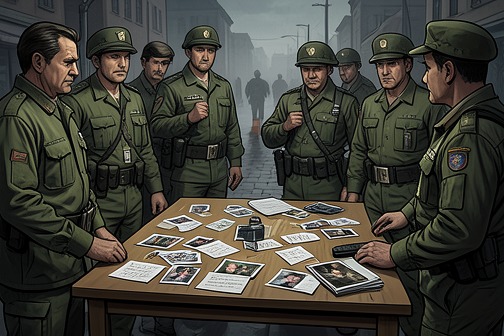
The disclosure operation at [Thunder Hill](entity:location-recall-location-thunder-hill-b1ea42221a8b) was an attempt from inside the military establishment to undermine the cover-up surrounding the [Tranquility Motel](entity:location-recall-location-tranquility-motel-17316482b285) witnesses. [General Bob Alvarado](entity:character-recall-character-general-bob-alvarad-728d00bffb3a) and [Miles Bennell](entity:character-recall-character-miles-bennell-fd741f9d1a85) acted separately, using postcards, anonymous messages, and photographs to draw witnesses toward the truth. Their efforts made the motel—not the official story of a toxic spill at [Shenkfield](entity:location-recall-location-shenkfield-0e9d5a5eb820)—the center of an inquiry that could no longer be contained as a routine military secret.
## The official story and the hidden site
The witnesses’ route toward Thunder Hill began with an account of a chemical emergency. The Tranquility Motel registry for Friday and Saturday, [July 6](entity:time-recall-time-july-6-664e6e27c147) and 7, showed the dates on which the motel had closed. [Faye Block](entity:character-recall-character-faye-block-43b77274239e) and [Ernie Block](entity:character-recall-character-ernie-block-f9eb5d1128b4) recalled that a truck carrying dangerous chemicals toward Shenkfield had supposedly caused the interstate to be shut down, forcing the motel to close until Tuesday. According to the explanation given to residents, roadblocks and an evacuation order had sent guests away in their own cars; [Ned Sarver](entity:character-recall-character-ned-sarver-8226efdc1143) and [Sandy Sarver](entity:character-recall-character-sandy-sarver-5f80709b9fa1) had been permitted to return to their trailer near Beowawe because it lay beyond the quarantine area.
The newspaper record made that account look less convincing. Army units attached to Shenkfield closed a ten-mile stretch of [I-80](entity:location-recall-location-80-c4cf3ea59949) after the supposed accident, but did so before informing the county sheriff or Nevada State Police. They kept local authorities out of the quarantine operation and excluded them from contingency planning, even though changing winds might have carried nerve gas beyond the initial danger zone. The Army’s command of the crisis, and its distrust of civilian officials, suggested that controlling what could be seen mattered as much as controlling a hazardous spill.
A further discrepancy concerned the [DERO](entity:character-recall-character-dero-bc813f57d1bd) team assigned to enforce the quarantine. [Ginger Weiss](entity:character-recall-character-ginger-weiss-c0c2e7ef6acc) argued that an ordinary toxic spill would not explain why specially trusted personnel had been needed at the roadblocks. Their presence made more sense if the patrols could see something classified, and if the Army did not trust ordinary soldiers to keep it secret. When [Dominick Corvaisis](entity:character-recall-character-dominick-corvaisis-5f0bc1572735) and Ginger searched beyond the week of the crisis, they found stories that seemed unrelated to the highway closure but pointed toward Thunder Hill. The witnesses began to suspect that Shenkfield had served as a diversion from the real source of the events, at the [Thunder Hill Depository](entity:location-recall-location-thunder-hill-deposit-2a2f832ed9fe), an Army installation north-northeast of the motel.
## Clues that draw the witnesses together
The anonymous correspondence arrived as a series of disturbances in Dominick Corvaisis’s private life. Trying to determine whether he had typed an earlier note himself, he reproduced its twenty-three words on an [IBM Displaywriter](entity:object-recall-object-ibm-displaywriter-9048da2d8017) using four type styles. The Courier 10 copy appeared to match the original, so his test did not rule out the possibility that he had sent it to himself. Later, a plain white envelope with no return address contained only the words The moon. The message struck him with a force that seemed to place him inside a world where ordinary logic no longer applied.
A third envelope, postmarked New York, contained two [Polaroid photographs](entity:object-recall-object-polaroid-photographs-3353f6f84d16) but no note. One showed a young priest sitting rigidly beside a suitcase, his eyes unsettlingly empty. The other showed a woman Dominick recognized as someone he had met, though he could not recall where: restrained in a narrow bed, an IV needle in her wrist, and the same vacant expression. The photographs turned abstract suspicion into evidence of people subjected to an unknown process. They also intensified Dominick’s fear that he had once been caught in a dangerous situation and had lost the memory of it.
As the witnesses gathered again at the motel, their recovered memories and new nightmares raised the stakes. Dominick, Ginger, Ernie, and [Ned](entity:character-recall-character-ned-160602ecacc7) experienced vivid dreams of being strapped to motel beds and attended by people in decontamination suits. Ned was so shaken that he and [Sandy](entity:character-recall-character-sandy-457b75877fae) moved from their trailer into the motel, unwilling to remain isolated if Colonel [Leland Falkirk](entity:character-recall-character-leland-falkirk-8c66510f5e4a) came after them. The group’s investigation thus depended not only on assembling documentary clues, but on restoring memories that appeared to have been deliberately blocked.
## Two covert efforts
Alvarado’s plan began with [Jack Twist](entity:character-recall-character-jack-twist-b2feffa09d4e). Believing that Jack’s Ranger background and readiness to challenge authority made him a possible organizer, Alvarado used information collected during the earlier memory-wiping operation to locate Jack’s safe-deposit boxes. The files contained the banks, passwords, and copies of the keys; they had been prepared as possible leverage against Jack, either for blackmail or to frame him and put him in prison. Alvarado copied the keys and, during ten days of leave in late December, traveled to New York with [Tranquility Motel postcards](entity:object-recall-object-tranquility-motel-ac9819d1a586). He placed one in each box, handling them with gloves so that he would leave no fingerprints.
Alvarado meant to give Jack time to find the postcards, then make anonymous calls from a pay phone in [Elko](entity:location-recall-location-elko-6d564a531c69) to other witnesses. He planned to give them Jack’s unlisted number and suggest that Jack could answer their questions about their psychological problems. In his view, this would bring the witnesses back into contact and make the cover-up harder to sustain. He chose the postcards as a way to start that process without exposing his own role; if Falkirk discovered them, he would not know who had planted them.
Bennell pursued a parallel strategy with different targets. He sent photographs to Dominick and additional photographs to the Blocks, reasoning that Dominick’s work as a writer and his vivid imagination would make anonymous clues especially compelling. Dominick’s first novel had also received substantial advance publicity, which might make reporters more willing to listen if he uncovered the truth. Bennell hoped the clues would focus attention on the motel and the witnesses before anyone decided to erase their memories again one by one.
The plans were not a coordinated campaign from the outset. Alvarado had intended to recruit witnesses through Jack; Bennell had already chosen Dominick and the Blocks, and other anonymous notes and photographs had set a new crisis in motion before Alvarado could make his calls. Their separate interventions nevertheless converged on the same effect: they gave people with fragmented memories reasons to return, compare experiences, and investigate together.
## The confession and the division over secrecy
Alvarado disclosed his part of the operation to Bennell in a darkened room, shutting the door and leaving the lamp off so that they could speak without seeing each other’s faces. He asked whether Bennell had sent the photographs. After explaining that he had brought Jack back to the motel, Alvarado admitted that he had used the safe-deposit boxes and postcards to draw Jack into the investigation. Bennell then acknowledged that he had sent the photographs. Alvarado understood why Bennell might have targeted the Blocks, who were local and central to events, but asked why he had selected Dominick; Bennell’s answer was the writer’s imagination and growing public profile.
Their admissions revealed both friendship and shared misgivings. Alvarado described Bennell as the one person with whom he enjoyed playing chess and poker, but neither man had initially chosen to go public. Alvarado feared disobeying orders, losing his career and pension, and being killed by Falkirk. Bennell understood the same risks. By the time they compared their actions, they recognized that covertly encouraging witnesses had been too slow: open disclosure, despite the risk of prosecution and Falkirk’s anger, might have been the more direct course.
The disagreement over what the cover-up was for had already become explicit elsewhere at Thunder Hill. [Foster Polnichev](entity:character-recall-character-foster-polnichev-986f8ed898bb) argued that the danger posed by the newly emerging powers was not as great as Falkirk claimed. He described [Emmy Halbourg](entity:character-recall-character-emmy-halbourg-ba50d86bb861) as a delightful child rather than a monster and regarded what was happening as potentially the greatest event in human history. Falkirk rejected accommodation as a trap: in his view, public scrutiny would invite political interference and prevent the Army from winning a war against a possible existential threat. The two men were not simply debating whether information should be released; they were defending incompatible interpretations of what the witnesses and their abilities meant.
The disclosure operation therefore exposes a contradiction at the heart of the military response. Alvarado and Bennell had been participants in secrecy, and their clues were designed to act indirectly rather than announce the truth themselves. Yet they recognized that suppressing witnesses had become more dangerous than the disclosures they feared. Their intervention redirected the inquiry from the public-facing toxic-spill narrative toward Thunder Hill, while showing that the cover-up was contested even among those charged with maintaining it.
Event 55
Parker Faine discovers the Salcoes’ memory-washing and escapes
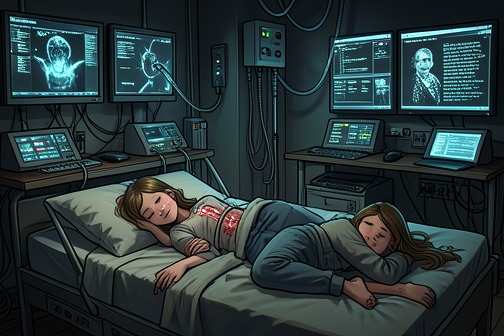
[Parker Faine](entity:character-recall-character-parker-faine-0e53d8b2c0c1) discovers that the [Salcoe family](entity:character-recall-character-6f0127ab7d97) is being subjected to renewed memory modification and escapes a government attempt to capture or kill him. The intrusion turns an account of erased memories into visible machinery: monitors, intravenous lines, and a recording feeding a false past to two unresponsive girls. Parker’s escape carries that evidence beyond the house, while the authorities’ response shows how far they will go to keep the operation concealed.
## Background: False Memories as Cover
The scene belongs to a wider effort to replace the [Tranquility Motel](entity:location-recall-location-tranquility-motel-17316482b285) witnesses’ memories, not merely suppress them. During a hypnotic session, [Ginger Marie Weiss](entity:character-recall-character-ginger-marie-weiss-70446262b1ad) reasons that brainwashing would require time in custody, and that the missing days should leave a blank in her past. [Pablo Jackson](entity:character-recall-character-pablo-jackson-48e95f0b1940) explains that false recollections could be implanted to cover that interval. The point is not simply to make a witness forget: it is to give the lost time an apparently ordinary history.
Pablo’s questioning of Ginger exposes the weakness in that fabricated account. She can describe the Tranquility Motel in detail, including the [Tranquility Grille](entity:location-recall-location-tranquility-grille-0a6b2303c557) where she says she ate, but cannot remember the books and television programs she claims to have encountered during those days. Pablo concludes that those activities never happened. The story supplied to Ginger has been rehearsed into a vague, hollow recollection, yet it cannot carry the convincing detail of experience. When he presses her, her voice remains flat and her face tightens with anxiety. He recognizes that abruptly challenging the imposed memories could trigger a coma or worse, so he proceeds cautiously rather than tearing away the false account at once.
[Dom Corvaisis](entity:character-recall-character-dom-corvaisis-d9ce4fde805e) applies the same suspicion to the memories of [Ernie Block](entity:character-recall-character-ernie-block-f9eb5d1128b4) and [Faye Block](entity:character-recall-character-faye-block-43b77274239e). They remember a toxic spill and evacuation, supported by newspaper accounts and by visitors who supposedly took them away. Dom argues that the visitors may also have witnessed the underlying events and been made to remember a cover story. These earlier discussions establish the possibility that the Salcoe family’s treatment is part of a repeated system: witnesses’ memories are not left empty but furnished with substitutes.
## The Room and Its Apparatus
Parker follows two patterns of beeping down a hallway to a darkened room. The pale light at the curtains and a faint green glow do little to dispel the gloom. Inside, the Salcoe twins lie side by side in a large bed, covers drawn to their shoulders, eyes open and bodies still. For an instant, Parker thinks they are dead. He then recognizes the green-lit equipment as EEG and EKG monitors and sees intravenous lines running from racks to their arms. They are alive, but being brainwashed. The room lacks the personal objects or individual character of a teenager’s bedroom; Parker takes it to be a guest room arranged for convenient monitoring.
The twins’ eyes make the procedure’s human cost unmistakable. One girl stares without blinking, then blinks in a sudden, repeated burst before returning to the fixed gaze. She does not respond when Parker waves a hand across her eyes. An earphone leads to a tape recorder on her pillow. When Parker lifts the earpiece, he hears a soothing woman’s voice narrating a purported stay at a hotel: sleeping late, walking the grounds with a companion, and hoping to meet boys. The account is delivered as an ordinary recollection, its calm, repetitive rhythm making the fabrication more disturbing rather than less.
Parker infers that one or more of the Salcoes had recovered memories of the Tranquility Motel and that those memories have been suppressed again. The recording is now supplying a new false history to cover the current period of treatment; he suspects it carries messages both audible and subliminal. Dom had explained elements of the operation to him by telephone, but hearing the voice in the girl’s ear makes the conspiracy tangible. What had been an account of manipulation becomes an intimate scene of a person’s attention and memory being worked upon while she lies helpless in bed.
## Escape from the House
Parker considers whether pulling out the IV lines and disconnecting the equipment would harm the twins. He has no time to resolve that question: two men enter the room, with a bespectacled man in a suit behind them. Their rolled sleeves, loosened ties, and business clothes suggest to Parker that they are government agents. One demands to know who he is. Parker does not try to explain himself or argue for his rights. He makes a decision to flee through the curtained opening, hoping it conceals a window or balcony door.
The opening proves to be French doors. Parker drives through the curtains and crashes through the glass; the flimsy lock gives way, and he lands on a second-floor balcony. He tumbles over lounge chairs and a glass-topped table, then vaults the railing. The fall is about twelve feet, onto bare lawn. His shoulders and back are jarred, but he breaks no bones. He scrambles up and runs rather than staying to confront the men or attempt to free the twins.
As he crosses the grounds, foliage snaps and bark bursts from a tree. Parker realizes that the men are shooting at him with silenced weapons. He zigzags, falls into an azalea bed, gets up, reaches a hedge, and throws himself over it. The escape is physical and precarious, but its stakes are also informational: he understands that the men may be prepared to kill him to prevent him from revealing what he saw. He doubts that the police would necessarily believe an eccentric, bearded intruder over neatly dressed agents offering a legitimate explanation for their presence.
## Consequences and Significance
The government’s response confirms that Parker has threatened an active operation. During a later conference call, the Director of the [Federal Bureau of Investigation](entity:organization-recall-organization-c3b9c0848e8c) reports that the team modifying the Salcoe family’s memories had been interrupted by a persistent intruder who escaped after being cornered. All four Salcoes are transferred in a medical van to a safe house, where the modifications can continue. A check on Parker’s abandoned rental car identifies him as the intruder and as a friend of [Dominick Corvaisis](entity:character-recall-character-dominick-corvaisis-5f0bc1572735). Officials trace him from [Monterey, California](entity:location-recall-location-293b960f8134), to San Francisco, but lose track of him after his flight lands.
Parker’s flight therefore does not end the memory-washing, and the Salcoes remain under the authorities’ control. It does, however, expose the operation to someone outside its machinery and adds a concrete breach to a cover-up already facing other challenges. The scene’s sharpest reversal is that the instruments and voice meant to manufacture normality instead reveal the violence beneath it: an invented hotel stay plays softly into a girl’s ear while agents stand ready to silence the witness who has heard it.
Event 56
The government siege of Calvin Sharkle’s home and its deadly explosion
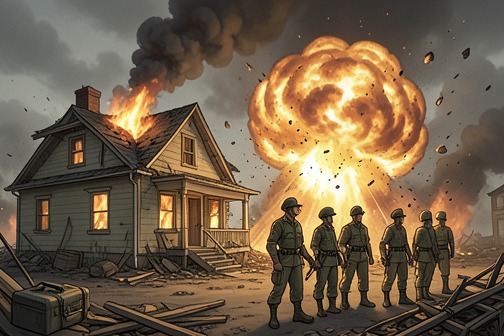
The government siege of [Calvin Sharkle](entity:character-recall-character-calvin-sharkle-03a299e430b2)’s home in [Evanston](entity:location-recall-location-evanston-665c6693f85a) ends with a bomb explosion that kills Sharkle, his sister, brother-in-law, and an entire SWAT team. The event turns an attempt to contain a secret into a nationally visible disaster: Sharkle’s ravings offer reporters a possible trail to Nevada, while the authorities’ increasingly extreme response sharpens the conflict over whether secrecy is protecting humanity or putting it at risk.
## Background and Stakes
The siege unfolds against a wider effort to control what witnesses know about the [July 6](entity:time-recall-time-july-6-664e6e27c147) incident in Nevada. The Army had closed a ten-mile stretch of [I-80](entity:location-recall-location-80-c4cf3ea59949), established roadblocks, and excluded local law enforcement from the quarantine response. [Ginger Weiss](entity:character-recall-character-ginger-weiss-c0c2e7ef6acc) later reasons that the use of a [DERO](entity:character-recall-character-dero-bc813f57d1bd) team suggests the soldiers guarding the zone were expected to see something classified, not simply an overturned truck and leaking chemicals. This pattern of military secrecy helps explain why the government treats Calvin Sharkle’s knowledge—and the possibility of its spreading—as a threat.
By the time the crisis at Sharkle’s home reaches its violent conclusion, [Leland Falkirk](entity:character-recall-character-leland-falkirk-8c66510f5e4a) regards containment as a matter of species survival. He fears that making the story public would invite political interference and prevent the government from fighting what he believes may be an alien infection. [Foster Polnichev](entity:character-recall-character-foster-polnichev-986f8ed898bb), by contrast, argues that the evidence does not justify killing the Halbourgs, the Tolks, and the Nevada witnesses to keep the secret. Their disagreement frames the siege’s aftermath: the question is no longer only how to suppress a story, but whether suppression itself has become more dangerous than disclosure.
## The Siege and Explosion
The operation culminates at Sharkle’s house in Evanston. The available account emphasizes the result rather than detailing the siege’s tactical course: Sharkle detonates a bomb, and the explosion takes his sister, his brother-in-law, and an entire SWAT team with him. Sharkle is dead, but the scale and violence of the ending prevent the authorities from treating the operation as a quiet resolution.
The explosion becomes national news. Reporters and television crews focus on O’Bannon Lane, and the story remains compelling enough that Falkirk fears prolonged coverage will eventually lead an aggressive reporter from Sharkle’s ravings to Nevada, the [Tranquility Motel](entity:location-recall-location-tranquility-motel-17316482b285), and possibly [Thunder Hill](entity:location-recall-location-thunder-hill-b1ea42221a8b). The attempt to contain the secret has created a conspicuous public event that can point investigators toward the very places the government wants hidden.
## Witnesses and New Exposure
[Father Stefan Wycazik](entity:character-recall-character-father-stefan-wycaz-8bcbf4db75a8)’s movements add another danger to the authorities’ account of the crisis. Before the FBI knew what was happening at the Mendoza apartment or the Halbourg home, Wycazik had already visited both. An FBI agent later saw him near the barricades at Sharkle’s house at the moment the bomb detonated. By the time the officials discuss the matter, no one has seen him for almost six hours. Polnichev concludes that Wycazik is piecing together the connections and argues that the government should abandon the cover-up and go public before it is caught in the act.
The siege also coincides with news of another event that makes containment harder: [Winton Tolk](entity:character-recall-character-winton-tolk-f08f71997413), whose life [Brendan Cronin](entity:character-recall-character-brendan-cronin-2fbbbf142f5f) had saved, has apparently revived a stabbed child in the Mendoza family’s apartment. Polnichev believes Brendan has passed an extraordinary ability to Tolk; Falkirk instead fears that something dangerous may be living within those affected. The reports do not establish that this development caused the siege, but they show why the government’s response to Sharkle is part of a much broader struggle over how to interpret the new abilities and the people connected to them.
## Consequences and Significance
The siege leaves Falkirk with a dead target but a worsening crisis. Its national attention risks exposing Thunder Hill, Wycazik may be carrying the truth beyond the officials’ control, and reports of healing powers make the supposed threat harder for Polnichev to regard as an enemy to be destroyed. The operation’s deadly outcome thus fails to restore control: it intensifies scrutiny while widening the split between those who favor secrecy at any cost and those who believe the cost has become indefensible.
Event 57
Winton Tolk revives a dying child in the Mendoza home
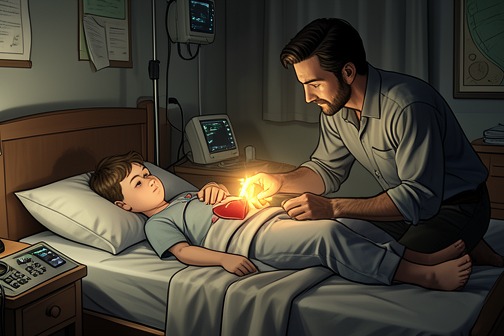
[Winton Tolk revives a dying child in the Mendoza home](entity:event-recall-event-winton-tolk-mendoza-21174bc5cf21) when the healing ability passed on by [Brendan Cronin](entity:character-recall-character-brendan-cronin-2fbbbf142f5f) becomes visible in a second person. The rescue widens the story’s crisis from isolated miraculous recoveries to the possibility that Brendan’s power can spread—and that compassion may be interpreted as danger by those determined to contain it.
## Background and Connection to Brendan
Tolk’s healing follows an earlier encounter with Brendan, who first reached him after the Uptown sandwich-shop shooting and saved his life. The connection becomes more than a personal debt: the narrative identifies Brendan as having passed his own remarkable talents to Tolk, though it leaves open what, beyond healing, that transfer might involve.
The event also belongs to a growing sequence of unexplained recoveries. [Father Stefan Wycazik](entity:character-recall-character-father-stefan-wycaz-8bcbf4db75a8) tells surgeon [Bennet Sonneford](entity:character-recall-character-bennet-sonneford-0dddf3519207) that he senses a force behind the events, one concerned less with Tolk himself than with Brendan. To explain why he sees a larger pattern, Wycazik recounts [Emmy Halbourg](entity:character-recall-character-emmy-halbourg-ba50d86bb861)’s recovery: limbs once crippled by disease had mended. He withholds Emmy’s name, but the comparison places Tolk’s new ability in a chain of events linked to Brendan.
## The Rescue and Its Public Aftermath
In a Mendoza family home in [Chicago](entity:location-recall-location-chicago-eb77a855d5aa), a stabbing and shooting become the setting for the child’s return from near-death. The rescue is described as an extraordinary extension of Tolk’s newly acquired power. What had been a private act of healing rapidly becomes a public spectacle: the incident causes a sensation within the police department, and reporters and television crews gather outside the tenement house.
Tolk gives no interviews and retreats to his own house, where another crowd of reporters waits. His silence delays, but does not remove, the danger of exposure. Officials anticipate that he may eventually speak publicly about Brendan; that account could lead reporters from Tolk to Brendan and then to Emmy, connecting the separate recoveries in public view.
## Competing Interpretations of the Power
For [Foster Polnichev](entity:character-recall-character-foster-polnichev-986f8ed898bb), the new ability is not in itself evidence of a threat. He believes the power may be all that is present in Brendan, Tolk, and Emmy, and sees the events as potentially the greatest in human history. His assessment treats the visible consequences—the healings—as reasons to consider wonder and accommodation rather than fear.
[Leland Falkirk](entity:character-recall-character-leland-falkirk-8c66510f5e4a) interprets the same evidence through the possibility of infection or possession. He argues that the recipients might no longer be human, or might be hosts to a parasite, even if the relationship were benign and the people themselves unaware of it. The child’s rescue therefore has two opposed meanings: a life is restored, while the spread of the ability intensifies Falkirk’s conviction that those who possess it cannot be trusted. He orders the entire Tolk family taken into custody, but Polnichev warns that doing so in front of the reporters would expose the cover-up.
## Significance
The event changes healing from a miracle associated with Brendan into a transferable capacity with consequences beyond its first recipient. Tolk’s rescue gives the power a public witness and a potential trail of disclosure, while the officials’ response turns the question of what the power is into a struggle over who may interpret and control it. The child’s return from near-death is an act of care; its aftermath shows how quickly that care can become evidence in a contest between faith, wonder, and institutional suspicion.
Event 58
Falkirk secretly activates the VIGILANT lockdown
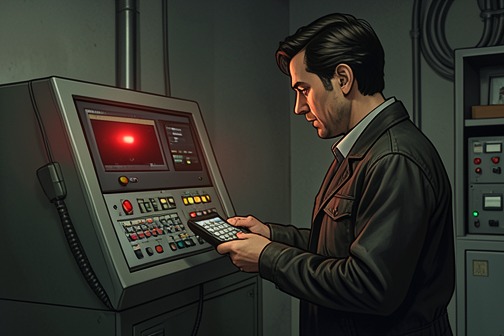
[Leland Falkirk](entity:character-recall-character-leland-falkirk-8c66510f5e4a)’s activation of the [VIGILANT](entity:object-recall-object-vigilant-b2970bc5fc5a) lockdown converts a secret contingency into an immediate prison: everyone at [Thunder Hill](entity:location-recall-location-thunder-hill-b1ea42221a8b) is barred from leaving unless Falkirk authorizes an exit. The episode reveals both how long he has prepared to impose control and how readily he treats extraordinary measures as necessary to contain what he believes may be an existential threat.
## A contingency prepared in secret
Eighteen months before the lockdown, Falkirk had ordered a special program added to VIGILANT, Thunder Hill’s security system. It was designed to make departure impossible without a special code, which Falkirk alone possessed. He had prepared the measure for the possibility that people at the installation might try to split up, but the staff had not been told it existed.
The program’s design joined technical control to personal authority: the system could bar everyone from leaving, while the sole codeholder retained the power to decide when the restriction ended. This was not a response improvised in the moment. It was a plan Falkirk had kept ready for a crisis he anticipated might test his control over the installation.
## The signal and the realization
Falkirk activated the policy through an unobtrusive change to his routine. When he entered the office, he placed his left hand on the identification plate instead of his right. That was the signal instructing VIGILANT to institute the new order.
He then told [Miles Bennell](entity:character-recall-character-miles-bennell-fd741f9d1a85) that no one but himself and [Lieutenant Tom Horner](entity:character-recall-character-lieutenant-tom-horn-0e31d2f7bbeb) could leave Thunder Hill until he decided it was safe. Bennell began to protest that Falkirk would imprison them, but stopped as he understood the significance of the disclosure: Falkirk would not have revealed the program unless he had already activated it. The announcement therefore did more than threaten a future restriction; it confirmed that the confinement was in effect.
Falkirk left the office and walked into The Hub satisfied that he had finally broken Bennell’s composure. His response makes the confrontation personal as well as institutional: he takes satisfaction in having overcome the scientist’s resistance, even as the lockdown subjects the whole installation to his decision.
## The precedent of the quarantine
The lockdown echoes the military’s earlier handling of the supposed toxic spill in [Elko County, Nevada](entity:location-recall-location-elko-county-nevada-500bca0898e6). [Faye Block](entity:character-recall-character-faye-block-43b77274239e) recalled that guests at the [Tranquility Motel](entity:location-recall-location-tranquility-motel-17316482b285) had been told to evacuate after a truck carrying dangerous chemicals was said to be headed to [Shenkfield](entity:location-recall-location-shenkfield-0e9d5a5eb820). The motel closed until Tuesday, while roadblocks and quarantine orders separated the area from ordinary travel.
Reports in the [Elko](entity:location-recall-location-elko-6d564a531c69) Sentinel described a much broader assertion of military authority during that emergency. Army units attached to Shenkfield closed a ten-mile stretch of [Interstate 80](entity:location-recall-location-interstate-80-09dbb90e2ea2) and established roadblocks before informing the [Elko County](entity:location-recall-location-elko-county-b64ae78f502b) sheriff or Nevada State Police. Local officials complained that the Army excluded them from managing the quarantine and from planning for the possibility that the nerve gas could spread. The episode made the military’s control of information and movement visible even under the public explanation of a chemical accident.
Later, Dom and Ginger reasoned that the use of a [Domestic Emergency Response Organization](entity:organization-recall-organization-domestic-emergen-55d71c6ee6ce) team suggested the Army expected the people guarding the zone to see something highly classified. In their view, a genuine chemical spill would not by itself explain why specially cleared personnel were needed. That reasoning connects the earlier quarantine to the secrecy surrounding Thunder Hill: both emergencies involve restrictions on movement, military control, and the stated need to keep a larger danger contained.
## Containment and the threat of annihilation
Falkirk’s readiness to confine the staff belongs to a still more extreme security logic. He argues that the danger is no longer merely that the public might learn the truth; he believes the human species may face obliteration if the threat is an infection. From that perspective, public disclosure could invite political interference and weaken the effort to prevent catastrophe.
Yet [Foster Polnichev](entity:character-recall-character-foster-polnichev-986f8ed898bb) challenges the premise behind Falkirk’s escalation. Although he has told the guards at the Halbourgs’ residence to treat the family as a threat, he says he does not believe Emmy or the others are dangerous. He regards the power appearing in them as potentially benign, even a cause for wonder. Falkirk rejects that interpretation as a possible deception by an enemy seeking surrender. Their disagreement exposes the danger within the lockdown: uncertainty about the people involved is treated not as a reason for restraint, but as grounds for greater coercion.
Falkirk also keeps a still more destructive contingency to himself. He has devised a way to reduce Thunder Hill to molten slag if he decides its inhabitants are infected and only pretending to be human; the plan would kill him along with everyone else. He has not enacted that plan in the lockdown scene, but its existence clarifies the stakes of the policy he does activate. VIGILANT’s code-controlled confinement is one level of his response; beneath it lies a willingness to make the entire installation—and its commander—expendable in the name of containment.
Event 59
The Thunder Hill meeting breaks down and Falkirk plans a nuclear purge
The breakdown of the [Thunder Hill](entity:location-recall-location-thunder-hill-b1ea42221a8b) conference call marks the point at which [Leland Falkirk](entity:character-recall-character-leland-falkirk-8c66510f5e4a)’s campaign to contain the [Tranquility Motel](entity:location-recall-location-tranquility-motel-17316482b285) witnesses turns into a unilateral plan for mass killing. He had expected senior officials to endorse a roundup and, once he obtained the proof of infection he believed inevitable, the destruction of the witnesses and Thunder Hill staff. Instead, the call leaves the cover-up suspended between opposing camps; Falkirk responds by planning to isolate the witnesses, take them underground, and detonate two five-megaton backpack nuclear weapons. His intended purge is not carried out in this episode, but the call’s failure makes clear how far he is prepared to go without authorization.
## The Cover Story and Its Evidence
The conference’s argument grows out of the military quarantine imposed around the earlier crisis in [Elko County, Nevada](entity:location-recall-location-elko-county-nevada-500bca0898e6). The public explanation was a toxic spill: a truck carrying dangerous chemicals toward the [Shenkfield](entity:location-recall-location-shenkfield-0e9d5a5eb820) military installation had supposedly caused the closure of [Interstate 80](entity:location-recall-location-interstate-80-09dbb90e2ea2), and the motel had remained closed until the situation was under control. Guests were evacuated, while [Ned](entity:character-recall-character-ned-160602ecacc7) and [Sandy Sarver](entity:character-recall-character-sandy-sarver-5f80709b9fa1) were permitted to go to their trailer near Beowawe, outside the quarantine area. This account furnished the cover story Falkirk later intends to reuse, not merely a background detail: he plans to close the highway again under the same pretense in order to isolate the motel group.
The conduct of the Army had already made that official account difficult to accept at face value. Army units attached to Shenkfield established roadblocks and closed a ten-mile stretch of Interstate 80 before notifying the [Elko County](entity:location-recall-location-elko-county-b64ae78f502b) sheriff or Nevada State Police. Civilian authorities complained that the Army excluded them from managing the emergency and from planning for the possibility that the nerve gas might spread. Later, Ginger argues that the use of a [DERO](entity:character-recall-character-dero-bc813f57d1bd) company makes sense only if the troops guarding the zone needed the highest security clearance: they were positioned to see something classified, not simply an overturned truck or leaking container. These details make the quarantine look less like an ordinary response to a spill than a security operation organized around concealed information.
## The Conference Call Breaks Down
Falkirk enters the call expecting to persuade General [Maxwell D. Riddenhour](entity:character-recall-character-maxwell-d-riddenhou-a9ec000bc395) and the other officials that the threat of infection is both real and urgent. He wants the Tranquility witnesses taken to the [Thunder Hill Depository](entity:location-recall-location-thunder-hill-deposit-2a2f832ed9fe) and expects authority to destroy them and the Depository staff once he can demonstrate that they are no longer human. But the case for caution has strengthened. Emil Foxworth reports that a persistent intruder broke into the [Salcoe family](entity:character-recall-character-6f0127ab7d97)’s home in Monterey during another round of memory modifications, escaped the team that tried to corner him, and was identified as [Parker Faine](entity:character-recall-character-parker-faine-0e53d8b2c0c1), a friend of [Dominick Corvaisis](entity:character-recall-character-dominick-corvaisis-5f0bc1572735). The Salcoes were moved to a safe house to continue the memory work. For [Foster Polnichev](entity:character-recall-character-foster-polnichev-986f8ed898bb), the escape reinforces the conclusion that maintaining the cover-up is becoming impossible.
Falkirk insists that the danger extends beyond disclosure. In his view, the officials are no longer merely trying to keep news from the public; they are defending the human species from possible obliteration. He fears that if the government goes public and then uses violence to contain an infection, politicians and critics will interfere until the supposed war is lost. Polnichev rejects the premise that the people affected are necessarily a threat. He points to [Emmy Halbourg](entity:character-recall-character-emmy-halbourg-ba50d86bb861) as a child rather than a monster and argues that the evidence may indicate a new human capacity, not an enemy inhabiting its recipients. The disagreement is therefore about both what the changes mean and what the government is entitled to do in response.
Riddenhour, Chairman of the Joint Chiefs, does not give Falkirk the decisive support he expects. He says the matter has moved beyond the authority of soldiers alone and calls for input from neuropathologists, biologists, philosophers, and others. He leaves open the possibility of stronger action if evidence of an imminent danger appears, but, for now, favors caution and acknowledges that the cover-up may have to be undone. Falkirk regards this as delay in the face of an obvious threat. His contemptuous response provokes Foxworth and National Security Adviser James Herton; the conference call becomes a shouting match until Riddenhour brings it under control.
The resulting agreement is deliberately provisional. No one will move against the witnesses or further strengthen the cover-up, but no one will take steps to weaken it either. Riddenhour says he will seek an emergency meeting with the President and try to produce a plan within twenty-four to forty-eight hours. The compromise denies Falkirk immediate approval without resolving the dispute that produced the call. He believes agreement is impossible, and the delay leaves him free to decide whether to obey the pause or act on his own.
## Falkirk’s Unilateral Nuclear Plan
After hanging up, Falkirk remains at his desk in a windowless room at Shenkfield, too furious to summon [Lieutenant Tom Horner](entity:character-recall-character-lieutenant-tom-horn-0e31d2f7bbeb). He does not want Horner to know that the operation he is about to launch directly contradicts Riddenhour’s orders. The distinction matters: Falkirk’s next move is not an extension of the conference’s agreement but a secret decision made after he has failed to win consent.
His plan is to close Interstate 80 under the toxic-spill pretext, isolate the Tranquility Motel, take its witnesses into custody, and transport them to the Thunder Hill Depository. Once the witnesses and the Depository’s staff are underground behind the facility’s blast doors, he intends to detonate two five-megaton backpack nukes stored among its munitions. He expects the explosions to destroy everyone inside the mountain, including himself, and to erase what he calls the primary source of contamination. He also recognizes that other possible targets would remain: the Tolk and Halbourg families, witnesses whose memory modifications have failed, and people who have not returned to Nevada. He nevertheless expects his example to shame Riddenhour into continuing the purge against every remaining source.
Falkirk’s intended self-sacrifice is bound up with his conviction that he has been chosen to save the world. He trembles with pride rather than fear as he imagines dying in the blast. The anticipated pain seems to him proof of his courage and a path toward heaven, despite his Pentecostal parents’ belief that he would not attain it. He becomes calm and serene as he savors that prospect. The contrast between the scale of the planned destruction and his private anticipation of spiritual reward reveals how completely he has converted suspicion into certainty: in his mind, an unauthorized nuclear massacre has become a righteous personal ordeal.
## Significance
The event brings the government’s competing responses to the contact crisis into direct conflict. The toxic-spill explanation, the military’s exclusion of civilian authorities, and the use of highly cleared DERO personnel all belong to a system of concealment; the conference asks whether that system can still be defended by force. Polnichev and Riddenhour treat uncertainty as a reason to reconsider containment, while Falkirk treats uncertainty as evidence that delay is intolerable. His plan shows the danger in defining an unverified threat as an existential one: once he believes the species itself is at stake, the destruction of witnesses, government personnel, and himself can all be recast as necessary protection. The call ends without a resolution, but Falkirk’s private decision turns that institutional deadlock into an immediate threat to the people at the motel and inside Thunder Hill.
Event 60
Tranquility’s group escapes in a blizzard and splits up

The Tranquility group’s escape in a blizzard is both a tactical dispersal and a farewell under threat. [Jack Twist](entity:character-recall-character-jack-twist-b2feffa09d4e) divides the witnesses between routes toward [Boston](entity:location-recall-location-ccccb9ca0ba9) and [Chicago](entity:location-recall-location-chicago-eb77a855d5aa), where they can bring the story to influential allies and the press, while [Dom Corvaisis](entity:character-recall-character-dom-corvaisis-d9ce4fde805e), [Ned](entity:character-recall-character-ned-160602ecacc7), and Jack are to enter [Thunder Hill](entity:location-recall-location-thunder-hill-b1ea42221a8b). As the snow closes around the vehicles, the plan’s political calculation gives way to the fear that some of them may not meet again.
## Pressure Before the Escape
The departure follows a growing chain of clues that has turned the group’s stay at the Tranquility into a confrontation with a concealed past. Dom’s anonymous correspondence includes a note that he tests against four type styles on his [IBM Displaywriter](entity:object-recall-object-ibm-displaywriter-9048da2d8017), only to find that Courier 10 appears to match. Another envelope contains the two words “The moon.” Later, a third envelope, postmarked New York, brings two [Polaroid photographs](entity:object-recall-object-polaroid-photographs-3353f6f84d16): one of a young priest and one of a woman Dom recognizes without being able to recall where they met. The images suggest that the anonymous sender is pointing toward people and experiences the witnesses cannot yet place.
The pressure becomes more personal as memories begin to break through. After the group gathers again at the motel, Dom, [Ginger Weiss](entity:character-recall-character-ginger-weiss-c0c2e7ef6acc), [Ernie Block](entity:character-recall-character-ernie-block-f9eb5d1128b4), and Ned experience vivid, closely similar nightmares of being restrained on motel beds while men in decontamination suits tend to them. Ned is especially shaken: unlike Dom, Ginger, and Ernie, he has had little time to become accustomed to the frightening dreams. He and [Sandy Sarver](entity:character-recall-character-sandy-sarver-5f80709b9fa1) move into a motel room rather than remain isolated at their trailer, fearing that Colonel Falkirk may come for them.
Meanwhile, Dom and Ginger’s review of the [Elko](entity:location-recall-location-elko-6d564a531c69) Sentinel yields a new lead. Reading beyond reports about the supposed toxic spill, they find an apparently unrelated place whose news coverage seems connected to the closure of [I-80](entity:location-recall-location-80-c4cf3ea59949). They identify Thunder Hill, where the Army operates the [Thunder Hill Depository](entity:location-recall-location-thunder-hill-deposit-2a2f832ed9fe), as the likely source of the crisis; [Shenkfield](entity:location-recall-location-shenkfield-0e9d5a5eb820), they conclude, was a misdirection. The discovery gives the group a destination, but it also raises the stakes: as they approach the truth, they may become targets of a preemptive attack.
## Jack’s Two-Part Strategy
Jack treats the escape as a race against time. He has the plan ready and presses it with the force of someone who believes there is no safe opportunity for extended debate. The witnesses are to leave by an overland route behind the motel, reach Elko without following the expected road, and divide there. The routes are meant to carry their account beyond Nevada before the conspirators can seize or silence them.
Ginger, [Faye Block](entity:character-recall-character-faye-block-43b77274239e), and Ernie are to take the Cherokee north by way of Twin Falls and Pocatello, then fly to Boston. There, Ginger can tell the Hannabys what the group has uncovered and use her professional and personal connections to bring the account before physicians at [Boston Memorial](entity:location-recall-location-boston-memorial-85b81dd3f87c). George and [Rita Hannaby](entity:character-recall-character-rita-hannaby-0552fc62d74f) are also expected to help arrange meetings with influential people. Only after the story has circulated among such potential advocates are Ginger and the Blocks to approach the press, and then the police, to challenge the accepted account of [Pablo Jackson](entity:character-recall-character-pablo-jackson-48e95f0b1940)’s murder.
A second party—[Brendan Cronin](entity:character-recall-character-brendan-cronin-2fbbbf142f5f), [Sandy](entity:character-recall-character-sandy-457b75877fae), [Jorja Monatella](entity:character-recall-character-jorja-monatella-98b7ee510e90), and [Marcie](entity:character-recall-character-marcie-12363d0e1b68)—has a different destination. Jack directs them to buy another four-wheel-drive vehicle in Elko with cash, head east toward Salt Lake City, and fly to Chicago when the storm permits. Brendan is to contact [Father Stefan Wycazik](entity:character-recall-character-father-stefan-wycaz-8bcbf4db75a8) and seek an emergency meeting with the [Archdiocese of Chicago](entity:organization-recall-organization-50cd0a8738a7). Jack urges the group to build a network of powerful supporters quickly, then take its case to the press. Brendan’s telekinetic ability, Jack proposes, could make a public demonstration impossible to dismiss as ordinary testimony.
The two public campaigns are not simply alternative routes to publicity. Jack wants them to generate pressure fast enough to prevent the authorities from delaying, contradicting one another, and fashioning a new cover story. Dom, Ned, and Jack, by contrast, are to go into Thunder Hill. If they are detained there, the others can report that their friends are being held against their will inside the mountain. Jack sees the prospect of a hostage crisis involving government agencies as leverage that might force a quicker disclosure.
## Departure Through the Snow
Preparing to leave takes nearly half an hour. The group puts on gear for the bitter night, loads guns and spare ammunition, and transfers supplies to the vehicles. They keep up inconsequential conversation rather than work in silence, taking care not to alert anyone listening that departure is imminent. Outside, the wind rises against the plywood-covered windows, and the worsening storm promises to make the group harder to observe.
At 4:10, they turn a radio up loud in the hope that it will cover their absence, then leave through the maintenance room’s rear door. In the wind and snow, they embrace and exchange prayers, encouragement, and promises that things will be all right. Ginger notices Jack and [Jorja](entity:character-recall-character-jorja-cc334f0a308c) holding one another for an especially long time. Jack’s kiss to Marcie and his embrace of her have the tenderness of a parent’s goodbye. The group’s farewells feel more final than those at an ordinary family gathering because, despite their reassurances, its members suspect that some may not survive to meet again.
Ned drives the Cherokee out first. Snow falls so heavily that the vehicle is nearly lost to sight within a hundred feet. Rather than climb directly toward the hills, it takes a narrow glen, where the folds of the land help conceal its passage; the wind soon swallows the sound of its engine. Ginger, Dom, and Jack follow in the Servers’ pickup, jolting upward through the same white terrain. Ginger watches the Cherokee disappear and wonders whether she will see those in it again. She has come to love the others in only a few days and is afraid for them.
## Separation as Leverage and Kinship
The departure puts the group’s divided purposes into motion: some carry the account toward influential audiences, while Dom, Ned, and Jack undertake the dangerous approach to Thunder Hill. The plan depends on separation, but it also binds the separated parties together. The witnesses’ public effort is meant to make the men’s possible detention visible; the men’s entry into the mountain gives the others a claim that cannot be reduced to a disputed memory or a set of unexplained documents.
Ginger’s fear at the departing vehicle gives the strategy its human cost. The group is not only a collection of witnesses coordinating an escape; it has become a family whose members are reluctant to let one another go. The storm hides their movements even as it obscures their prospects. In that tension, their care for one another is both a vulnerability—the reason the farewell hurts—and a resource that sustains the plan.
Event 61
Falkirk’s manhunt for Tranquility witnesses and the Vista Valley shooting
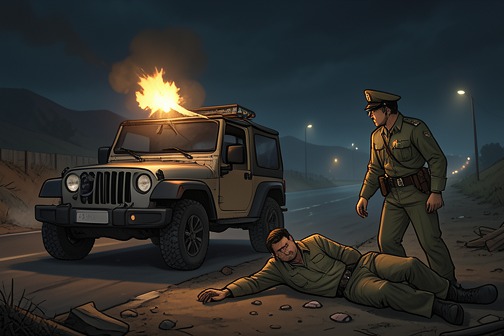
Falkirk’s manhunt for the Tranquility witnesses and the Vista Valley shooting expose how a quarantine once presented as a response to a chemical accident becomes a means of concealing the truth and seizing control of the people who witnessed it. At the roadblock, that secret operation turns lethal: a soldier fires on an unidentified Jeep, and Brendan’s effort to save the wounded reveals both the growing force of his healing gift and its limit in the face of death.
## The Quarantine and Its Hidden Purpose
The operation’s public story reaches back to [July 6](entity:time-recall-time-july-6-664e6e27c147), when a truck carrying dangerous chemicals toward [Shenkfield](entity:location-recall-location-shenkfield-0e9d5a5eb820) was said to have spilled its load near [I-80](entity:location-recall-location-80-c4cf3ea59949). The supposed emergency closed the interstate and forced the [Tranquility Motel](entity:location-recall-location-tranquility-motel-17316482b285) to shut until Tuesday. Guests evacuated in their own cars, while [Ned](entity:character-recall-character-ned-160602ecacc7) and [Sandy Sarver](entity:character-recall-character-sandy-sarver-5f80709b9fa1) were allowed to go to their trailer near Beowawe, outside the quarantine area. The account gave the later manhunt an established rationale: the Army could again invoke a hazardous zone and the need to control movement.
The contemporary newspaper record, however, showed how far the Army had already gone beyond an ordinary emergency response. Army units attached to Shenkfield closed a ten-mile stretch of I-80 and established roadblocks before informing the [Elko County](entity:location-recall-location-elko-county-b64ae78f502b) sheriff or Nevada State Police. Local authorities complained that they were excluded from managing the crisis and from planning for the possibility that winds might carry nerve gas beyond the danger zone. The Army’s control of the perimeter, and its refusal to share responsibility with civilian agencies, made secrecy part of the emergency itself.
Dom and Ginger’s investigation sharpened the suspicion that the spill explanation was false. Ginger reasoned that a [DERO](entity:character-recall-character-dero-bc813f57d1bd) team would not have been needed to guard a routine chemical accident: its presence suggested that the roadblocks gave their personnel sight of something highly classified. She also doubted that a team could have arrived and manned the perimeter so quickly without advance warning. These were deductions rather than confirmed proof, but together they recast the quarantine as a screen for a concealed event—and made the witnesses, rather than the alleged contamination, the focus of the Army’s precautions.
## Falkirk’s Rationale and the Roadblock
Falkirk’s decision to seize the witnesses rested on a conviction that concealment had become a matter of species survival. [Foster Polnichev](entity:character-recall-character-foster-polnichev-986f8ed898bb) argued that the danger appeared less than the Army feared: he regarded [Emmy Halbourg](entity:character-recall-character-emmy-halbourg-ba50d86bb861) as a child, not a monster, and considered the emerging powers potentially the greatest event in human history. Falkirk answered that such hope was precisely how an enemy would make surrender seem benevolent; if the public learned of the crisis, he believed, political interference would prevent the Army from fighting what he saw as a war against extinction. That belief turned secrecy from a temporary precaution into a justification for violence. At the western end of the quarantine zone, Falkirk and [Lieutenant Horner](entity:character-recall-character-lieutenant-horner-5b45c6a99fdd) arrived with two armed DERO corporals as Army transports blocked I-80. DERO personnel, dressed for Arctic conditions, spoke courteously to motorists and described the closure as a short wait; Falkirk ordered that drivers with low fuel be given ten gallons from the emergency supply. The reassuring routine concealed his actual timetable. A prolonged closure would create a traffic backup and force him to involve Nevada State Police and the county sheriff, who might discover that he had gone rogue. He needed only about an hour to keep civilian authorities uninformed, collect the witnesses at the motel, and take them into [Thunder Hill](entity:location-recall-location-thunder-hill-b1ea42221a8b)’s deep vaults. The roadblock therefore served two purposes at once: it performed the appearance of public protection while buying Falkirk the time to turn a quarantine into a mass abduction.
## The Vista Valley Shooting and Brendan’s Healing
As the witnesses tried to escape through a blizzard, Falkirk ordered a corporal to fire on a Jeep approaching Vista Valley Road from the hillside. Brendan was appalled that Falkirk did not even know who was inside. The soldier, too, hesitated, judging the order improper; Falkirk menaced him and invoked national security, insisting that no innocent civilian would be driving overland around the roadblock in such weather. The corporal finally obeyed. Automatic gunfire shattered the night, bullets broke the headlights and windshield, and the Jeep continued downhill without control before slowing in the snow and stopping about forty feet from the armed men. The witnesses had already recognized that resistance would be futile against Falkirk’s heavily armed force, making the roadside encounter a trap rather than a contest they could win.
Brendan knelt beside one of the wounded men, whose blood had soaked through his clothes at the left shoulder and abdomen. He could not summon the healing that had saved Emmy Halbourg and [Winton Tolk](entity:character-recall-character-winton-tolk-f08f71997413); with the stranger’s blood between his fingers, he felt the life ebbing away and raged at his helplessness and at death itself. Then he felt a tingle in both palms. For the first time, he consciously experienced his power as it flowed into the wounded man, and understood it through the image of spinning threads woven into living tissue. The healing had become perceptible to him rather than an unconscious act, and he sensed that the ability was growing: he believed he had become ten times as powerful as when he saved Winton and would be twice as capable the next day. The change was visible in the patient’s body. His eyes focused, the bleeding stopped, and a bullet pushed backward out of his abdomen as the wound closed; Brendan then felt a second bullet working free from the shoulder.
The Jeep’s driver was still inside. Brendan willed the damaged door open, pulled [Father Stefan Wycazik](entity:character-recall-character-father-stefan-wycaz-8bcbf4db75a8) from the seat, and laid him on the snow. He found a fatal wound at the base of the throat, alongside a furrow in the skull, and tried to heal him with the same power. But the threads could not mend the dead man. Brendan realized that healing required an empathetic, bilateral process: he supplied the life-giving power, while the patient had to provide a living structure through which it could work. Father Stefan Wycazik had died before Brendan reached the Jeep, leaving no living capacity for the healing to join. Brendan could cure the wounded and sick, but could not raise the dead. He sobbed and persisted in trying despite understanding the limit, returning to prayer as grief overwhelmed him.
## The Human Cost of Containment
The shooting makes the conflict between Falkirk’s policy and the witnesses’ survival brutally concrete: his claim that violence is necessary to protect humanity authorizes fire on a vehicle whose occupants he has not identified. Brendan’s response reverses the scene’s purpose. Kneeling in the snow, he uses a power he had not previously understood to save a wounded stranger, while discovering that even this extraordinary gift cannot restore Father Stefan Wycazik. The contrast is not between power and helplessness, but between two uses of power: Falkirk’s coercion produces injury and death, whereas Brendan’s healing depends on a living person and an empathetic connection. His renewed prayer follows the recognition that compassion can mend the living but cannot undo every consequence of violence.
Event 62
Alvarado arms the Thunder Hill staff for resistance
[General Bob Alvarado](entity:character-recall-character-general-bob-alvarad-728d00bffb3a)’s decision to arm the [Thunder Hill](entity:location-recall-location-thunder-hill-b1ea42221a8b) staff turns a concealed government crisis into the prospect of armed resistance from within the Depository. Believing that Colonel [Leland Falkirk](entity:character-recall-character-leland-falkirk-8c66510f5e4a) is bringing the witnesses back to kill them—and intends to eliminate the staff as well—Alvarado quietly equips his people and prepares [Miles Bennell](entity:character-recall-character-miles-bennell-fd741f9d1a85) for a possible confrontation with Falkirk and [Lieutenant Tom Horner](entity:character-recall-character-lieutenant-tom-horn-0e31d2f7bbeb).
## The threat behind the order
The exchange begins with the failure of a cautious strategy. Miles Bennell regrets that sabotaging the cover-up has proved too slow and reflects that openly violating the secrecy oaths might have been preferable, even at the risk of Falkirk’s anger and government prosecution. Alvarado’s response makes clear why he has come to speak privately with Miles: he needs an ally against the colonel. Neither man trusts Falkirk’s assurances. Alvarado does not believe that Falkirk has suddenly become reasonable or that bringing the witnesses back to the Depository means they will be studied rather than harmed.
Alvarado states his conclusion plainly: he thinks Falkirk will kill the witnesses and the staff. He attributes the colonel’s intended violence to the belief that they have all been taken over, a conviction Alvarado dismisses as foolish but treats as an immediate danger. His suspicion is not presented as proof that an attack has begun; it is the assessment that drives his preparations. The distinction matters. The staff are being armed in anticipation of what Falkirk may do, not in response to an already described assault.
## Arming the Depository
The order arrives through the public-address system installed in every room in the Depository. After a crackle and whistle, all military and civilian personnel are instructed to report first to the armory for handguns, then to their quarters to await further instructions. Alvarado intends to use the official movement of staff to establish a defensive position without openly challenging Falkirk’s command. Once the personnel are in their quarters, he will tell them that Falkirk ordered them there but that arming them was his own decision.
His planned warning will explain that everyone is in danger from Falkirk and his [DERO](entity:character-recall-character-dero-bc813f57d1bd) personnel, although some will understand the reasons and others will not. The handguns are meant to change the outcome if the colonel’s men later arrive to round up and shoot the staff: Alvarado hopes that his people will then be able to shoot back. The plan is therefore both protective and confrontational. It gives the personnel a means of resisting a threatened execution while keeping them, for the moment, inside the routine of reporting to the armory and returning to their quarters.
## A concealed contingency
Alvarado assigns Miles a particular role in the contingency. He tells him to take a handgun and conceal it beneath a laboratory coat so Falkirk will not see that he is armed. Alvarado, in turn, plans to wear his uniform coat unbuttoned and hide a small pistol at the back of his waistband. The precautions reflect the need to prepare for violence without revealing the preparation to the officer who may initiate it.
If Falkirk appears about to order the staff’s destruction, Alvarado intends to draw his pistol and kill him. He will first alert Miles with a code word so Miles can turn on Horner and kill him as well. Alvarado insists that both men must be dealt with: if Horner remains able to act, he could kill Alvarado when Alvarado opens fire on Falkirk. Alvarado also emphasizes that he must survive, both from personal self-interest and because, as a general, he expects to be able to make Falkirk’s men obey him once their commanding officer is dead. The plan thus depends not simply on stopping two officers, but on preserving a chain of command that might prevent the anticipated killing from spreading.
Miles says he will be able to pull the trigger if stopping Horner requires it. He also calls Alvarado a good friend, pointing not only to their poker and chess games but to Alvarado’s having read all of T. S. Eliot. Alvarado answers with a line from Eliot’s The Waste Land, then opens the office door. In the cavern lights, he jokes about his father’s fear that an interest in poetry would make him a sissy: instead, the poem has helped persuade a friend to kill for him and save his life. He then invites Miles to come to the armory. The literary allusion does not cancel the danger; it gives their alliance a personal history at the instant they prepare to carry out a lethal plan.
Event 63
First Contact at the Tranquility Grille

The first contact at the [Tranquility Grille](entity:location-recall-location-tranquility-grille-0a6b2303c557) is the [July 6](entity:time-recall-time-july-6-664e6e27c147) encounter in which a crowd of motel guests, diner patrons, and strangers saw an alien spacecraft descend over the diner and then gathered at its landing place beyond [Interstate 80](entity:location-recall-location-interstate-80-09dbb90e2ea2). The craft’s arrival transformed a frightening spectacle into a shared threshold: [Brendan Cronin](entity:character-recall-character-brendan-cronin-2fbbbf142f5f), [Dominick Corvaisis](entity:character-recall-character-dominick-corvaisis-5f0bc1572735), and [Ginger Weiss](entity:character-recall-character-ginger-weiss-c0c2e7ef6acc) approached an open portal and entered, making the encounter, in the novel’s reckoning, the moment that divides history into [Before and After](entity:time-recall-time-before-and-after-f72ba916f635).
## The sky changes
The event returns through memories breaking free while the witnesses are in military custody. [Sandy Sarver](entity:character-recall-character-sandy-sarver-5f80709b9fa1) recounts the night; [Jorja Monatella](entity:character-recall-character-jorja-monatella-98b7ee510e90) and Brendan recover their own perspectives as the memory barriers imposed by mind-control specialists crumble. The layered recollection matters: what once appeared as confused terror becomes a collective account of a specific encounter. [Jorja](entity:character-recall-character-jorja-cc334f0a308c) remembers standing in the Tranquility Grille parking lot with [Marcie](entity:character-recall-character-marcie-12363d0e1b68) in her arms, while [Sandy](entity:character-recall-character-sandy-457b75877fae)’s words restore the sight and sound of the craft’s arrival.
At first, the crowd faced an overwhelming disturbance rather than an identifiable visitor. The shaking and roaring grew louder, accompanied by a strange whistling, warbling sound beneath the thunder. Beams came down from what seemed to be the moon, illuminating the parking lot with a frosty glow. Then the light changed and the apparent moon turned blood-red. Sandy recalls that the people understood it was not the moon, but something else. The change is both visual and cognitive: the familiar object in the sky gives way to an event for which the witnesses have no ordinary explanation.
The craft passed over the diner low and extraordinarily slowly. Sandy compares its speed to a Goodyear blimp, while emphasizing that it seemed too heavy to be one. Its slowness made the sight difficult to reconcile with its weight, and its presence, not any elaborate design, made its origin unmistakable to the watchers. Jorja remembers a cylindrical vessel roughly fifty feet long and twelve or fifteen feet in diameter, rounded at both ends like two worn lipstick tubes joined at their bases. A scarlet energy field surrounded a plain, mottled hull. The ship did not resemble the familiar saucers and rockets of films and television; its unremarkable form sharpened the force of its actual existence.
## From the diner to the landing site
The spacecraft crossed the diner and descended toward Interstate 80, with jet escorts wheeling and swooping above it. It came down in the barren country beyond the highway, at a place some of the witnesses already regarded as special without knowing why. The landing scattered fire across clumps of sagebrush and bunch-grass; by the time the group arrived, those small fires had almost burned out. The red glow around the vessel had faded to amber, but the ship still seemed luminous.
The witnesses could not be held back from going to the landing site. They piled into whatever vehicles were available, and the ordinary separations between strangers briefly lost their meaning. [Ernie Block](entity:character-recall-character-ernie-block-f9eb5d1128b4) and [Faye Block](entity:character-recall-character-faye-block-43b77274239e) rode in the motel van with Dominick Corvaisis, Ginger Weiss, and the professional gambler [Zebediah Lomack](entity:character-recall-character-zebediah-lomack-bd96015ca4da). Jorja rode in the back of Sandy Sarver’s pickup with her husband and Marcie. Brendan Cronin and [Jack Twist](entity:character-recall-character-jack-twist-b2feffa09d4e) traveled in cars with others. Their different routes converged at the roadside: some vehicles came from [Elko](entity:location-recall-location-elko-6d564a531c69), people crossed the divider, and cars arriving from the west stopped on the highway.
At the berm, the gathered witnesses stood on the shoulder and looked toward the ship. The crowd was initially quiet, hesitant before a scene that seemed to set a boundary between the known world and whatever came next. Sandy recalls the feeling not as a plunge into danger but as a movement toward something beyond it. Jorja recognizes that sensation when the memory returns: the impression that humanity had been enclosed in darkness and that, at last, the lid had been torn away. The assembly is therefore more than a crowd drawn to a spectacle. It becomes a temporary human community formed by the same sight and the same uncertain decision to approach.
## The open portal
Brendan remembers descending the embankment from the interstate toward the vessel, which appeared to him like shimmering amber quartz. Jets still swooped overhead as other people followed, including [Faye](entity:character-recall-character-faye-ad32954c4aae), Ernie, Dominick, and Ginger. But only Dominick and Ginger continued all the way to the ship with Brendan. Jorja, holding Marcie on the shoulder, remembers being afraid to go closer and telling herself that she needed to keep her daughter safe. At the same time, she wanted to warn the three approaching figures and urge them onward. She and the others moved east along the highway to keep the trio in view.
On the side of the hull, Brendan, Dominick, and Ginger found a round portal standing open. Jorja saw it too: a circle of blazing light against the ship’s gleaming surface. The three gathered before the entrance expecting something to emerge. Nothing did. Instead, Brendan recalls, the golden light within seemed both comforting and compelling, like the light that had appeared in his dreams. The approaching helicopters made the choice urgent. Brendan and the others sensed that government personnel would take control as soon as they arrived and push the witnesses back; the three wanted to be part of the encounter before that happened.
Brendan confirms that he, Dominick, and Ginger went inside. Sandy remembers their entry as well. The scene stops at that crossing: the evidence establishes that they entered the alien vessel, but does not describe what they encountered within it here. That limit gives the open portal its full weight. The first step into the craft is both an action taken by three people and a passage beyond the witnesses’ existing knowledge.
## Memory, custody, and the historical divide
The recovered scene also explains why the witnesses’ memories matter in the later present. Ernie’s memory of riding in the van with Faye, Dominick, Ginger, and Zebediah Lomack reconnects the group to the night and clarifies why Lomack had written their names on moon posters in his house. For Jorja, the sight of the red moon and the descending ship breaks through the implanted barriers and brings fear together with exultation. Marcie murmurs about the moon against her mother’s neck, while Jorja, still uncertain what [Leland Falkirk](entity:character-recall-character-leland-falkirk-8c66510f5e4a) intends to do with the people in his custody, cannot promise that everything will be fine.
When the memory fully returns, its scale leaves the group silent. The witnesses understand that Brendan, Dominick, and Ginger were the first representatives of humanity to set foot in a place made neither by nature nor by human hands. The narrative names this moment the division between Before and After. Its significance rests not only on the existence of a spacecraft, but on the witnesses’ collective recognition, their movement from the diner to the landing site, and the three people who crossed its threshold. In the darkness of the transport, the returning memory draws the witnesses close: they share an event that had been taken from them, and with it a new understanding of humanity’s place in the world.
Event 64
The First Contact Cover-up

[The First Contact Cover-up](entity:event-recall-event-the-first-contact-cover-16dec765a48c) concealed the arrival of an extraterrestrial spacecraft in [Elko County](entity:location-recall-location-elko-county-b64ae78f502b) by turning an emergency response into a campaign of secrecy, sedation, and memory manipulation. The government’s account directed attention toward a supposed toxic spill at [Shenkfield](entity:location-recall-location-shenkfield-0e9d5a5eb820), while civilian witnesses were kept from giving a full account of what they had seen. The operation did not simply hide an event: it left its victims with manufactured memories that could be mistaken for their own, and with fragments of experience that later resurfaced as fear and nightmares.
## The approach and the decision to conceal
The crisis began when a newly deployed Strategic Defense Shield satellite detected an object approaching Earth. At first, planners treated it as a meteorite and prepared to fire the satellite’s antimissile missiles. The system was still incomplete, but its missiles were expected to break the object into pieces too small to cause destructive damage at the surface. That plan changed as the object’s shape became more distinct. Its symmetry and spectrographic readings did not fit standard meteorite profiles; photographs taken at ten-minute intervals increasingly suggested a spacecraft. With the possibility of destroying an inhabited vessel before them, officials abandoned the attack.
Secrecy had already shaped the response. The government had not informed the Soviet Union about the object or the plan to destroy it, since doing so would have exposed the satellite’s capabilities. Once officials suspected the object was a ship, they began randomly jamming Soviet high-altitude radar and creating false signals to conceal its approach. The spacecraft descended along a path resembling that of an unpowered meteorite, but under control. Defense computers gave only thirty-eight minutes’ warning that it would land in Elko County. That short interval was enough to close [I-80](entity:location-recall-location-80-c4cf3ea59949) and summon [Leland Falkirk](entity:character-recall-character-leland-falkirk-8c66510f5e4a) and his [DERO](entity:character-recall-character-dero-bc813f57d1bd) troops, who were on training maneuvers in southern Idaho.
## The witness operation
Civilians who saw the arrival were taken into custody and returned to the [Tranquility Motel](entity:location-recall-location-tranquility-motel-17316482b285). The people inside the spacecraft had not yet been thoroughly debriefed: three had entered the vessel, but officials did not know that anything extraordinary had happened to them there. They emerged as helicopters and DERO personnel reached the site, and their brief stay inside the ship passed unnoticed. After their arrest, they were sedated and brought back to the motel. When the decision was made to conceal the event and brainwash civilian witnesses, they were never brought out of sedation for a proper interview. Instead, they were moved directly onto the drug program used to erase their memories. [Miles Bennell](entity:character-recall-character-miles-bennell-fd741f9d1a85) later judged this both cruel and a waste of potential evidence.
The operation replaced missing time with false recollections rather than leaving an obvious blank in a person’s past. During a hypnotic session, [Ginger Weiss](entity:character-recall-character-ginger-weiss-c0c2e7ef6acc) recognized the problem in her own account: she could describe the motel, but her supposed recollections of books and television programs did not hold up under questioning. [Pablo Jackson](entity:character-recall-character-pablo-jackson-48e95f0b1940) concluded that she had never actually spent those hours in such pursuits. The details were artificial memories, reinforced by post-hypnotic suggestions; when pressed, Ginger answered in a flat, hollow voice, while her face tightened with anxiety. Jackson proceeded cautiously because directly attacking the implanted memories or the deeper memory block could send her into a coma or worse. He instead traced the time she had lost by returning her to the day she signed the Tranquility Motel register.
The false account could be refreshed as well as implanted. When [Parker Faine](entity:character-recall-character-parker-faine-0e53d8b2c0c1) broke into the [Salcoe family](entity:character-recall-character-6f0127ab7d97) home, he found a girl lying with a tape recorder beside her pillow and earphones over her ears. A soothing woman’s voice narrated an invented hotel routine, including a late morning and a walk around the grounds. The recording was part of a new attempt to cover the time occupied by the current brainwashing session. Parker’s discovery made the process concrete: reconditioning was not a single erasure but an ongoing effort to supply a plausible replacement for experience.
## The cover story and its contradictions
The public explanation centered on a toxic spill at Shenkfield and an evacuation order. [Ernie Block](entity:character-recall-character-ernie-block-f9eb5d1128b4) remembered newspaper coverage and saved clippings from the [Elko](entity:location-recall-location-elko-6d564a531c69) Sentinel; [Faye Block](entity:character-recall-character-faye-block-43b77274239e) recalled visiting friends, Elroy and Nancy Jamison, offering to take them in during the evacuation. To the Blocks, those details confirmed that the evacuation had happened. [Dominick Corvaisis](entity:character-recall-character-dominick-corvaisis-5f0bc1572735) argued that the ordinary explanation could not establish what the witnesses had actually seen: if the Jamisons were present, they too might have been held and brainwashed, and their memories of helping the Blocks could have been planted. The cover story therefore survived partly by attaching itself to events that people still remembered, even as the most important part of the night had been removed from their accounts.
The first cracks came through evidence that seemed unrelated to the official explanation. While searching issues of the Elko Sentinel from the weeks after the supposed spill, Ginger Weiss and Dominick Corvaisis read beyond stories directly about the crisis, looking for unusual reports that might connect to the closed highway. Their search led them to [Thunder Hill](entity:location-recall-location-thunder-hill-b1ea42221a8b). They concluded that Shenkfield was a misdirection and that the Army installation at Thunder Hill was the real source of the trouble. The discovery shifted the investigation from the public story of contamination toward the military site near the events.
Other clues arrived as personal messages and images. Dominick received an anonymous note reading “The moon,” and later two Polaroids of people with empty, lifeless expressions: a priest seated beside a suitcase and a young woman restrained in a bed with an intravenous line in her wrist. Their connection to the hidden operation was not immediately explained, but the images made the consequences of coercion visible. In a separate attempt to test whether Dominick had sent an earlier anonymous note to himself, he reproduced its wording on an [IBM Displaywriter](entity:object-recall-object-ibm-displaywriter-9048da2d8017) in four typefaces. The Courier 10 copy appeared to match. Rather than settling the question of authorship, the test left the note embedded in the wider uncertainty over who knew about his sleepwalking and the suppressed past.
## The memories return
The memory-wipe did not hold permanently. When the Tranquility group gathered again, several witnesses began having vivid, closely similar nightmares of being strapped to motel beds and attended by men in decontamination suits. Dominick understood the gathering and the effort to recreate the group as pressure on the implanted memory blocks. [Ned Sarver](entity:character-recall-character-ned-sarver-8226efdc1143), badly shaken by his first such nightmare, moved with [Sandy Sarver](entity:character-recall-character-sandy-sarver-5f80709b9fa1) from their trailer in Beowawe into a motel room, afraid that Leland Falkirk might come for them. The same suppression that had once prevented witnesses from speaking now made renewed investigation dangerous: as they approached the truth, they feared becoming targets again.
Bennell eventually explained why the witnesses had received no careful debriefing and how officials had concealed the spacecraft’s arrival, but explanation did not immediately restore what had been taken. Ginger believed that returning to the ship might help the remaining memory block crumble. The cover-up thus ends not with a clean recovery of the past, but with a struggle between imposed recollection and partial return. Its central horror lies in that uncertainty: the witnesses must reconstruct their history from newspaper trails, anonymous messages, photographs, and memories whose apparent detail may itself have been manufactured.
Event 65
The Transfer of the Alien Gift
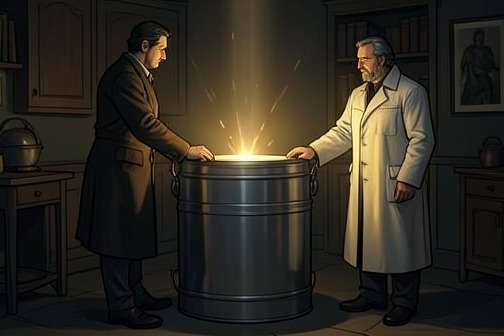
[The Transfer of the Alien Gift](entity:event-recall-event-the-transfer-of-the-ali-ffc0de8bf4fc) is the remembered act by which two barely living travelers aboard the starship passed their abilities to [Dom Corvaisis](entity:character-recall-character-dom-corvaisis-d9ce4fde805e) and [Brendan Cronin](entity:character-recall-character-brendan-cronin-2fbbbf142f5f). Its decisive significance lies in the gift’s continuation: healing can transmit the power to others, so the encounter did not end with the travelers’ deaths or with the government’s effort to suppress its meaning. What began as a private contact in a ship becomes, in the witnesses’ understanding, a change already moving through humanity.
## [The Gift](entity:concept-recall-concept-the-gift-3828f3be8c64) aboard the ship
The transfer comes into view as Dom and Brendan recover memories of entering the starship during the July incident. Dom stands beside one of the suspended-animation chambers and places his hands on the rings set into its top. He recalls feeling that the group had been drawn toward two containers by something still alive inside them, though only barely. This was not a discovery made by inspecting the ship from a distance: the rings and the nearly lifeless occupants become the point of contact through which the encounter is remembered.
Brendan’s recollection supplies the sensory and physical detail. A golden light came from two boxes and exerted an attraction that was both obvious and subliminal; he felt compelled to approach and put his hands on the rings. He understood, without yet being able to explain how, that someone beneath the lids was clinging to life in order to pass on a gift. The travelers, he remembers, pressed their own hands against the inner surfaces of the conductive rings. In placing his hands on the outside, Brendan received what they had come so far to give. The transfer thus joins two gestures across the chamber’s boundary: the travelers’ hands within and Brendan’s on the rings above them.
The memory changes the meaning of the travelers’ final moments. Dom says he now believes that only six of the crew were fully dead that night; two occupants remained barely alive. The account of the bodies’ differing conditions had been observed, but the survivors had not understood that life might have persisted in the chambers long enough to make the transfer possible. The travelers’ remaining vitality, as Brendan recalls it, was directed not toward their own survival but toward passing on their abilities. After the gift was given, they died at last.
## How the power passes on
[Miles Bennell](entity:character-recall-character-miles-bennell-fd741f9d1a85) explains that the travelers belong to an ancient species whose abilities include healing and telekinesis. They have not only evolved these capacities themselves; they have learned to infuse them into other intelligent species that do not possess them. The group does not know precisely how this process works. Bennell can say that the travelers passed power to Dom and Brendan, and that those two now have the ability to pass it onward, but the mechanism remains only partly understood.
Brendan reports that the transfer is already extending beyond the original recipients. [Emmy Halbourg](entity:character-recall-character-emmy-halbourg-ba50d86bb861) and [Winton Tolk](entity:character-recall-character-winton-tolk-f08f71997413), whom he healed in [Chicago](entity:location-recall-location-chicago-eb77a855d5aa), have both acquired the power. [Parker Faine](entity:character-recall-character-parker-faine-0e53d8b2c0c1) expects to develop it as well because Brendan healed him. Brendan does not claim that healing is the sole means of transmission; rather, he thinks its intimacy makes the transfer especially possible. Healing knits a person’s tissues together, and somehow the power passes in the same contact. The gift is therefore not a sealed inheritance reserved for two chosen people. It can travel outward through acts that restore another person’s body.
That possibility produces sharply different interpretations in the room. [Leland Falkirk](entity:character-recall-character-leland-falkirk-8c66510f5e4a) calls the newly empowered people sources of infection, turning the spread of an ability into a threat of contamination. [Ginger Weiss](entity:character-recall-character-ginger-weiss-c0c2e7ef6acc), by contrast, sees the news as evidence that the travelers may have come to help humanity evolve. Bennell agrees cautiously that such a transformation appears to be underway. The disagreement is not over whether the power has spread—the healed recipients make that concrete—but over whether its spread should be understood as danger or as development.
## A memory withheld
The transfer had happened before Dom and Brendan could understand what they had received. Brendan remembers that he did not yet know what was within him or how to use it; learning would have taken time. Before he had the chance, he and the others were taken into custody. Dom, expecting to be interrogated and to explain what had happened aboard the ship, never got that opportunity. The government’s eagerness to shield society from the shock of contact, followed by its fear of the unknown, prevented him from giving his account.
This interruption separates the original gift from its explanation. The travelers could pass on the power, but the human recipients initially lacked both understanding and a public forum in which to describe the encounter. Years later, the memory returns in conversation around the chambers themselves, and the evidence that once seemed merely physical—the rings, the bodies, their varied states of preservation—takes on a purpose. Remembering does not undo the captivity or restore the time in which the witnesses could have spoken; it gives them a way to recognize what had happened and to connect it to the abilities now emerging among them.
## From inheritance to a future mission
Bennell places the transfer on a scale beyond the immediate group. He imagines humanity first learning to use the travelers’ knowledge and technology over a hundred years, then taking at least another thousand years to mature enough to make a comparable commitment. In his envisioned future, humans launch a crew in suspended animation; roughly 32,000 years later, their descendants reach the travelers and return the call, renewing a contact of which the travelers themselves are unaware. This is Bennell’s conviction and projection, not a completed expedition, but it gives the gift a direction: receiving it may eventually enable humanity to offer something in return.
Brendan understands the prospect as thinking and acting on a scale far larger than an individual life. Dom’s recovery of the transfer supplies the intimate origin of that vast horizon: two beings, barely alive, made contact through conductive rings and gave what they could before dying. The scene’s movement is from an unexplained touch to an ability passed through healing, and from there to a possible exchange between civilizations separated by immense time. The gift matters not only because it grants power, but because its passage binds recipients to one another and suggests that humanity may one day answer the act that began aboard the ship.
Event 66
The Discovery of the Starship at Thunder Hill
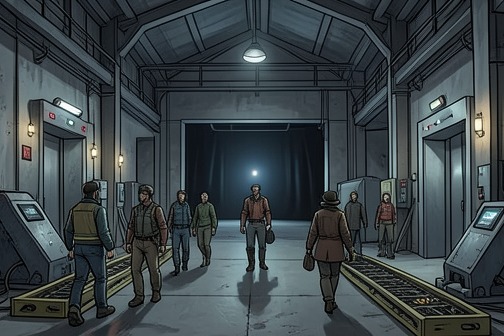
[The Discovery of the Starship at Thunder Hill](entity:event-recall-event-the-discovery-of-the-st-f1e6be1c029c) brings a suppressed first-contact memory into the present: while searching the mountain facility, [Dom Corvaisis](entity:character-recall-character-dom-corvaisis-d9ce4fde805e), [Ginger Weiss](entity:character-recall-character-ginger-weiss-c0c2e7ef6acc), and [Jack Twist](entity:character-recall-character-jack-twist-b2feffa09d4e) remember entering an extraterrestrial craft on [July 6](entity:time-recall-time-july-6-664e6e27c147) and then find that same ship concealed inside [Thunder Hill](entity:location-recall-location-thunder-hill-b1ea42221a8b). The scene joins private recollection to material proof. The witnesses’ memories return not as isolated impressions but as evidence of what the government has hidden, and of how the three visitors were bound to one another by an experience they had been made to forget.
## The memory returns
The discovery begins before the group reaches the craft. Moving through Thunder Hill, they pass enormous hydraulic platforms, each about seventy feet wide and nearly as deep, capable of carrying fighter aircraft into and out of the mountain. After passing smaller cargo lifts, they approach a pair of ordinary elevators. Before Jack can call one, Dom is overtaken by a vivid memory that displaces his surroundings: on the night of July 6, the moon changed from white to scarlet, and what seemed to be the moon revealed itself as the rounded bow of a descending ship. Dom remembers its plain cylindrical form and senses that its journey had not begun on Earth.
The memory leaves Dom leaning against the elevator doors, his head lowered between his arms. Ginger puts a hand on his shoulder, and Jack stands behind her. When Dom tells them what he has remembered, he does not need to persuade them. The reminder breaks their own memory blocks rapidly. Their faces register a mingling of awe, terror, joy, and hope, emotions that make the restored memory feel shared rather than merely personal. Ginger remembers that they went inside the vessel; Jack supplies that she, Dom, and [Brendan Cronin](entity:character-recall-character-brendan-cronin-2fbbbf142f5f) were the ones who entered it.
That recognition clarifies the force of Ginger and Dom’s connection. Dom understands why their response to each other was so powerful when Ginger arrived at the [Elko County](entity:location-recall-location-elko-county-b64ae78f502b) Airport: they had entered the ship together and shared an experience that had permanently bonded them. Ginger’s inference is immediate—the ship must be inside Thunder Hill. Dom agrees and links its concealment to the government’s acquisition of land from local ranchers. In his reconstruction, the grounds around the Depository were enlarged to make the truck carrying the vessel harder to spot. The hidden craft is therefore not only a recovered memory but a physical explanation for the land seizure and the expanded security around the facility.
## The concealed craft
As the group approaches the fourth cavern, Dom is drawn toward its nearly three-story wooden doors, at least sixty feet wide. He follows that feeling to a smaller door set into one of the huge portals. It is ajar, and brighter light falls through the opening. Hearing two men speaking quietly inside, Dom considers retreating, then decides that this room offers their best chance to see something important before they are caught. He opens the door and enters, with Ginger and Jack following.
The cavern is about two hundred feet long and between eighty and one hundred twenty feet wide, with a high domed ceiling. Its rock floor has been levelled and its holes filled with concrete. Oil and grease stains, together with recessed ringbolts, suggest that it was once used to store or service vehicles. Along one wall stand trailer-like buildings converted into research facilities, their hand-lettered signs identifying spaces such as a chemical laboratory and library, pathology, biology, physics, and anthropology. In a chamber built for industrial-scale work, research and concealment occupy the same space.
The spacecraft lies to the left of the entrance, raised five feet above the floor on steel trestles. It is between fifty and sixty feet long, fifteen feet in diameter, cylindrical, and rounded at both ends. Its hull is almost entirely smooth, marked by wear and age, but broken by shallow depressions, protruding hemispheres, and circular elevations whose purposes are not apparent. It has no visible rockets or propulsion system. The strange red-and-amber glow remembered from July 6 is absent; otherwise, the craft matches Ginger’s recovered recollection. Its unshowy surface and unexplained features intensify rather than diminish its impact: she is terrified by the unknown and at the same time exultant to see it.
## Witnesses, researchers, and the cover-up
Two men sit at a table near portable stairs leading to an open hatch in the ship’s side. One is a lanky, bearded civilian in a white laboratory coat; the other is an older, portly man in an Army uniform. When Dom, Ginger, and Jack appear, the men rise but neither call for guards nor trigger an alarm. They watch the visitors’ reactions with interest. Ginger realizes that they expected them, yet the realization matters less to her than the vessel itself.
The civilian identifies himself as [Miles Bennell](entity:character-recall-character-miles-bennell-fd741f9d1a85), director of the team studying the event, and introduces the military officer as [General Bob Alvarado](entity:character-recall-character-general-bob-alvarad-728d00bffb3a), the commanding officer of Thunder Hill. Bennell examines the hull and describes its material as an alloy harder than any steel produced on Earth, harder than diamond, yet extremely light and surprisingly flexible. His account confirms that the ship is not merely a remembered image or a rumor about the July event: it is present, under study, inside the mountain. Bennell also says that he regrets what has been done to the witnesses, believes the discovery belongs to the world rather than a small circle, and would disclose it publicly if he could.
Bennell’s explanation connects the recovered memory to the mechanics of its suppression. The authorities knew that three people had entered the vessel, but did not know anything unusual had happened inside. The three had emerged just as [DERO](entity:character-recall-character-dero-bc813f57d1bd) troops and scientific observers arrived by helicopter. In custody, they said they had only looked around; they were sedated soon after arrest and transported back to the [Tranquility Motel](entity:location-recall-location-tranquility-motel-17316482b285). The sedatives meant they had no opportunity to give a fuller account even if they had wanted to do so.
When the government decided to conceal the event and brainwash civilian witnesses, there was not time for a thorough debriefing. Dom, Ginger, and Jack were never brought out of sedation: they were transferred directly to the drug program used to erase their memories. Bennell calls this process both cruel and a waste of potential sources of data. His account makes clear that the memory loss was not simply an unexplained aftermath of contact; it was imposed through a deliberate program that also prevented the researchers from learning what the visitors had experienced.
## What the discovery changes
The craft’s presence turns the trio’s recollections into a chain of corroborating facts: the apparent moon was the ship’s approaching bow, the three witnesses entered it, and the government later concealed it in Thunder Hill. The discovery also exposes a division within the facility. The ship is guarded by a secretive military operation, yet Bennell and Alvarado do not present themselves as enemies of the visitors; Bennell openly opposes the cover-up, while the two men allow the group to approach the craft. The scene does not resolve the conflict between secrecy and disclosure, but gives that conflict named participants and a concrete object at its center.
The return of memory also changes how the characters understand their relationships and losses. Ginger recognizes that the shared experience explains her powerful bond with Dom. Jack’s wish that [Jenny](entity:character-recall-character-jenny-0118fe89ab5a) had lived longer carries a more painful implication than Ginger first assumes: he means that, had Jenny survived, Dom and Brendan might have used their newly acquired healing abilities to repair her damaged brain and bring her out of her coma. The ship therefore represents not only proof of alien contact but also a power whose consequences reach into intimate grief. At the cavern’s open hatch, Ginger wonders whether entering the vessel again might break the remaining memory block. The possibility is left unresolved, keeping the discovery at once a revelation and the threshold of further recovery.
Event 67
Leland Falkirk's Nuclear Attack
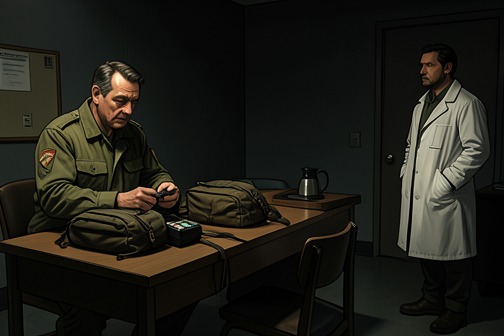
[Leland Falkirk's Nuclear Attack](entity:event-recall-event-leland-falkirk-s-nuclea-36e56a24729a) is the attempted destruction of [Thunder Hill](entity:location-recall-location-thunder-hill-b1ea42221a8b) by the colonel who believes that the people affected by extraterrestrial contact carry an infection capable of annihilating humanity. Falkirk converts a secretive military response into a plan for nuclear mass murder: he assembles two backpack bombs and sets their timers, intending to destroy the witnesses, the facility, and himself. His plot is stopped by the witnesses' newly emerging powers, but his suicide shows that the conflict is not resolved by physical survival alone; Falkirk refuses the future that the others are trying to protect.
## Causes and Background
The crisis grows out of the Army's earlier account of events in [Elko County, Nevada](entity:location-recall-location-elko-county-nevada-500bca0898e6). The motel registry places the initial emergency on Friday and Saturday, [July 6](entity:time-recall-time-july-6-664e6e27c147) and 7, when, according to the explanation given to the evacuated guests, a truck carrying dangerous chemicals to [Shenkfield](entity:location-recall-location-shenkfield-0e9d5a5eb820) had been involved in a toxic spill. The motel was closed until Tuesday, and guests left in their own cars. The official account described roadblocks and an evacuation of the danger zone; [Ned](entity:character-recall-character-ned-160602ecacc7) and [Sandy Sarver](entity:character-recall-character-sandy-sarver-5f80709b9fa1) were permitted to go to their trailer near Beowawe, outside the quarantine area.
The newspaper record makes the Army's handling of that alleged emergency look less like ordinary spill control and more like the protection of a secret. Army units closed a ten-mile stretch of [Interstate 80](entity:location-recall-location-interstate-80-09dbb90e2ea2) and established roadblocks before informing the [Elko County](entity:location-recall-location-elko-county-b64ae78f502b) Sheriff or Nevada State Police. Local authorities complained that the Army excluded them from managing the quarantine and contingency planning, even as the papers reported the reopening of the highway, removal of the quarantine, and evacuees who claimed to have seen nothing. The Sheriff threatened to seek a court order over the Army's intrusion into civilian jurisdiction, but the crisis ended before that dispute could be decided.
[Dom Corvaisis](entity:character-recall-character-dom-corvaisis-d9ce4fde805e) and [Ginger Weiss](entity:character-recall-character-ginger-weiss-c0c2e7ef6acc) connect the exceptional secrecy to the use of a [DERO](entity:character-recall-character-dero-bc813f57d1bd) team. Ginger reasons that the team would have been assigned to the quarantine because its members could be trusted with access to something highly classified, not because a routine chemical spill required them to guard an overturned truck or leaking container. She also argues that the Army could not have improvised its roadblocks so quickly without some advance notice of an event. These clues undermine the cover story without yet giving Dom and Ginger a complete explanation of what happened. By the time Falkirk acts, however, the possibility of alien infection has become, in his mind, the central fact—and a justification for treating everyone touched by the event as a threat.
## Falkirk's Decision and Access to the Arsenal
Falkirk frames secrecy as a defense of the human species. When [Foster Polnichev](entity:character-recall-character-foster-polnichev-986f8ed898bb) argues that the Halbourgs and Tolks do not appear dangerous, and that the new power in [Emmy Halbourg](entity:character-recall-character-emmy-halbourg-ba50d86bb861) may be the only thing inside her, Falkirk rejects the possibility that the encounter could be beneficial. He insists that disclosure would invite political interference just when, in his view, humanity must fight an existential war. Polnichev sees evidence of a potentially extraordinary human development; Falkirk treats that interpretation as the enemy's means of conquest. The disagreement is not merely about what the witnesses can do. It is about whether contact demands accommodation or destruction.
At Thunder Hill, Falkirk possesses a route to carry out that conviction. The tactical-nuclear vault is designed to require three palm identifications from a group of eight authorized people, submitted within a minute. [VIGILANT](entity:object-recall-object-vigilant-b2970bc5fc5a) oversees the system, but a new program Falkirk designed has made him the sole keeper of the Depository's tactical arsenal. He opens the vault with his own palm. Inside are twenty backpack nuclear weapons, with their detonators and binary explosive packages stored separately. Falkirk's access is therefore both technical and political: a collective safeguard has been subverted into a capability concentrated in one man's hands.
His DERO training has familiarized him with nuclear devices and their assembly. He takes two bomb frames from the wall, retrieves the necessary components, and assembles both weapons in eight minutes. He sets each detonator's timer for fifteen minutes, then carries the devices out of the vault. Each weighs sixty-nine pounds. The narrative stresses the bodily effort of the act: the weight strains his back and shoulders, but the growing pain makes him happier. The weapons turn an abstract security doctrine into an immediate physical burden, one Falkirk willingly bears because he imagines the coming destruction as proof of resolve.
## The Attempt and the Race Against the Timers
Falkirk's target is the facility and everyone inside it. In the main cavern he places one backpack bomb on the floor, reasoning that a nuclear blast could bring down the granite chambers and kill anyone sheltering on that level. He also believes the heat would prevent an alien life-form from reconstituting itself. The intended explosion is thus both a killing operation and a test of his certainty: he expects to die in the blast, but regards that death as an acceptable price for preventing what he imagines to be an infection-driven conquest.
The threat becomes explicit when Falkirk turns his machine gun toward [General Bob Alvarado](entity:character-recall-character-general-bob-alvarad-728d00bffb3a) and announces that two backpack bombs are in place: one outside the door and one in the main chamber below. With less than three minutes remaining, he declares that the group will be vaporized before anyone can change him into one of the beings he fears. [Lieutenant Horner](entity:character-recall-character-lieutenant-horner-5b45c6a99fdd) is armed beside him. The danger is not confined to an eventual nuclear detonation: the countdown leaves the witnesses almost no time, while the armed men can prevent them from reaching the devices.
Dom acts immediately, directing [Brendan Cronin](entity:character-recall-character-brendan-cronin-2fbbbf142f5f) to take the bomb outside the door while he goes for the one downstairs. Brendan kneels beside a device with one minute and thirty-three seconds remaining. His previous acts of healing and telekinesis have not given him a reliable procedure for handling a nuclear detonator; earlier, his powers have produced uncontrolled movement among objects and furniture. The scene sets his uncertainty against the precision the task seems to demand: a mistaken move could be fatal, and the clock continues to count down.
[Parker Faine](entity:character-recall-character-parker-faine-0e53d8b2c0c1) joins Brendan and urges him to stop intellectualizing and act on instinct. Parker thrusts his hands toward the detonator and commands it to come out. The device snaps free of its wires and leaps into his hands, but removing it does not end the danger. Its clock is still running, and the detonator contains a conventional explosive charge. The countdown reaches three seconds before Dom wills the illuminated numerals to stop. Parker throws the detonator toward the cavern wall and dives for cover; the ensuing explosion is not the nuclear blast Falkirk intended. The episode's narrow escape depends on several distinct interventions—Parker's extraction, Dom's halt of the timer, and the others' response to the conventional charge—rather than on any one person's control of the crisis.
## Aftermath and Significance
The bomb threat ends, but Falkirk is not reconciled to the survivors or their vision of what contact means. In the confusion, he breaks away from [Jack Twist](entity:character-recall-character-jack-twist-b2feffa09d4e) and [Ernie Block](entity:character-recall-character-ernie-block-f9eb5d1128b4), takes a revolver from a member of the Thunder Hill staff, and refuses to be changed like the others. Before anyone can reach him or use telekinetic power to pull the weapon away, he puts the revolver in his mouth and fires. Ginger Weiss and Dom turn away from his falling body. The narration distinguishes their horror at the waste from revulsion at the physical death: they see Falkirk's act as senseless because humanity has, at that moment, the secret of immortality within its grasp.
That ending makes the failed attack a confrontation between two responses to uncertainty. Falkirk treats the unknown as an enemy and makes annihilation the ultimate instrument of control; the witnesses' actions instead use their powers to preserve one another and prevent the destruction he has set in motion. His suicide completes the logic of his refusal: even after the immediate danger is over, he would rather die than accept transformation. The attempted nuclear strike is therefore not simply averted catastrophe. It exposes how the machinery of containment—the secret program, the exceptional authority, and the arsenal's safeguards altered to serve one keeper—can culminate in a private war against the very people it claims to protect.