Animal-Land
Surprised by JoyAnimal-Land is the fictional country C. S. Lewis created in childhood and elaborated with his brother through stories, maps, and play. Its importance lies not only in its animal heroes but in the way it grew from imaginative adventure into a shared, systematized world, with its own history, geography, and political arrangements.
Stories and Historical Design
C. S. Lewis’s first stories were written and illustrated with great satisfaction, bringing together two literary pleasures: animals dressed as people and knights in armor. The protagonists were chivalrous mice and rabbits who rode out in full mail to fight cats rather than giants. Even at this early stage, invention was accompanied by a strong impulse to organize. The medieval country in the stories had to be the same place as the modern Animal-Land that came alive in holiday play with his brother; the two eras therefore needed to fit into a continuous history.
That continuity turned romancing into historiography. C. S. Lewis set about writing a full history of Animal-Land, and more than one version survived, though none reached modern times: inventing enough events to fill centuries proved difficult. The histories also show an early critical instinct. The chivalric adventures were treated as material that might belong to legend, and the reader was cautioned that they might be only legends. Rather than simply presenting heroic stories as fact, the young author distinguished epic tradition from a historian’s account.
Maps and Shared Worldbuilding
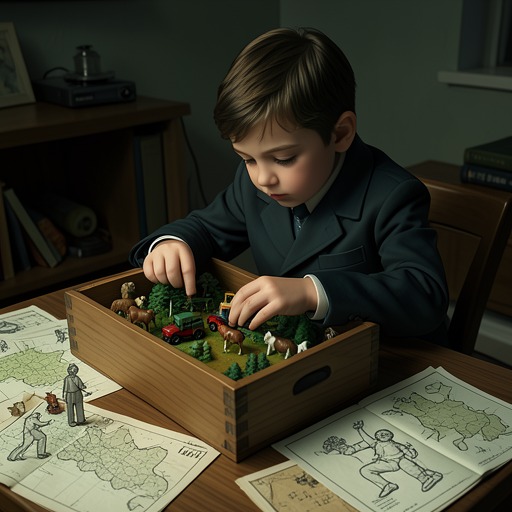
Geography followed history. C. S. Lewis made several maps of Animal-Land, which were reasonably consistent, then placed the country in relation to his brother’s India. In the imagined geography, India was lifted from its real-world position and made an island; its northern coast ran along the back of the Himalayas. His brother supplied the principal steamship routes between India and Animal-Land. The maps eventually expanded into a whole world, colored with every paintbox color, while Animal-Land and India became increasingly populated by consistent characters.
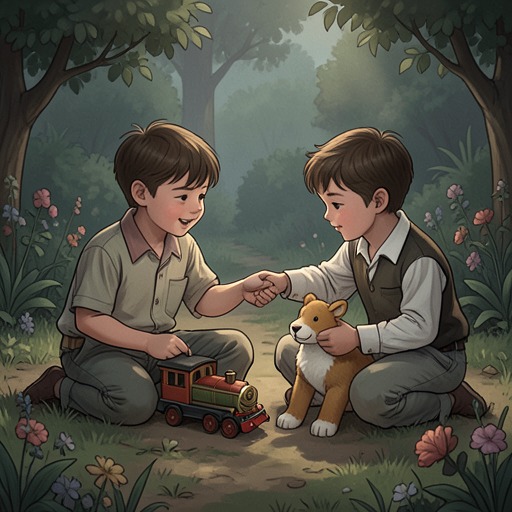
This was collaborative worldbuilding rather than a private fantasy kept apart from family life. Animal-Land’s modern period took shape in the holidays when C. S. Lewis’s brother was at home, and trains and steamships were necessary because the country was meant to be shared with him. The imagined world could accommodate modern transport and medieval romance at once, provided their relation was worked out. Its internal consistency was both a pleasure and a task: every new invention had to find a place in an already developing geography and chronology.
From Animal-Land to Boxen
By the time C. S. Lewis later described the world, Animal-Land and India had been united into the single state of Boxen, at some point in their own late eighteenth century. The two former countries retained separate kings but shared a legislative assembly called the Damerfesk. Thus Animal-Land did not simply disappear when the setting broadened; it became part of a larger political order that preserved its distinct sovereignty while linking it to India.
The Damerfesk’s democratic electoral system mattered less than its unsettled meeting place. The joint sovereigns could summon it wherever they chose, and the court learned the location before ordinary members did, allowing local accommodation to be taken before a member could make arrangements. Even an elected representative who reached a session could not be certain it would remain there. One member, according to the records, had sat in the assembly only once, on the fortunate occasion when it met in his home town. Although the records sometimes called the Damerfesk a Parliament, it was a single chamber presided over by the kings.
In the period C. S. Lewis knew best, practical authority rested with the Littlemaster, a figure combining the roles of prime minister and judge and, at least according to some accounts, commander-in-chief; he was certainly a member of the General Staff. The officeholder was Lord Big, a powerful frog who had tutored the two young kings and retained quasi-parental authority over them. Their intermittent attempts to escape his control were directed more toward avoiding his scrutiny of their private pleasures than toward pursuing political change. Lord Big’s influence made him nearly the state itself, showing how the imagined country’s history and institutions could develop into a detailed political world.
A Country Across Different Realities
C. S. Lewis later distinguished the imaginative life associated with Joy from his outer life, and explicitly placed Animal-Land and India on the outer side of that division. The distinction did not make the country insignificant; it describes the category in which he located it. Animal-Land belonged to the created, organized sphere of reading, invention, and shared play, rather than to the inward experiences of Joy that he was trying to narrate separately.
The setting also persisted as a point of contrast with actual places and later experience. On the voyage from Ireland to England, the departing lights receded until they seemed to comprise everything C. S. Lewis had known; his first impressions of England were markedly hostile, shaped by the contrast between the familiar sea and high ridges and the flat landscape he encountered. In his account of the trenches, he likewise distinguishes the physical realities of war from an imaginative moment that seemed more consequential: the first distant bullet called up the world of Homer. These passages do not make Animal-Land a direct record of those later experiences. They help clarify the larger role of the imagined country: it was one of the early worlds through which C. S. Lewis organized narrative, geography, and the relationship between lived reality and imaginative meaning.