C. S. Lewis and his brother
Surprised by JoyC. S. Lewis and his brother were more than siblings: from childhood they were allies and collaborators whose shared inventions gave form to their differences, while their mutual reliance helped them endure bereavement and difficult schools. Their relationship joined imaginative play to practical loyalty, and its recurring pattern—a few trusted companions set against a larger, hostile world—became one of the most consequential structures in Lewis’s account of his own life.
Early Companionship and Different Imaginations
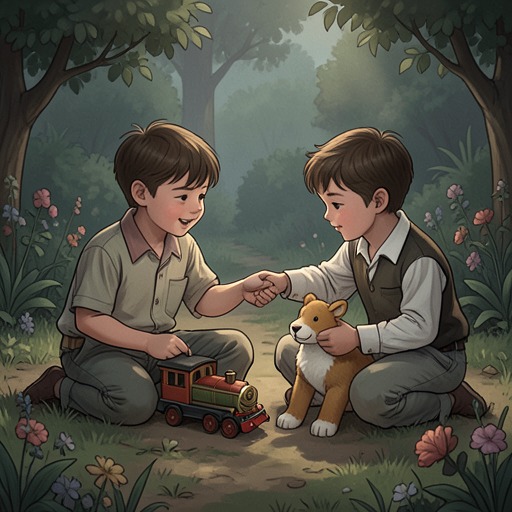
Although his brother was three years older, Lewis recalls that he never seemed like an elder brother; they were allies, even confederates, from the beginning. They differed in their creative interests. Their earliest drawings show his brother turning toward ships, trains, and battles, while Lewis drew the dressed animals familiar from nursery literature. His brother’s first story, The Young Rajah, made India his imagined country; Lewis claimed Animal-Land as his own.
The difference did not divide them. Instead, their separate interests became material for a common imaginative enterprise. Lewis’s stories brought together dressed animals and knights in armor: chivalrous mice and rabbits rode out in complete mail to fight cats. When his brother was home for the holidays, the modern Animal-Land they shared had trains and steamships. Lewis then connected that world to the medieval Animal-Land of his stories, attempting a continuous history rather than leaving the two imaginative periods unrelated.
That collaboration grew from stories into world-building. Lewis wrote several versions of an Animal-Land history, though he never brought the chronology up to modern times. He treated its chivalric adventures as possibly legendary, then moved from history to geography, making several reasonably consistent maps. To connect Animal-Land with his brother’s India, the brothers relocated India into their invented geography: it became an island whose north coast ran along the Himalayas, with steamship routes between it and Animal-Land. Their shared map soon encompassed a larger world, while the two regions they regarded as their own acquired increasingly consistent inhabitants.
The Toy Garden and a Shared Inheritance
Their partnership also supplied Lewis with an early image of beauty. The house and real garden had not awakened in him a sense of formal design; the brothers’ childhood drawings, for all their action, comedy, and invention, showed little attention to natural form. The first beauty he remembered came instead from an object his brother made: a biscuit-tin lid covered with moss and decorated with twigs and flowers, arranged as a toy garden or forest.
Lewis later distinguished the impression this small construction made from an appreciation of nature as a catalogue of shapes and colors. The toy garden made nature present to him as something fresh and flourishing, and its importance grew in memory. He said that his imagination of Paradise would retain something of his brother’s creation. The episode therefore belongs not only to their shared play but also to Lewis’s account of how his imaginative life began: his brother’s handmade miniature gave lasting form to an experience that the larger garden had not produced.
Bereavement and Mutual Reliance
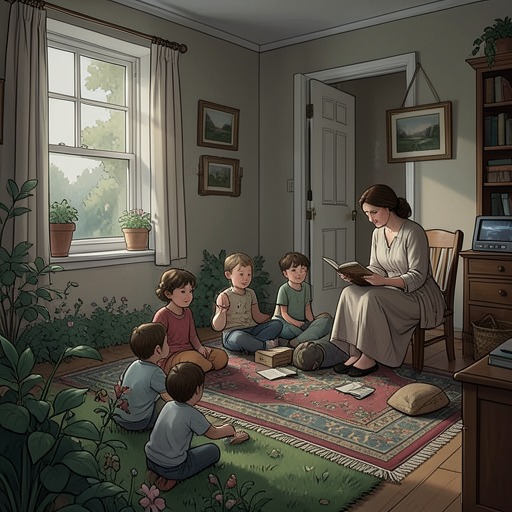
The brothers’ alliance deepened as their mother’s illness transformed family life. As she was increasingly withdrawn into medical care, the house and its routines became unfamiliar to the boys. Lewis describes their bereavement as beginning before her death: they gradually lost their mother to illness, while the family’s distress also separated them from their father. In this changed household, the brothers increasingly relied on one another for what made life bearable and trusted one another more than anyone else.
Lewis presents this closeness as the good consequence of an otherwise painful period. He also acknowledges that he and his brother may already have been learning to lie to their father, whose anxiety and unpredictable temper made their relationship with him more difficult. The brothers’ growing trust in each other was thus not simply an extension of their childhood games. It answered a rupture in family life: when home no longer felt dependable, their companionship became a refuge they could create together.
School, Solidarity, and the “We Few” Pattern
The same structure appeared at school. At Belsen, Lewis’s brother protected him during his first terms, though Lewis doubts the protection was necessary. The school’s remaining boarders were few, and their shared experience of poor treatment and the absence of new boys bound them together. Lewis describes the boys as having pleasant hours among themselves, taking walks on half-holidays, buying sweets in village shops, lingering by the canal or railway, and maintaining the curiosity of children in their conversations. Their fellowship, rather than school’s formal activities, made the place less damaging in retrospect.
Lewis explicitly connects this school solidarity to the earlier bond between the brothers at home: hardship had drawn the two boys together, just as fear and resentment of the school’s headmaster drew the remaining boarders together. In both settings, a small group held together against a stronger authority. He later identified this repeated pattern as a possible bias in his own outlook. The image that came most naturally to him was that of “we two” or “we few” standing together against something larger; consequently, friendship mattered more to him than broad acquaintance, and his interest in large, impersonal causes was limited.
Their school companionship did not end when they attended different institutions. In January 1911, when Lewis was just thirteen, he and his brother travelled together to Wyvern: his brother was going to the college, while Lewis was bound for the preparatory school he calls Chartres. The joint journeys to school and their reunions for the journey home became the structural points of the school year. As they grew older, they changed the routine, spending the morning at the Lime Street Hotel in Liverpool before taking a later train south, and eventually replacing magazines with books. The homeward journey had its own shared sequence: supper, a visit to the old Empire music hall, and the passage to the Landing Stage to see the ships before departing. Even as their schooling diverged, the repeated journeys preserved a common rhythm of separation and reunion. Their relationship thus shaped both the imaginative worlds of childhood and Lewis’s later account of why intimate friendship, rather than society at large, remained central to his life.