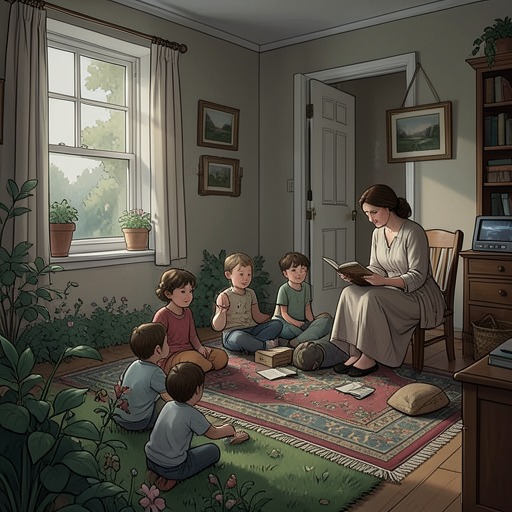
C. S. Lewis and his mother
Surprised by JoyC. S. Lewis and his mother were joined by an affectionate and intellectually serious household life, but their relationship is defined most decisively by its abrupt destruction. His mother’s cheerful steadiness stood against the emotional volatility he observed in his father; when she fell ill and died, the family’s familiar security gave way to fear, estrangement, and a bereavement that shaped Lewis’s childhood understanding of death and prayer.
Temperament and intellectual inheritance
Lewis remembered his mother’s affection as cheerful and tranquil, a quality he set in vivid contrast to his father’s emotional fluctuations. He traced this early contrast to his own distrust of emotion, which seemed uncomfortable, embarrassing, and potentially dangerous. The contrast did not mean that his mother was intellectually remote: both parents were bookish, but her interests and abilities had a particularly direct bearing on Lewis’s education.
She had been a promising mathematician and earned a B.A. from Queen’s College, Belfast. Before her death, she began teaching Lewis French and Latin. She read novels voraciously, and Lewis believed that the Meredith and Tolstoy books he inherited had been bought for her. This inheritance connects her not only to his earliest learning but also to the books that remained in the family after her death.
Their literary tastes were not identical. Lewis’s mother, he was told, cared for no poetry, and neither parent shared his early allegiance to the kind of literature he chose for himself. The household contained no Keats or Shelley, while the copy of Coleridge went, as far as Lewis knew, unread. His account thus distinguishes maternal intellectual cultivation from the particular romantic imagination he later developed: she helped initiate his formal reading, but he did not attribute that imaginative preference to her.
Illness and the loss of home
Lewis recalls the onset of his mother’s illness through a child’s bewildered view of one night in the house. He was sick with headache and toothache and distressed because she did not come to him; he did not yet understand that she was ill too. Doctors, voices, and the repeated opening and shutting of doors filled the house. After what seemed to him hours, his father came into the room in tears and tried to explain something the frightened child had never imagined: his mother had cancer.
The illness followed what Lewis calls its usual course: an operation performed in the patient’s home, apparent recovery, the return of the disease, increasing pain, and death. His account does not present bereavement as beginning only at the moment of death. The boys had already been losing their mother as nurses, delirium, and morphia gradually withdrew her from their shared life. At the same time, the household changed into something alien and menacing, marked by strange smells, midnight noises, and whispered conversations.
Lewis distinguishes this prolonged separation from the final death. In his recollection, the family’s ordinary life and sense of home had been failing throughout the illness, so that the death confirmed a loss already underway. The domestic setting, once associated with maternal affection and security, became a place of uncertainty and dread.
Bereavement and family estrangement
The illness divided the boys from their father as well as from their mother. Lewis later questioned the familiar idea that shared sorrow necessarily brings people closer, observing that the gulf in age could make adult misery and terror paralyzing and alienating to children. He acknowledged, without claiming certainty, that the boys might have lightened their father’s suffering had they been better children; instead, he remembered his father’s nerves and emotions becoming increasingly unstable under pressure. His temper was unpredictable, and he spoke wildly and acted unjustly.
As the adults’ world became less dependable, Lewis and his brother increasingly relied on one another. They came to trust each other above anyone else and drew closer in the effort to make life bearable. Lewis even suspected that he, and perhaps both boys, had already begun lying to their father. In his retrospective image, they were two frightened children huddled together for warmth in a bleak world. Their closeness was not an abstract consolation: it was the one support left in a home where everything else that had made it a home seemed to have failed.
The change in Lewis’s relation to his father endured beyond the immediate crisis in the form of that remembered division, while his father himself never fully recovered from his wife’s death. Lewis’s account holds both consequences together: the father’s lasting grief and the sons’ withdrawal from him, without simplifying either into a story of shared mourning that healed the family.
Death, prayer, and lasting consequences
Lewis was taken into the bedroom where his mother lay dead, supposedly to see her, but he felt that he was being made to see it. He recalls no disfigurement apart from death itself, and says that terror overwhelmed grief. He never understood descriptions of dead bodies as beautiful. The coffin, flowers, hearse, and funeral brought no comfort; he reacted with horror and even lectured an aunt about the absurdity of mourning clothes. He later connected this aversion to funeral display with a continuing distaste for public and collective forms and an awkwardness about formality.
Her illness also occasioned what Lewis later identified as a possible first religious experience, though he explicitly questioned whether it should count as one. When her case was declared hopeless, he remembered the teaching that prayers offered in faith would be granted. He tried by force of will to believe that his prayers for her recovery would succeed and thought he had managed it. After she died, he shifted to believing that a miracle would occur. Neither expectation was fulfilled, but he says the disappointment produced no further religious consequence at the time.
His later explanation emphasizes how he had approached God: not with love, awe, or fear, but as though God were a magician summoned to restore things to their previous state and then disappear. Because he had imagined prayer as a means of obtaining a specific result, its failure did not then lead him to reconsider his whole understanding of religion. The episode therefore stands as a formative but limited encounter with prayer, distinct from a lasting conversion.
Lewis describes his mother’s death as the end of all settled happiness and everything tranquil and reliable in his life. There would still be fun, pleasures, and experiences of Joy, but not the old security. His image is one of a continent sinking, leaving only sea and islands: a compact measure of how the loss altered the emotional ground on which the rest of his childhood would unfold. Years later, remembering the cold oilcloth, the chimes marking the quarters, and his desperate nightly efforts to pray with sufficient vividness, he recalled the pressure of religious practice in the wake of childhood loss; the memory preserves the bodily weariness of those nights rather than turning them into a simple story of faith restored.