C. S. Lewis’s apostasy at Chartres
Surprised by JoyC. S. Lewis’s apostasy at Chartres was a slow, uneven loss of the Christian faith he had begun to practice seriously at Oldie’s school, not a single moment of declared disbelief. The memoir traces how fascination with occult possibilities, a punishing misunderstanding of prayer, classical accounts of pagan religion, and intellectual pessimism weakened that earlier belief. Lewis describes the outcome as relief rather than bereavement, while making clear that his later surrender to theism and eventual acceptance of Christianity were separate stages, not the immediate reversal of Chartres.
From belief at Oldie’s to the Chartres rupture
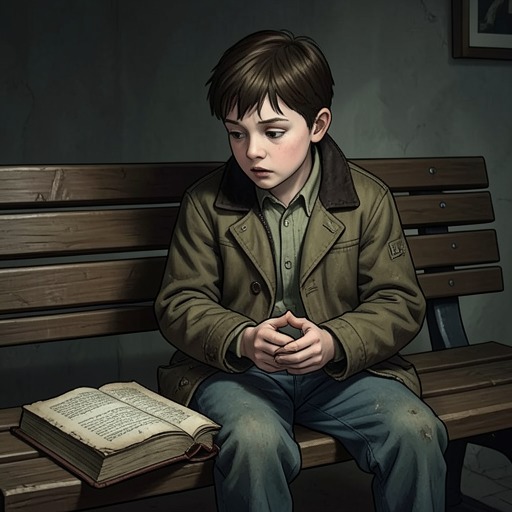
At Oldie’s school, twice-weekly church attendance exposed Lewis to Christian doctrines taught by men who plainly believed them. Though he resisted the unfamiliar high Anglo-Catholic rituals, the teaching brought to life what he had already said he believed. Fear for his soul accompanied the change, particularly on moonlit nights in the dormitory, but he regarded its effects as good: he began to pray seriously, read the Bible, and try to obey his conscience. Chartres therefore marks a departure from an active religious beginning, not merely the rejection of a faith he had never practiced.
The place that healed his quarrel with England also became the setting of a more consequential change. Lewis delighted in the blue plain and green hills around the school and recognized Wyvern Priory as the first building he had perceived as beautiful. He made real friends there, and his education took hold under a patient headmaster. Yet within this setting of aesthetic pleasure and intellectual progress, he ceased to be a Christian. He dated his stay from the spring term of 1911 to the end of the summer term of 1913, but could not locate the apostasy precisely: it had not begun when he arrived, and the process was complete shortly after he left.
Occult attraction and the erosion of belief
Lewis identified Miss C., Chartres’s beloved matron, as an unintended occasion of his loss of faith, not as someone seeking to destroy it. He remembered her as selfless, caring, and companionable, and said that she had been searching for truth through Theosophy, Rosicrucianism, Spiritualism, and other currents of Anglo-American occultism. Lewis had previously treated imagined worlds as inventions rather than realities. Her conversations introduced the possibility that marvels and spiritual beings might actually exist beyond the visible world, and that his simple theology might not account for all that was real.
This new possibility awakened a lasting appetite for the preternatural. Lewis called the attraction a spiritual lust: while it held him, other interests seemed dull beside the prospect of occult realities. Its effect on his Christianity was not simply that one belief replaced another. The speculative vagueness associated with occultism spread, in his retrospective account, to the firm claims of his creed. Belief began to feel like a matter of personal inclination rather than truth demanding obedience. He described the change as a movement from revelation’s demands toward a more comfortable kind of thought, in which nothing had to be obeyed and belief could follow whatever seemed consoling or exciting. He attributed this development not to Miss C.’s intention, but to his own susceptibility to ideas she had innocently introduced.
Prayer, education, and the wish to escape
The occult influence found an opening because Lewis already wanted to be rid of his religion. At Oldie’s, after taking belief seriously, he had tried to ensure that he was thinking properly about every prayer. An anxious inner voice repeatedly questioned whether he had attended sufficiently to the words and urged him to try again. Lewis responded by imposing a further test: no clause counted unless accompanied by a vivid imaginative and emotional experience he called a realization. Because he could not reliably produce or identify this state by force, each attempt created grounds for another attempt.
The practice turned prayer into a nightly ordeal. Lewis recalled lying awake, exhausted and despairing, trying to manufacture the very intensity that his will could not command. The demand could even seem to reach backward: if he prayed for better realizations, he might then wonder whether that preliminary prayer had itself been properly realized. Bedtime became something he dreaded, and the strain darkened the whole evening. In retrospect, he understood this false duty as an unconscious motive for escape from Christianity, rather than as an authentic requirement of Christian prayer.
Classical education supplied a different, more conscious pressure. Reading Virgil exposed Lewis to a range of religious ideas, while teachers and editors treated those beliefs as illusions without explaining how pagan religion might prefigure or be fulfilled by Christianity. Religion appeared to him to be a recurring human error, with Christianity arbitrarily marked as the sole exception. If it belonged to the same general kind as the religions dismissed around it, he wondered, why should he continue to treat it differently? The question did not settle the truth of Christianity; it made the privileged status he had granted it feel unsupported.
Intellectual pessimism reinforced these doubts. Lewis was not necessarily unhappy, but he had come to regard the universe as, on balance, regrettable. The thought he associated with an argument from undesign—that a designed world would not be so frail and faulty—coexisted without any logical reconciliation with his occult fascinations. He later insisted that the two dispositions operated in different moods; their common consequence was that both worked against Christianity. The memoir thus presents his apostasy as the convergence of distinct pressures, not as the conclusion of one consistent philosophical proof.
The end of faith and its longer aftermath
Lewis says that he became an apostate gradually, amid fluctuations he could no longer reconstruct, and that he dropped his faith without a sense of loss but with great relief. The change was therefore both intellectual and practical: Christian doctrines no longer held his assent, and release from the burdens he had attached to religion felt welcome. But the memoir does not treat Chartres as the end of his religious history. Its account of the departure is retrospective, and it places the later return to belief on a separate timeline.
That distinction matters when Lewis recalls his surrender in Magdalen during Trinity Term in 1929. There, after feeling the persistent approach of God while alone in his room, he admitted that God was God, knelt, and prayed. He stresses that this was a conversion to theism, not Christianity: he did not yet believe in the Incarnation, and he experienced no assurance that God was connected to the Joy he had pursued since childhood. The later recognition of Christianity followed another stage of reflection, in which pagan myths and the Gospels came to seem related as anticipation and fulfillment. Chartres, the 1929 surrender, and the eventual Christian commitment are distinct turns in the memoir’s chronology. The apostasy’s importance lies in this separation: it records not a simple slide from childhood belief to mature faith, but an actual period of unbelief whose causes Lewis later examined in detail.