C. S. Lewis’s relationship with God
Surprised by JoyC. S. Lewis’s relationship with God is a progression from early Christian belief through apostasy to reluctant theism and, later, belief in Christ. Its decisive pattern is a repeated loss of distance: Christianity first becomes real to him through preaching and practice, then seems dispensable, and eventually returns as an imminent personal claim that he cannot keep at the level of philosophy. The memoir distinguishes these stages carefully; theism in 1929 is not yet Christianity, and the later recognition of the Incarnation is a further change in what Lewis understands God to be.
Early belief, doubt, and apostasy
At Oldie’s school, Lewis first became an effective believer. The church’s Anglo-Catholic rituals initially met his conscious resistance: as an Ulster Protestant, he regarded them as part of an English atmosphere he disliked. He later suspected that candles, incense, vestments, kneeling hymns, and other unfamiliar practices affected him in the opposite direction, but he identified the central influence elsewhere. He heard Christian doctrines, rather than general moral uplift, taught by people who plainly believed them. Because he had not been skeptical, the teaching brought to life what he would already have said he believed.
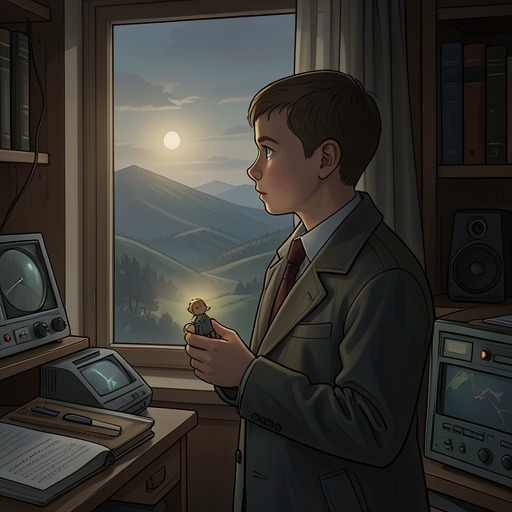
This beginning involved fear of damnation, especially on blazing, moonlit nights in a curtainless dormitory, where the sound of other boys breathing in sleep remained vivid in memory. Lewis judged the fear neither excessive nor harmful in its original setting. He began to pray seriously, read the Bible, and try to obey his conscience; religion was also discussed among the boys with gravity, without hysteria or shamefacedness. In retrospect, he connected this Anglo-Catholic experience at Belsen—not the supposed Puritanism of his Ulster childhood—to the prominence of Hell in his later books. He also left the beginning unresolved: the memoir signals that he would later explain how he went back from it.
The retreat from belief gathered force through both a burdensome practice and intellectual objections. In prayer, Lewis demanded a vivid imaginative and emotional “realization” to validate every clause. Night after night he tried by willpower to produce an experience that could not be compelled, and the test threatened an infinite regress: even the preliminary prayer for a realization might itself need to be realized. The cold oilcloth, chiming quarters, lost hours, and dread of bedtime made the effort a torment. Lewis later recognized this self-imposed burden as an unconscious motive for wanting to abandon Christianity.
Classical reading supplied a more conscious difficulty. In his account, teachers and editors treated the religious ideas in works such as Virgil’s as illusion, while Christianity alone was assumed to be true, without an explanation of how Pagan religion related to it. Religions in general seemed to be a natural growth of human error, with Christianity arbitrarily exempted. Lewis wondered why he should continue to treat that exception differently. His pessimism reinforced the separation: he came to regard the universe as largely regrettable, and his “Argument from Undesign” joined his occult interests in opposition to Christianity, though he saw no logical connection between the two. Gradually, with fluctuations he could no longer reconstruct, he became an apostate, relinquishing faith with relief rather than a sense of loss.
Imagination, literature, and the return of religious possibility
The apostasy did not end Lewis’s attraction to religious or supernatural possibilities, but it changed their place in his thinking. At Chartres, he recalled that the experience of authentic Joy had vanished so completely that even its memory and desire were gone. Encountering the words “Siegfried and the Twilight of the Gods” and an illustration by Arthur Rackham in a literary periodical abruptly restored the memory. The image awakened what Lewis called Northernness and connected it with an earlier poetic world; the remoteness of that world and the remembered Joy fused into an intense longing. The experience did not itself reinstate Christian belief, but it reopened a sense of desire that his intervening years had lost.
Wagner deepened this imaginative recovery. Before hearing the music, Lewis had already made the printed name a kind of magical symbol; the Ride of the Valkyries, heard on a record in T. Edens Osborne’s shop, struck him as a thunderbolt. Wagnerian records became a major use of his pocket money and a customary request for presents. Later, at Dundrum, he found the Rackham-illustrated volume that had first awakened his interest. These encounters gave imaginative force to a world beyond materialist assumptions, but they were not, by themselves, steps equivalent to conversion.
A different literary encounter later changed the quality of that imaginative world. In October, at Leatherhead station, Lewis picked an Everyman edition of Phantastes from the bookstall while waiting for the Bookham, Effingham, Horsley train. The woodland journeys and enchanted figures resembled imagery he already loved in Malory, Spenser, Morris, and Yeats, yet the book seemed to carry a new quality, which he later named holiness. Rather than confusing the tale’s scenes with reality, he distinguished the story from the light that rested upon it. What had once seemed to call from a remote world now felt near—too close to see or understand. This encounter redirected his search, but Lewis describes its effect as a change in how he perceived familiar material, not as an immediate doctrinal conclusion.
Intellectual change and the approach of theism
Lewis’s reconsideration of belief also developed through arguments about knowledge and the authority of modern assumptions. Reading W. B. Yeats’s prose showed him that a respected, non-Christian writer could seriously believe in magic and in a world beyond the material one. Maurice Maeterlinck’s engagement with Spiritualism, Theosophy, and Pantheism added another such example. Lewis did not simply assent to their claims; their importance was that they made materialism less secure. A “Perhaps” reopened the possibility of something beyond the physical world, while leaving Christian theology unaccepted.
Owen Barfield’s arguments then undermined two pillars of Lewis’s outlook. Barfield challenged chronological snobbery: the assumption that an idea is discredited simply because it belongs to the past. Lewis came to ask whether an old position had actually been refuted, and to recognize that his own age, like every period, had its characteristic assumptions and possible illusions. Barfield also exposed a problem in the realist account of knowledge Lewis had shared with him. They treated the sensory universe as ultimate reality while claiming objective authority for logic, morality, and aesthetic judgment. Lewis concluded that if thought were merely subjective, those claims could not stand; yet a behaviorist account that reduced them to sensory reality was, to him, literally unbelievable. He therefore gave up realism and accepted that mind could not be merely a late by-product of matter, moving toward the view that the universe was ultimately mental and that logic participated in a cosmic Logos.
These changes did not make Lewis a Christian. His intellectual development instead narrowed the space in which he could dismiss religious claims without examination. When an atheist friend remarked that the historical evidence for the Gospels was surprisingly good and that the dying-god story seemed to have happened once, Lewis found the comment especially disturbing because it came from someone he had regarded as beyond the reach of Christianity. The remark weakened the confidence that unbelief offered a secure refuge, but it did not itself complete the change.
Surrender to God
Lewis recalled a moment of apparent choice while riding on the top of a bus up Headington Hill. Without a sequence of words or clear images, he became aware that he was holding something at bay. He pictured himself as wearing stiff clothing, a corset, or even armor, like a lobster; he could open a door or keep it shut, unbuckle the armor or retain it. Neither option came with a threat or promise, though he understood that opening the door meant the incalculable. He chose to open it and loosen the rein, while also feeling that he could not truly have chosen otherwise. The act registered imaginatively as a snowman beginning to melt, drip by drip, a sensation he disliked.
The intellectual opening became personal when a philosophical proposition ceased to remain abstract. Lewis had tried to bring his conduct into line with universal Spirit, but serious practice made the distinction between Spirit and prayer to God collapse. In his account, the question was not yet whether his Absolute Spirit matched the God of ordinary religion. The unsettling change was that the concept became a living presence, one that declared its own authority rather than entering a debate on Lewis’s terms. He had wanted above all not to be interfered with, to call his soul his own, and to avoid suffering more than to attain delight. Now an ideal became a command, and no assurance was offered that God would be “reasonable” in the comfortable sense Lewis hoped for. The demand was total surrender, not a negotiated accommodation.
In the Trinity Term of 1929, alone in his room at Magdalen, Lewis yielded. He described God’s approach as steady and unrelenting, felt whenever he lifted his mind from his work. He admitted that God was God, knelt, and prayed, later calling himself perhaps the most dejected and reluctant convert in England. His retrospective emphasis falls on the contrast between his resistance and what he understood as divine mercy: he was not a willing pilgrim walking home, but a reluctant convert who seemed to be brought in struggling. The event marks his conversion to theism, not yet to Christianity.
From theism to Christian belief
After surrender, Lewis did not immediately connect God with Joy, nor did he believe in an afterlife. He understood the God he had acknowledged as nonhuman and knew nothing yet of the Incarnation. He received no assurance that the source of Joy would be connected to God; he even feared that relinquishing Joy might be among the first demands made of him. For several months, perhaps a year, he attempted obedience without making immortality a central question. These limits matter to the memoir’s account: acknowledging God, accepting Christian doctrine, and anticipating future life were not one simultaneous conversion.
Lewis’s next question was where religious history had reached maturity. In correspondence with Griffiths, who also believed in God, he considered the traditions of worship as more than a mass of falsehoods surrounding one arbitrary true exception. Barfield’s encouragement to treat Pagan myth with respect, together with the atheist’s remark about the dying god, helped him ask whether the hints in Pagan religions had been fulfilled. He considered Hinduism and Christianity as the two possible answers, but found Hinduism, as he then understood it, to place philosophical thought alongside unpurged Pagan practices and to lack Christianity’s historical claim. The Gospels did not strike him as myths, although their narrative had the substance of great myth. He came to see Christianity as the place where myth had become fact: the Word made flesh, God become Man.
Even as that conclusion approached, Lewis felt a resistance comparable to his earlier resistance to theism. Each step—from Absolute to Spirit, Spirit to God, and God to the Incarnation—made the divine more concrete, imminent, and difficult to keep at a distance. On a drive to Whipsnade, he left home not believing that Jesus Christ was the Son of God and arrived believing it. He recalled no extended argument or great emotion on the journey, comparing the recognition instead to becoming aware, after long sleep, that one is awake. The memoir thus presents his relationship with God not as a single change of mood but as a sequence of increasingly specific commitments: early belief and prayer, apostasy, intellectual openness, surrender to theism, and finally acceptance of the Christian claim that God had become human.