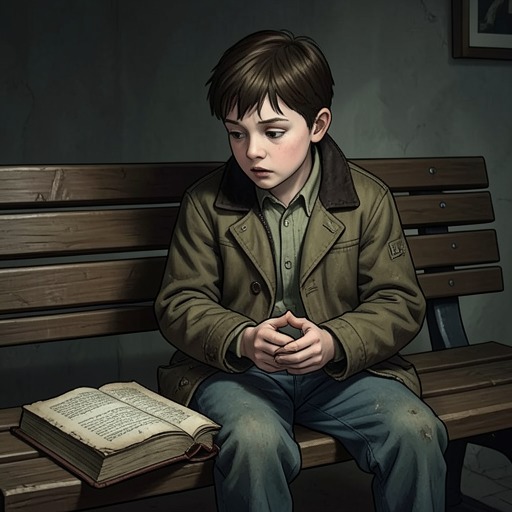
C. S. Lewis’s religious awakening at Belsen
Surprised by JoyC. S. Lewis’s religious awakening at Belsen was the first point at which Christianity became effective belief and practice for him. At the school’s Anglo-Catholic church, doctrines he had already said he believed were taught by people who plainly believed them; he began to pray seriously, read the Bible, and try to obey his conscience. The memoir gives this beginning lasting importance while making clear that it did not secure a continuous Christian faith: Lewis later became an apostate, and his return to belief began with a separate, reluctant surrender to theism years afterward.
The church and the beginning of belief
Twice each Sunday, Belsen’s pupils were taken to church. Lewis consciously resisted its Anglo-Catholic character: as an Ulster Protestant, he associated the unfamiliar ritual with the English atmosphere he disliked. Candles, incense, vestments, and hymns sung on the knees may nevertheless have affected him in the opposite direction, though he retrospectively judges that they were not the decisive cause. What mattered most was that he heard Christian doctrines, rather than a generalized message of uplift, from men who obviously believed what they taught. Because he had not been skeptical, their teaching did not introduce an entirely new creed; it made what he already claimed to believe come alive.
The account therefore distinguishes inherited or professed belief from effective belief. Belsen’s importance lies not in an argument that overturned disbelief, but in the change from assenting to Christian teaching in principle to taking it seriously in conduct. Lewis identifies the church as the likely instrument of that change while remaining cautious about explaining precisely how its influence worked.
Fear, prayer, and conscience
Fear accompanied the awakening. Lewis worried about the state of his soul, especially on blazing, moonlit nights in the curtainless dormitory. The remembered sound of the other boys breathing in their sleep gives this religious anxiety a concrete setting: it belonged to solitary nights within the ordinary life of the school, not simply to abstract reflection. In retrospect, he considers the fear wholesome and perhaps necessary, and judges the experience’s effect entirely good.
Its practical signs were serious prayer, Bible reading, and attempts to obey conscience. Religion also became a subject the boys discussed, in Lewis’s recollection, with gravity but without hysteria or the shamefacedness he associated with older boys. The episode thus includes more than private apprehension: it begins a pattern of religious attention expressed in reading, ethical effort, and conversation. Lewis does not claim that these practices guaranteed the permanence of his faith; he explicitly postpones the story of how he went back from this beginning.
A beginning, not a continuous conversion
That qualification is essential to the event’s meaning. Lewis later describes his gradual apostasy as occurring amid conflicting influences and fluctuations he could no longer reconstruct exactly. He eventually dropped his faith without a sense of loss and with relief. The later rejection does not erase the earlier awakening, but it prevents the Belsen experience from being treated as a conversion that simply carried him forward into settled Christianity. In the memoir’s sequence, effective belief, apostasy, and subsequent religious return are distinct stages.
The later return also began at a different level. In Trinity Term 1929, alone in his room at Magdalen, Lewis admitted that God was God, knelt, and prayed. He characterizes that moment as a reluctant surrender to theism, not yet a conversion to Christianity: he knew nothing of the Incarnation, and he did not then believe in a future life. The distinction clarifies what Belsen had and had not achieved. There, Christian doctrine became real enough to shape his conduct; in 1929, he acknowledged God after years of unbelief, but had not yet accepted Christian doctrine in full.
Retrospective significance
The later memoir places the Belsen awakening within a history of changing intellectual and religious positions rather than presenting it as destiny. Lewis’s subsequent encounters with classical religion and occult writing contributed to doubts about Christianity, while later discussions and arguments altered how he assessed religious traditions and the assumptions of his age. Those developments help explain why the early experience did not settle the matter for him, but they do not make its initial force unreal: at Belsen he began to pray, read scripture, and act in accordance with conscience.
The episode’s significance is consequently both formative and limited. It marks Lewis’s first effective Christian belief, yet the account preserves the rupture that followed and distinguishes theism from the later recognition of Christianity as the fulfillment of religious myth. Its retrospectively stated incompletion—Lewis promises that the departure from faith will be told later—makes the awakening the start of a religious history, not its resolution.