France
Surprised by JoyFrance is where Lewis’s account of military service brings together the physical hardships of the First World War, unexpected kindness from fellow officers, and a sharp contrast with the school life that preceded it. He arrived in the front-line trenches on his nineteenth birthday in November 1917, served around the villages before Arras, and was wounded near Lillers in April 1918. Yet the war’s lasting significance in his recollection lies not only in danger and exhaustion, but in the candor of its hardships and the human relationships formed amid them.
Service and setting
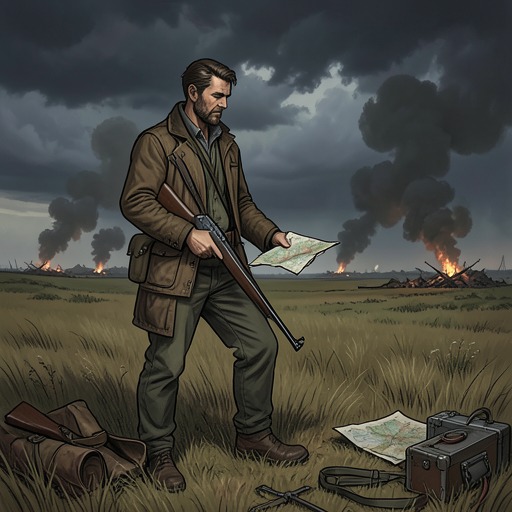
After training, Lewis received a commission as a Second Lieutenant in the Somerset Light Infantry. His service took him to the front line and to villages near Arras, including Fampoux and Monchy. In April 1918 he was wounded at Mt. Bernenchon, near Lillers. These place names anchor the account in a particular stretch of the Western Front, though Lewis says little about military operations themselves, noting that others who witnessed more had already described the war extensively.
The conditions he does record are those of a difficult winter: weariness and water were principal enemies, and he sometimes fell asleep while marching, only to wake and find that he was still marching. In the trenches, water rose above the knee; concealed barbed wire could puncture a thigh boot and let icy water flow inside. Later, during a German attack in the spring, the enemy concentrated on the Canadians to the right, while shells fell on Lewis’s line at roughly three a minute. The memoir makes the scale of danger legible through these immediate circumstances rather than through a broad account of the campaign.
Hardship, companionship, and contrast
Lewis was surprised that he did not dislike the army more. He calls it detestable, but explains that its misery was openly acknowledged: soldiers were not expected to enjoy it, and no one pretended it was pleasurable. In his comparison, straightforward hardship was easier to bear than a regime that advertised itself as a benefit while making life miserable. The army’s shared recognition of its conditions could foster camaraderie; the school system’s pretence of pleasure instead encouraged distrust and concealed resentment.
He also found his military seniors kinder than the older boys at Wyvern. Lewis partly attributes this difference to age: adults, unlike adolescents, did not need to reassure themselves of their authority. He wonders, too, whether his own expression had changed. The face once criticized for its look seemed to have acquired an appearance that prompted pity or kind amusement. On his first night in France, two middle-aged Canadian officers took him under their care in a large sleeping hall where about a hundred officers were accommodated on plank beds. Later, while dining alone with a book and wine at the Officers’ Club in Arras, he was invited to join two senior officers for brandy and cigars. Lewis presents these encounters as acts of uncomplicated goodwill, part of a wider succession of brief meetings with scholars, poets, storytellers, and other congenial men.
The contrast with school is also visible in Lewis’s retrospective account of authority and social standing. At Oldie’s school, a boy remembered as decent and hardworking was repeatedly punished, which Lewis connects to the boy’s lower social status and his father’s occupation as a dentist. At Wyvern, the club system could turn a new boy’s reliance on misleading information into a punishable offense: Lewis believed he had been assigned to one club, discovered that his name had appeared on another club’s notice board, and was flogged for skipping clubs. He uses such episodes to show how institutions could make their own rules and hierarchies feel absolute to a powerless junior. France offers a contrasting, though not idealized, social world: senior officers could exercise authority without treating a nineteen-year-old as a rival to be subdued.
Memory and the ordinary soldier
Lewis does not present France as a place of uninterrupted benevolence. The army also brought him encounters with absurdity and the wider world, and he explicitly resists painting wartime service as wholly good. Nevertheless, his recollection of the trenches is often less vivid than the personal relations formed there. He came to pity and respect ordinary soldiers, especially Sergeant Ayres, who he believed was killed by the shell that wounded him. Lewis describes himself as an ineffective officer whom Ayres guided; the relationship became, in retrospect, something beautiful and almost fatherly.
The landscape and conditions of war remain in the account—cold, exhaustion, shellfire, damaged ground, and the constant presence of death—but Lewis says that these experiences often feel detached from the rest of his life, almost as if they happened to someone else. He links his understanding of the dead to an earlier encounter with his mother’s death. Against the physical scale of the war, he singles out an imaginative moment: hearing his first bullet, distant enough to make a whine, and recognizing that he was now inside the kind of war described by Homer. In this recollection, France is both a concrete theatre of service and the setting for a memory whose emotional center lies in shared endurance, unexpected kindness, and the way a single imaginative recognition can outlast much larger events.