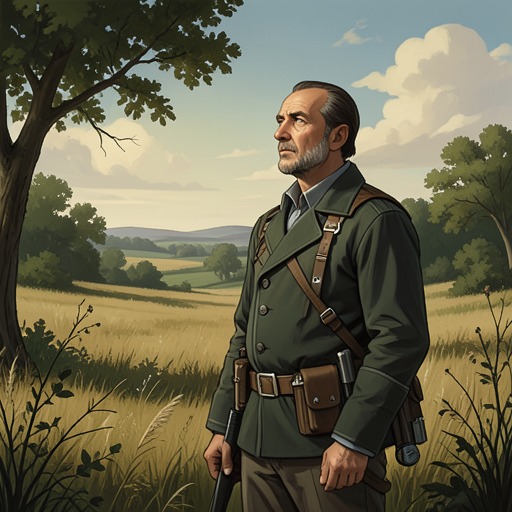
H. V. V. Dyson
Surprised by JoyH. V. V. Dyson was a Christian friend of C. S. Lewis at Oxford whose importance in Lewis’s conversion narrative lies in his place among the companions who helped him cross the final distance toward Christianity. Lewis identifies Dyson as a fellow English Faculty teacher and one of the Christian friends who appeared around him as his intellectual defenses weakened; he also names Dyson as a source of help in getting over the last stile. The memoir establishes that role without assigning Dyson a specific argument or a single decisive conversion scene.
Identity and Oxford setting
Lewis met Dyson after he began teaching for the English Faculty. He introduces him alongside J. R. R. Tolkien, describing both as Christians who would later help him through the last stage of his religious change. Dyson was then of Reading, while Tolkien’s friendship with Lewis challenged old prejudices about both Catholics and philologists. Lewis does not supply a comparable biographical portrait of Dyson, but places him within the circle of teachers and friends whose counsel made knowledge available through conversation rather than unaided effort.
A fellow Christian in Lewis’s changing world
Dyson’s appearance in the memoir belongs to a period when Lewis’s earlier positions were losing their stability. Lewis had abandoned realism, become less secure in the intellectual fashion he called the New Look, and seen his chronological snobbery seriously shaken. The Christian friends he encountered in the English Faculty therefore entered a life already undergoing intellectual revision. Dyson is named as one of those friends, not as the cause of any one change; Lewis’s account distinguishes the cumulative setting of friendship from the particular arguments and experiences through which his beliefs developed.
Help toward the final threshold
Lewis later says that he and Dyson kept up a copious correspondence during the period when both believed in God and were willing to hear more about Him from Pagan or Christian sources. Lewis’s account of the transition does not claim that churchgoing itself moved him toward Christianity: he calls it a merely symbolic and provisional practice and says he was unaware of any such effect. Instead, the correspondence places Dyson beside Lewis as a companion in inquiry while Lewis reconsidered how Pagan religion related to Christianity and where religious traditions might reach maturity.
Lewis’s retrospective account gives the final theological reasoning in detail: he came to regard the Gospels as neither simply myth nor ordinary history, but as the place where myth had become fact, and where God had become Man. He also recalls resistance to the Incarnation, because each step toward a more concrete and personal God reduced his imagined freedom to keep himself apart. These reflections illuminate the threshold Dyson helped Lewis approach, but the memoir does not attribute their formulation to Dyson.
Significance in the conversion narrative
In Trinity Term 1929, alone in his Magdalen room, Lewis surrendered to theism, admitting that God was God and kneeling to pray. He explicitly distinguishes that surrender from conversion to Christianity: at this stage he knew nothing of the Incarnation. Dyson’s significance is consequently not that Lewis credits him with converting him, but that he belonged to the Christian companionship surrounding Lewis’s passage from acknowledged theism toward fuller Christian belief. Lewis’s brief identification of Dyson as one of the friends who helped him over the last stile records a consequential relationship while preserving the memoir’s careful distinction between stages of conversion and between the people who accompanied them.