Joy (C. S. Lewis's technical sense)
Surprised by JoyJoy (C. S. Lewis's technical sense) names an unsatisfied desire that briefly breaks into ordinary experience and then vanishes, leaving the longing itself more precious than any attainable pleasure. In the memoir, it is not a mood of contentment but a recurring shock of recognition: a biscuit-tin garden, the idea of Autumn, a poem’s cold northern distance, and later the image of Wagner’s gods each open onto something the narrator cannot hold. Its importance lies in that pattern of desire, disappearance, and renewed recognition, which Lewis identifies as the central story of his life.
Definition and Distinction
Lewis gives Joy a deliberately narrow meaning. It shares with happiness and pleasure the fact that those who experience it want it again, but otherwise it may feel more like unhappiness or grief. Its defining feature is not satisfaction but an intense desire that cannot be fulfilled by possessing the thing that occasioned it. One returns to an image, book, or scene not to acquire what it depicts but to awaken the longing again. Joy is therefore both a pleasure and a pang, while remaining distinct from ordinary pleasure and even from aesthetic pleasure: the experience must carry an inconsolable longing.
This distinction also separates Joy from the power to choose one’s satisfactions. Lewis concludes that Joy is never within a person’s control, whereas pleasure often is. The difference is consequential: Joy cannot be commanded, secured, or reliably repeated. Its disappearance is part of its nature, and its return does not make it a possession. What remains is the desire to encounter it again.
Childhood Images and First Awakenings
The early images associated with Joy begin with the toy garden Lewis’s brother made from a biscuit-tin lid, moss, twigs, and flowers. The real garden had not taught the child to notice beauty in the same way. The toy garden made nature felt as cool, dewy, fresh, and exuberant, and later became part of his imagination of Paradise. The Green Hills, the distant Castlereagh Hills visible from the nursery, added another element: they were near enough to see but unattainable to reach. Before the age of six, they had taught him longing and made him a votary of the Blue Flower.
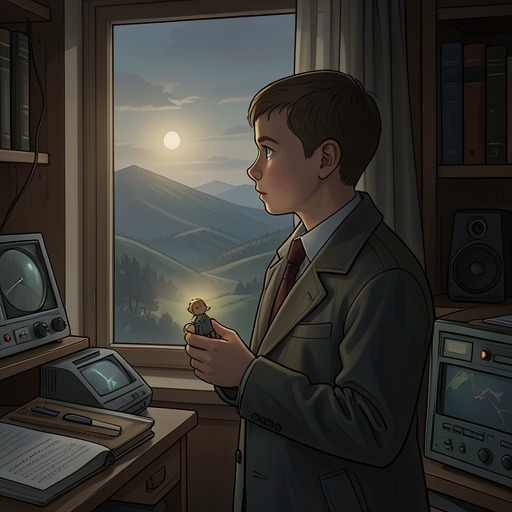
Years later, standing beside a flowering currant bush on a summer day, Lewis experienced what he calls the memory of a memory. Without warning, the earlier morning at the Old House and his brother’s toy garden returned from an apparently immeasurable distance. The sensation was one of desire, but not simply for the biscuit tin or for his own past. Before he could identify its object, the desire had gone; the world had become commonplace again, leaving only a longing for the longing that had just ended. Its brevity did not diminish its force: Lewis considered everything else that had happened to him insignificant beside that moment.
A second awakening came through Squirrel Nutkin, though Lewis loved all of the Beatrix Potter books. This one troubled him with what he understood as the Idea of Autumn. He describes the experience as an enamorment with a season: he returned to the book not to possess Autumn, which was impossible, but to reawaken the desire it had stirred. The episode repeats the first encounter’s combination of surprise, intensity, and ungraspable importance, making clear that Joy could be evoked by an imaginative impression rather than by a reachable object.
The third childhood glimpse came through Tegner’s Drapa, encountered while Lewis was turning the pages of Longfellow’s Saga of King Olaf. He knew nothing about Balder, yet the lines announcing that Balder the beautiful was dead lifted him into immense northern spaces. The desire was for something he could describe only through qualities of coldness, spaciousness, severity, paleness, and remoteness. As in the earlier episodes, he was already falling out of the desire as he felt it, and wished to return to it. The poem thus supplied an early form of the Northernness that would later return through Wagner.
Loss, Return, and the Work of Imagination
Joy did not remain available throughout Lewis’s youth. Looking back on boyhood, he describes it as a period in which authentic Joy had vanished so completely that neither its memory nor the desire for it remained. His reading of Sohrab and Rustum gave him a powerful aesthetic experience, but not Joy: the distinction depended on the stab of longing, not on literary pleasure alone. The interval matters because the later return is not simply a continuation of childhood feeling; it is recognition that something once experienced has been lost.
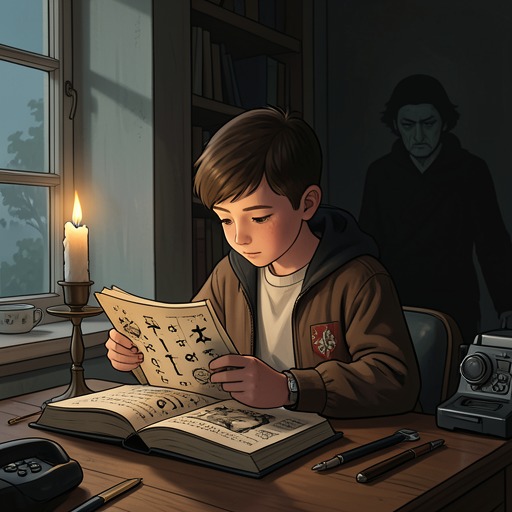
That return came early in Lewis’s time at Chartres, when his eye fell on the words Siegfried and the Twilight of the Gods and an illustration by Arthur Rackham. He had never heard of Wagner or Siegfried and misunderstood the title, but the image immediately awakened a vision of Northernness: vast, clear spaces above the Atlantic in the endless twilight of northern summer, marked by remoteness and severity. At once he recognized a connection to the earlier experience of Tegner’s Drapa, and with it recovered the knowledge that he had once known Joy.
The recognition joined two distances: the unattainable world suggested by the Twilight of the Gods and the lost Joy of childhood. Their convergence produced an intense sense of desire and loss, which vanished even as Lewis first recognized it. In the dusty schoolroom, he understood that having the experience again had become his supreme object of desire. This scene turns the recurrence of Joy into a narrative of exile and return: the image does not satisfy the longing, but lets Lewis recognize what the longing has been for and how long it has been absent.
Literature, Music, and Nature as Occasions
The Wagnerian awakening changed the way Lewis approached writing. He began an unfinished poem based on the Ring, and at the start of its fourth book attempted to convey the excitement he felt rather than merely tell a story in correct rhyme and metre. The attempt fell apart: he lost his earlier prosaic clarity, struggled to make language suggest rather than state, and eventually fell silent. Yet this failure taught him what writing meant. The importance of the experience lay not only in what he could make, but in the new demand that the intensity of an encounter be expressed.
Before hearing Wagner’s music, Lewis had already made the printed shape of Wagner’s name into a magical symbol. At T. Edens Osborne’s shop, he finally heard a record of the Ride of the Valkyries. For a boy whose previous highest musical experience had been Sullivan and who was already absorbed in Northernness, it arrived like a thunderbolt. Wagnerian records, chiefly from the Ring but also from Lohengrin and Parsifal, became the principal drain on his pocket money and the presents he regularly requested. This was not simply a new musical pleasure: Lewis experienced it as a different kind of pleasure, or perhaps as trouble, ecstasy, astonishment, and a conflict of sensations without a name.
On a later holiday in Dundrum, the illustrated Siegfried and the Twilight of the Gods brought Rackham’s images into direct view. Lewis regarded the pictures as music made visible and coveted the book intensely. His brother shared its cost with him, an act Lewis later understood as kindness. In the Wicklow Mountains, he initially searched the landscape for scenes that might belong to the Wagnerian world: a fir-covered hillside for Mime and Sieglinde, a glade where Siegfried might listen to a bird, or a dry rocky valley where Fafner might emerge. In time, however, nature ceased to function merely as an illustration of books and music. It became a medium of Joy in its own right, though it remained one of the reminders of something beyond itself.
Lewis’s response to nature was directed toward the mood of a scene rather than the study of plants or birds. Its sensory force could involve skin and nose as well as sight. The same distinction applies to his growing knowledge of Norse mythology. Books such as Myths of the Norsemen, Myths and Legends of the Teutonic Race, and Mallet’s Northern Antiquities repeatedly gave him the stab of Joy. Yet intellectual satisfaction in learning the Eddaic universe was not the same as the longing that sometimes accompanied it; as his knowledge grew, he did not notice at first that Joy was becoming rarer.
Recurrence, Sensory Memory, and Significance
Lewis’s memoir presents Joy through sharply contrasting sensory worlds. The toy garden is cool, dewy, and fresh; the northern vision is cold, spacious, and remote; Wagnerian landscapes invite the imagination to search for mythic scenes. These impressions do not function as interchangeable sources of pleasure. Each gives access to a desire that exceeds the particular image, book, or place and then withdraws before it can become an object of possession.
The memoir also gives Joy a double relation to ordinary life. Lewis describes his outer life as months of familiar weariness interrupted by brief flashes of intense experience, each swallowed again by the commonplace. From within the remembered inner life, by contrast, the same ordinary period seems like a coarse curtain that could at any moment be drawn aside to reveal the heavens. Neither account cancels the other. The force of the distinction is that the outer chronology cannot by itself measure the inner life: a moment lasting seconds can become more important in retrospect than extended stretches of daily experience.
The later return through Wagner makes that structure especially clear. Lewis recognized his new encounter by remembering the earlier one, and recognized the earlier one through the loss that had separated them. Joy consequently involves more than an initial sensation: it includes the afterimage of its disappearance and the wish to recover it. Repeated readings and musical experiences may renew the desire, but cannot turn it into something possessed. The result is a governing pattern in Lewis’s account of imagination: particular works and landscapes awaken Joy, while the longing they release points beyond those occasions and survives their passing.