Lewis's father
Surprised by JoyLewis's father was a Belfast solicitor and a gifted, emotionally volatile public speaker whose wife's death altered the relations within the family. Lewis's account presents him not as a simple antagonist but as a vivid, affectionate, and difficult parent: his oratory could turn a minor domestic fault into a grand denunciation, while his grief and his tendency to misunderstand what his sons told him widened the distance between them. The father's character is therefore inseparable from the memoir's account of bereavement, family estrangement, and the early formation of Lewis's reserve.
Identity and Family Background
Lewis's father belonged to the first generation of his family to attain professional standing. His own father had risen from work as a laborer to become a partner in Macilwaine and Lewis, a firm of boiler-makers, engineers, and iron shipbuilders. Lewis contrasts this Welsh family inheritance with his mother's Hamilton family, whose background included generations of clergy, lawyers, and sailors. He describes his father's people as sentimental and passionate, quick to anger and tenderness, and not especially gifted in happiness; the Hamiltons, by contrast, were cooler, more ironic, and more disposed to find happiness. From early childhood, Lewis noticed the contrast between his mother's tranquil affection and his father's emotional fluctuations. He later connected that contrast to his own early distrust of emotion, which seemed uncomfortable and potentially dangerous.
The father's talents were closely tied to public life. He had spoken on political platforms in England as a young man and, Lewis believed, might have pursued a parliamentary career had he possessed independent means. A fine presence, resonant voice, quick mind, eloquence, and memory suited him to public speaking; his acute sense of honor, Lewis suggests, could also have made political life difficult for him. He relished political novels, especially Trollope's accounts of Phineas Finn, which Lewis retrospectively understood as offering his father a vicarious outlet for political ambitions. His literary tastes favored rhetoric and pathos, and he enjoyed humorous writers from Dickens to W. W. Jacobs.
Lewis remembers his father as an exceptional raconteur. In telling anecdotes, he acted out the different characters with grimaces, gestures, and pantomime; he was especially happy sharing such stories, which the family called wheezes, with one or two of Lewis's uncles. This theatrical gift had a less benign counterpart at home. The father could move from ordinary conversation into elaborate performance, making his expressive powers a source of both family pleasure and domestic strain.
Grief and Estrangement
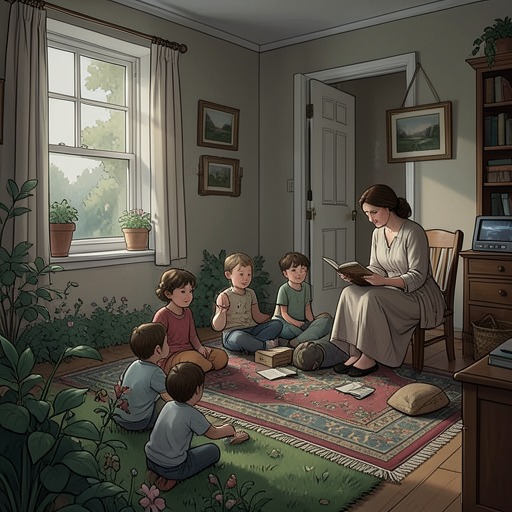
When Lewis was ill with headache and toothache, he wondered why his mother did not come to him. She was ill too, and doctors, visitors, and movement throughout the house announced that something serious was happening. Lewis's father entered his room in tears and tried to explain what the child could scarcely comprehend: his mother had cancer. An operation was followed by apparent recovery, the return of the disease, increasing pain, and death. Lewis says his father never fully recovered from the loss.
For the boys, the bereavement had begun gradually before their mother died, as illness, nursing, delirium, and morphia withdrew her from family life. Lewis describes the resulting household as strange and threatening. His father's distress did not draw the children closer to him. Lewis later reflects that a shared sorrow may fail to unite people of widely different ages: adult misery and terror left the boys paralyzed and alienated. Under anxiety, his father's temper became unpredictable; he sometimes spoke wildly and acted unjustly. Lewis and his brother increasingly relied on one another for comfort and confidence, and Lewis thinks they may already have been learning to lie to their father. The loss thus produced two opposite movements: their bond as brothers strengthened while their connection with their father weakened.
The father's grief also exposed how unequal the children's and adults' experiences of loss were. Lewis recalls being taken to see his mother's body, an experience that filled him with terror rather than the consoling response adults might have expected. His father, meanwhile, remained overwhelmed by the death. Lewis does not present the family's separation as the result of a single deliberate act; he understands it as an accumulating consequence of grief, difference in age, and a household in which the children no longer felt able to confide in their father.
Domestic Authority and Rhetoric
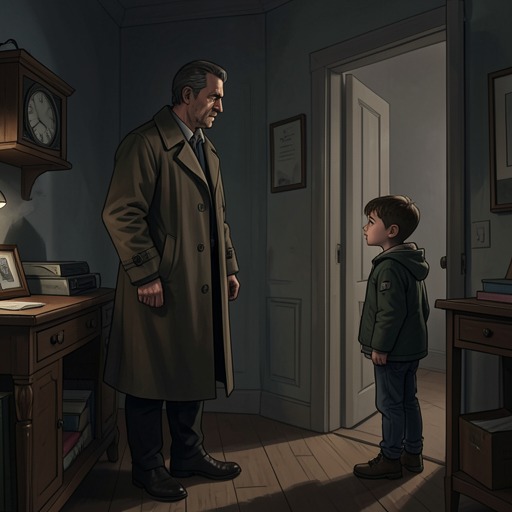
Lewis describes his father's discipline as an unintended consequence of his temperament and professional habits. His father was too generous, he says, to strike a child in anger, and too impulsive to impose punishment calmly as a matter of principle. He relied instead on speech. But the language that came naturally to a former public speaker and prosecutor could overwhelm the small offense that had prompted it. A boy who had walked on damp grass in slippers or left a bathroom untidy might receive a denunciation on the scale of Cicero or Burke, complete with accumulating comparisons, rhetorical questions, gestures, pauses, and the forceful expression of an advocate.
The mismatch between fault and reprimand could become comic, but it also made the father's authority hard to navigate. Lewis recalls one extended pause in a denunciation: his brother, supposing it had ended, resumed reading, whereupon their father interpreted the innocent gesture as deliberate insolence. In Lewis's account, the episode captures how the father's rhetorical performance could transform a minor misunderstanding into a new offense. Lewis recognizes the same taste for dramatization in himself, describing it as an inheritance even as he recounts its effects on family life.
A deeper obstacle was the father's way of receiving information. Lewis emphasizes that his father was intelligent and could have a streak of genius, yet in certain circumstances he was unusually prone to confuse a question or misapprehend a fact. He might ask about school, fail to wait for the answer, or forget it immediately; facts sometimes had to be repeated weekly as if they were new. More often, he retained an altered version. His imagination, already active with humor, sentiment, and indignation, could supply its own account before he had properly listened, and his mistakes with proper names made the result difficult to recognize.
Lewis illustrates this habit with a story about a boy named Churchwood, who had kept a field mouse as a pet. Years later, his father might remember the boy as Chickweed and the animal as a rat, then treat that altered version as the story Lewis had always told. Correction did not readily dislodge it. The father's belief that people's actions rarely had an obvious motive compounded the problem: though Lewis describes him as honorable and impulsive in his own conduct, the father could become suspiciously elaborate in interpreting people he had never met. The gap between his good intentions and his mistaken reconstructions made communication difficult even when the sons had no particular secret to protect.
Privacy, Memory, and Narrative Role
The father's failure to understand his sons' accounts contributed to a habit of concealment in Lewis. After one incident involving a pile of papers and Lewis's list of resolutions, Lewis began checking his pockets before entering his father's house, removing anything he wanted to keep private. He says this practice began before he had anything guilty to hide; later, he did have secrets, and even matters he might have wanted to share were hard to explain. Telling his father about life at Wyvern or Chartres seemed risky, potentially embarrassing, and, because of the father's patterns of misunderstanding, nearly impossible.
Lewis's retrospective portrait holds affection and criticism together. He invites readers to approach his father in a Shandean spirit, as an odd and whimsical figure whose contradictions deserve imaginative sympathy. At the same time, the memoir traces concrete costs: grief made the father less predictable, oratory made discipline disproportionate, and misremembered conversations helped the sons retreat into privacy. The father's story is not one of simple estrangement, but of a relationship in which affection and admirable qualities coexisted with forms of communication that repeatedly failed.
The memoir also places this family history alongside Lewis's later reflections on illness, prayer, and war without suggesting that his father directed those experiences. In recalling the moment after he was hit during the war, Lewis says that he thought he was dying and experienced the proposition as factual rather than frightening or courageous. The episode belongs to Lewis's own account of his response to bodily danger, not to his father's biography; its inclusion underscores the memoir's wider concern with how distinct experiences reshape a person's understanding of emotion and self. Within the account of his father, the decisive change remains the earlier loss of Lewis's mother: it left the father bereaved, the brothers more dependent on one another, and the family home altered by a distance that Lewis could explain more fully only in retrospect.