Lewis's imaginative Renaissance
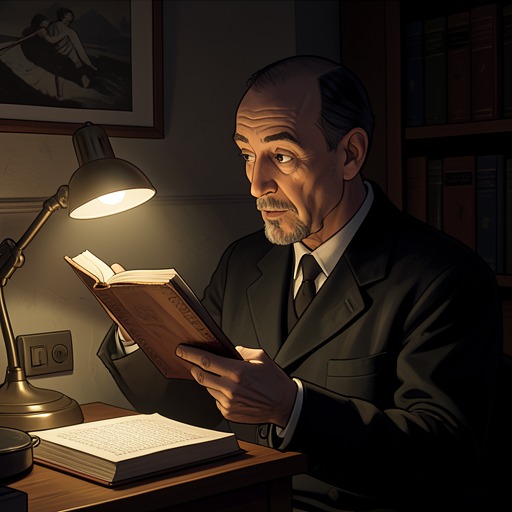
Surprised by JoyLewis’s imaginative Renaissance is the sudden return of imaginative longing after a boyhood in which the childhood experience he called Joy had disappeared. Its decisive moment comes at Chartres, when a printed title and Arthur Rackham illustration awaken a remembered world of Northernness and make the loss of Joy itself newly perceptible. The recovery is not simply renewed aesthetic pleasure: through later reading, music, and argument, imaginative desire becomes one route by which Lewis reconsiders materialism, religion, and the nature of reality.
Boyhood and the Loss of Joy
Lewis distinguishes childhood from boyhood as sharply as a remembered homeland from an alien country. He doubts the grand historical account of the Renaissance as a sudden European spring, suggesting instead that the image may reflect people’s memories of their own rebirth after puberty. In his account, boyhood often interrupts rather than continues childhood: imagination sleeps while greed, cruelty, noise, and prosaic ambition become conspicuous. The transition is not merely a change in taste but a rupture in the continuity of the self.
His own childhood, he says, remained at unity with the rest of his life, while boyhood did not. Books that had delighted him as a child could still please him; many books read at Oldie’s school and Campbell College seemed, in retrospect, to belong to a sandy desert. The reading of Sohrab and Rustum at Campbell had given him an intense aesthetic response, but it had not restored Joy. For Lewis, Joy is neither ordinary pleasure nor aesthetic pleasure alone: it includes a sharp pang and an inconsolable longing. By the time he reached Chartres, the authentic experience had vanished so completely that even its memory and desire seemed absent.
The Chartres Awakening
The change came early in Lewis’s time at Chartres, not through a gradual return but in an instant. In a schoolroom, his eye fell on a headline and picture in a literary periodical; he thinks the publication may have been The Bookman or the Times Literary Supplement. The words Siegfried and the Twilight of the Gods and an illustration by Arthur Rackham abruptly altered the scene’s meaning. Lewis had never heard of Wagner or Siegfried, and initially misunderstood the title as referring to the twilight in which the gods lived. Yet he immediately recognized that the image belonged to a northern world rather than a Celtic, sylvan, or terrestrial one.
He calls the sensation Northernness: a vision of vast, clear spaces above the Atlantic in the endless twilight of northern summer, marked by remoteness and severity. The illustration also recalled Tegner’s Drapa and its Balder and cranes sailing toward the sun. The recognition joined two distances—the distant world of the image and the lost world of his own childhood Joy. Lewis describes them merging into an unbearable desire and loss. The experience disappeared almost as soon as he could recognize it, but its passing disclosed what he now wanted above all: to have it again.
Wagner, Reading, and the Work of Imagination
The first image was followed by a sequence of encounters that gave the awakened desire material to work on. Lewis already liked reading gramophone catalogues, though he had not imagined that records of grand opera could matter to him. A magazine, The Soundbox, published summaries of operas week by week and eventually treated the Ring; through these accounts he learned who Siegfried was and what the gods’ twilight meant. He began a heroic poem based on the Wagnerian Niblung story, drawing only on the summaries. His inexperience showed in rhymes such as Alberich with ditch and Mime with time, but the project became more than an exercise in plot and metre.
The unfinished poem marked a change in Lewis’s idea of writing. Its first three books seemed to him competent for a boy, but the fourth broke down as he tried to convey the excitement he felt, seeking language that would suggest rather than merely state. He failed to sustain the effort, yet recognized that he had learned what writing meant. At this point, before hearing Wagner’s music, even the printed shape of the composer’s name had acquired the force of a magical symbol.
During the next holidays, in T. Edens Osborne’s shop, Lewis heard a record of the Ride of the Valkyries. He received it not as an isolated concert piece but as heroic drama, against the background of the Northernness already awakened by Rackham. The music struck him like a thunderbolt. Wagnerian records, especially from the Ring but also from Lohengrin and Parsifal, became a principal use of his pocket money and a regular choice for presents. He insists that this was not simply a new musical pleasure: Wagner’s music seemed to belong to a different order of experience, combining trouble, ecstasy, astonishment, and sensations he could not name.
The illustrated Siegfried and the Twilight of the Gods later came within reach during a visit with Cousin Mary in Dundrum, where Lewis found the book on her drawing-room table. He coveted it intensely; learning that a cheaper edition cost fifteen shillings did not make the sum any less daunting, and he eventually acquired it largely because his brother shared the cost with him. Rackham’s pictures seemed to him to make the music visible, deepening a response first kindled by a periodical image. The sequence—from headline and illustration to opera summaries, poem, recording, and book—shows how the initial awakening gathered force through different artistic forms.
Imagination and Belief
Lewis’s Renaissance also belongs to a larger change in how he understood religious ideas. Earlier, reading classical authors such as Virgil had presented him with pagan religious material that teachers and editors treated as illusion, without showing how Christianity might fulfil or be anticipated by paganism. Religion consequently appeared to him as a widespread natural error, with Christianity arbitrarily exempted as the one true case. That contrast helped make his inherited faith difficult to sustain. The later imaginative recovery does not by itself settle these questions, but it reopens a world that a narrowly materialist account cannot comfortably contain.
During the Bookham period, W. B. Yeats’s prose exposed Lewis to an adult, non-Christian writer who believed in a world of beings beyond the material one and in the possibility of contact with it. Reading Maurice Maeterlinck brought him into contact with Spiritualism, Theosophy, and Pantheism. Lewis did not simply accept those claims; their importance lay in introducing a disturbing possibility into the materialism he had treated as secure. The older occult interests associated with Chartres returned as a consequence of that doubt, even though this renewed interest did not amount to settled belief.
His later dispute with Owen Barfield further changed the intellectual setting in which imagination could be taken seriously. Barfield’s arguments destroyed Lewis’s chronological snobbery: the assumption that ideas become false merely because they have gone out of fashion. They also pressed him to examine a difficulty in their shared realism. They had treated the sensory universe as fundamental while still claiming objective authority for logical thought, moral judgment, and aesthetic value. Lewis came to regard those commitments as inconsistent: if thought were merely subjective, those claims could not stand; if reality were confined to what the senses reveal, a behaviorist account of logic, ethics, and aesthetics followed, which he found impossible to believe. He therefore felt compelled to abandon realism and allow that mind was not merely a late by-product of the universe.
A different literary encounter gave this movement a more specifically spiritual direction. On an October evening at Leatherhead station, Lewis picked up a dirty-jacketed Everyman edition of George MacDonald’s Phantastes, a faerie Romance, before catching the train. Its woodland journeys, ghostly enemies, and good and evil ladies belonged closely enough to the imaginative world he already knew to draw him in without an obvious break. Yet Lewis understood the quality that distinguished the book from his earlier romances as holiness. The familiar imaginative material was still present, but the light accompanying it was no longer merely the old longing at a distance: it seemed nearer than he could grasp, something he could not see because it was too close.
That reading clarified, without immediately resolving, the direction of his search. The old confusions between longing and the scenes that awakened it were, for a time, disarmed; Lewis could distinguish the imaginative story from the quality that rested upon it. Later, with Owen Barfield and Dom Bede Griffiths as important companions in religious inquiry, he came to ask not which religion stood alone as true among a thousand false ones, but where the hints of pagan religion had reached maturity. He considered Hinduism and Christianity as the remaining possibilities, and judged Christianity’s historical claim and the character of the Gospels decisive considerations. The imaginative Renaissance was thus not a conversion in itself. It restored the capacity for desire and opened intellectual questions through which that desire could acquire a religious meaning.
Memory, Contrast, and Significance
The memoir’s account of imaginative life is deliberately doubled. In one recollection, Lewis’s outward existence could seem weary and sordid; in another, the inner world was alive with gods, heroes, and mythic figures. He describes the two accounts as oil and vinegar, or a river running beside a canal: each claims the whole field when viewed alone, but neither cancels the other. The Renaissance belongs to this tension. A sudden inner illumination can coexist with the mundane schoolroom where it occurs, and a recovered imaginative life does not erase the conditions of ordinary boyhood.
The contrast between Lewis’s first journey from Ireland to England and the later awakening at Chartres sharpens this point. As a child, he experienced the flat Lancashire landscape and the railway journey to Euston as imprisoning and suffocating, a hostile separation from sea and high ridges. At Chartres, an illustration could open a sense of immense northern distance inside a schoolroom. The physical surroundings did not need to change for imagination to disclose another world; what changed was the kind of attention and longing through which those surroundings were apprehended.
Lewis’s imaginative Renaissance is therefore both a recovery and a redirection. The Rackham image recalls the lost Joy of childhood, while Wagner enlarges the recovered Northernness into an artistic pursuit and Phantastes reveals a quality he identifies as holiness. Reading and debate then unsettle the assumptions by which materialism had dismissed what imagination seemed to disclose. The episode’s significance lies not in presenting art as proof of religious belief, but in showing how a vanished longing returned, became intelligible through successive encounters, and helped make questions of belief impossible for Lewis to dismiss.