Lewis’s Wartime Treaty with Reality
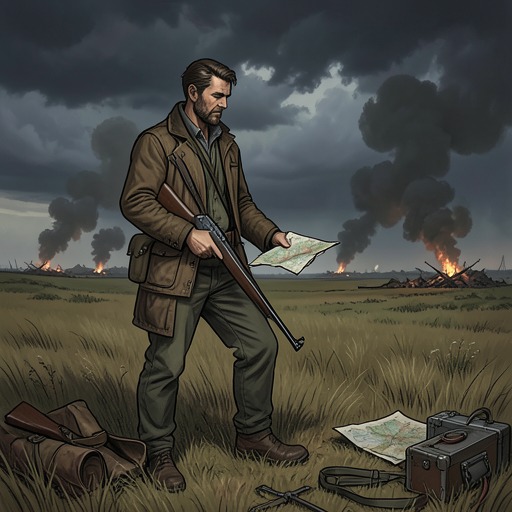
Surprised by JoyLewis’s Wartime Treaty with Reality names the boundary he drew between the First World War and his life as a schoolboy in Ireland. Though he anticipated that the conflict might last until he reached military age and decided to serve, he would not let its unfolding consume his attention in advance. The treaty gave the future a fixed claim on his body, but not on his present mind.
The decision to set a boundary
As the war continued on the Continent, Lewis foresaw that it would probably still be underway when he became old enough for military service. English boys of his age faced a decision that the law had already removed from their hands; in Ireland, there was no conscription. He chose to serve, but did not take pride in the choice. Instead, he felt that deciding had released him from the need to keep attending to the war.
Arthur faced no comparable decision because his heart disqualified him from military service. Lewis’s decision was therefore his own, not a shared arrangement between the friends. He set aside the war to a degree he knew others might call shameful, incredible, or an escape from reality. His account contests that last description: he calls the stance a treaty, a way of fixing a frontier between the claims of the future and the life he could still live in the present.
What the treaty reserved
Lewis’s formulation made the boundary temporal and specific: the country could claim him on a certain date, but not before. He accepted that he might die in its wars and intended to take part in battles if called; until then, he would live his own life. The distinction he drew was not between service and refusal, but between a future obligation he had accepted and an immediate mental involvement he withheld. He was prepared to fight without reading about the fighting.
The boundary applied to attention as well as action. Lewis later explained that a schoolboy unhappy at school learns to keep the future in its place: if the coming term intrudes into the holidays, despair follows. He also connected his ease in drawing that line to an internal tension, saying that the Hamilton in him kept watch against the Lewis and that he already knew the self-torturing temperament. The treaty thus served not only as a position on wartime news but as a way of protecting the present from a future he could not yet alter.
The case against following the news
Lewis did not present his method as wholly admirable. Even if the attitude itself was right, he considered the personal quality that made it so easy to adopt somewhat repellent. At the same time, he could hardly regret avoiding what he saw as the waste of time and spirit involved in following war news or participating in conversations about the conflict only formally.
His objection was epistemic as well as personal. Without military knowledge or good maps, a reader encountered accounts of fighting already distorted before reaching a divisional general, distorted again before leaving him, and then rewritten by journalists. Trying to master reports contradicted the next day, or to hope and fear on shaky evidence, seemed to him a poor use of the mind. His criticism extended beyond wartime reporting: even in peacetime, he opposed encouraging schoolboys to read newspapers. He expected much of what boys encountered in their teens to prove false in emphasis and interpretation, if not in fact, and to lose its importance before they were twenty. What remained, he argued, might be something they would need to unlearn, alongside a taste for sensationalism and the habit of skimming from one incident to another.
Meaning and limits
The treaty’s logic rests on a distinction between accepting an obligation and allowing anticipation to take over the present. Lewis did not claim that the war was unimportant, nor did he deny the possibility of serving or dying in it. He instead drew a limit around when he would engage with it, treating the decision to serve as sufficient acknowledgment of the future claim.
His retrospective account holds the practical value of that limit beside its moral discomfort. It protected his attention from reports he considered unreliable and from anxieties he regarded as unproductive, but he also recognized that his ability to detach could appear repellent. The treaty is therefore neither a simple declaration of indifference nor a claim that withdrawal is universally right. It records a personal frontier, formed under the pressures of school life and approaching military age, whose protection came with an acknowledged cost.