Lewis’s first boarding-school experience at Belsen
Surprised by JoyLewis’s first boarding-school experience at Belsen, from 1908 to 1910, combined an oppressive school regime with the beginnings of both durable fellowship and effective Christian belief. The experience did not determine a straight path toward faith: Lewis later became an apostate, and only much later returned through distinct stages of theism and Christian commitment. Its lasting significance lies in the pattern he discerned between shared adversity and close friendship, and in the first serious practices of prayer, Bible reading, and conscience that he traced to the school’s church services.
Arrival and Setting
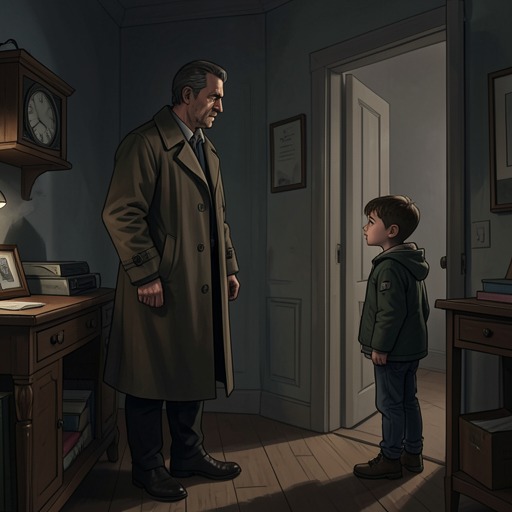
In September 1908, Lewis travelled to school in a four-wheeler with his father and brother, arriving in low spirits. The immediate distress was not an abstract fear of growing up but the clothes imposed for school: a stiff Eton collar, thick dark fabric, boots, knee-buttoned knickerbockers, and a bowler hat. He regarded the outfit as a prison uniform, and his gloomy expectation of adult life was reinforced by his father’s habitual warnings about financial ruin, which the child took literally.
The destination was a small town in Hertfordshire, which Lewis called Belsen. Coming from County Down, he found the English landscape alien: the fences, red-brick farmhouses, broad fields, and haystacks seemed wrong beside the stone walls, hedges, and white cottages he knew. He recalled the region’s weather as more extreme than anything he had experienced before, including frost, fog, heat, and thunderstorms. The school’s curtainless dormitory windows also exposed him to the full moon, an image that later recurred in his account of religious fear and practice.
School and Authority
The school was small and declining. When Lewis arrived, it had about eight or nine boarders and a similar number of day pupils. Organized games had largely disappeared, apart from rounders in the flinty playground, and were abandoned soon after his arrival. There was no regular bathing beyond a weekly bath. Lewis had already begun Latin exercises under his mother’s instruction and continued them throughout his time there, yet left without having reached a Roman author. He remembered the school’s teaching less for its curriculum than for the canes kept in the single classroom.
The staff consisted of the proprietor and headmaster, whom the boys called Oldie, his grown son Wee Wee, and a succession of ushers. The ushers changed rapidly; one lasted less than a week. The school’s atmosphere was shaped by Oldie’s power over both pupils and household. At meals, his family, the usher, and the boys sat in silence with food inferior to the separate fare served to Oldie and Wee Wee. Oldie’s wife and daughters had little voice in his presence, and the boys saw a household organized around his authority.
Lewis describes himself as a kind of pet or mascot to Oldie, a position he had not sought and whose advantages were slight. Oldie also had boys he treated as habitual failures. Lewis came to believe that these targets were selected in part for low social standing and vulgar accents; he recalled that a hardworking, friendly boy was punished repeatedly and believed the boy’s family background contributed to his treatment. Such memories made cruelty and social hierarchy inseparable in Lewis’s retrospective picture of the school.
The severity did not produce much learning. Outside geometry, which Oldie liked, Lewis felt that the headmaster scarcely taught. He questioned pupils, threatened punishment for unsatisfactory replies, and used intimidation instead of explanation. The resulting fear was unpredictable, and Lewis later suggested that this disorder helped make the school’s academic life as barren as its social regime was oppressive.
Fellowship and the School’s Decline
Lewis’s brother protected him during his first terms, before leaving for another school, but Lewis doubted that this protection had been essential. By the school’s final years, the boarders were few, there were no new boys, and they had endured the same conditions for long enough to become close. Their quarrels seemed serious at the time, yet long acquaintance and shared hardship turned them into old companions. Lewis believed that oppression by peers could hurt a boy more deeply than oppression from above; at Belsen, he found that the boys’ solidarity limited the harm the institution did him.
The remaining boarders also found freedom in the school’s lack of organized games, despite its poor preparation for the public-school life many would later enter. On half-holidays they were sent out alone. Their walks might amount to buying sweets in village shops, lingering by the canal, or watching trains at a railway tunnel. Through these small excursions Hertfordshire became less hostile. Their conversation retained the curiosity of children, extending even to a metaphysical argument over whether the future was like a line that could not yet be seen or a line not yet drawn.
As numbers dwindled, the school eventually had only five boarders. Oldie’s youngest daughter taught the junior pupils after there were no ushers, and Oldie ultimately gave up the school to seek a religious appointment. Lewis, one of the last pupils, described leaving only when the school itself went down around them. The institution’s collapse is therefore part of the experience’s shape: its final pupils were not entering a stable school tradition so much as enduring the last years of a failing establishment together.
Religious Awakening and Later Reversal
Lewis identified the church services, held twice each Sunday, as the setting in which he first became an effective believer. The church was Anglo-Catholic, and its unfamiliar rituals initially met his conscious resistance: he associated them with the English atmosphere he disliked and with his identity as an Ulster Protestant. In retrospect, however, he suspected that candles, incense, vestments, and hymns sung on their knees may have affected him in a different way. More important, he heard Christian doctrines taught by people who plainly believed them. Because he did not think of himself as skeptical, the teaching gave life to beliefs he would already have said he held.
This awakening involved fear for his soul, which Lewis associated in part with the school’s Anglo-Catholic setting rather than simply with his Ulster background. He remembered particular moonlit nights in the dormitory and the sound of other boys asleep. He judged the effect beneficial: he began to pray seriously, read the Bible, and try to obey his conscience. The pupils also discussed religion gravely and, in his recollection, without hysteria or embarrassment. The school thus gave him more than a set of doctrines; it prompted a practical religious life and a mode of serious conversation.
That beginning did not remain intact. Lewis later attributed an unconscious wish to abandon Christianity partly to the burdensome standard he imposed on prayer, demanding a vivid inner realization to accompany every clause. He also encountered classical religious ideas, especially in Virgil, presented by teachers and editors as false without an account of how Pagan thought might relate to Christianity. This made Christianity appear to him as one exception among many religions deemed natural but mistaken. His intellectual pessimism added a further pressure: he came to regard the universe as fundamentally regrettable. He eventually combined neither this judgment nor his occult interests into a coherent system; both nevertheless worked against Christianity, and he gradually dropped his faith with relief.
Retrospective Significance
The Belsen experience belongs to a longer religious history, not to a single conversion story. Lewis’s later apostasy followed the effective childhood belief he dated to the school; his eventual surrender in 1929 was to theism, not yet Christianity. He explicitly distinguished acknowledging God from believing in the Incarnation, which he accepted later. His memoir likewise presents Christian belief in its mature form as a later conclusion: he came to see the Gospels as neither simply myth nor ordinary history, but as the point at which myth had become fact.
Lewis also used Belsen to explain a durable social pattern in his outlook. He connected the solidarity of the boys under Oldie’s authority with the closeness he and his brother had found during difficult periods at home. Because this pattern appeared twice early in his life, he suspected it had shaped his expectation that a small group would stand together against a stronger power. Friendship consequently mattered more to him than broad acquaintance, and he found large, impersonal causes less compelling than conflicts involving a few people. Belsen left him with memories of institutional cruelty, but also with a lasting grammar of loyalty—and with the first serious religious practices that his later history would both abandon and, by a different route, recover.