Lewis’s mother’s illness and death
Surprised by JoyLewis’s mother’s illness and death is the decisive break between the settled security of childhood and the exposed, unstable life that followed. In Lewis’s account, the loss unfolds not only through cancer and death but through a child’s altered experience of home: familiar rooms fill with illness, adult terror, and strange sounds; the brothers become one another’s refuge; and an attempted prayer for recovery fails to produce the miracle Lewis expects. The event leaves a lasting imprint on his understanding of grief, religious belief, and the difference between pleasure and security.
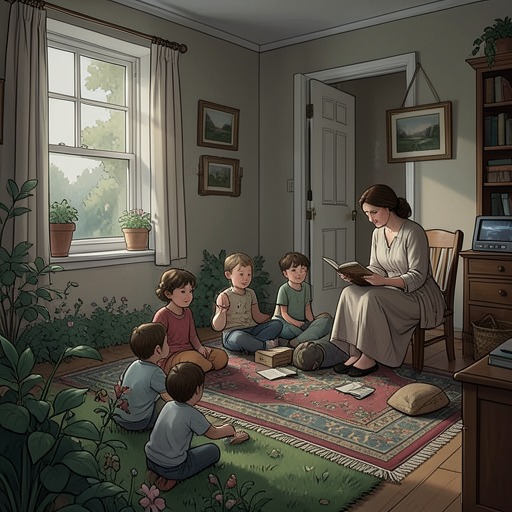
Illness and the changing household
Lewis recalls being ill himself, crying with headache and toothache because his mother had not come to him. She could not come: she too was ill. Doctors occupied her room, while voices and people moved through the house and doors opened and shut. The disturbance seemed to continue for hours before Lewis’s father entered his room in tears and tried to explain something the frightened child had never imagined. His mother had cancer. The illness followed a course Lewis later summarizes as an operation in the patient’s home, an apparent recovery, the disease’s return, increasing pain, and death. His father, Lewis says, never fully recovered from the loss.
The diagnosis is only one part of what changes. Lewis stresses that the boys’ bereavement began before their mother died, as she was gradually withdrawn from their lives into the care of nurses and the states of delirium and morphia. Their existence became strange and threatening: the house filled with unfamiliar smells, midnight noises, and whispered conversations. The gradual separation meant that the mother they had known was already becoming inaccessible while the household continued to contain her illness.
The brothers and their father
The crisis widened the distance between the children and their father. Lewis does not treat shared sorrow as a reliable bond across generations: in his experience, adult misery and fear paralyzed and alienated children. He leaves open the possibility that the boys might have eased their father’s suffering had they been better children, but says plainly that they did not.
He describes his father as having unsteady nerves and uncontrolled emotions. Under anxiety, his temper became unpredictable; he spoke wildly and acted unjustly. Lewis sees the resulting separation as a cruel further loss: without realizing it, his father was losing his sons as well as his wife. The boys increasingly depended on each other for whatever made life bearable and trusted only one another. Lewis suspects that he, at least, was already learning to lie to his father. What had made the house a home had failed them, except for their attachment to one another: he remembers the brothers as two frightened children huddled together for warmth in a bleak world.
Encounter with death and its public forms
Lewis’s memory of being taken into the bedroom to see his dead mother distinguishes the child’s knowledge from the adults’ explanation. Though the adults described the visit as an opportunity to see her, he understood that he was being taken to see a dead body. He recalls that there was no disfigurement in the ordinary sense; death itself was the total disfigurement. Terror overwhelmed grief, and the scene shaped his enduring rejection of the idea that dead bodies are beautiful. He contrasts even the ugliest living person with the loveliest of the dead.
The coffin, flowers, hearse, and funeral brought their own horror. Lewis remembers lecturing one of his aunts about mourning clothes, in language adults would have considered heartless and precocious. The aunt was his maternal uncle’s Canadian wife, Aunt Annie, whom he describes as nearly as sensible and sunny as his mother. Looking back, Lewis connects his hatred of funeral formality and what he calls its fuss and flummery with a lasting defect: his distaste for public and collective forms, and his boorish inability to manage formality. The funeral thus becomes more than a scene of bereavement; it is an early instance of his resistance to communal ritual.
Prayer, disappointment, and belief
When his mother’s case was declared hopeless, Lewis remembered being taught that prayers offered in faith would be granted. He tried by force of will to make himself believe that his prayer for her recovery would succeed, and thought he had managed it. When she died, he changed his expectation and persuaded himself that a miracle would follow. Neither expectation was fulfilled.
Lewis’s adult interpretation is that the failure caused no religious upheaval because the belief behind the prayer was itself too irreligious. In his childhood picture, God was neither savior nor judge but a magician asked to perform a required act and then leave. Lewis had sought a return to the previous state of affairs without imagining that contact with God might have consequences beyond restoring it. The disappointment therefore passed without becoming a conversion or a crisis of faith. He treats this kind of childhood belief as potentially common: if the imagined miracle had happened exactly as the child pictured it, he suggests, it would still have had little religious significance.
Aftermath and retrospective significance
Lewis is uncertain whether the experiences of Joy he has just described occurred before or after this family loss. That uncertainty prevents a neat chronology, but sharpens the distinction he draws between Joy and ordinary happiness. With his mother’s death, all settled happiness, tranquility, and reliability disappeared from his life. He could still experience fun, pleasures, and further stabs of Joy, but not the old sense of security. Lewis renders the change as a landscape transformed: life had become sea and islands after the great continent sank like Atlantis.
The memoir also places the bereavement beside later experiences without confusing them. Lewis recalls that, after being hit in the war, he thought he was not breathing and concluded that he was dying. His response was not fear or courage but detached attention to the proposition that a man was dying, an experience he later connected with Kant’s distinction between the Noumenal and Phenomenal self. The wartime moment is not part of his mother’s illness, but its inclusion shows how the memoir returns to bodily vulnerability and death as occasions for later reflection. The childhood loss remains distinctive: it altered the structure of home, exposed the boys to adult distress, and removed a dependable happiness whose absence Lewis could still name long afterward.