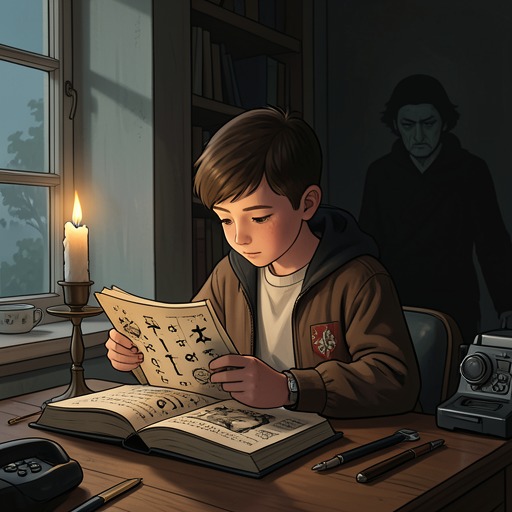
Lewis's occult fascination
Surprised by JoyLewis’s occult fascination was a recurring attraction to supernatural possibilities for their own sake, first awakened at Chartres and later revived by literary encounters with writers who took a world beyond material nature seriously. In his retrospective account, it was both a source of excitement and a pressure on belief: occult speculation helped dissolve the certainty of his Christianity, yet its later return also unsettled the materialism he had adopted in its place.
First Encounter at Chartres
The immediate occasion was Miss C., the Matron at Chartres. Lewis remembered her as exceptionally kind and selfless, a comforting presence to boys in sickness and a cheerful companion in health. He particularly loved her as an orphan. She was herself seeking spiritual answers, but, in Lewis’s later description, had become entangled in Theosophy, Rosicrucianism, Spiritualism, and the wider Anglo-American occult tradition. He was careful not to blame her: she had no intention of undermining his faith and could not know how vulnerable it was to the ideas she introduced.
Before those conversations, Lewis had encountered marvels chiefly as imaginative material. His invented worlds of Animal-Land and India were not things he believed to exist; he understood that he had created them. He had also imagined strange sights and other modes of being without taking them as real. Miss C.’s talk altered the terms of possibility. For the first time, he considered that the visible world might conceal extensive, uncharted realms and that supernatural beings might exist beyond God and humanity as he had understood them.
Desire and Religious Doubt
Lewis distinguished this new attraction from assent to a definite occult system. What it awakened was a desire for the preternatural simply as such: a fascination with marvel and hidden reality that could make other interests seem unimportant while it held sway. He later called it a spiritual lust and observed that the hunger for occult experience could be more compelling than the desire for power. His account presents the occult not merely as a set of propositions but as an appetite, one capable of organizing attention and desire.
That appetite also affected how he regarded Christianity. The speculative vagueness of occult ideas spread, in his recollection, to the doctrines of his faith; religious truth became a matter for speculation rather than something to obey and believe. He described the result as a relief from the demanding certainty of his earlier Christian life, but did not attribute the change straightforwardly to Miss C. Instead, he understood her conversations as an occasion that his own inner resistance exploited. His account therefore separates the Matron’s benevolent influence from the consequences Lewis later traced in himself.
The attraction mattered alongside other causes of his loss of faith. In his classical education, religious ideas in writers such as Virgil were treated as illusions, while Christianity was presented as the exceptional true religion without a satisfying account of why it differed from the others. Lewis found it difficult to accept that division. His attraction to occult possibilities made the question of other forms of spiritual reality especially charged: it offered the prospect of something beyond material nature without requiring him to return to Christian theology.
Revival Through Reading
During the Bookham period, the fascination resurfaced as Lewis’s confidence in materialism began to waver. His reading of W. B. Yeats proved decisive because he came to see that Yeats did not treat supernatural beings as inventions or mere objects of longing. Lewis understood him to believe seriously in magic and in the possibility of contact between the material world and another order of beings. Yeats thus confronted Lewis with an authority outside the Christian tradition who nevertheless rejected a wholly materialist picture of reality.
Lewis then read Maurice Maeterlinck, encountering Spiritualism, Theosophy, and Pantheism in the work of another respected, non-Christian writer. He did not simply accept those claims. Their effect was more tentative: they introduced the possibility that something existed beyond the material world, while leaving open whether that possibility had anything to do with Christian theology. The old occult lore and the excitement first stirred at Chartres returned with that possibility. The recurrence links his early experience at school to his later intellectual uncertainty without making the two episodes identical: in the later one, occult ideas challenged the materialism he had come to inhabit.
Reassessment and Intellectual Consequences
Lewis later recognized that he had once misread other people’s interest in Anthroposophy as the same consuming occult appetite he had experienced. In particular, he had assumed that Owen Barfield and his friends were drawn by a hunger for occult thrills; he subsequently judged that the evidence did not support this. He acknowledged that Anthroposophy did not necessarily cater to such a desire and made a belated amends for the harsh and unjust things he had said about it. This correction marks a distinction between his own fascination and the beliefs of those around him.
Barfield’s conversion to Anthroposophy nevertheless began an extended intellectual dispute with Lewis. It was not a personal quarrel, though Lewis conceded that his own manner could have made it one. Their exchanges, by letter and in person, lasted for years and became a turning point in his life. Barfield did not convert Lewis to Anthroposophy; rather, his arguments undermined Lewis’s uncritical confidence in the assumptions of his own age and exposed tensions in the materialist realism they had previously shared. Lewis came to see that claims about logic, moral judgment, and aesthetic value sat uneasily alongside a view that treated the sensory universe as the only rock-bottom reality.
The movement away from materialism did not simply validate the occult beliefs that had once excited Lewis. His later account places that fascination within a longer effort to understand religious experience and the competing explanations of reality available to him. In his developing view, the question shifted from choosing Christianity as the lone true religion against a mass of false ones to asking where religious traditions reached maturity and whether pagan myths were fulfilled elsewhere. Occult interest was one recurring pressure within that search: first it loosened his Christian certainty, then it returned as an alternative to materialism, but it did not itself settle his eventual religious judgment.