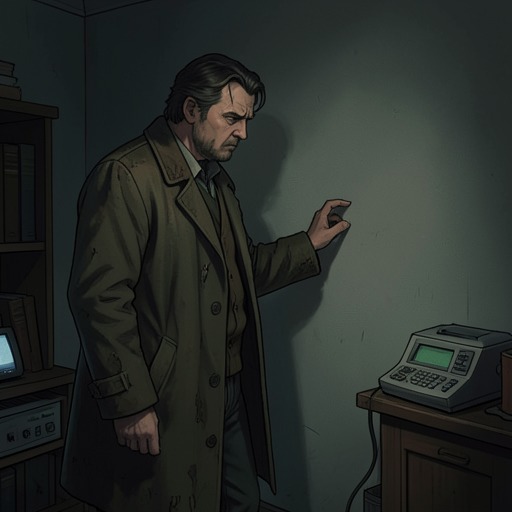
Liu Yiushan's decision at the summit of Haydon
Surprised by JoyThe choice on Headington Hill is C. S. Lewis’s account of a moment when he knowingly stopped holding something at bay. Made on the top of a bus and experienced as both free and strangely inevitable, it loosened the defenses by which he had tried to keep himself apart from religious claims. Its importance lies in that change of posture, not in an instantaneous conversion: Lewis later distinguished this opening from his surrender to theism and, later still, his acceptance of Christianity.
Background: Belief, Rejection, and Return
Lewis’s religious history had already moved through sharply different states. At Oldie’s school, the church services had made him an effective believer: Christian doctrines, taught by clergy who evidently believed them, brought to life what he had already thought he believed. He began praying, reading the Bible, and trying to obey his conscience. That early faith did not endure. At Chartres, atheistical reasoning and occult interests worked on him in different moods; because both opposed Christianity, he gradually abandoned his faith with relief rather than a sense of loss.
The later movement back toward belief was not a simple reversal of that apostasy. Lewis recalled reading G. K. Chesterton’s The Everlasting Man and finding its account of Christian history intellectually persuasive, while still managing not to be seriously shaken. In early 1926, an avowed atheist remarked that the evidence for the Gospels’ historicity was surprisingly good and that the myth of a dying god seemed as if it might have happened once. The challenge mattered because Lewis considered the speaker exceptionally resistant to Christianity. If even this skeptic was not a safe refuge, Lewis wondered where escape remained possible.
The Bus-Top Choice
Going up Headington Hill on the top of a bus, Lewis became aware, without words and almost without images, that he was holding something out. He pictured the resistance as stiff clothing, a corset, or a suit of armor, and felt that he could open a door or keep it shut, unbuckle the armor or leave it on. Neither option appeared to be a duty; there was no threat or promise attached. Yet he understood that opening the door would mean the incalculable.
He chose to open it, unbuckle the armor, and loosen the rein. Lewis emphasized the paradox of the act: he called it a choice, though doing otherwise did not seem possible, and he was aware of no motive driving him. He considered that it might have been freer than most of his actions, suggesting that necessity and freedom need not be opposites. The decision was not described as an emotional surge or as a reasoned argument completed on the bus. Its force came instead from his recognition that he could no longer sustain the same guarded refusal.
The choice also registered imaginatively as a physical change. Lewis felt like a snowman beginning to melt, with the thaw starting in his back, drip by drip and then trickle by trickle. He disliked the sensation. The image makes the opening more than an abstract assent: resistance begins to dissolve, but the change is uncomfortable rather than consoling.
From Opening to Surrender
Lewis connected the bus-top decision to a wider collapse of his intellectual defenses. He pictured himself as a fox driven out of Hegelian Wood and running in the open, with a pack of thinkers and former companions closing in. A conversation in which Owen Barfield called philosophy a way rather than a subject, and Dom Bede Griffiths quietly agreed, exposed what Lewis regarded as his own frivolity. He concluded that enough had been thought, said, felt, and imagined; it was time to act. The bus choice thus belongs to a developing demand for commitment, not to a completed theological argument.
That demand became explicit in Trinity Term 1929. Alone in his room at Magdalen, Lewis felt the approach of the God he had earnestly wished not to meet. He gave in, admitted that God was God, knelt, and prayed. He described this as surrender to theism, pure and simple—not yet belief in Christianity or the Incarnation. The distinction prevents the bus episode from being mistaken for the end of his religious journey: opening the door marked a decisive loosening of resistance, while the later act of prayer named theism as an acknowledged reality.
Significance and Limits
In retrospect, the episode stands between religious rejection and surrender, but Lewis did not present it as a complete conversion or as proof that every later step was inevitable. The image of the door makes the choice an act of consent; the armor gives that consent a defensive history; and the melting snowman registers its cost as a loss of resistance rather than immediate happiness. The moment’s unusual combination of choice and necessity remains central to Lewis’s account of freedom: he felt able to refuse, yet found no motive by which he could honestly explain the decision to open.
The later stages also clarify what the choice did not yet promise. After surrendering to God, Lewis said he had no assurance that God was connected to Joy, and his conversion involved no belief in a future life. His eventual recognition of Christianity came later, when he came to understand the Gospels as history in which myth had become fact. The Headington Hill decision is therefore a threshold in a gradual account: it ends one form of evasion without erasing the distinctions between opening, theistic surrender, and Christian belief.