Magdalen College, Oxford
Surprised by JoyMagdalen College, Oxford, is both a scholarly home and the setting for a decisive inward change in C. S. Lewis’s memoir. Its rooms and teaching life frame the movement from philosophical systems toward a personal encounter with God: in Trinity Term 1929, Lewis knelt and prayed, admitting that God was God. Yet this was a conversion to theism, not Christianity. The college’s importance lies in holding together the intellectual arguments, friendships, practices, and resistance that preceded that distinction.
Academic Setting and Teachers
Lewis’s connection with Magdalen included his election as a fellow in 1925 and, later, teaching for the English Faculty. He recalls his early years there as unusually rich in guidance: when he wanted to pursue a subject, experienced scholars could point him toward relevant sources. He presents this help as a feature of a learned community in which accomplished teachers made time for those still finding their way. The episode establishes the college not simply as a place of employment, but as an environment where intellectual inquiry was sustained through personal instruction and scholarly generosity.
Lewis also names several tutors and senior scholars to whom he felt indebted, including G. H. Stevenson and E. F. Carritt, and describes five Magdalen figures as having enlarged his conception of a learned life. His account of this academic world is deliberately selective: as his narrative approaches its conclusion, he acknowledges leaving out people and episodes that would belong in a fuller autobiography. What remains is a portrait of intellectual formation through contact with teachers, rather than an exhaustive institutional history.
Friends and Changing Ideas
Teaching at Magdalen brought Lewis into friendship with H. V. V. Dyson and J. R. R. Tolkien, both Christians. His friendship with Tolkien challenged two inherited prejudices: distrust of Roman Catholics and distrust of philologists. The encounter shows how personal relationships at the college could unsettle assumptions that abstract argument alone had left intact. Lewis’s changing ideas were not produced in isolation from this community, even when the eventual decision remained his own.
The college setting also belongs to the afterlife of Lewis’s long intellectual disputation with Owen Barfield. Barfield’s arguments had challenged his chronological snobbery—the habit of treating an idea as discredited merely because it belonged to the past—and exposed a conflict in his theory of knowledge. Lewis had wanted to treat the sensory universe as ultimate reality while also granting objective authority to logic, moral judgment, and aesthetic experience. He came to see that this position could not comfortably sustain both commitments. When the alternative seemed to require a behaviorist account of thought and value that he found impossible to believe, he abandoned realism and moved toward an idealist account in which mind was fundamental.
That shift did not itself make Lewis a Christian. He could still interpret Christian belief as a symbolic version of philosophical idealism, a way for people unable to grasp the Absolute to approach some part of the truth. Magdalen’s academic life thus accompanies a sequence of partial revisions rather than a simple leap from unbelief to faith: inherited materialism and realism give way to idealist speculation, while Christian doctrine remains, for a time, at a distance.
The Room and the Turn to Theism
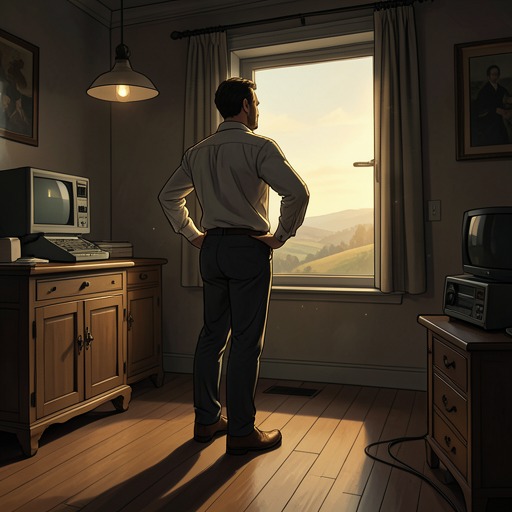
The decisive theistic change is located in Lewis’s room at Magdalen. He recalls being alone there night after night, with the approach of God persistently intruding when he turned from his work. His philosophical idea of Spirit had become difficult to keep impersonal and safely abstract. The possibility of a personal God made the question practical: the divine presence could not be treated merely as a proposition under discussion, and Lewis could no longer assume that he controlled the terms of the encounter.
In Trinity Term 1929, he gave in, admitted that God was God, and knelt in prayer. He presents the surrender as reluctant, not as a moment of emotional exhilaration; the memoir emphasizes the distance between reaching an intellectual conclusion and willingly accepting what it demanded. His interpretation also turns on the reversal of agency: he had imagined himself as the one who might approach or avoid God, but came to understand that the initiative did not belong to him alone.
This event did not immediately resolve the question of Christianity. Lewis specifies that the conversion at Magdalen was to theism, pure and simple. The God he acknowledged was, as he then understood Him, nonhuman, and Lewis did not yet believe in a future life. He also recalls no immediate connection between this God and the childhood experiences of Joy that had mattered so much to him. The account therefore resists treating the scene in his room as the completion of his religious story: it marks a change in belief, while leaving major doctrinal and imaginative questions open.
Churchgoing and the Passage Toward Christianity
After becoming a theist, Lewis began attending his parish church on Sundays and the college chapel on weekdays. He describes this as a visible, provisional practice, prompted by a sense that he ought to declare his belief through an outward act. It did not mean that he already accepted Christianity or found church life attractive. He was wary of institutional religion and disliked the collective routines and ceremonies, so his attendance should not be mistaken for a settled Christian commitment.
At this stage, Dom Bede Griffiths was his principal companion in religious discussion. Their correspondence took place as Lewis reconsidered the relation between Pagan religion and Christianity. Earlier, his classical reading had contributed to doubt: he had encountered religious traditions treated as false, while Christianity was presented as a lone exception, without an account of how one might fulfill or relate to the others. Later, Barfield encouraged a more respectful attitude toward Pagan myth, and a remark by an atheist acquaintance about the historical claims surrounding the dying God further altered the question. Instead of asking which religion alone was true and all the others false, Lewis began to ask where religious traditions might reach their fulfillment.
In this developing account, Lewis considered Hinduism and Christianity as possible culminations of religious history. He found the Gospels distinctive: they appeared to him neither simply like myths nor simply like ordinary histories, but to unite aspects of both. He came to understand Christianity as the point where myth had become fact, and the divine Word had become flesh. The memoir acknowledges that Lewis could not reconstruct the precise chronology of this final transition and might be combining thoughts from different moments. He nevertheless identifies its central resistance: accepting the Incarnation meant accepting a further movement toward a God who was more concrete and immediate, and therefore harder to keep at a distance.
Lewis locates the final step on a journey to Whipsnade. When he set out, he did not believe Jesus Christ was the Son of God; when he arrived, he did. Magdalen is therefore not the setting of that last change, but it is where the preceding distinction becomes clear: the surrender of 1929 established theism, while acceptance of Christianity came later. Across the two stages, the college remains central as the place where ideas once treated as safely abstract became increasingly personal, demanding, and consequential.