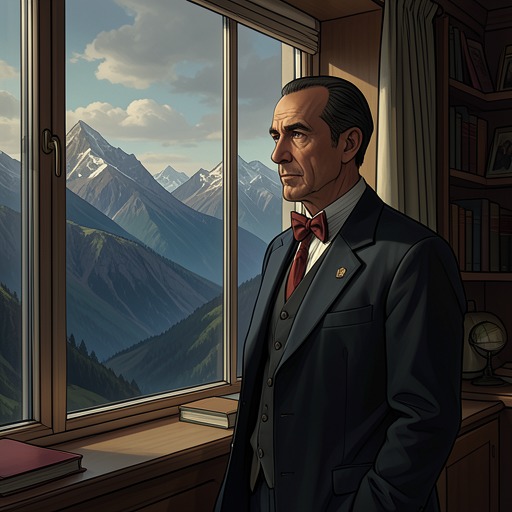
Mo'en Mountains
Surprised by JoyThe Mourne Mountains are the steep, compact, pointed range that rises at the far limit of the view across the plain of Down. In the remembered landscape, they are more than a distant landmark: their separation from the small hills and cottages before them makes them an image of longing, while their changing colors and seeming transparency lend the horizon an almost insubstantial beauty.
Setting and Approach
Seen from the far side of a bank, after crossing two fields and a lane, the mountains appear beyond what is called the plain of Down. The name is only loosely accurate: the intervening country is a turbulent pattern of small hills, fields, streams, and scattered cottages, so the land seems level only from the imagined perspective of a giant. The mountains stand at the visual limit of this uneven, inhabited foreground.
The approach matters to the view. The observer does not simply arrive at a destination but moves a short distance to a new vantage point, where the outlook opens southward with a little east in it. That modest change of position reveals what the account calls a different world, making the mountains the culmination of a landscape gradually disclosed rather than an isolated feature.
Appearance and Contrast
The Mourne Mountains are described as steep, compact, pointed, toothed, and jagged. They seem to have little connection with the small hills and cottages that divide the observer from them: the foreground is varied and intimate, while the range gathers itself into a remote, abrupt outline. Their visual separation is part of their effect.
Their color is not fixed. Sometimes they appear blue, sometimes violet; often, instead of seeming solid, they look transparent, like enormous sheets of gauze cut into mountain shapes. Through them the light of the invisible sea seems to show. This shifting appearance makes the mountains both sharply defined and strangely unsubstantial: a distant physical presence that also seems to open onto something beyond sight.
Significance in the Landscape
The range gives the plain of Down its far horizon, but the account makes the distance between them essential. Small fields, white cottages, and roads that repeatedly disappear and reappear fill the nearer country; beyond this busy, broken terrain, the mountains remain remote and apparently apart from it. Their abruptness intensifies the contrast between the familiar land close at hand and the far-off object of desire.
That contrast turns the view into an image of longing. The landscape is called a way toward the world's end and a place where hearts are broken and blessed; the mountains, at the edge of vision, anchor that sense of remoteness. Their beauty does not depend on being reached or possessed. They remain distant, and the distance is part of what makes the scene compelling.