New House
Surprised by JoyNew House, the house C. S. Lewis’s family built farther out from Belfast and entered in 1905, transformed the scale of his childhood. To the seven-year-old Lewis it seemed less a house than a city: its rooms and corridors offered space for solitude, its overflowing shelves made reading feel inexhaustible, and its prospect over Belfast Lough joined domestic life to a broad coastal landscape. Lewis later treated the house as almost a major character in his story, a setting that formed both the textures of memory and the conditions of his inward life.
Building and scale
Lewis’s father chose to leave the semidetached villa where Lewis had been born and build a much larger home in what was then the countryside. The construction was flawed: the builders cheated his father, the drains and chimneys were wrong, and drafts troubled every room. These defects mattered little to Lewis as a child. What mattered was the enlarged world the house gave him, a place whose scale seemed city-like and whose rooms made exploration possible.
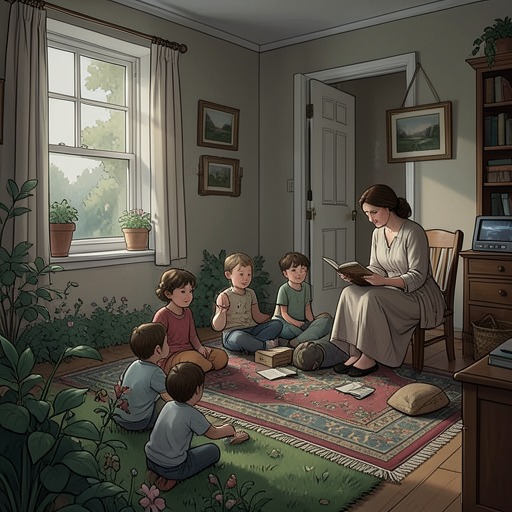
The home’s character lay not in comfort alone but in its succession of spaces and sounds. Lewis remembered long corridors, empty rooms lit by the sun, quiet upstairs, attics explored alone, the distant gurgling of cisterns and pipes, and wind moving under the tiles. The house made solitude readily available without requiring him to leave the family home; its interior seemed to hold unexplored reaches within ordinary domestic life.
Books and solitary life
Books were everywhere. Lewis’s father kept every volume he bought, so shelves and piles filled the study, drawing room, cloakroom, landing, bedroom, and cistern attic. Some books rose to Lewis’s shoulder; others stood two deep in the large landing bookcase. They represented changing interests, ranged from readable to unreadable, and included both books suitable for a child and books emphatically unsuitable. Nothing was forbidden to him.
On rainy afternoons, Lewis took volume after volume from the shelves. He recalled the expectation of finding another unfamiliar book as natural and certain as finding a new blade of grass in a field. Reading thus belonged to the house’s abundance: the accumulated library made discovery a recurring feature of childhood, while the rooms and attics gave that discovery a setting of privacy and exploration. Lewis later admitted that he had never even wondered where all the books had been kept before the family moved.
The view and the widening world
From the front door, the view ran over wide fields to Belfast Lough and the long line of the Antrim shore, including Divis, Colin, and Cave Hill. In the period when Britain was a major carrier and the Lough was busy with shipping, the vessels delighted both boys, especially Lewis’s brother. The sound of a steamer’s horn at night remained capable of summoning Lewis’s whole boyhood. Behind the house lay the nearer, lower Holywood Hills, though they attracted his attention only later.
At first, the northwestern prospect held him: summer sunsets behind blue ridges and rooks flying home. The open view contrasted with the house’s long interior spaces, making the move a change not just of address but of imaginative horizon. The view also placed the family home within a lived landscape of fields, water, mountains, and maritime traffic, a landscape whose sounds and colors persisted in Lewis’s memory.
Separation and the end of the first childhood
The move coincided with changes in family life. Lewis’s brother was sent to an English boarding school and was consequently absent for most of each year. Lewis remembered the joy of his brother’s returns for the holidays, but not a corresponding anguish at his departures; he said the new arrangement did not alter their relationship. While his brother was away, Lewis continued to be educated at home, learning French and Latin from his mother and other subjects from his governess, Annie Harper.
Lewis described his real life during this period as increasingly solitary, despite having family members and household staff around him. New House gave that solitude its practical geography: there was nearly always somewhere in the house or garden to be alone, and Lewis had learned to read and write and had many things to do. In retrospect, the move marked the first great change of his life and enlarged the setting in which his childhood imagination developed. The home’s importance lies in this conjunction of physical scale, books, solitude, and remembered landscape—not as a passive container for events, but as one of the formative presences of his early life.