Old House
Surprised by JoyThe Old House was the home of C. S. Lewis’s earliest childhood and the setting for experiences that later became central to his account of imagination. Its significance rests less on its architecture than on what its nursery held: his brother’s handmade toy garden, the distant Castlereagh Hills, and the beginnings of a longing that Lewis would remember as a lasting imaginative disposition.
Setting and Early Impressions
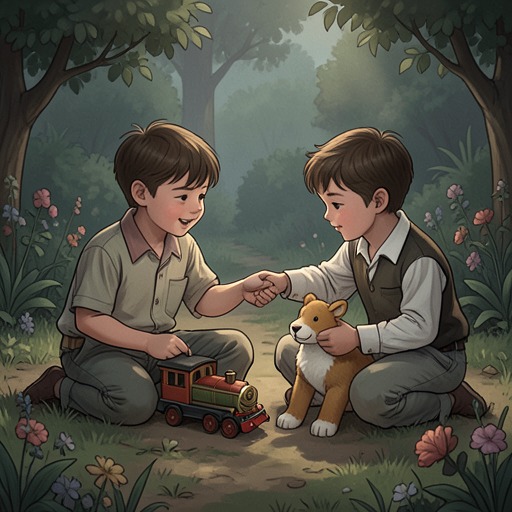
Lewis recalls the nursery as a place where he and his brother drew continually, though their interests diverged: his brother drew ships, trains, and battles, while Lewis gravitated toward anthropomorphized animals. The real garden did not initially teach either child to see beauty in natural forms. Instead, beauty first arrived in miniature, through a biscuit-tin lid covered with moss and arranged with twigs and flowers by his brother. Lewis remembered this toy garden as his first experience of beauty, not as an arrangement of forms and colors but as an impression of freshness and abundance.
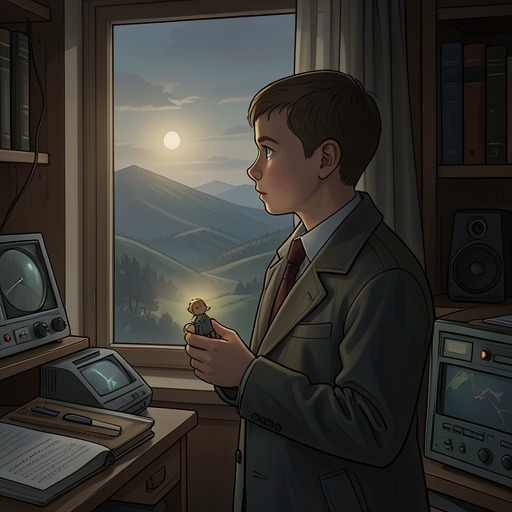
From the nursery windows the children also saw the low line of the Castlereagh Hills. Though physically near, the hills seemed unattainable to them. Lewis later associated this early distance with longing, an emotional pattern that became part of his imaginative life before he was six. The house thus joined intimate domestic play to a view that opened outward but remained beyond reach.
Memories That Outlasted the House
A later memory of the Old House’s toy garden returned unexpectedly beside a flowering currant bush. Lewis describes the episode as a memory of an earlier memory: the present sight called back the nursery scene, and with it came a sudden, intense desire. The longing was not simply for the biscuit tin or for his own past; before he could identify its object, the feeling had passed, leaving only a desire for the vanished desire. The episode made the toy garden more than a childhood possession: it became an enduring image through which Lewis understood a form of yearning that could not be satisfied by recovering its original object.
The memory also gave the Old House a place in Lewis’s later conception of Paradise. He says his imagination of Paradise would retain something of his brother’s garden. The house’s importance therefore lies not only in what happened there at the time, but in how a small handmade scene continued to furnish his adult imagination with an image of natural freshness and remembered possibility.
Departure and Contrast
In 1905, when Lewis was seven, the family left the Old House for a much larger home farther into the countryside. Lewis presents the move as the first great change in his life. The contrast is important: the Old House had provided the nursery setting for the toy garden and the view of the hills, while the New House expanded the scale of his surroundings and became a major presence in his story. The move did not erase the earlier home; it established it as the starting point against which later spaces and memories could be measured.
That contrast returned in Lewis’s account of leaving Ireland for school in England. On the family’s sea journey, the receding lights of the shore represented everything he had known. After landing, he reacted with immediate hostility to the flat English landscape, which seemed confining in comparison with a childhood formed near the sea and high ridges. The Old House belongs to this larger geography of memory: it stands at the beginning of Lewis’s attachment to a landscape whose distance and openness could awaken longing.
Place in the Memoir
Lewis’s later account of Wyvern makes clear that his outer circumstances and inner imaginative life did not always agree. He describes school as exhausting, yet also recalls moments of intense imaginative happiness, insisting that both accounts were true. The remembered world associated with home and the natural landscape remains part of that inward life, distinct from the hardships of institutions and daily routine.
The Old House is therefore a formative location rather than merely a former address. Its nursery concentrates several lasting elements of Lewis’s memoir: companionship with his brother, the transformation of ordinary materials into an imaginative scene, and the first stirrings of desire directed beyond what could be possessed. The house’s physical past ends with the 1905 move, but its images recur as part of the imaginative history Lewis carries forward.