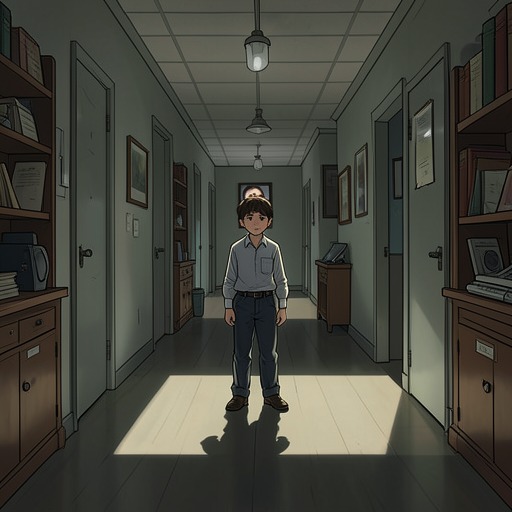
Oldie's School
Surprised by JoyOldie's school was a small boarding school in Belsen, Hertfordshire, where C. S. Lewis studied from 1908 to 1910. Its failing instruction and Oldie's arbitrary authority made it an oppressive institution, but its history in Lewis's account is not one-dimensional: the school also provided the church teaching that first made his Christianity effective and geometry lessons that trained his reasoning.
Identity and Setting
When Lewis arrived, the school had about eight or nine boarders and a similar number of day boys. The landscape and climate around Belsen sharpened his sense of dislocation from County Down: he found the Hertfordshire ground flat and yellow, and encountered there, for the first time, severe frost, fog, intense heat, and large thunderstorms. These surroundings were part of a broader experience of England that he initially met with hostility.
The school was already diminished. Organized games had largely ceased, apart from repeated rounders in the flinty playground, and were abandoned not long after Lewis arrived. The boys had no regular bathing facilities beyond a weekly bath. Lewis had studied Latin exercises with his mother before enrollment and continued them until he left in 1910, without reaching a Roman author. The schoolroom’s canes, rather than its instruction, seemed to him its most conspicuous educational equipment.
The staff consisted of Oldie, the headmaster and proprietor; his adult son, Wee Wee; and an usher. Ushers came and went rapidly: one remained for less than a week, while another was dismissed in front of the boys after a dispute with Oldie. At one point Oldie’s youngest daughter taught the junior pupils. As the school dwindled to five boarders, Oldie eventually gave it up and sought a cure of souls. Lewis, one of its last pupils, described himself as leaving only when the institution went down around them.
Authority and Discipline
Oldie's authority governed both the school and its household. Lewis portrays a home in which no one addressed him as an equal and only Wee Wee initiated conversation. At meals, Oldie and his son had separate food, while the rest of the family, the usher, and the boys ate silently. This domestic arrangement reflected the school’s concentration of power in its proprietor: his authority was personal, rarely checked, and difficult for those around him to challenge.
Lewis recalled being a kind of pet or mascot to Oldie, a position he had not sought and whose advantages were only negative. Oldie also had boys he treated as habitual targets, and Lewis came to believe that social standing shaped who was most vulnerable. He remembered a hardworking, friendly boy whom he thought was flogged because his father was a dentist, and described the atmosphere of fear among the other pupils. The school’s discipline was thus not simply strict: in Lewis’s account, punishments could be unpredictable and appeared to fall especially on boys of lower social status.
Teaching itself often took the form of questioning followed by threats of punishment when answers failed. Lewis says the boys nevertheless did little work, in part because the discipline was irrational and in part because instruction was poor. Geometry was the important exception. Oldie taught it harshly, but taught it well: he made pupils reason, and Lewis credited those lessons with benefiting him throughout his life. Lewis also recalled a boy confessing a lie that could not otherwise have been discovered. Oldie responded by patting him on the back and urging him to stick to the truth. That moment complicated the portrait without undoing the larger record of fear and arbitrary discipline.
In retrospect, Lewis considered whether Oldie might have been mentally ill. His brother later met a man who had grown up next door to the school and whose family, and perhaps the neighbors generally, believed Oldie insane. Lewis treated this as a possible explanation, not a certainty. It helped him account for the contrast between the school’s dismal condition during his own years there and its earlier record of scholarships: it may not always have been the poor institution he experienced.
Religion and Lasting Effects
The school’s most consequential influence on Lewis came through its church attendance. The boys went to church twice each Sunday, where the services were Anglo-Catholic. Lewis consciously resisted their unfamiliar rituals, which seemed to him part of the English culture he disliked. Looking back, however, he suspected that candles, incense, vestments, and hymns sung on their knees may have affected him differently at an unconscious level. He regarded the preaching as more important: he heard Christian doctrines, rather than general moral uplift, taught by people who appeared to believe them. Because he was not skeptical, the teaching gave life to beliefs he already thought he held.
Lewis associated this religious beginning with fear for his soul, especially on bright, moonlit nights in the dormitory. He later judged the effect good: he began to pray seriously, read the Bible, and try to obey his conscience. The boys also discussed religion, in his recollection gravely but without hysteria or the self-consciousness he associated with older pupils. Oldie's school therefore became the setting for an important spiritual change, even though Lewis would later describe a retreat from this beginning.
The institution’s influence was mixed rather than uniformly formative or destructive. Its everyday education was meager, its discipline could be cruel, and Lewis remembered its social atmosphere as fearful. Yet the geometry teaching strengthened his reasoning, while the services introduced him to a form of Christianity that became personally effective. Those effects endured beyond the school’s collapse and Lewis’s departure.
Place in Lewis's Account of Schooling
Lewis's later descriptions of Wyvern College provide a contrast to the small, failing school in Belsen. Wyvern’s Bloods formed a school aristocracy whose standing rested chiefly on seniority and athletic ability, with appearance, personality, and conformity to fashion also helping candidates. In that later institution, nearly all prefects were Bloods, joining social prestige to official authority. Lewis described a structure in which younger pupils were too weak to rebel, while those with enough strength to lead a revolt hoped instead to enter the privileged class themselves.
The same contrast clarifies what was distinctive about Oldie's school. Lewis portrays Belsen through a proprietor’s isolated personal power and unstable discipline; his account of Wyvern instead emphasizes an organized hierarchy that recruited ambition and enforced status through custom. At Wyvern, younger boys formed a labor pool for the Bloods, doing tasks such as cleaning boots and preparing kit. Games were compulsory, and the pressure to display enthusiasm served both the prestige of the school’s leading boys and the advancement of aspirants. Lewis argued that the deeper harm lay in a social struggle that made advancement the dominant concern and encouraged sycophancy, calculated friendships, and the abandonment of those who could not help one rise.
These later comparisons do not make Oldie's school an early version of Wyvern’s system. They show Lewis examining two different forms of school power: the small school’s erratic, concentrated rule and the larger institution’s durable hierarchy. His recollection of Belsen remains shaped by concrete contradictions—an underperforming school that once produced scholarships, a cruel headmaster who could teach geometry well, and an institution that helped awaken the religious belief Lewis later reconsidered.