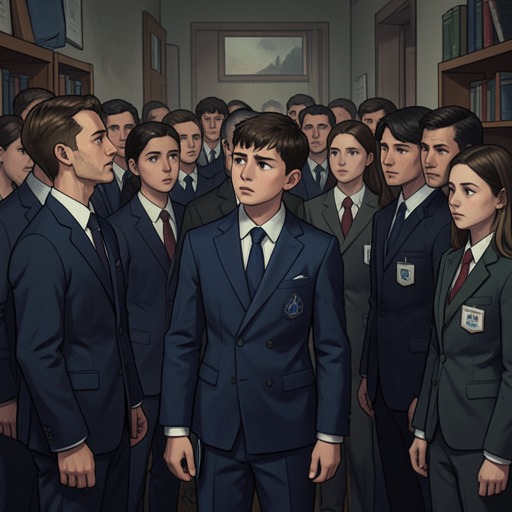
the Gurney
Surprised by JoyThe Gurney, the library at Wyvern College, mattered to Lewis as more than a collection of books: it was a rare sanctuary within a school governed by compulsory activities and the threat of fagging. There he found both protected leisure and reading that enlarged his imaginative world, allowing different mythologies to retain their distinct qualities without competing for exclusive possession of his attention.
A refuge inside the school
The Gurney’s protection began at its threshold. A boy inside could not be fagged, but getting there was uncertain. In winter terms, boys not listed for clubs had to go out for a run; in summer, an afternoon visit depended on circumstance. Clubs might occupy a boy, a House or College match might require him to watch, and on the way to the library he might be caught and made to serve for the whole afternoon. Reaching the sanctuary meant running a gauntlet of the school’s demands.
That difficulty sharpened the contrast between outside and in. In the library, books, silence, and leisure replaced compulsory activity; beyond its open windows came the distant sound of bat and ball and the buzzing of bees. The Gurney offered freedom not by changing the school’s rules but by creating a bounded place where their reach stopped.
Reading and discovery
Among the works Lewis found there was Corpus Poeticum Boreale. He tried, unsuccessfully but happily, to work out the original texts from the translations printed at the bottom of the page. The effort joined pleasure to apprenticeship: the book invited him toward the language behind the translation, even when he could not fully recover it.
The Gurney also brought him to Milton, W. B. Yeats, and a book on Celtic mythology. Celtic material became a modest companion to Norse mythology, while Lewis had begun to love Greek mythology as well. The library thus supported not simply the accumulation of books but an expanding, comparative imagination.
Multiple mythologies and imaginative work
Lewis valued the balance that came from enjoying several mythologies while remaining conscious of their different qualities. He contrasted the stony, fiery sublimity of Asgard with the green, leafy, amorous, elusive world of Cruachan, the Red Branch, and Tir-nan-Og, and with Olympus’s harder, more defiant, sun-bright beauty. Their differences mattered: the Gurney’s reading made room for a plurality of imaginative worlds rather than reducing them to a single atmosphere.
During this period Lewis began an epic on Cuchulain in English hexameters and another on Finn in fourteeners. He abandoned both before, as he later put it, their easy and vulgar metres could spoil his ear. The only work he completed then was Loki Bound, a tragedy with a Norse subject and Greek form. The library’s place in his development is therefore both practical and imaginative: it offered protected time for reading, and its books accompanied a widening literary range that fed into his own experiments.