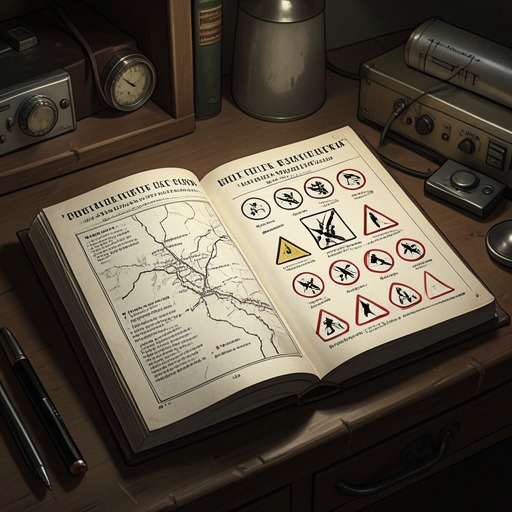
A.B.C. alphabetical rule
The A.B.C. MurdersThe A.B.C. alphabetical rule is the apparent system governing the first murders: places and intended victims seem to follow the alphabet, with a railway guide marking the sequence. It gives the crimes a legible pattern that Poirot can test, but the evidence also exposes its limitation: alphabetical order describes how the murders are presented, not necessarily why they were committed.
The proposed pattern
After Alice Ascher’s murder in Andover, Poirot suggests that the next victim’s surname might begin with B. He explains that the name Ascher, clearly displayed over the murdered woman’s shop, prompted him to consider whether the victim, as well as the announced location, had been chosen according to an alphabetical system. When the warning named Bexhill, the possible connection between place and victim became a working hypothesis, not a certainty.
The distinction matters. Poirot expressly presents the B surname as a possibility rather than a settled deduction. The authorities consider an alternative: Ascher might be a coincidence, and a later victim might again be an older woman who kept a shop, rather than someone selected for an initial. At this point, the proposed rule is an interpretive framework to be tested against the next crime.
The guide as a material clue
After Betty Barnard is found dead at Bexhill, the A.B.C. railway guide is discovered open at the Bexhill page. The copy has no fingerprints and appears new, little used, and not purchased from the likely stationers in the area. Its placement and condition make it a conspicuous connection between the crime and the announced place, while providing no straightforward trail to its purchaser.
The guide’s evidential role is therefore double. Its alphabetical arrangement reinforces the apparent sequence, and its presence at a murder scene turns that arrangement into a physical sign left for the investigators. Yet the lack of fingerprints and the unsuccessful local shop inquiries limit what the object can establish: it supports the existence of a staged pattern without, by itself, identifying who constructed it or what the pattern is meant to conceal.
Rule, motive, and doubt
In discussing the murders, Dr Thompson challenges the idea that alphabetical selection supplies a motive. He observes that Alice Ascher and Betty Barnard do not belong to a single social class, and that an account based on removing particular kinds of people does not fit them. He allows that both victims are women, but treats a possible sexual motive as unresolved pending another crime. His reasoning separates a visible selection rule from an explanation of the killer’s purpose.
Poirot makes a related distinction through the image of a fly: a murderer might eliminate a person who irritates him or someone he regards as a danger to the community. But if the victims are selected alphabetically, Poirot argues, they are not being removed because they personally obstruct or annoy the murderer. The regularity of the pattern thus creates an apparent logic while making the motive harder to infer. The discussion establishes that an orderly sequence is not the same as a psychologically sufficient reason for murder.
The pattern at Combeside
The apparent rule recurs at Combeside, where Sir Carmichael Clarke is found after failing to return from his usual evening walk. Police discover him during a search, and an open A B C has been placed face downwards on his body. The recurrence carries the guide’s signature from the earlier investigation into a murder at the house built on a two-acre site overlooking the sea.
That placement gives the alphabetical scheme a continuing presence even as the series moves beyond the earlier scenes. Read alongside Poirot’s tentative theory, the guide is not merely a reference book associated with a location: its repeated appearance encourages investigators and readers to connect crimes through an imposed sequence. The rule’s narrative force lies in that contrast between a pattern that appears precise and a motive the pattern cannot, on its own, explain.