Alexander Bonaparte Cust
The A.B.C. MurdersAlexander Bonaparte Cust is the apparently inconspicuous man at the centre of the A.B.C. murders’ false solution: manipulated by Franklin Clarke, he comes to believe that he committed the crimes, though Hercule Poirot recognizes that he is not the murderer. Cust’s role turns the investigation from a search for a pattern of victims into a study of how a vulnerable person can be made to mistake another man’s design for his own actions.
Identity and Background
Cust is introduced outside Arthur Hastings’s personal narrative, in a shabby bedroom on a Thursday, June 20. He rises from a cramped seat with a stiff back; although he is tall, his stoop and near-sighted way of peering make him appear otherwise. The gap between his actual stature and the impression he gives establishes a defining feature of his characterization: other people, and eventually Cust himself, misread what they see.
His room and belongings underscore his modest circumstances. He takes cheap cigarettes and matches from a worn overcoat, consults a railway guide, then checks a typewritten list of names and marks one of the first entries with a pen. The list and guide initially place him in the orbit of the ordered murders, but the scene does not explain his purpose. Instead, it presents the outward signs on which suspicion will later fasten: a man alone, a schedule, and a list that seems to connect him to a sequence.
The investigation later establishes that Cust was born in a place the account does not name, served in the war, received a slight head wound, and was discharged from the army because of epilepsy. He has lodged with Mrs Marbury for nearly two years and is described as quiet and retiring, the sort of person people do not notice. These facts sketch a life shaped by illness, military service, and social invisibility, without making any one of them a sufficient explanation for the crimes attributed to him.
Cust in the Pattern of Murders
Cust’s movements and the public reports of the killings become part of Franklin Clarke’s framing scheme. After leaving the Torquay Palladium, where he has watched the emotional film Not a Sparrow…, Cust emerges blinking into the afternoon light. He has the characteristic appearance of a lost dog and murmurs that he has an idea. Newsboys are announcing a homicidal maniac at Churston; their placards report the latest murder. Cust buys a paper but does not open it immediately.
He takes the paper to a shelter in Princess Gardens overlooking Torquay harbour. Its headlines announce the murder of Sir Carmichael Clarke at Churston and present it as the work of a homicidal maniac. The scene links Cust’s private movements to the public narrative of the crimes: he encounters the news not as an investigator, but as a reader being drawn into an interpretation of events that already places him near the pattern.
The false pattern works cumulatively. As Poirot later explains, the Andover crime means nothing to Cust at first. The Bexhill murder shocks him, particularly because he was in the area around that time; then the Churston murder takes place nearby, and the newspapers make the sequence unmistakable. Cust has been at the scene of each of the three crimes. He knows that epilepsy can involve gaps in memory, and he is nervous, highly neurotic, and extremely suggestible. Clarke turns coincidence, illness, and sensational headlines into mutually reinforcing reasons for Cust to suspect himself.
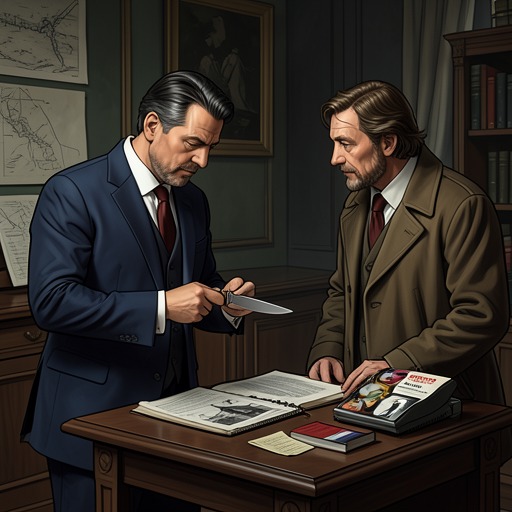
The Doncaster murder completes the trap. Cust is ordered there by his firm, so his presence can be made to look like another instance of the pattern. Clarke follows him and uses the opportunity at a cinema: while Cust watches the film, Clarke kills a man seated in front of them, places an A.B.C. railway guide on the victim’s knees, and collides with Cust in the darkened doorway, transferring the knife into his pocket. The victim is not selected because his name begins with D. Clarke relies on the expectation that the killing will be treated as a mistake in the alphabetical sequence, allowing the apparent rule to protect the real purpose of the crime.
Arrest, Misidentification, and the Case Against Him
Cust’s guilt is made plausible through a mixture of genuine circumstances and deliberate staging. The public sees the A.B.C. pattern; Cust sees his own presence at the earlier scenes and knows about his lapses of memory. At Doncaster, the planted murder weapon and the railway guide give this pattern physical evidence. But the scheme also depends on what Cust does not know: he is not the author of the murders, and his apparent connection to the final killing has been engineered by Clarke.
At the end of the pursuit, Cust has no money left and is worn out; he makes his way to the police station. Even while convinced that he committed the murders, he continues to maintain his innocence. He clings particularly to his alibi for the second murder, which he regards as the one crime that cannot be laid at his door. His position is therefore not a simple confession or denial. He believes himself guilty, yet insists on a concrete limit to that guilt.
When a register is produced during the investigation, its small, cramped handwriting is difficult to read. The Chief Constable asks whether the signature says A. B. Case or A. B. Cash. The uncertain reading echoes the larger problem of Cust’s identity in the case: even his name appears susceptible to misinterpretation. The moment supplies no independent proof that Cust committed the murders, but it shows how readily a doubtful mark can be absorbed into the case against him.
Poirot’s Reading of Cust
Poirot rejects the idea that putting Cust in the dock is the same as solving the mystery. He recalls that the known facts include Cust’s birthplace, his military service and head wound, his discharge because of epilepsy, and his long residence with Mrs Marbury. They also include his withdrawn manner, the elaborate murder scheme attributed to him, the apparently foolish mistakes associated with it, and the contrast between ruthless killing and his refusal to let blame fall on another person for crimes he thought he had committed.
For Poirot, these contradictions demand an explanation rather than a convenient label. Cust can appear stupid and cunning, ruthless and magnanimous; the case cannot be understood by treating the arrest as its conclusion. The distinction matters because the supposed author of the scheme and the man who believes he is its perpetrator are not the same person. Cust’s conduct contains both the evidence that makes him look culpable and the resistance that helps disclose the injustice of that interpretation.
Poirot says that when he saw Cust, he knew at once that Cust was not the murderer and that Poirot’s name meant nothing to him. He also recognized that Cust believed himself to be the murderer. Cust’s confession therefore does not settle the question of authorship: it reveals the depth of his self-suspicion, while Poirot’s reading separates that belief from the actual facts. After Cust confesses, Poirot becomes more certain that his own theory is correct.
Narrative Role and Significance
Cust is both the apparent answer to the alphabetical murders and the means by which that answer is exposed as false. The early image of him checking a railway guide and marking a list primes the reader to interpret ordinary objects as signs of murderous purpose. Later, the newspaper headlines and his proximity to the crime scenes turn those signs into a story he can believe about himself. The same pattern that seems to identify the criminal instead shows how Clarke has arranged appearances around an unsuspecting man.
His epilepsy and head injury are presented as particulars of his history and as vulnerabilities Clarke exploits, not as proof of criminal responsibility. Poirot’s insistence on examining the man rather than merely the case challenges the apparent neatness of the alphabetical solution. Cust’s significance lies in that distinction: the visible pattern, the confession, and the arrest all point toward him, while the contradictions within his account require the detective to look beyond the person made to carry the blame.